

Payment terms are the part of an agreement a procurement manager can verify alone, because every question is about an event or a document rather than about a legal concept. Below is a checklist that runs in about forty minutes and catches the four failures that matter — and it is worth reading as a checklist rather than as an article, because the value is not in the analysis. It is in having the answers on paper before anyone is tempted by them.
The reason this part of the agreement is verifiable is also the reason it is often wrong. Payment structures in this category are assembled from templates, copied between programmes, and adjusted only where a supplier pushes back. A copied structure is usually internally coherent, which is why it survives a review, and usually inherited, which is why it does not fit the programme it is being used in. A structure that fits a first production run is not the right structure for a split delivery, and a structure that suits a repeat order is badly wrong for a programme with a tooling charge on the front.
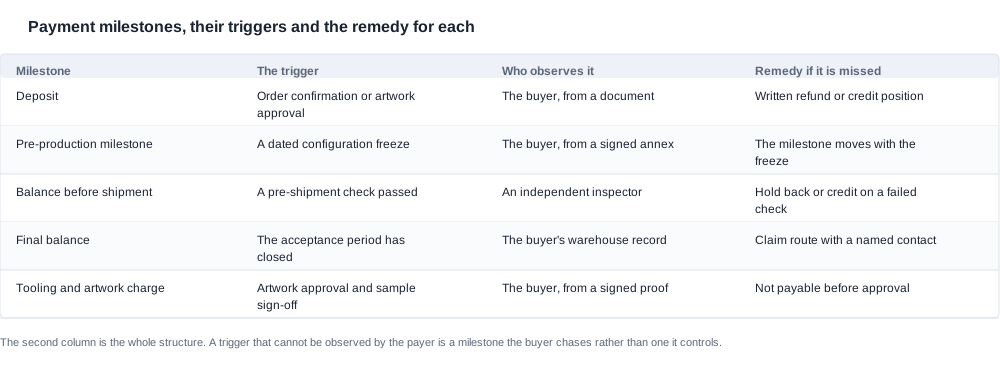
Smart glasses payment terms: the part of an agreement a buyer verifies
Cash timing, control, and defensibility are managed at once
The reader is a brand-side procurement lead, a channel buyer or an importer who has a draft payment structure in front of them and a first order to place. The decision is whether to accept it, and the anxiety is rarely the percentages. It is the two clauses that are hard to fix later: a deposit with no written refund position, and an acceptance window that starts at the wrong event.
Three things are being managed at once. The first is cash timing, which in a first order in this category is a significant fraction of the programme's working capital and is usually the reason the structure is being negotiated at all. The second is control: a payment structure is a set of control points, and a milestone that releases money without giving the buyer anything to check against is not a milestone, it is a date. The third is defensibility — a structure whose triggers are all observable by the payer is a structure the buyer can actually enforce, and one whose triggers depend on a supplier's report is a structure the buyer can only ask about.
The internal argument is usually the same one. A colleague asks why the balance is released before the goods have arrived, and the honest answer is that the structure was copied from the previous programme. That is an uncomfortable position to defend, and it is entirely avoidable: the fix is a forty-minute review before signature rather than a renegotiation in month six.
There is one more reason to do this before you order rather than after. Payment terms are usually agreed late in a negotiation, and the buyer who has spent the negotiation on price is rarely in a good position to ask for structural changes. The review takes an hour and it either confirms a structure that works or produces three specific questions, and both outcomes are better than a structure nobody examined.

The five checks, and what each one catches
In order, with a completion test for each
- Every milestone names an event, not a percentage. "Against approved artwork" is an event. "At 40%" is a schedule with nothing behind it, and a percentage milestone is a date that happens to be a proportion of a sum, which tells nobody what has to be true for it to fall due. Completion: every milestone can be restated as a document that exists or a thing that has happened.
- Each trigger is observable by the payer. An inspection performed at the factory by the factory is not observable by the buyer. A balance released on performance rather than on passing gives the buyer no control point at all, because the condition has no documentary form. Completion: for each trigger, the name of the document the buyer will hold, or the party independent of the supplier who will produce it.
- Each trigger has an owner and a deadline. Who produces the document or performs the check, and by when. Without both, the trigger drifts: the owner is unclear, so the deadline is unclear, so the milestone is settled by whoever is most anxious. Completion: a named role and a date per trigger.
- Each milestone has a remedy. What happens if the event does not occur, or occurs and fails. A milestone without a remedy is one the buyer chases rather than one it enforces, and chasing a supplier across a payment cycle is a cost that the structure was supposed to prevent. Completion: a stated consequence per milestone, including the case where the event occurs late.
- The acceptance window starts at the right place. From arrival at the buyer's premises, not from production and not from despatch. This is the clause that decides whether a visibly defective batch can be rejected at all, and it is the one most often drafted from the seller's side of the table. Completion: a start point that is an event the buyer controls.
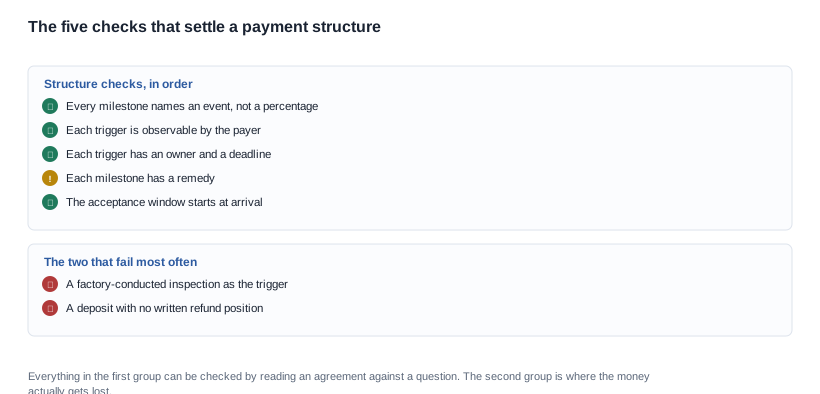
The five checks together take about forty minutes because none of them requires interpretation. Each is answered yes or no by reading an agreement against a question, and the value is not the analysis — it is that the answers are on paper before anyone is tempted by them.
The two that fail most often, and why they fail
The factory-conducted inspection, and the deposit with no refund position
Check two and the refund position on the deposit are the two that fail most often, and they fail for opposite reasons.
The factory-conducted inspection fails because it looks like leverage and is not. A buyer who reads "the buyer or its representative may inspect the goods before shipment" believes they hold a control point, and then discovers that the inspection is conducted by the factory, that the factory's own staff conduct it, that the factory's own report is the evidence, and that the balance is released when the report says so. The clause grants an appearance of control and none of its substance. The fix is one of three things: a named third party, a buyer witness, or a document the buyer receives and can challenge. Any of the three converts an appearance into a control point, and any of the three is cheap.
The deposit refund position fails because a deposit with no refund clause is a prepayment with a percentage attached. Sample refund terms are not standard anywhere in this category, and asking for one after the money has moved starts from zero, because the supplier has nothing to lose by refusing. A refund clause asked for at the quotation stage is a normal commercial term, because it is one.
Everything else on the checklist is worth getting right. These two are worth getting right before signature, because neither can be renegotiated mid-programme without a conversation nobody wants to have, and because both of them concern the buyer's own money.
The two questions that are not on the list
What would you change about this structure if we ordered three times the quantity? The answer tells the buyer whether the terms were built for this order or inherited from a template, and it is usually where the structure for the second order comes from. A supplier that has an answer has thought about the programme; a supplier that does not has a default.
Who inside the supplier can move a milestone, and what triggers them? Not the account manager. A milestone that only the account manager can move is a milestone that will not move when it needs to, because the person best placed to move it is usually the one with the least authority to do so. The answer is worth writing into the agreement, because a named role with a trigger is a route, and an unnamed route is an escalation that starts with a phone call.

The structures, and how to choose between them
Four programme shapes and the structure each one calls for
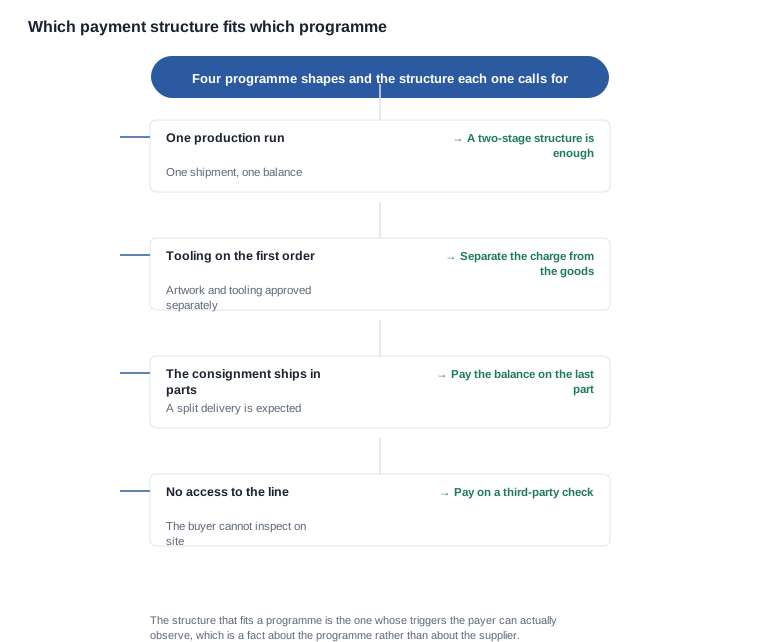
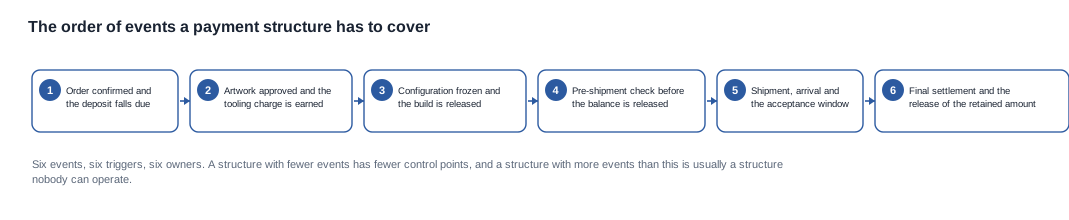
A single production run needs the simplest structure that works: a deposit against a confirmed order, a milestone against a frozen configuration, a balance against a pre-shipment check the buyer can observe, and final settlement after the acceptance window closes. Anything beyond that is complexity that has to be operated for no additional control.
A programme with a tooling charge on the front needs the charge separated from the goods. Tooling and artwork are earned at a point — artwork approval, a sample sign-off — and tying them to a production milestone means the buyer pays for a mould before it has approved the artwork that goes on it. The principle is the same as the one behind a staged payment for a first run: pay for what has been approved, not for what has been ordered.
A consignment that ships in parts needs the balance tied to the last part, not the first. A structure that releases the balance on the first shipment has given away the only control point the buyer has over the remaining units, and a split delivery that is a supply-chain convenience for the seller is a scheduling risk for the buyer.
A buyer with no access to the line needs a third-party check, or a document the buyer receives. This is the case in which the factory-conducted inspection is most tempting and most dangerous, because the buyer has no practical alternative and is therefore inclined to accept the default. The alternative exists and costs a fraction of the balance at stake.
Where a structure leaves the buyer
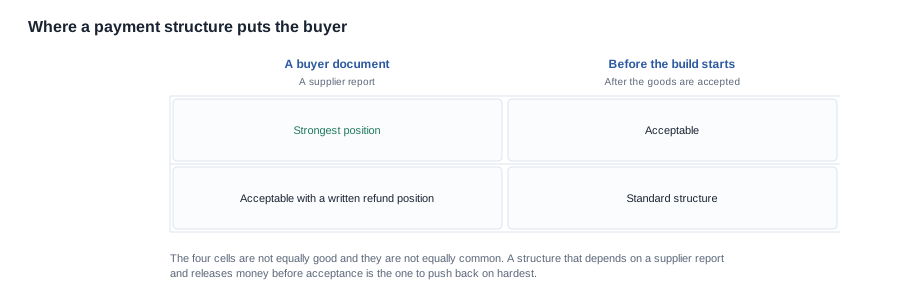
The matrix states the test in its simplest form. A structure is strongest when the trigger is a buyer document and the money moves before the build starts, because that is the position where the buyer controls both the condition and the timing. It is weakest when the trigger is a supplier report and the money has already moved before the goods are accepted, because that is the position where the buyer has neither.
The four cells are not equally common. The standard structure in this category sits in the middle: a deposit against confirmed artwork, then a balance against a supplier report. That middle cell is acceptable when the report is backed by something the buyer can check, and it becomes the bottom-right cell the moment it is not.
The trade-off worth naming is the one between control and speed. A structure with more milestones gives the buyer more control points and slows every payment, which has a working capital cost that a buyer with a tight cash cycle will feel immediately. The right answer is not fewer milestones; it is fewer milestones that are all meaningful. A structure with six meaningful triggers is easier to operate than one with ten, of which four are percentage markers that nobody has to chase.
Comparing two payment structures, and the total cost of each
Two structures are usually compared on their percentages, and the percentages are the least informative part of either. A structure with a smaller deposit and a larger final balance is not automatically better, because the percentages say nothing about when the money actually moves relative to the work.
The comparison that works is on the six events in the flow chart, and it is made by filling in the same six rows for both structures. For each event, the buyer writes down four things: the trigger, the owner, the deadline, and the remedy. Any row where the two structures differ is a row worth spending time on, and the question to ask on that row is always the same — what does the buyer hold in their hand when that milestone falls due?
In practice, three rows account for almost every difference between two quotes. The deposit row differs on the refund position. The balance-before-shipment row differs on who performs the check. The final settlement row differs on where the acceptance window starts. If the three rows match, the structures are the same structure with different numbers on them, and the negotiation should be about the numbers rather than about the control.
The total cost of a structure is more than the schedule of payments. Four costs sit behind the percentages, and they are the ones that decide which structure is cheaper in practice.
- The cost of capital on the deferred amount. Money released before the goods are accepted is money the buyer is funding for the supplier. In a first order in this category, where the deposit can be a significant share of the programme, that is not a rounding difference.
- The administrative cost of operating each milestone. Every milestone is an invoice, a document, a signature and a reminder. A structure with six meaningful triggers costs roughly twice what a structure with three costs to operate, and that cost is recurring, which makes it larger than it appears on a one-order programme and much larger across a standing relationship.
- The cost of a failed milestone. If a check fails and there is no remedy written down, the buyer discovers the failure when the money has already moved, and the recovery is a negotiation rather than a withholding. The cost of that negotiation is what the remedy clause exists to avoid.
- The cost of renegotiating the second order. A structure whose basis was never written down is renegotiated from scratch, and the renegotiation is conducted from a weaker position because the buyer has nothing to point at.
When a supplier will not move on the trigger. There is a legitimate reason a supplier resists a third-party check: it adds cost and a delay to a milestone the supplier would rather see paid. A buyer has three positions, and they are not equally good.
The first is to accept the weaker trigger and buy the document instead. The supplier's own report becomes the trigger, but the buyer receives it in a form that can be checked — a dated record against a unit identifier rather than a summary — and the difference between the two is enormous in practice. The second is to accept the weaker trigger and price it, by asking what the check costs and adding it to the comparison against another supplier. The third, and the worst, is to accept the weaker trigger silently, which is what happens when a buyer assumes the point is administrative and moves on.
There is a fourth position, and it is the one to use when the amounts are large: pay for the check. A third-party inspection on a first order is a fraction of the balance, and it converts the structure from the weakest cell of the matrix to a defensible one. The trade-off is a cost and a delay at a milestone, which is a smaller price than a milestone that releases money without giving the buyer anything to check against.

Recording the outcome, and what it is worth
Forty minutes, and what the notes become
Note each result with its date and the name of the person who answered. Those notes are what make a payment structure defensible in month six, and they are the only part of the agreement a buyer can produce unaided.
Forty minutes is enough because none of the five checks requires interpretation. Each is answered yes or no by reading the agreement against a question, and the value is not the analysis — it is that the answers are on paper before anyone is tempted by them.
The same notes become the basis for the second order's negotiation, which is the only moment in a relationship where this work pays twice. A buyer who has a written record of what was agreed, by whom and when, walks into that conversation with a position, and a buyer who does not walks into it with a memory. The evidence for the first position is a document; the evidence for the second is a recollection, and the supplier knows the difference.
There is one further use of the notes that is worth planning for. A payment structure is the part of the agreement a buyer will have to explain to a finance team, an auditor or a new colleague, and the notes are what makes that explanation short. A buyer who can produce a dated record of the trigger, the owner and the remedy for each milestone can answer the question in a paragraph.
Where Cynrin stands on payment structures
What we will state, and what we will not
The boundary we hold: we will state, for any structure we propose, what triggers each milestone and what we can do if a milestone is missed. We do not offer open terms to a relationship we have not run, and we would rather put a structure in writing that both sides can operate than a generous one that neither side can enforce.
On price, minimum quantities and schedule we publish nothing we cannot evidence. A unit price list, a standing minimum order quantity and a standard lead time are all absent from our documentation, and any of them will need revisiting once the real configuration is known, because a structure that is built on an unknown configuration is a structure built on an assumption. That is not a reason to delay the conversation; it is a reason to have the conversation about the configuration first.
The rows we do not publish for this category are these: our payment structure templates, our deposit percentages, our accepted milestone triggers and any standard refund position. They are quoted per request because they depend on the configuration, the volume and the destination, and because the whole point of this article is that a payment structure is a per-programme document rather than a catalogue item.
The structures themselves are covered at the payment terms section, the questions suppliers are asked most often are at what buyers most often ask, the vocabulary is at the payment terms glossary, and what each trigger actually measures is at the quality implications.
The action to take now. Send us the model, the configuration, the destination and the volume, and we will propose a payment structure with the trigger, the owner and the remedy written against each milestone, and we will tell you plainly which of the five checks our proposal would fail. A structure that passes the five checks on the buyer's side is worth negotiating on, and one that does not is worth fixing before signature rather than after the first missed milestone.
Related reading
- The questions buyers ask most — the same ground from the other side
- Glossary — the vocabulary
- Quality implications — what the trigger measures


