

What affects smart glasses payment terms, in order of importance, is: your cash cycle, the supplier's willingness to hold stock for you, the currency you are exposed to, and the cost of the money you are using.
But the published position constrains the fourth of those more than the first three, and it does something else that matters more. We do not publish unit prices, production lead times, minimum order quantities, defect rates or per-model certification rows. A payment schedule is therefore not a financing decision taken against a known number — it is a negotiation on a number nobody has yet seen. And that is exactly why the structure of the schedule has to do the work that published data would otherwise do: each milestone has to be tied to a document, because the document is the only thing that produces the disclosure you need. A payment schedule in this category is a disclosure mechanism that happens to move money.
That reframe is the whole article. Once payment terms are read as enforcement rather than as finance, the questions to ask become specific, the clauses worth writing become obvious, and the common negotiation — two percentages against each other — stops being the conversation that matters.
Smart glasses payment terms: the order a schedule instrument comes before financing
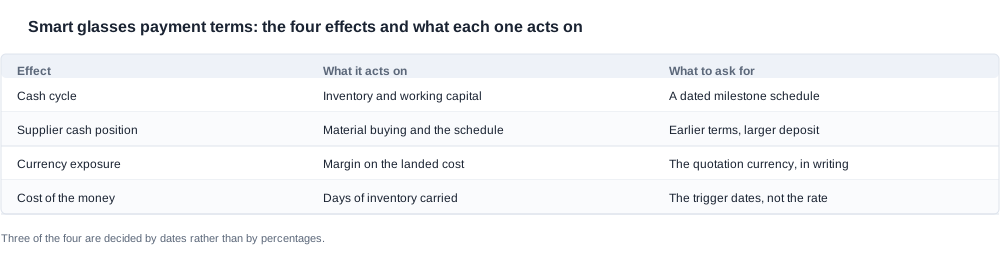
The table above lists the four effects in order, but it is worth being precise about which of them are decided by percentages and which by dates.
The cash cycle is a function of dates. How many days of inventory and working capital you carry is set by when the money leaves and when the goods arrive, and the percentages are a secondary adjustment on top of that. A buyer who negotiates the deposit from thirty per cent to twenty per cent and leaves the milestone dates untouched has moved a fraction of a day of exposure.
The supplier's cash position is the effect that buyers most often underrate, and it is the one that connects payment terms to the schedule. A term that gives the supplier earlier cash lets them buy material sooner, and material availability is one of the places a production schedule can bind. A better payment term is therefore not only a cash decision; it can be a schedule decision. That is a genuinely tradable point and it is usually worth more than a price concession, because the material chain sits outside the factory's control.
The currency exposure is a structural fact rather than a negotiable term. If the quotation is in a currency that is not yours and the payment is not hedged, the margin moves with the exchange rate, and no amount of negotiating the unit price changes that. The published data does not help here either, because unit prices are not published, so the exposure has to be assessed against the total landed cost rather than against the unit.
The cost of the money is real, and it is the one most often described as negligible in a negotiation where the two percentages look small. The way to judge it is against the inventory cycle rather than against the rate: a small percentage on a large number of days of inventory is not a small cost, and the honest way to compare two proposals is to multiply the percentage by the days and by the value at risk.
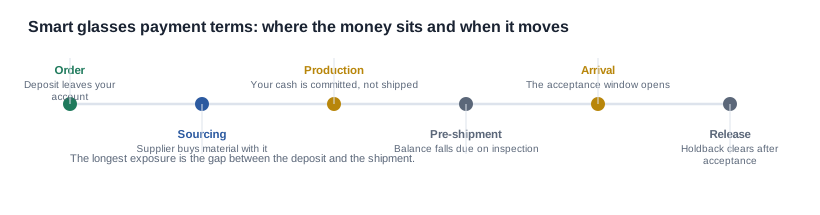
The timeline above shows the exposure most buyers misjudge. The longest gap is not the transport leg and it is not the payment leg — it is the stretch between paying the deposit and the goods actually shipping, during which the money is committed and nothing has moved. That stretch is where a slipped schedule hurts, and it is why a payment structure that releases money against production evidence is worth more than one that releases it against a date.

Each milestone is also a disclosure trigger
Here is the part that distinguishes this category, and the reason the schedule has to carry documents rather than dates.
Because the catalogue does not publish the rows a buyer would otherwise rely on, every one of the following is a row the buyer has to obtain from the supplier: the specification of the ordered configuration, the charging method where the catalogue publishes no row for it, the case capacity where the model has one, the measured weight of the shipped unit, the document set for the destination market, the acceptance criteria and the pass condition, and the inspection results for the actual lot.
A milestone tied to a document is therefore an obligation to disclose, with a date attached to it. A milestone tied to a month is an obligation to pay.
That single sentence is the practical core of a smart glasses payment schedule, and it changes what a buyer writes into it. A deposit tied to the order confirmation is tied to the configuration string. A production-start milestone tied to the confirmed configuration is tied to the written specification rows the catalogue does not publish. A pre-shipment balance tied to the inspection report is tied to a per-unit measurement record. A holdback tied to the document set for the destination market is tied to the market-access work. Each of these is an information request with a financial consequence attached, and a supplier who cannot produce the document cannot release the instalment.

The flow above is the structure. Four documents and one window, and each one names a thing the supplier has to produce rather than a date it has to hit. In a category where the published specification is thin, that is the only mechanism available to a buyer who cannot verify from public data.
There is a second, less obvious benefit. A schedule with documents attached changes what happens in a dispute. Without them, a dispute is two accounts of a date and the party with the better records usually wins by default. With them, the dispute is a question about a document that either exists or does not, and neither party's account is decisive.

The clauses that turn a payment schedule into an enforcement mechanism
A payment schedule that is only a schedule has three weaknesses that a buyer can close in writing.
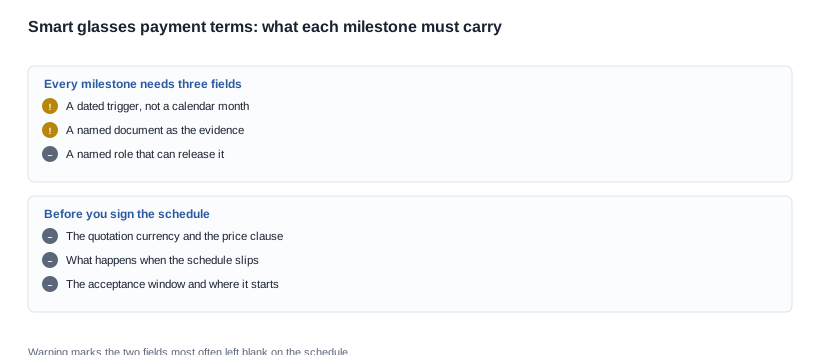
The trigger has to be a dated event with evidence, not a calendar month. "Within 30 days of shipment" is a month. "Within 10 days of the pre-shipment inspection report bearing the lot identifier" is an event with evidence, and it cannot be satisfied by a supplier who has not had the inspection done. The difference matters most in exactly the situation where the schedule is under pressure, which is when a month-based trigger quietly passes.
The release needs a named role. A milestone that says "upon approval" and does not say by whom is a milestone that waits for whoever is slowest. Naming a role — and naming that the approval must be given or the milestone is deemed to have occurred — removes the deadlock that a passive schedule creates.
The acceptance window needs a start point. The period in which a buyer may inspect the delivered goods has to begin at a defined moment, because it is the period in which the money is genuinely at risk. The best-defined start point is the arrival of the goods, not the arrival of the paperwork, and the difference between the two can be days.
The five documents worth attaching to a schedule
The clause is general; these are the five attachments that make it work in this category, and each one is a row the catalogue does not publish.
- The configuration string. Model code, colourway, case option, charging method and destination market, in one line, signed by both sides. It is the shortest document in the list and it does more work than any other, because every other document is meaningless without it and because it is what makes a later delivery comparable to the order at all. The published data makes this concrete: the V03 Pro publishes three colourways and the V06 publishes four, and the L2 Utral publishes two case capacities at 900 mAh and 1400 mAh, so "one model" is not a configuration.
- The written specification rows for the ordered model code. The sensor part number, the field of view, the video resolution, the frame rate, the measured weight and the charging method are all absent from the catalogue. A document that states them for the ordered code converts six unverified attributes into six disclosed ones, and it is the document that most often does not exist in any form.
- The production confirmation. Evidence that the build started against that configuration rather than against a stock one. In this category a unit can be built from a different configuration and still look identical from the outside, so the confirmation is the only thing that distinguishes the two.
- The inspection report with per-unit identifiers. A summary sheet for a batch proves that something was measured; a record per unit proves that this unit was measured. The difference is the difference between a quality claim and a quality record, and it is the document a receiving inspection at goods-in will need.
- The destination-market document set. For a Bluetooth-equipped device sold into the European Union, the route runs through the Radio Equipment Directive (EU) 2014/53/EU, and the general product safety regulation has applied since 13 December 2024. The set itself is not published per model, so the obligation to produce it is the attachment.
There is a predictable resistance to the first two, because a supplier may read an obligation to disclose unpublished rows as an invitation to renegotiate. The way to remove that reading is to state the purpose in the clause itself: the documents are not there to test the product, they are there so that the delivery can be compared against the order and so that a receiving inspection has something to inspect against. A supplier who understands that is usually willing to supply them.
Two further clauses sit alongside these three and are worth adding regardless of the cash arrangement.
A schedule-slip clause. What happens when the schedule slips, and whether the payment moves with it. Most agreements have a date and no consequence, and a date with no consequence is a preference rather than a commitment. The clause that works is specific: if the supplier's own delay causes the milestone to pass its trigger, the instalment is released against the revised trigger rather than falling due immediately, and if the delay exceeds a stated period the buyer may suspend the balance.
A price-adjustment clause, in the open. If the currency can move and the quotation is in that currency, the clause that governs the adjustment should be written down rather than left to a later conversation. This is not a prediction about rates; it is a statement of which side bears which movement over which period.

What a slipped schedule does to the payment, and what it does not
The most common error in this category is treating a delayed shipment as a payment problem. It usually is not.
A slip does not change the total you owe. It changes when the money is exposed and when you get it back. A buyer whose balance falls due on despatch and whose goods arrive four weeks late has four extra weeks of committed cash and four fewer weeks of inventory risk, and the net effect on working capital is usually smaller than the headline suggests.
A slip does change the risk profile. The exposure that matters is the one where the money has left, the goods have not arrived, and the date at which you find out something is wrong is still in the future. That is the deposit-to-shipment stretch, and it is why the production milestone — the one tied to the confirmed configuration — is the most valuable milestone in the schedule for a buyer who is exposed to a new supplier.
A slip that comes from you is different from one that comes from the supplier. Artwork delivered late, a specification change made after production started, a destination market added after the documentation was scoped — these are buyer-caused delays, and a supplier who treats them as supplier-caused will renegotiate rather than absorb them. The clause that prevents the argument is a notice-and-revise clause that requires the trigger to be reset in writing, by both sides, with the new date recorded.
A slip caused by a documentation problem is the one worth watching. In this category the documentation work is frequently the longest pole, and it is rarely visible on the production floor. A buyer who pays the balance against despatch rather than against the document set has no visibility of it at all until the goods are somewhere between two countries.
That last point is worth turning into a rule, because it is cheap and it is often missed. Any milestone that falls due after the goods have left the factory should be tied to something that is produced before they leave, and the only things produced before despatch are the inspection record and the document set. A milestone tied to the arrival of the goods, to the warehouse or to the channel tells the buyer nothing about whether the shipment was right, because by then the money has already gone and the evidence has already travelled. The questions to ask are therefore about the order of events rather than about the amounts: which document exists at despatch, who signs it, and what the buyer is supposed to be able to do with it on arrival.
A payment structure worked through, and what we will and will not offer
A deposit, a balance and a holdback, worked through
The example below is constructed. No client, no order and no payment schedule is claimed; the camera model with a charging case, the European destination and the first production run are all assumed, so that the structure can be followed.
A brand is opening a first production run of a camera model with a charging case into the European market. The factory proposes a deposit, a balance on despatch and a holdback. The terms look unremarkable, and the real question is what each of them is tied to.
The first move is to read the three milestones against the four unpublished rows this model has. The charging method is not published for this configuration family, the case capacity is published but the case matching to the unit is not, the unit weight is not published, and the market-access document set for the destination is not published. That is four pieces of information the buyer does not have and will need.
The second move is to re-anchor each milestone to one of them. The deposit becomes payable against an order confirmation that names the configuration string, including the charging method once the supplier states it in writing. The production milestone becomes payable against the confirmed configuration — the written specification rows for the ordered model code — which is the document that closes the largest number of open questions. The pre-shipment balance stays against the inspection report, and the holdback is tied to the document set for the destination market rather than to a date.
The third move is the slip clause, and here the answer arrives quickly. The factory's schedule depends on the documentation for the destination market, and the buyer now sees that the holdback is attached to exactly the work that could delay it. They agree that a supplier-caused delay in the documentation resets that milestone's trigger, and that the balance is not payable while the document set is outstanding.
The fourth move is the currency. The quotation is in a currency the buyer does not settle in, and neither side wants an open price-adjustment clause, so the agreement records the quotation currency, the validity period and the review date, which is the minimum that makes the exposure assessable.
The result is a schedule that looks slightly less favourable on cash than the one proposed and considerably more useful on information. The decisive move was not the percentages. It was the decision to attach a document to each of them.
Where our position sits
Stated plainly: payment terms in this category should be judged as a schedule instrument and a disclosure instrument before they are judged as a financing one, because the numbers they act on are not published. We publish the model data, the resolution class, the cell capacities, the charging methods, the case options and the colourways. We do not publish prices, minimum order quantities, lead times, defect rates or per-model certification rows, so the terms have to do the work that published data would otherwise do.
What we will do is agree a milestone schedule against named documents, state the quotation currency and its validity period, and write the acceptance window and its start point into the same schedule. What we will not do is quote a unit price against which the terms could be assessed, or offer a schedule that releases money against a calendar month with no evidence attached, because in this category a milestone without a document is a date and not a control.
If you tell us the payment pattern you are being asked to accept, we will say which parts of it are structural, which are cosmetic, and which documents each instalment ought to be tied to. The payment terms buyer checklist is the item-level version, and the payment terms practical advice covers the mechanics by situation. The contract documentation requirements sets out the documents that make a schedule enforceable, and the lead time template is the format for the milestone grid. The remaining cost structure is covered at payment terms hidden costs.
Send us the configuration, the destination market and the payment pattern you have been asked to accept, and we will tell you which smart glasses payment terms are doing real work and which are decoration.


