

Seven questions come up in almost every smart glasses payment terms conversation, and six of them have a clean answer. The seventh is the one that decides the structure of everything else: does the balance fall due when the inspection has been carried out, or when it has been passed. A balance released on performance gives the buyer nothing to hold; a balance released on passing gives the buyer the only control point they have before the goods ship. This article works through the seven questions in the order they should be asked, sets out what each one is really asking, and explains why a payment structure in this category is worth as much attention as a price list.
Smart glasses payment terms: the seven questions, and who performs the inspection
Seven questions about the deposit
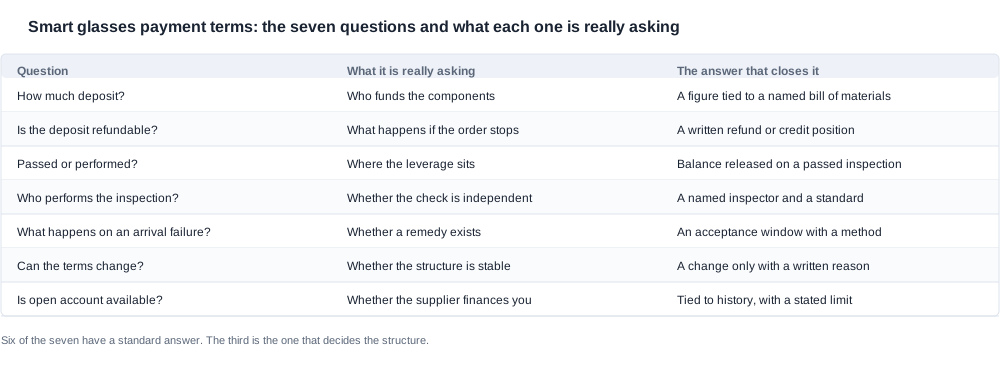
The seven questions are: how much deposit, and what does it fund; whether the deposit is refundable or convertible; whether the balance is released on a passed inspection or a performed one; who performs the inspection; what happens if the goods fail on arrival; whether the terms can change mid-programme; and whether open account terms are available. The first, second, sixth and seventh are commercial drafting, and a competent buyer and supplier will get through them in one exchange. The third and the fourth are the ones that decide whether the payment structure does any work at all.
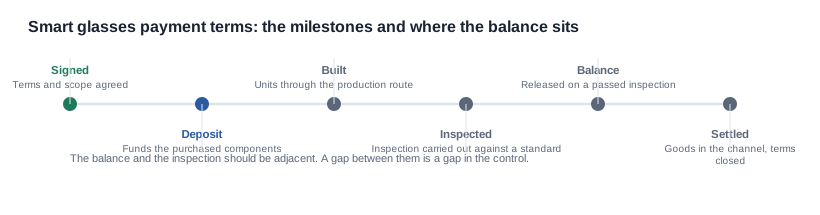
The reason is structural rather than legalistic. A payment schedule is the enforcement mechanism behind quality and schedule: the deposit funds the components, the balance is the thing the supplier wants, and the inspection is the only point at which the buyer can find out whether the goods are what was ordered. If the balance falls due before the inspection, the buyer has paid for goods it has not checked, and the enforcement mechanism is gone before it starts. If the balance falls due on a passed inspection, the entire programme runs on a single point of leverage, and a supplier that understands the point will have every reason to pass the inspection.
Who is asking, and what the terms have to protect
The reader is a procurement manager at the brand, a channel buyer or an importer. The typical situation is that a programme is about to start, the first order is scoped, and the payment terms are the last thing to be agreed and the first thing to be regretted. The thing being managed is rarely the amount of the deposit. It is the moment at which the buyer stops being able to stop the goods.
That moment is worth thinking about carefully, because it is not the same as the moment at which the buyer stops owning the risk, and in a cross-border order those are three separate moments: the order is placed, the goods leave the factory, and the goods are accepted at the destination. A payment structure that is silent about the middle two leaves the buyer carrying risk it has not priced, and in this category the middle two are the expensive ones, because a case shipped in the box and a case not shipped in the box are different shipments with different weight, different packing and different documentation.
What the catalogue settles, and what the terms have to carry
The published data settles the product side of a payment conversation and none of the commercial side. It publishes 28 models with their cell capacities, charge times, run times, charging interfaces where a row exists, camera classes, Bluetooth versions where they are published, charging case capacities where they are published and the colour options for the two models that carry them. It publishes no unit price, no minimum order quantity, no lead time, no sample cost and no payment terms.
So the commercial terms have to be written down, and the first two things a buyer should attach to them are the configuration string and the acceptance window. The configuration string is what the money buys: the model, the charging case option, the colourway, the packaging and the destination market. The acceptance window is what the money is conditional on. The payment terms section covers the structures behind these answers, the glossary is the vocabulary, the verification article is the set of checks, and the advanced guide covers the repeat stage.
The seven questions in one table
The table below is the whole subject on a single screen: what each question is really asking, the answer that closes it, and what the buyer learns from that answer. It is worth keeping, because the questions arrive in a different order every time and the answers only make sense once they are lined up against a common structure.

The deposit, and what happens to it if the order stops
What the deposit is actually for, and why the size is the smaller question
A deposit funds components. In this category that is quite literal: the cell, the camera module for the camera models, and the charging case are purchased against the order, and the deposit is what converts them from a supplier's inventory risk into a buyer's committed cost. That is why the size of a deposit is less informative than its source. A deposit quoted as a percentage of the order value tells the buyer very little; a deposit quoted as a figure against a named bill of materials tells the buyer which parts are at risk and, therefore, what a cancellation would cost.
The second thing that makes the size less important is the refund position, and this is where most of the real information sits. A deposit with no refund clause is a prepayment, and a prepayment is the buyer's money converted into the supplier's working capital with nothing to show for it. A deposit that is refundable if the components have not been ordered, or convertible into the first order if they have, is a commitment rather than a gift, and it is materially better use of the same money.
The refund question, asked at the right moment
The refund position is far easier to agree before an order than after one, and the reason is structural: before the order there is nothing to lose for either side, while after the order the supplier has committed cash to components that a specific buyer ordered. Suppliers are noticeably more willing to write a refund or credit clause into a quotation than into a variation after the first purchase order has gone in, which is one of the few arguments for asking early that always holds.
There is a third option that is sometimes better for the buyer than either a refund or a credit, and it is the conversion: the deposit becomes part of the price of the first production order. That keeps the money inside the programme, it reduces the working capital tied up in the first order, and it gives the supplier the same cash at the same time.
What a deposit tells a buyer about the supplier
A payment structure is also information about the supplier's own position, and a buyer who reads it that way gets value from a document it would otherwise just have to accept. A supplier who asks for a large deposit against a small order is telling the buyer that the components are bought to order rather than held. A supplier who offers open account early is telling the buyer something else entirely, and a buyer should weigh the two answers against each other rather than treating them as separate conversations.
Passed or performed: the balance trigger is where the leverage sits
The distinction, stated plainly
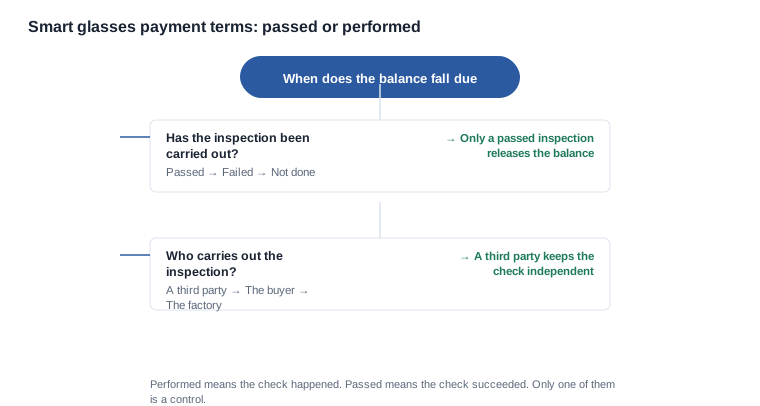
This is the whole question. Performed means the inspection has taken place. Passed means the inspection was carried out and the goods met the standard. A balance released on performance gives the buyer no leverage at all, because the check has happened but its outcome does not affect the money, and the buyer is left with a dispute mechanism rather than a condition. A balance released on passing gives the buyer the only control point they have before the goods ship, because the money and the goods have not yet changed hands.
The distinction matters more in this category than in a category where the goods are simple and the failure modes are obvious. A smart glasses order has a published specification behind it that is precise about electrical behaviour and silent about a dozen other things, so the inspection is where a buyer finds out whether the unit matches the catalogue rows: the charge time written as a ceiling of two hours or less for 26 of the 28 models, the run time for the model, the charging interface where the catalogue publishes one, the case capacity where it is published, and the camera class for the 11 camera models. Those are checkable, and they are exactly the things a buyer should be checking when the money is still conditional.
Who performs the inspection, and against what standard
An inspection performed at the factory by the factory, on the factory's schedule, measures what the factory has already checked. That is not a reason to distrust it, but it is a reason to notice that it is a different arrangement from a third-party inspection, and that the same percentage of the balance means something different in each case.
The second half of the question is the standard, and it is the half most often left out. An inspection against a standard that both sides can read is a check. An inspection against a general expectation of quality is a negotiation that happens after the money has moved. The standard should be the written specification, which in this category is short because the catalogue is precise: the configuration string, the published electrical rows, and the documentation that travels with the goods.
What happens when the goods fail on arrival
Only what the agreement says. If the acceptance window is stated, the acceptance criteria have a method, and each milestone has a remedy, then the answer is a process and a buyer knows what to do on the day. If any of those three is missing, the answer is a negotiation, and the first order in a new category is where buyers usually discover that.
Three things make the difference. The window has to start from a named event rather than from a date, because a consignment that sits at a terminal for a week should not consume the buyer's inspection time. The criteria have to be the written specification rather than a description. And the remedy has to say what happens to the balance and to the goods, because a remedy that only covers the goods leaves the money paid.

The order to ask the seven questions in
Why the sequence matters more than the list
Asking the questions in the right order means each answer is about something already settled rather than about something still in dispute. The sequence below starts with the configuration, because everything after it is priced and timed against it, and ends with open account, which is usually a repeat-stage question dressed as a first-stage one.

The seven checks before signing
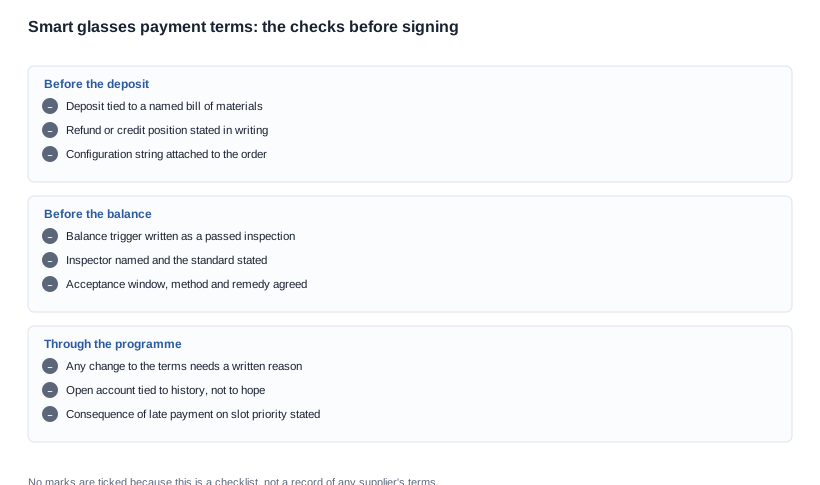
The checklist is the same seven questions in a form that can be sent, grouped by the point in the programme at which they have to be answered. Grouping by stage is deliberate, because two of the seven are settled before the deposit and two of them are settled before the balance, and the moment at which a question is asked determines how much leverage the buyer still has.
Whether the terms can change, and what open account actually means
The terms can change, and a change with a reason in writing is a normal part of a long programme: a currency move, a capacity constraint, a change of trading entity, a documented problem with a previous order. What should not be possible is a change without a reason, because a terms structure is the mechanism through which quality and schedule are enforced, and a structure that moves silently is not enforcing anything.
Open account is the same question at a later stage. On a first order it means the supplier is financing the buyer's channel with no history to underwrite it, and most suppliers price that risk into the unit price or refuse it outright. Once a relationship has run, it is a reasonable structure, and the questions to ask are what the credit limit is tied to — time, value or history — and what happens to slot priority when a payment is late. That last clause matters more than the limit, because priority is the thing a supplier actually controls and the thing a buyer will miss most.
The two clauses that sit outside the payment schedule
Payment terms do not decide a programme on their own, and two clauses that live next door are routinely left unstated. The first is the delivery term, which decides who carries the cost and the risk at each point of the journey. A buyer who agrees a payment schedule without agreeing the delivery term has agreed the timing of a payment for goods whose risk has not been allocated, and in a cross-border order the two decisions have to be read together rather than separately.
The second is the currency clause, which is a pricing decision disguised as a payment one. When the order is priced in one currency and paid in another, the exposure sits between the quotation and the invoice, and the question to ask is which rate the price is fixed to. The practical answer in this category is to fix the price to the currency of the invoice and to state how long the quotation is valid, because a quotation with no validity date is an invitation to argue about the exchange rate after the goods are made.
Three further lines belong in the payment schedule rather than in an email, and each of them costs nothing to write:
- The date by which the configuration string is final, after which a change is treated as a new programme with its own dates.
- The consequence of a late payment, stated in terms a supplier can actually deliver, which in practice means the effect on slot priority rather than a general right to cancel.
- The documentation that travels with the payment, so that the evidence for the configuration is handed over at the moment the money moves rather than at the end of the programme.

Where payment terms fail in practice
Four failures account for most of the problems, and all four are structural rather than adversarial.
The balance that falls due before the inspection. The schedule puts the payment milestone ahead of the inspection milestone, usually because both were copied from a template. The control is to draw the two milestones on the same line and check their order, and to state the balance as conditional on a passed inspection.
The deposit that became a prepayment. The refund or credit position was never written, and a cancellation after the components were ordered left the buyer with no route to the money. The control is to settle the refund position at the quotation stage, when it costs nothing to agree.
The acceptance window that started at the wrong point. The window runs from the order date rather than from the arrival of the goods, so a consignment in transit has already consumed it. The control is to name the event, and to name who carries the cost of the transit period.
The terms that changed without a reason. A programme that ran for a year on one structure and moved to another with no written explanation leaves the buyer unable to say whether the change was commercial or a response to a problem. The control is a written reason and a date, and the right to end the programme cleanly if a change is unacceptable.
None of the four is a reason to change supplier. They are reasons to put a line in the order.
What we will and will not do on payment terms
We will state what triggers each milestone and what we can do if it is missed, and we will put the balance against a passed inspection rather than a performed one, because that is the arrangement that lets both sides run a programme without a dispute at the end of it. We will not offer open terms to a relationship we have not run. We will not change a structure mid-programme without a reason in writing, and we will not move a milestone without moving the condition attached to it.
On pricing and scheduling we will not publish a figure we cannot stand behind — a unit price list, a minimum order quantity or a standard lead time — and a payment structure resting on any of them tends to return to the table within a year. What we will do is build a payment schedule against a real configuration, with the deposit tied to a named bill of materials, the balance tied to a passed inspection, and an acceptance window with a stated method.
The payment terms section covers the structures behind these answers. Send us the model, the configuration, the quantity and the destination market, and we will tell you what the deposit would fund, where the inspection would sit, and where the balance would fall. We will also say plainly which of the two clauses that sit outside the payment schedule — the delivery term and the currency clause — we would want settled in the same document, because in a cross-border order the three decisions are read together by everyone downstream of them, including the freight forwarder and the importer of record.
That is the whole of what buyers most often ask about smart glasses payment terms: not a percentage, but the moment at which the money moves and the moment at which the buyer can still stop it. A structure that makes the second moment later than the first is a structure that works, and a buyer who has read the two clauses together knows which of the seven questions is worth the most of their negotiating time.


