

A glossary is normally a reference document, and for payment terms it is more useful than that. Smart glasses payment terms are written by people who use the vocabulary fluently, and the buyer who is meeting that vocabulary for the first time can negotiate a whole schedule while believing they have understood every word in it. The cost of that misreading is not a bad schedule; it is a schedule whose important clauses are agreed on the wrong basis.
This glossary takes the terms that appear in real payment schedules in this category and states, for each one, what it actually means, what it changes in the schedule, and what it is most often mistaken for. The terms are ordered roughly as they appear in a negotiation rather than alphabetically, because that is the order in which a buyer needs them.
Smart glasses payment terms: vocabulary for buyers
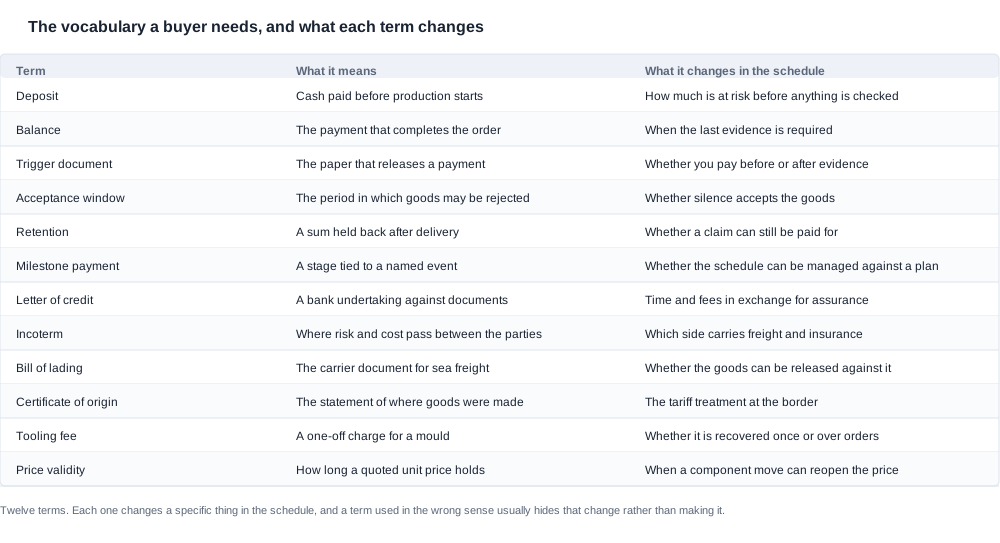
The first twelve terms are the ones that decide a schedule. The rest of this article covers the terms that get used interchangeably, a test for any term before it is signed, and the words we deliberately do not use.
| Term | What it actually means | What it changes in the schedule |
|---|---|---|
| Deposit | Cash paid before production activity begins | How much is at risk before anything can be checked |
| Balance | The payment that completes the order | When the last evidence is required |
| Trigger document | The paper that releases a payment | Whether the buyer pays before or after evidence |
| Acceptance window | The period in which goods may be rejected | Whether silence accepts the goods |
| Retention | A sum held back after delivery | Whether a claim can still be paid for |
| Milestone payment | A stage tied to a named event | Whether the schedule can be managed against a plan |
| Letter of credit | A bank undertaking against presented documents | Time and fees in exchange for assurance |
| Incoterm | Where risk and cost pass between the parties | Which side carries freight, insurance and the declaration |
| Bill of lading | The carrier document for sea freight | Whether the goods can be released against payment |
| Certificate of origin | The statement of where the goods were made | The tariff treatment at the border |
| Tooling fee | A one-off charge for a mould | Whether it is recovered once or over a stated number of orders |
| Price validity | How long a quoted unit price holds | When a component move can reopen the price |
Three of these twelve carry more weight than the other nine, and they are the three that a schedule is usually missing: the trigger document, the acceptance window and the price validity.

Why a shared word is a shared risk
The reason terminology matters commercially is that a term used in the wrong sense does not just cause confusion. It causes a clause to be drafted against the wrong subject, and a clause drafted against the wrong subject is worse than no clause at all, because both sides believe it has been settled.
A concrete example. "Balance on arrival" is heard in two different ways. In one, the balance falls due when the goods are handed over at the destination; in the other, it falls due when the buyer has received, opened and checked the consignment. The first reading puts the buyer's money out before the buyer has seen the goods; the second puts it after. Between those two readings there is an acceptance window, an inspection scope and a whole claim process, and a clause written under the first reading will not contain any of them.
The same applies in a subtler way to "payment against documents". For a buyer it usually means the shipping document set, which evidences that the goods left the factory. For a supplier it can mean the inspection report, which evidences that the goods are finished. Both parties can use the phrase honestly and mean different documents.
The diagnostic question is always the same: what document, named precisely, would satisfy this clause? If the answer is a description rather than a name — "the relevant documents", "the shipping papers", "on completion" — the clause is not ready to be signed, because it will be resolved by whoever moves fastest at the moment it is needed, and that party will not be the buyer.
There is a second reason the vocabulary matters in this category specifically. The product description carries a lot of published detail — cell capacity, charge time, charging method, case capacity and, on camera models, a resolution tier — and it carries almost no published commercial detail. That asymmetry means the buyer is often better informed about the goods than about the deal. It is worth reversing that, because the commercial terms are where the money is and where the vocabulary is hardest.
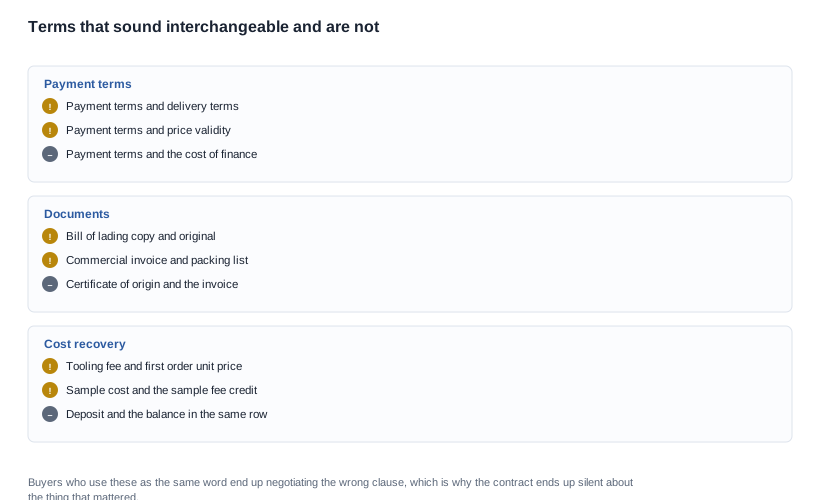
A third reason is reputational rather than structural, but it is not a small one. In a category where a first order is often the first time a buyer has traded with a supplier, and where the second order is often negotiated by a different person, the vocabulary is what travels between the two. A buyer who has agreed terms using precise language will find that the second negotiation is shorter, because the terms can be pointed at rather than re-described.
Twelve terms, and what each one changes
A glossary that only defines words is not much use, so each entry below states what the term changes and what a buyer should ask to see.
Deposit. Cash paid before production activity begins. The term is often used loosely to mean "the first payment", which is a different thing: a schedule can have a first payment that is not a deposit, and a deposit can be structured across two stages. What to ask: the proportion, and specifically what it funds — materials, production, or both. A deposit that funds materials is a commercial position both sides can defend; a deposit that quietly includes a tooling recovery is a fixed cost hidden inside a percentage.
Balance. The payment that completes the order. What makes it consequential is not its size but its trigger, and the trigger is what decides whether the buyer has paid before or after the goods can be checked. What to ask: the named document that releases it.
Trigger document. The paper that releases a payment. This is the most useful term on the list, because it converts a stage into an event with a completion state. What to ask: the document name, who prepares it, and what happens if it is issued late.
Acceptance window. The period in which goods may be rejected, running from arrival or from delivery. Its length has to be compatible with receiving a consignment, opening it, sampling it and checking it against the approved sample. What to ask: the number of days, when the clock starts, and what silence inside the window means.
Retention. A sum held back after delivery. It protects the buyer only when there is an inspection period behind it, because money held back with no window in which to raise a finding cannot be released against anything. What to ask: the amount, the release conditions, and the period the claim can be raised in.
Milestone payment. A stage tied to a named event, usually with a document. It suits orders where one-off costs are a large share of the value, because it lets those costs be paid as they are incurred. What to ask: a verifiable trigger for each milestone, because a milestone trigger that cannot be evidenced is a dispute with extra steps.
Letter of credit. A bank's undertaking to pay against conforming documents. It substitutes an institution for a supplier's promise, at a cost in bank fees and in time. In this category the fees can be a meaningful share of order value, because the unit prices are modest relative to the fixed arrangements. What to ask: the total cost of the instrument and the realistic timeline.
Incoterm. A rule that determines where risk and cost pass between the parties. It is a delivery term rather than a payment term, and buyers routinely leave it unexamined because it appears on a different part of the order form. What to ask: which term is used, and whether the freight arrangement and the payment trigger are consistent with it.
Bill of lading. The carrier document for sea freight, and the document against which payment is often released. The distinction that matters commercially is between the copy and the original, because payment against a copy is faster and weaker. What to ask: which version releases the payment, and who handles the originals.
Certificate of origin. The statement of where the goods were made, used to determine the tariff treatment at the border. It is a condition of clearance rather than of payment, and it has to exist before the booking. What to ask: who issues it and when.
Tooling fee. A one-off charge for a mould, usually expressed as a figure rather than as a share of the order. The commercial question is not the amount but the recovery schedule: recovered in full on the first order, or amortised across a stated number of orders. What to ask: the recovery schedule and the volume it is spread over.
Price validity. How long a quoted unit price holds. Without it, a supplier may legitimately treat a component movement during a long negotiation as grounds for repricing, and a buyer may treat a price as firm when it never was. What to ask: the expiry date, and what happens at expiry.
Six terms that appear in the second conversation
The first twelve are the terms a buyer meets before the first order. The six below are the terms that surface once the programme is running, and they are the ones that decide whether a reorder is easy.
Firmware revision. The version of the software on the unit, identified by a revision code. It matters commercially because a defect can be a revision issue rather than a hardware one, and because a claim without a revision code cannot be matched to a batch. What to ask: the revision that ships, and whether a revision can change after the artwork and packaging are locked.
Serial range. The block of serial numbers covered by a shipment or a batch. It is the difference between a claim about one unit and a claim about a batch, and it is the field that turns a warranty conversation into a traceable one.
Amortisation. The spreading of a one-off cost across a stated number of orders. The term matters because a first order that absorbs the whole recovery looks far more expensive per unit than it is, and a buyer who judges the programme on the first order may reject a configuration that is actually the right one.
Open account. A structure in which the buyer pays after the goods are received and used. It asks the supplier to carry the entire production risk to collection, and it is rarely granted without a trading history. What to ask: whether it is available at all, at what volume, and on what terms.
Lead time validity. How long a quoted production or delivery date holds. It is different from price validity and it is frequently omitted, even though it is the field that decides whether a launch date is realistic. What to ask: the number of days the date holds and what triggers a re-quote.
Defect rate. The proportion of units that fail a defined test. In this category it is usually expressed as a figure the supplier proposes rather than as a measured rate, because the measurement method has to be agreed first. What to ask: the definition of a defect, the test method, the sample size and the response period.
None of the six is exotic, and each one is a place where the absence of a definition becomes an argument. A glossary earns its place by anticipating the second conversation rather than the first.

How to test a term before you sign it
Any term in a payment schedule can be tested against four questions, and a term that fails any one of them is not a term yet — it is a shared assumption, and shared assumptions do not survive a negotiation.
- Does the term name a document? If it does not, the trigger is undefined and the payment will be released against an event that cannot be evidenced.
- Does the term carry a date? If it does not, it will be decided later, at a moment chosen by whichever party moves fastest.
- Does the term have an owner? If it does not, the document will arrive late, because nobody is accountable for producing it.
- Would this clause mean the same thing to both parties? If the answer is uncertain, rewrite it in the name of a specific document and see whether it still reads the same way.
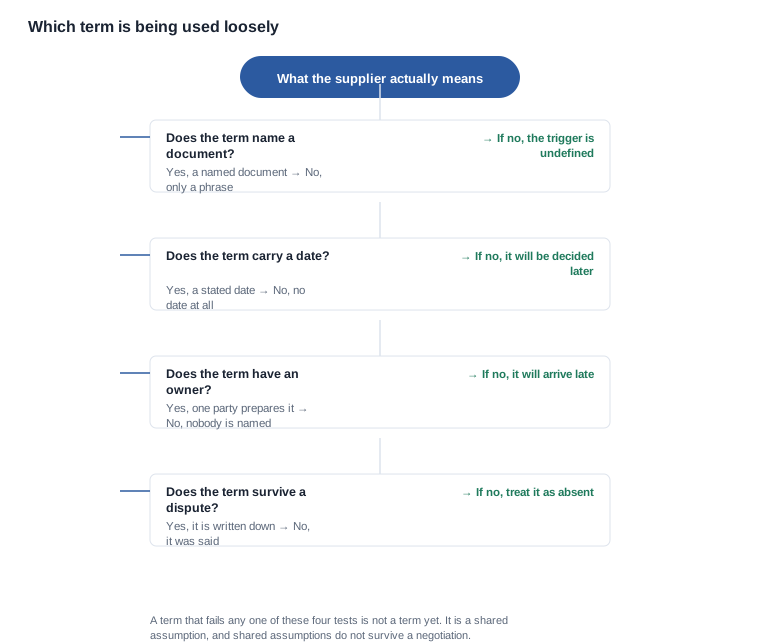
The fourth question is the one that catches the subtlest errors, because a term can pass the first three tests and still be ambiguous. "Balance on arrival" passes all three and means two different things. So does "payment against documents". The way to disambiguate is to write the clause as a sentence with a named artefact in it — "the balance is released against the signed inspection report for the production lot" — and then check that the sentence is one a bookkeeper on either side would act on identically.
Translating a loose phrase into a clause
The practical application of the four tests is a translation exercise, and it is worth doing because the loose phrases are so widely used that they have started to look like clauses. The table below takes five of the most common and rewrites each one into a form that can be acted on.
| The loose phrase | What it usually means | The clause that can be acted on |
|---|---|---|
| Payment on shipment | The money leaves when the goods leave | The balance is released against the packing list and the bill of lading copy |
| Balance on arrival | The money leaves when the goods arrive | The balance is released on the fifth working day after the buyer records the delivery note |
| Standard inspection | Somebody checks the goods | The inspection covers a stated sample count against the approved sample and its revision |
| Tooling to be recovered | The mould cost is in there | The tooling charge is recovered at forty per cent on the first order and the balance over the next two |
| Price firm for thirty days | The number will not move | The unit price for the quoted configuration is fixed at signature and holds until the stated expiry date |
Each rewrite adds one thing the loose phrase was missing, and the added thing is always one of four: a named document, a number, an owner or a date. That is the whole technique, and it is the reason a buyer who rewrites the loose phrases ends up with a schedule that works while a buyer who leaves them in ends up with a schedule that is discussed rather than administered.
There is one point of care. Rewriting a phrase into a clause is not the same as changing the deal, and the rewrite should be checked against what the supplier actually meant. "Payment on shipment" is often shorthand for exactly what the clause says, and the buyer who rewrites it into something else has created a difference rather than clarified one. The correct move is to make the rewrite and then ask, in the same message, whether it reflects the intent — which is a far better use of a message than a paragraph arguing about what a phrase means.
There is also a point of timing. The translation is cheapest before the first order and becomes expensive afterwards, because each unclear phrase becomes a dispute that has to be resolved against an existing schedule rather than drafted into a new one.
There is also a practical rule about which terms deserve the most attention, and it is the opposite of what buyers tend to assume. The terms that sound routine — payment against documents, balance on arrival, price valid thirty days — are where the ambiguity lives, because they are used without thinking. The terms that sound unusual get negotiated properly, because somebody had to look them up.

Who owns each layer of the transaction
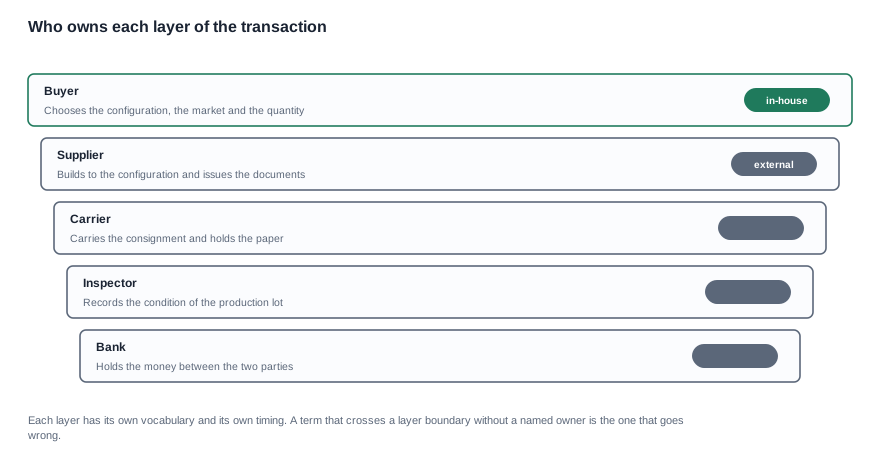
The layer diagram above is worth reading as a vocabulary diagram. Each layer has its own language, and the vocabulary changes at the boundary between them. Inside the buyer's organisation, the commercial terms are described in terms of cash and dates. Inside the factory, the same arrangement is described in terms of production and release. Between them sit the carrier, the inspector and the bank, each with its own documents and its own terminology.
Most ambiguity in a payment schedule is created at a boundary and lands on the buyer, because the buyer is the party that has to hold all the layers in view at once. A buyer who knows which layer a term belongs to can ask the right party for it: a production-stage question to the factory, a transport-document question to the freight forwarder, a payment-instrument question to the bank. Sending the production question to the forwarder is how a schedule ends up with a trigger nobody can produce.
What we publish, and the words we will not use
The short answer: the published material on our products is the part of the specification we can stand behind, and the rest is a question for the supplier's own file. We publish what our documentation states, we mark the rows that are open, and we will not fill an open row with a typical figure from a supplier's general data. A buyer who builds a claim on an estimate finds the error in the field rather than in the quotation, and the correction runs to more than the question did.
The rows we do not publish for any configuration are these:
- Unit price, minimum order quantity and production lead time are not published anywhere in our documentation. They are confirmed per enquiry, against a configuration, a quantity and a destination market.
- Per-model certification rows and test report numbers are not published. The catalogue carries a company-level export certification page and no certification row per model.
- Component cost, conversion cost and yield are not published by anyone in this category.
The words we will not use are worth naming as well, because they are the ones that create false confidence. We will not describe a payment schedule as "standard" when it has been agreed for a particular order. We will not use "balance on shipment" when the balance is in fact released against a named document, because the loose phrase hides the trigger that matters. And we will not quote a lead time without the configuration, the quantity and the destination market attached, because a lead time without its conditions is a number rather than a commitment.
The payment terms section sets out the structures themselves. The step by step article covers the order in which the decisions are taken, the myths article deals with the beliefs that do not survive contact with a first order, and the beginner guide is the shortest route through the four structures most buyers meet.
Send the configuration, the quantity and the market, and we will say which parts of the schedule are settled, which are open, and which are yours to obtain.


