

The advanced question about smart glasses payment terms is not what the schedule says. It is what the schedule is tied to. A first-order schedule is usually a set of percentages, and a repeat programme needs something better: a structure in which every instalment is anchored to a document that a third party can read. This guide is for the buyer who has already been through one order and now knows which parts of the first schedule were decoration.
The single most useful thing a repeat buyer can do is stop treating payment terms as a commercial courtesy and start treating them as a risk-transfer mechanism. That reframing changes what is worth negotiating, which is the content of the sections below.
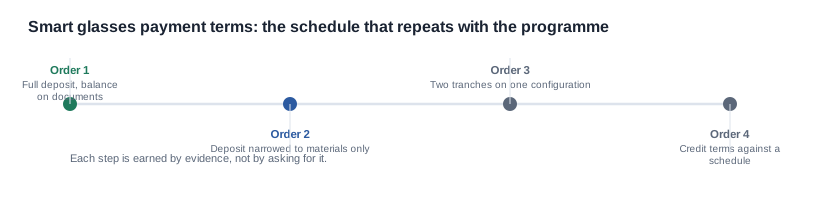
Smart glasses payment terms: the advanced structure for a repeat programme
What the first order taught you, and what it did not
A first order in this category teaches a buyer four things, and they are worth stating precisely because the second order is where buyers usually apply them badly.
It teaches that the deposit falls due before the configuration is stable, because the material commitment has to be made against something and the something is whatever was specified in the order. It teaches that the balance is usually collected at a point defined by the seller's internal process rather than by the buyer's evidence, and that this is invisible until the moment a shipment is short or a document is missing. It teaches that the compliance work sits somewhere in the schedule, usually unlabelled, and that it is the component most likely to be paid for twice if the programme changes. And it teaches that the tooling and artwork recovery, if it was recovered in full on a small first order, distorted every unit price in the programme and will distort the second one too unless it is explicitly amortised.
What the first order does not teach is which of these were structural and which were simply the opening position of a supplier who had no reason yet to do better. That is the gap this guide addresses. The schedule a mature programme runs is not a better-negotiated version of the first schedule; it is a different object, built on a different premise.
The premise that changes: money follows evidence, not time
The principle behind an advanced payment schedule is that each instalment should be released against an artefact that exists and can be inspected, rather than against an elapsed period on a production calendar. The distinction sounds procedural until a buyer runs the numbers on what it is worth.
Consider a balance released "on production completion" against a balance released "against the pre-shipment inspection report". Between those two points sits the entire window in which defects are found, the entire window in which documentation is assembled, and the entire window in which the shipping documents are checked. If the balance is released at the start of that window, the buyer has paid for the goods before it has any way of knowing whether they conform, and the only remedy left is a claim against a supplier it has already paid in full.
The cost of that structure is not the invoice. It is the second shipment, the replacement cost, the delay, the inspection fee, and the working capital tied up in the dispute. Buyers who have never had a defective shipment routinely price this at zero, and then discover it is the single largest number in the failure case.
The advanced move is to attach a document to each milestone that a third party could read, name who prepares it, and state the response period. The document does not have to be elaborate. A typed inspection report against the agreed specification, a pre-shipment photograph set of the production lot, a conformity documentation handover, or a signed packing list reconciled to the configuration string all work. What matters is that it exists, that it is dated, and that the agreement says what happens if it does not arrive.
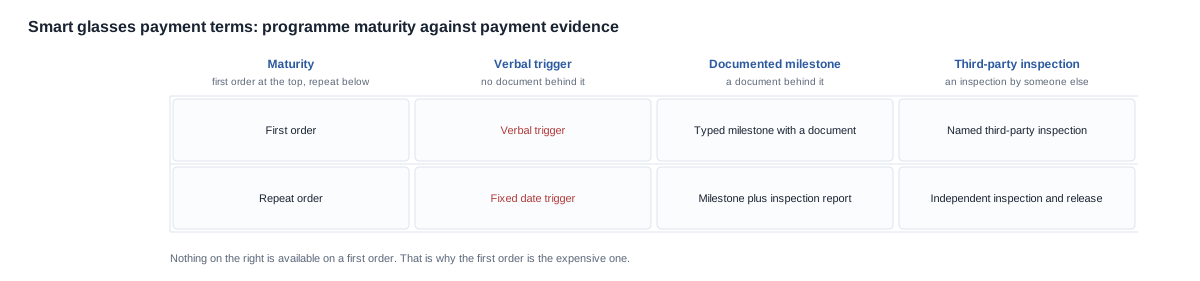
The matrix above makes the maturity argument more precisely. Nothing on the right-hand side is available on a first order, and that is not a failure of negotiation, it is a fact about the relationship. A supplier has no reason to fund a third-party inspection for a buyer it does not know, and no reason to accept a balance that depends on documents it has never produced. The evidence has to be earned, and the first order is where it is earned.
The practical consequence is that a mature programme should be priced differently from a first order even when the unit price is identical. The administrative cost of a milestone-linked schedule is real, and a supplier charging for it is charging for something the buyer values. A buyer who treats the schedule as a document to be filed, rather than as a control to be operated, is buying the control and then not using it.

What changes between the first order and the fourth
Four things change across a programme, and each one changes the payment structure rather than merely the price.
The one-off costs amortise. Tooling, custom artwork and the first production run of a new colourway are fixed costs that only make sense spread across volume. A repeat programme has volume, and the correct treatment for a fixed cost with volume behind it is amortisation. The negotiation is specific: state the total, state the volume it is spread over, and state whether the amortisation ends. A supplier who recovers tooling in full on every order has not amortised anything, and a supplier who amortises across a volume the buyer will never reach has not amortised anything either. Both are visible if the recovery schedule is asked for as a table rather than as a note.
The configuration stops moving. In the first order the configuration list is a proposal. By the third order it is a settled production system with known material sets and known lead times, and that changes what the deposit is funding. A deposit that funded uncertainty in order one funds a routine material call in order four, and the right structure is a smaller proportion because the risk it protects against is smaller. This is the most commonly missed negotiation in the category, because buyers assume the first order sets the precedent. It does not; it sets the precedent for a risk profile that no longer applies.
The compliance position stabilises and can be scheduled. A technical file for a model string does not have to be rebuilt for every order. Once it exists, the documentation route for the destination market becomes a recurring process with a known duration, and it can be placed on the schedule as a milestone rather than as an open risk. Where a new variant or a new market is added, the documentation work re-enters the schedule as a one-off, and it should be priced as one.
The supplier's willingness to hold risk changes. A supplier that has shipped four orders for a buyer has a track record it values, and the assessment cost of the next order is lower. That is what makes credit terms or a reduced deposit negotiable at all, and it is worth understanding that the negotiation is not really about the buyer's creditworthiness in the financial sense. It is about the supplier's internal cost of being exposed.
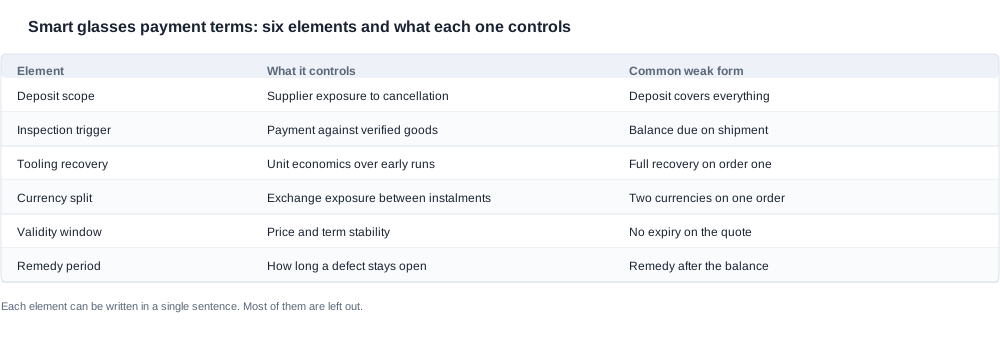
The table above is the working reference for the conversation. Each of those six elements is negotiable in principle, and each one has a common weak form that a buyer will accept by default if they do not raise it. The common weak forms are not dishonest; they are simply the version of the structure that requires the least effort from both sides.
What does not improve automatically with repeat orders
There is a category of terms that a mature programme still gets wrong, and it is worth naming so that it is not assumed away along with the rest.
The balance trigger is the first. Buyers assume that a supplier who has accepted an inspection-linked balance on the second order will keep it on the third, and they assume that because it was written into the agreement once. In practice the schedule is often re-quoted with each order, and the trigger can quietly revert to a shipment-date basis because that is what the seller's own process makes easy. The defence is to make the trigger a standing term of the agreement rather than a term of an individual order, so that a change to it requires a deliberate amendment rather than a fresh quotation.
The remedy window is the second. A remedy period that was generous on the first order tends to be the first thing trimmed on a repeat, because by the third order the relationship is comfortable and the supplier assumes the buyer will not push. Remedy windows should therefore be a standing term as well.
The third is the currency of each instalment. This is often treated as an administrative detail that was settled in the first order, and it is occasionally changed by a treasury decision rather than by a negotiation, which leaves the buyer with an exposure they did not accept.
Designing the schedule around milestones you can inspect
The design procedure is short and mechanical, and it is worth running before the request goes out rather than after the schedule arrives.
Take the production schedule and mark every checkpoint that will actually exist as an event. The list is shorter than buyers expect: order confirmation and artwork sign-off, material readiness, production completion, pre-shipment inspection, documentation handover, and shipment. Some of these will coincide, and a schedule with two instalments sharing a trigger is a schedule where one of the two instalments is decorative.
Attach a document to each checkpoint that a third party could read, and be specific about what it contains. An inspection report should state which configuration it was performed against, how many units were sampled, and what was checked. That level of specificity is not bureaucratic; it is what makes the document usable when a claim is made, and it is what stops the report being a photograph of a box.
Then place one instalment after each checkpoint that carries risk, and no earlier. The deposit belongs at the first checkpoint that genuinely commits the supplier to material spend, which is usually material readiness rather than order confirmation. The balance belongs after the last checkpoint that can reveal a problem, which is the inspection, and before the shipping documents move.
Finally, write down the response period and the consequence. If the inspection report is late, what happens? If it arrives with findings, what happens to the balance? If it never arrives, what happens? A milestone without a response period is a date, and a date is not a control.

The output of this exercise is a schedule with fewer instalments than the buyer expected, each one anchored to a document, and each one placed at a point where something real has happened. That is what an advanced schedule looks like in practice. It is not more generous than the opening schedule. It is better aimed.

Currency, validity, and the exposure that is not on the order
Three exposures in a payment schedule are invisible on the face of the document and larger than most of the visible ones.
The split-currency exposure. A deposit in one currency and a balance in another creates two exchange exposures rather than one, and they are not the same exposure. The deposit is paid when the buyer has committed and the supplier has not delivered, so the rate movement over that period is the buyer's problem. The balance is paid after delivery, and if it settles in a different currency the movement between the invoice and the payment date is again the buyer's problem. Splitting a payment across two currencies can easily cost more than the difference a buyer negotiated on the deposit percentage. Ask what currency each instalment is in, and price the exposure rather than assuming it away.
The validity exposure. A quotation without a validity period does not expire, which sounds like a benefit and is not. It means the price and the terms can be re-evaluated at the moment the buyer places the order, which is the moment at which the buyer's urgency is highest and the supplier's leverage is greatest. Put an expiry on the terms and a review point on the schedule. In a market where component and freight costs move, an expired schedule quoted as if it were current is a false position rather than a negotiation.
The concentration exposure. A large balance paid on shipment for a programme that depends on one supplier, one production window and one inspection route is a concentration risk that does not appear anywhere on the invoice. Tranching a repeat order against a single configuration, or splitting a large order into a smaller first tranche on the same configuration, reduces it. Both are worth offering in exchange for a better payment structure rather than paying for them separately.
There is a fourth item that belongs in this section because it is commercial rather than financial but behaves the same way: the remedy window for a defective shipment. It is not a payment term, but a payment structure that pays the balance on acceptance with no defined remedy window is a structure that releases the money before the problem is known. The quality consequences of that are set out separately under payment terms and quality, and the clauses to re-check are under contract mistakes.

A composed schedule with two configurations and one production window
Consider a constructed schedule rather than a client project. A buyer has a repeat programme with one camera configuration and one audio configuration, both produced in a single window because they share a packaging run.
The first question is whether the two lines can genuinely share a window, and the answer determines the structure. Where the shared element is a print run and the electronic builds are separate, a shared window produces one run changeover rather than two, and one inspection can cover both lines if the report is written against both configuration strings rather than one.
The deposit is then placed at the material readiness checkpoint, because by then the cell and the camera module have been committed for both lines and the packaging run has been ordered. The balance is placed after the inspection report, and the report names both configuration strings and states the unit count against each.
The setup cost from the first programme is amortised across the two lines and named as its own line, which is what stops it from reappearing inside the unit price at a third order. The compliance documentation for the two model strings is a recurring process rather than a one-off, so it sits on the schedule as a task with a known duration rather than as a risk.
What the schedule deliberately does not do is tie the balance to the buyer's own acceptance. Acceptance is fine in principle and dangerous in practice, because an acceptance procedure without a time limit is a payment term with no end. The agreement names the document instead: the balance falls when the inspection report is issued and the shipping documentation is handed over, with a stated response period for findings.
The result is a schedule with two instalments, each anchored to something that exists. Compare it with the common alternative, which collects a deposit at order confirmation, a second instalment at production completion and the balance on shipment. The alternative pays the buyer nothing for the inspection window, and the inspection window is where the defects are found.
What we publish about payment terms, and what stays in the quotation
The published material on payment terms is the part of the specification we can stand behind, and everything else is a question for the supplier's own file. We publish what our documentation states, we mark the rows that are open, and we will not fill an open row with a typical figure drawn from a supplier's general data.
The practical effect for a buyer working through this guide is that unit prices, minimum order quantities and lead times are not published on our side, so we cannot hand you a staged plan that happens to match your cash cycle. We can and do propose a structure tied to the actual milestones of your order, and we will state a cancellation position in writing before the deposit is paid.
What we will not do is quote a payment schedule from a photograph, or fill a specification gap with a number that cannot be traced to a document. What we will do is take a use case, a configuration and a market, and tell you which parts are settled, which are open, and which have to come from a sub-supplier.
Send the order value, the configuration, the target market and the date the cash has to move, and we will propose a structure against that order rather than against a generic programme. Where a milestone cannot be evidenced because it does not exist as an event in the production sequence, we will say so rather than write a trigger that will be disputed when it is reached.
The second-order risks that sit behind this are covered under sourcing risk and hidden costs, and the framework this article applies sits under payment terms.
Related reading
-
Quality implications — what the trigger measures
-
Hidden costs — the second-order cliff
-
Contract mistakes — the clauses to re-check
Send the configuration, the quantity and the market, and we will say which parts of the schedule are settled and which are yours.


