

Smart glasses pricing benchmarks worth building for a buyer
The decision behind a pricing benchmark is not a question of which product is better. It is a question of whether you can tell, from a structure you built yourself, whether a supplier's answer is describing the same thing yours is. A benchmark in this category therefore cannot be a price. No price is published for this range — not ours, and not, so far as we can see, anybody else's — so a benchmark expressed as a number would be a number with no source behind it.
What can be built, and what is genuinely useful, is a benchmark expressed as a structure. Four of them are available from the published catalogue rows, and each one settles a question a buyer would otherwise settle by argument. A cell count index tells you whether two quotations are comparable before you compare them. A runtime band index tells you how wide a claim the published evidence supports. An accessory ratio tells you whether a charging case is inside a price or beside it. A configuration count tells you the real size of the order. None of them is a price, and all four of them are checkable against a document you can read.
The practical conclusion is short. If you are comparing suppliers, build the four structures first, from published rows, with the counts and the source written down, and then read the quotations through them. If a supplier sends you a benchmark — a "market price", a "typical cost" — ask what it is a benchmark of, built from what, and as of when, because a benchmark that cannot answer those three questions is a number with a story attached. And if you are the buyer rather than the benchmark owner, send us the configuration and we will tell you which of the published rows a comparison between two answers has to carry before the comparison is worth doing.
We publish no minimum order quantity, no unit price and no production lead time, and nothing in this article is one. What is published is the specification set that a benchmark can be built from, and this article is about how to build one that a supplier, a finance team and a market access reviewer can all look at and agree with.

The decision a benchmark is supposed to support
A benchmark earns its place by answering one question that would otherwise be answered badly. If a buyer cannot say which question theirs answers, it is not a benchmark; it is a research note, and research notes are the most expensive way to feel informed.
The three questions that come up constantly in this category, and which a benchmark can genuinely settle, are these. Is this supplier's answer describing the same product as the other supplier's answer? Is the product claim I am about to write in the listing wider than the published evidence supports? Is the accessory inside the price, or is it a line I have forgotten? And a fourth, which is really a family of the first: how big is the order I am actually placing, as opposed to the number of units in the headline?
The first is the one that matters most commercially, because a comparison of two non-comparable answers is not a small error — it is an order. Two suppliers quoting "the same model" can be quoting a 220 mAh unit and a 290 mAh unit, a configuration with a case and one without, an entry with a model designation and one without. Those are different products with different bills of materials, and the price difference between them is not a margin, it is a different question.
The supply chain is why structure is the only available form of benchmark. This category is assembled from sourced components and then built, tested and packed by the factory, and the factory's own inputs are the main determinant of its price. There is no costed reference product to compare against, because nobody publishes the bill of materials of a smart glasses unit. What everybody does publish is the specification that the bill of materials is built to, and a specification-derived structure is therefore the nearest thing to a market reference that this category actually has.
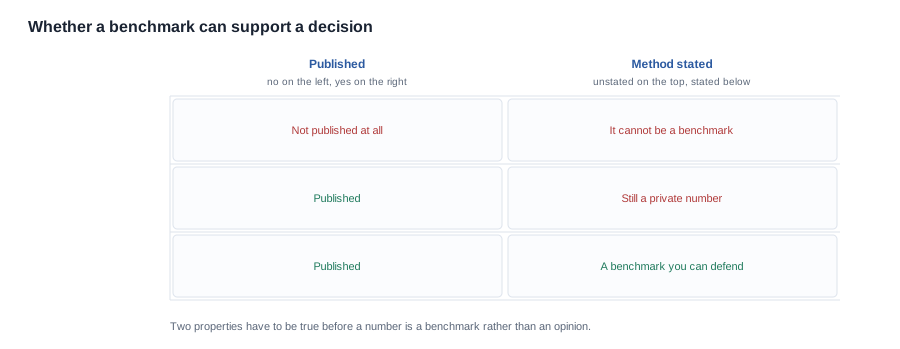
The matrix is the acceptance test. A benchmark whose source is not published is not a benchmark. A benchmark whose source is published but whose method is not stated is a number the owner happens to believe, and it cannot be transferred to another configuration, another supplier or another reviewer. Only a benchmark that is both sourced and method-stated survives a challenge, and a benchmark that survives a challenge is worth building.
Four benchmarks you can build from published rows
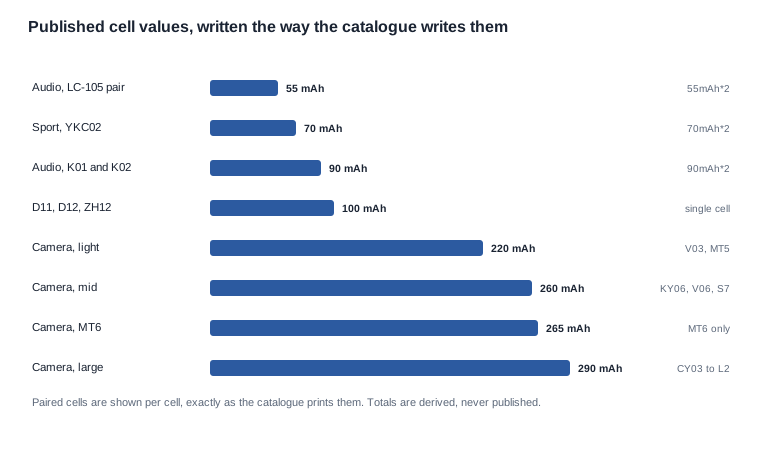
The chart above is the first benchmark in its raw form, and it is worth looking at carefully because the notation is the point. The catalogue writes 55mAh*2, 90mAh*2 and 70mAh*2 for paired cells and 100mAh for a single cell. Those are not decorative forms. They mean two cells and one cell, and a benchmark that flattens them into a single number has lost the distinction that matters most, because the distinction is not about energy — it is about how many physical objects ship in the parcel, how the transport declaration is written, and whether two quotations are describing the same product at all.
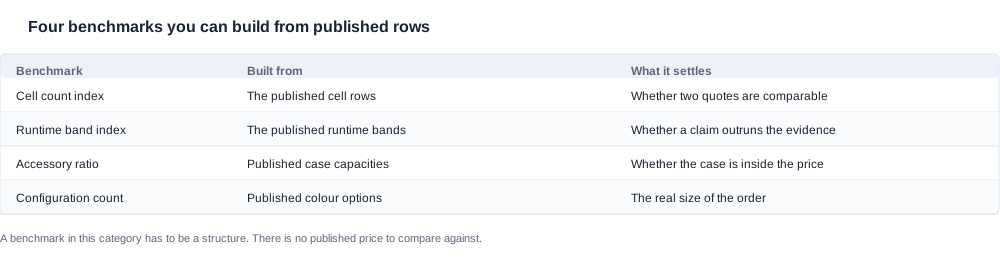
The cell count index. Built from the published cell rows. It settles whether two quotations are comparable, and it does it in a single line: count the cells on each side and write the count next to the capacity. A 100mAh row against a 55mAh*2 row is a one-cell configuration against a two-cell configuration, and the index says so before anyone starts reading prices. The derived total is legitimate in analysis, as long as it is labelled as derived, because a total sitting next to a catalogue value will be read as a catalogue value by the next person who opens the file.
The runtime band index. Built from the published runtime bands. It settles how wide a claim can be. Six bands exist across the catalogue: roughly twenty hours on the A05, the A06 and the A07; roughly eight hours on the K02 and the K01, the LC-105-2 and the LC-105-1, and the ZH12 and the YKC02, and on the AR entry; roughly seven hours on the MT6 and the L2 Utral, and the CY03 and the CY05, and the D17 and the D12, and the L1 Pro and the D11, and on the photochromic entry and the bone conduction entry; six to eight hours on the KY06 and the MT5; five to eight hours on the V03 Pro and the V03, and the S7 and the V06; and roughly six hours on the G07 and the YK12. The index is the mapping from a band to the claim it supports, and it exists because none of these figures is published with a test condition. A claim wider than the band is a claim the evidence does not carry.
The accessory ratio. Built from the published case capacities. It settles whether a case is inside a price. 1400 mAh on the L1 Pro and the CY05, and the CY03, 900 or 1400 mAh on the L2 Utral, 1200 mAh on the MT6's foldable case, cases of unpublished capacity on the KY06 and the MT5, and no case at all on the V03 Pro. When the case capacity on one side of a comparison is 1400 mAh and the other side has no case row, the two answers are not comparable on price, and the index makes that visible without an argument. The same index catches the interface question, because magnetic charging is published on seventeen entries, Type-C on seven, and four cased camera models publish no charging method at all.
The configuration count. Built from the published colour options and the model designations. It settles the real size of the order. A model with three published colour options is three configurations; a model with four is four; a model that publishes no colour options has a colour range that still has to be established, which is one more configuration question rather than one fewer. Because a minimum order quantity is normally a per-configuration quantity, the configuration count multiplied by the per-configuration minimum is the order the programme will actually place, and it is the number that determines the working capital.
A fifth benchmark is worth building if the buyer has the data for it, and it is the only one that is not derived from a published row: the own-history cost index, which compares what a shipped unit cost last quarter against what a quotation today implies, at the same configuration. It is the most useful benchmark a channel buyer can own and the most difficult to build, because it depends on a configuration that did not change. Built properly — same model, same options, same destination, same delivery term — it is the only benchmark in this category that says something about price rather than about structure, and it is the one that will catch a supplier's input cost moving.

Building a benchmark that survives a challenge
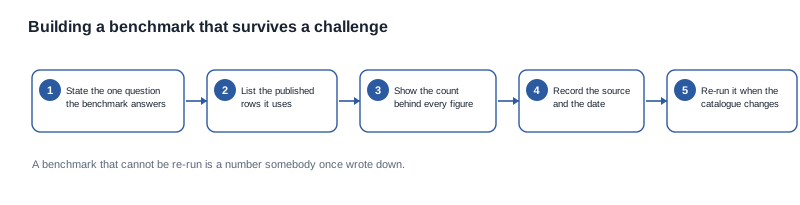
The five steps are short, and the third of them is the one that does the work.
State the one question the benchmark answers. "Is this quote comparable to that quote" is a question a benchmark can answer. "Is this a good price" is not, and a benchmark built for the second question will drift into the first by accident. A benchmark with a stated question can be re-run and compared with its own previous version; one without has nothing to be consistent with.
List the published rows it uses. This is the step that makes the benchmark transferable. A benchmark built on published rows can be handed to a supplier, to a finance reviewer, to a market access reviewer and to another buyer, and all four can check the input. A benchmark built on a supplier's answer can only be handed to the people who already have the answer, which is usually nobody.
Show the count behind every figure. A ratio with no denominator is a claim, and a claim with a denominator is a measurement. "Most camera models" is a claim. "Eight of the eleven camera models publish a 220 mAh single cell" is a measurement, and the second one can be checked and the first one cannot. The counts in the published set are small enough that this is entirely practical.
Record the source and the date. The source is the catalogue page, and the date is the day the benchmark was built. A benchmark without a date is unusable, because the catalogue changes and the benchmark silently stops describing it. The same applies to every external rate a benchmark touches — freight, duty, an exchange rate — and those need their own dates.
Re-run it when the catalogue changes. This is the check that separates a benchmark from a piece of research nobody can repeat, and it is the one that gets skipped.
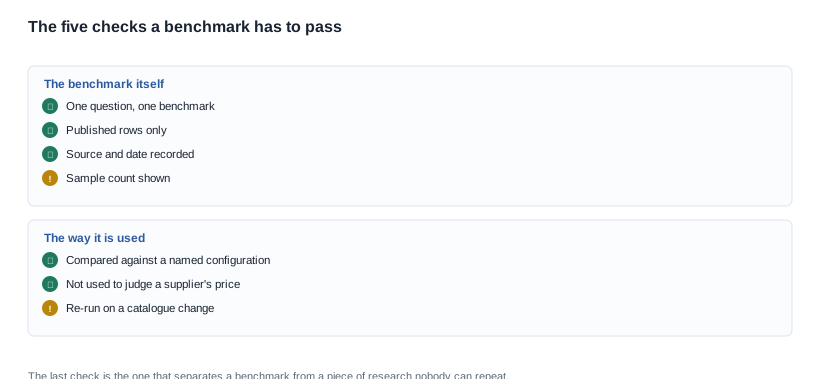
The checklist is the version to hand to a colleague. A benchmark that passes all of it can be cited, challenged and re-run. A benchmark that fails the third check is a private number, and a buyer who cites it in a negotiation has handed the other side an argument to win.
The questions to ask a supplier who sends you a benchmark. In this category, benchmarks arrive as market prices, typical costs, factory-direct ranges and a chart in a slide deck, and the questions that separate the four usable ones from the rest are the same three every time. What is the benchmark of — a configuration, a family, or the whole range? Which rows and which suppliers is it built from, and how many observations sit behind it? And as of when, because a benchmark whose date is missing cannot be re-run and cannot be compared with anything. If the answers come back with a configuration, a row list, a count and a date, the benchmark is usable and the total cost comparison can proceed. If the answers come back with "the market" and a range, then what to ask is which of the four structures above is the range actually measuring, because a range with no structure behind it cannot be compared with a quotation and should not be used in a decision. These are the red flags to watch for before you order: a benchmark that names no configuration, a benchmark that carries no count, and a benchmark that has no date. Any one of the three makes the comparison invalid rather than merely weak, and recognising that early is cheaper than discovering it in the review.

What a benchmark cannot settle, even a good one
Five things stay out of reach, and a buyer who expects a benchmark to settle one of them will be disappointed in a way that damages the benchmark's credibility.
It cannot tell you whether a price is fair. A benchmark built on published rows has no price in it, because no price is published for this range. It can tell you whether two answers describe the same product; it cannot tell you what that product should cost, because nobody has published the bill of materials and nobody has published a margin. Any benchmark that appears to settle the fairness of a price is either carrying an unsourced price or it is quietly restating the quotation.
It cannot tell you which product to choose. A structure narrows the field by removing comparisons that were never valid; it does not create a preference. The V03 and the L2 Utral are both in the catalogue and both are legitimate answers to different requirements, and no benchmark tells a buyer which requirement is right.
It cannot tell you about quality. The catalogue publishes a resolution class, a cell, a band, a charge time, an interface, a case capacity and, for two models, an IP54 marking. It does not publish sensor part numbers, field of view, video specifications, acoustic figures or ingress test report numbers, so a benchmark built from it cannot rank quality on any of those axes. If a buyer needs a quality argument, the source has to be a measurement on their own sample units, not a published row.
**It cannot tell you about the compliance position.Our catalogue carries one company-level export certification page and no per-model certification row, and it publishes no CE marking, no FCC record, no RoHS statement, no REACH statement, no patent count and no certificate number. So no benchmark built from the published rows can tell you what a model's market access position is. That is a request, and it belongs in a document pack, and the framework to reason about the European radio regime is the Radio Equipment Directive (EU) 2014/53/EU with the associated conformity assessment and declaration of conformity.
It cannot tell you what the market will pay. A resale price is set by the market, the channel and the season, and a benchmark derived from a catalogue has no view on any of them. The one benchmark that touches price at all is the own-history index, and it works by comparison with your own past shipments rather than with anybody's published figure.
Where our catalogue sits against a benchmark
The boundary we hold: the published specification set is the shared reference a benchmark can be built on, and we will publish a row we hold and mark the rest as open. We publish the model designation, the resolution class where a camera is fitted, the cell capacity with its cell count, the rated runtime band, the charge time for every entry, the charging interface where the page carries one, the charging case capacity where the page carries one, the IP54 marking on the V06 and the S7, the Bluetooth version where the page carries one, the colour options on the models that publish them, the 158 g weight of the MT6 glasses unit excluding its foldable case, and the 35 dB amplification gain of the bone conduction entry. Those are the rows all four benchmarks above are built from, and we hold them because they are the only rows a benchmark can be checked against.
What we do not publish, and will not estimate: minimum order quantities, unit prices, production lead times, tooling and non-recurring engineering figures, price tiers, frame weights for any model other than the MT6, the weight of the MT6 charging case, sensor part numbers, field of view, video specifications, ingress test report numbers, certification numbers, patent counts, acoustic figures, battery transport test report identifiers, case weights and carton dimensions. A benchmark that used any of those rows would be a benchmark built on numbers nobody can check, which is the thing this whole approach exists to avoid. We also make no vision, health, eye-protection or hearing-aid efficacy claim for any product, in any market, in any configuration, and we will not put one into a comparison to make a benchmark look more complete.
What we can do is build the benchmark with you, against your own question. Send us the two configurations you are trying to compare, the destination and the volume, and we will run the four structures across both of them, show the counts, mark the rows that have to come from the supplier or from a measurement on your own sample units, and tell you where the comparison is valid and where it is not. The working version of the cost side is in how to calculate pricing for your order, a worked model-to-model comparison is in L1 Pro versus CY03 price positioning, the beliefs that cost money are in smart glasses pricing myths, the cost structure itself is under procurement pricing, and the published range is at camera and audio smart glasses.
Related reading
- How the price is put together — procurement pricing
- The working calculation — how to calculate pricing for your order
- The published range — camera and audio smart glasses


