

Smart glasses pricing: what the calculation actually has to produce
The conclusion on what a pricing calculation has to deliver
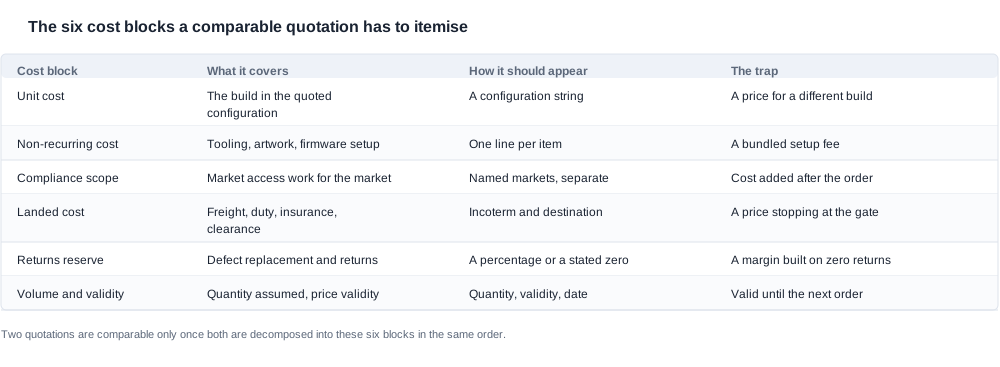
A comparable smart glasses pricing figure is not a number; it is a cost structure that two producers have decomposed in the same way. The useful output of a commercial conversation is a priced document in which the unit cost, the non-recurring cost, the market access scope, the landed cost, the returns reserve and the volume and validity basis each sit on their own line, with the configuration string attached to the unit line. Without that decomposition, the only honest way to compare two cost documents is to say they are not comparable yet, and to specify what is missing. A single headline figure cannot be evaluated on its own, because the published data for this category deliberately does not include unit prices, minimum order quantities or lead times, so there is no reference point outside the document itself. The calculation is finished when the purchasing side can state, for each of the six blocks, what it covers, what it excludes, and what happens if the assumption behind it turns out to be wrong.
Who is reading this, and what the pricing decision is
The reader is someone buying on the brand side, a channel buyer or an importer. The situation is a quotation to compare, a new programme to open, or a market to enter, and the underlying question is always the same one: which of the two or three suppliers in front of you can build what you have written down, and what happens to the schedule when they cannot. A price that cannot be built is not a low price; it is a number with no delivery date attached to it.
What the purchasing side is managing is not a price gap. It is a gross margin that assumes a returns rate nobody has measured, a landed cost that stops at the plant gate, and a market access scope that gets added to the invoice after the order is placed. Each of those is invisible in a headline figure and expensive in a landed cost model. The pricing myths article covers the assumptions that usually sit underneath a comparison like this, and the pricing section sets out the wider framework.
Two questions arrive before the specification does. The first is what is being ordered in enough detail to be quoted, because a configuration described in general terms produces a price that cannot be compared with anything. The second is what the programme has to survive, which is the part that decides whether a pricing calculation is a specification exercise or a lesson in finding out later which supplier was right. Both belong in the pricing buyer checklist.
The market backdrop: why two quotations for the same product differ so much
The gap between a low cost document and a high one in this category is rarely a margin difference. It is a scope difference. A producer who has already run the market access work for a configuration and a destination can state a firm number, because the testing is done and the file exists. A producer who has not run it states a lower number, because that work is not in the price yet. Both are honest. Only one of them is a price for the programme the purchasing side actually intends to run.
That gap is the mechanism behind most of the price differences the purchasing side sees, and it is also why two cost documents cannot be compared until the market access scope has been aligned on both sides. A second driver is the configuration. The published range carries 28 models, and the configuration options inside a single model are real: the charging case on one model moves between 900 mAh and 1400 mAh, a folding case is published at 1200 mAh, two models carry a case whose capacity is not published, and the V03 Pro has no case at all. A document that does not name the configuration is not offering a product, it is offering a category.
A third driver is the currency and the incoterm. A price quoted at the plant gate and a price quoted delivered to the warehouse are two different products, and the difference between them is frequently larger than the difference the purchasing side spent the comparison trying to resolve. This is the how a minimum order affects your margin question in a different form: the volume assumption inside the cost document changes the unit cost, and so does the destination.

The six cost blocks behind a comparable quotation
What each block covers and how it should appear
Each row below states how the block is measured, the line it has to meet, and how an inflated figure shows up. The order matters: a quotation is comparable only when both sides have decomposed it the same way, and it is much easier to hold that order if the buyer writes the decomposition sheet first and asks the supplier to fill it in.
| Cost block | What it covers | How it should appear | How inflation shows up |
|---|---|---|---|
| Unit cost | The build in the exact configuration quoted | A configuration string on the line | A catalogue entry price for a standard build |
| Non-recurring cost | Tooling, artwork, firmware setup, packaging development | One line per item with its own amount | A single bundled setup fee |
| Compliance scope | Market access work for the destination market | Named markets, quoted separately | Compliance cost added after the order |
| Landed cost | Freight, duty, insurance, clearance | Incoterm and destination named | A price that stops at the factory gate |
| Returns reserve | Defect replacement and channel returns | A stated percentage or an explicit zero | A margin structure built on zero returns |
| Volume and validity | The quantity assumed and how long the price holds | Quantity, validity period, review date | A price valid until the next order |
Two rows in this table are the ones most often skipped. The compliance scope row reads like a footnote until the invoice arrives with the market access work on it, and the returns reserve row reads like an internal accounting matter until the channel returns start and the margin was never carrying them. Both are cheap to settle at the quotation stage and expensive afterwards.
The published rows that give a quotation its context
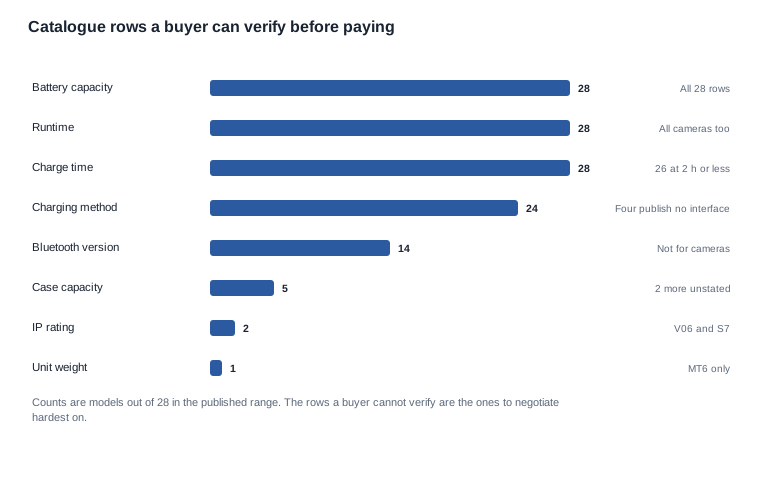
A cost calculation is easier when the purchasing side knows which parts of the product can be checked against the catalogue and which parts have to come from the producer. The published range carries battery capacity, runtime and charge time for all 28 models, and the charging method for the 24 of them that carry one. Bluetooth version is published for 14 of the 28 and is not published for the 11 camera models. Charging case capacity is published for five models, and two further models carry a case whose capacity is not published. The ingress marking appears on two models, the V06 and the S7, and unit weight is published for one model, the MT6 at 158 g for the glasses body including the cell and the camera and excluding the folding case.
That distribution is useful in a pricing conversation, because it separates what the buyer can verify from what has to be bought. Every published row is a line the buyer can check against a delivered consignment. Every unpublished row is a line where the only options are to ask for the evidence, to test it on a sample, or to accept it as a cost of doing business in that market.
Which blocks move with volume and which do not
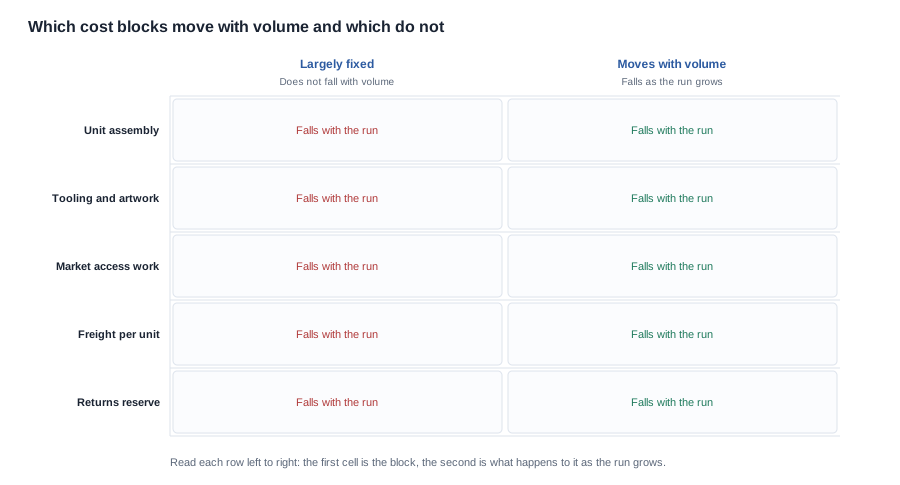
Not everything in a cost document responds to a larger order, and anyone who assumes it does will negotiate the wrong block. Unit assembly cost, the one-off setup and artwork, market access work, transport per unit and the returns reserve all behave differently as the run grows. Setup and artwork are one-off by nature, so their share of the unit cost falls quickly and their absolute value does not move. Market access work is close to fixed per product family per market, so its share falls and the absolute cost stays. Transport per unit usually falls with volume, but only if the consolidation rule allows it, which is a clause rather than a rate.
The practical consequence is that a purchasing manager who wants a better price should target the block that is genuinely volume-responsive and the producer who has a reason to respond in it. The blocks that are close to fixed are not worth arguing about, because the useful question about them is whether the scope is right, not whether the number can move.
The order in which the blocks are created matters as much as what they contain. A unit cost that is decomposed at the enquiry stage costs nothing to reopen; the same block separated for the first time when the invoice arrives cannot be renegotiated at all. The sequence below is the one that keeps a comparison available.
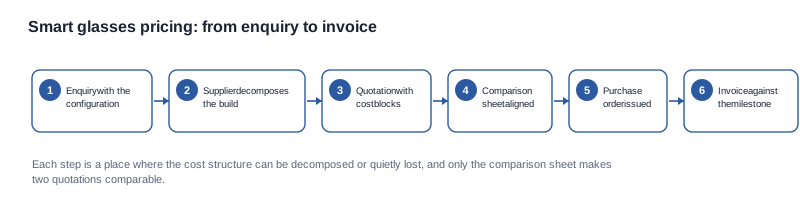
Two steps in that sequence are where the cost structure is usually lost. The comparison sheet is the step that turns two separate documents into one answer, and it is the step most often skipped because each side sends its own sheet and assumes the other can read it. The milestone invoicing step is where a block that was never itemised turns up as a separate charge, which is why the blocks have to be named before the order rather than reconciled after it.

How to evaluate a smart glasses pricing proposal before you compare it
Opening the right block first
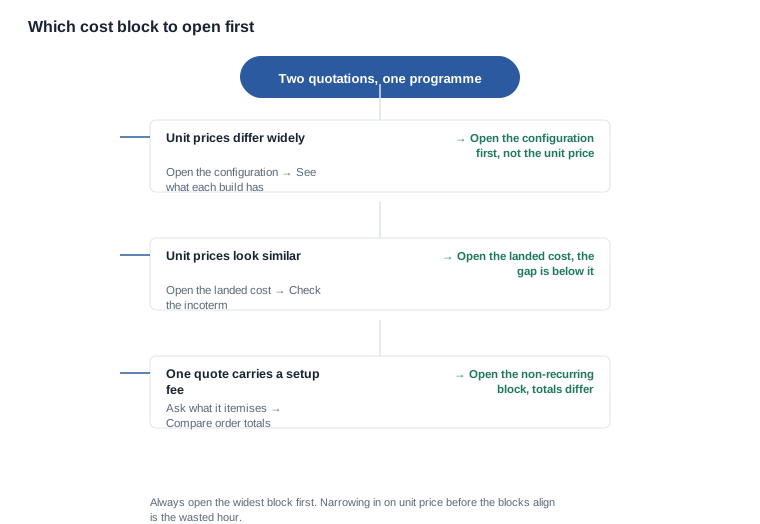
The order in which a cost document is opened determines how long the comparison takes. Opening the unit cost first is the most common mistake, because it is the number that is least comparable and the most likely to differ for reasons that are not about price at all.
- If the unit costs differ widely, open the configuration string on both. Two different builds at two different prices is a normal outcome, not a discovery. Ask what each build includes and write the answer next to the number.
- If the unit costs look similar, open the landed cost block. The difference between two producers is more often in transport, duty and clearance than in the plant price, and it is more often left out of the comparison entirely.
- If only one cost document carries a setup fee, open the non-recurring block. A bundled fee and an itemised set of fees can produce the same total on a first order and very different totals on a second, and only the itemised version tells you which.
- If neither document names the incoterm, neither is finished. Everything downstream of the landed cost depends on it, and the price comparison is not real until it is stated.
How to verify a pricing proposal, and how to compare two of them
Verification here is a document exercise, and every step below produces a document, a date or a named owner rather than an assurance. The criteria in the table above are what a shortlist should be built on, because they are the parts that survive contact with a shipment.
- Take the cost document apart on a single line. Write down what the unit cost is said to include, then ask the producer to confirm it in writing. The gap between the two documents is where the budget goes missing.
- Test the configuration dependency. Ask the same supplier for the unit price of a second configuration that differs in one visible way, such as the case option or the logo treatment. If the answer is identical, the first price was a catalogue price and not a buildable one.
- Check the validity clause against the buyer's own timetable. A price that expires with the component market is a price that has to be re-confirmed, and the re-confirmation is where a number usually moves.
- Align the two quotations on one sheet. Set out configuration, incoterm, destination, compliance scope, payment schedule and volume assumption in the same rows for both, and only then compare the unit cost line. A comparison sheet built in different orders will produce a different answer depending on which order it was built in, which is why the alignment has to happen first.
- Ask what happens to a unit that does not match. The remedy for a faulty unit, the returns process and the allowance built into the price are all part of the cost structure, and they are the parts that get decided later by default.
Run those checks before the order is placed rather than after the goods have shipped, and run them against the same documents the buyer intends to sign. Before you order, the shortlist question is narrow: which quotation is complete. That is what a pricing comparison is really measuring.
The questions to ask, and why each one changes the number
The questions below are the total cost of a comparison expressed as a list. Put them in the first enquiry round rather than the third.
- What does the unit price include, and what is billed separately?
- Which non-recurring costs are in this quotation, itemised one per line?
- Is the market access work for the destination included, or quoted separately, and for which markets?
- Is the returns allowance built into this price, and what is it based on?
- What quantity does this price assume, and until when does it hold?
- What is the incoterm, and what is the destination the price is calculated to?
- What does the price become if the consignment ships alone rather than consolidated?
A purchasing manager who asks all seven in the first round is establishing which cost document is complete, and which one to take further. The comparison only works between documents that answer the same questions, and this is where a smart glasses pricing comparison most often stalls.
Where smart glasses pricing programmes lose money after the order
The price that is not the product
What happens. The headline number came from a stock configuration and the order is a customised one. The first consignment arrives with a build that does not match the sample, and the difference has to be absorbed by the purchasing side at its own cost.
Why it happens. No configuration string on the cost line, so nothing in the order states what was bought. The producer offered a category, the purchasing side read it as a build.
How it is avoided. Require a configuration string on every quotation line and treat any quotation without one as a starting point rather than a price. Where a camera model is quoted, name the case option as part of the string, because the same model appears with a 900 mAh or a 1400 mAh case and with no case at all on the V03 Pro.
The compliance cost that was not quoted
What happens. The market access work for the destination market is charged later, after the order is placed, usually as an invoice attached to a milestone. The order that seemed like the cheapest one turns out to be the most expensive one, and the discovery lands at the point where changing the market is no longer possible.
Why it happens. The first round of the enquiry asked for a price, and the supplier answered with the price of the build. Nobody asked which markets the price assumed.
How it is avoided. Ask in the first round which compliance work is included in the price and which is billed separately, and get the destinations named. Where the destination is the European Union, the relevant framework for radio equipment is the Radio Equipment Directive (EU) 2014/53/EU, and the technical file behind it is part of the product, not an accessory to it.
The freight assumption that did not survive
What happens. The price assumed a consolidated consignment with other orders' goods, and the order shipped alone because the volume was not there or the season was too short. The unit cost was fine and the programme margin was not.
Why it happens. The cost document did not name the consolidation rule, so neither side knew which rate was being used. The logistics and shipping section covers the arithmetic.
How it is avoided. Ask for the shipment method in the quotation and for the price that applies if the consignment travels alone. Then budget the solo rate rather than the consolidated one, because the solo rate is the one that has to be true.
The margin that evaporated at the returns counter
What happens. The cost structure carries no allowance for channel returns and replacements. The margin was built on a gross figure, and the returns arrived as a deduction that nobody had provisioned for.
Why it happens. Returns are usually not the purchasing side's cost model to own, so they end up in nobody's cost model. A producer that has never published a defect rate cannot tell the other side what the allowance should be, and anyone who assumes a typical figure has invented a number.
How it is avoided. Build the reserve into the model before the price is signed off, even if the reserve is a deliberately conservative placeholder that the purchasing side's own channel data will refine later. Agree the return condition for each channel at the same time. The worked contract example shows how the blocks are laid out in a signed document.
The trade-offs in this category are the same in every programme: a figure with no condition behind it, a specification that names a product family rather than a buildable configuration, and a date with no owner. These are the pitfalls worth naming precisely, because they are the ones that repeat. None of these four is exotic, and none of them is a reason to change producer. They are reasons to put a line in the order, which is a better outcome than a lesson learned after a consignment has already been paid for.
What our smart glasses pricing position covers, and what it does not
What we publish and what we refuse to invent
Concretely, the published material on cost is the part of the specification we can stand behind, and the rest is a question for the producer's own file. We publish what our documentation states, we mark the rows that are open, and we will not fill an open row with a typical figure taken from general industry data. Anyone who builds a claim on an estimated number finds the error in the field rather than in the cost document, and the correction is more expensive than the question was.
The rows that are open for this category are these: unit price, production lead time, minimum order quantity, the certificate numbers and validity dates, the AI implementation, the storage path and the warranty terms. The camera specifications, the frame weights on all but one model, and the ingress, drop and ageing test reports are also not published, so each of those is a decision the purchasing side either settles with evidence or carries as an open item.
The rows our published data does settle are these: the battery capacity, runtime and charge time for every model, the charging method for the twenty-four models that carry one, the charging case options where they are stated, the colour options on the models that offer them, the ingress marking on the V06 and the S7, and the 158 g weight of the MT6 glasses body. Those are the rows a buyer can use to check a delivered consignment against what was ordered.
The pricing questions to ask, and the gaps a supplier will not fill
We will not state a price from a photograph, and we will not fill a specification gap with a number that cannot be traced to a document. We will take a use case, a configuration and a market, and tell the purchasing side which parts are settled, which are open, and which have to come from a sub-supplier. Where a cost block is genuinely a commercial decision taken elsewhere, we will say that plainly rather than dress it up as a technical constraint.
Models, quantities and the market
Send the models, the quantities and the target market, and we will tell you which configurations exist, which of them are open on the published data, and what the pricing answer is for each one. That is the evidence the purchasing side needs before comparing two cost documents. The AI camera glasses range lists the published baseline.
Send the configuration, the quantity and the market, and we will say which parts of a pricing comparison are settled and which are yours.


