

Two quotations at the same unit price are usually two different offers. The number is the last item on a quotation rather than the first, and without the documents behind it a buyer is comparing outputs rather than comparing the products being sold. Five document sets close that gap: the configuration-locked quotation, the bill of materials priced at your quantity, the split between recurring and non-recurring cost, the price break schedule with the quantity basis attached, and the commercial envelope that says how long the number holds and what it excludes. This guide takes them in that order, shows how the published configuration data determines what the price is made of, and gives the seven things that must match before two numbers can be compared at all.
Smart glasses pricing: five documents that show what the price assumes
The buying task behind a price request
The reader is a brand-side procurement lead, a channel buyer or an importer who has a price and needs to know whether it is a good one. The situation is usually a first comparison — two or three suppliers have quoted, and the numbers are close enough to be uncomfortable, or far enough apart to be suspicious. The buyer's job is to work out which differences are real and which are an artefact of what each supplier chose to include.
That question cannot be answered from the numbers, because a unit price is an output. To compare two outputs you need their inputs: what was actually built, what was bought in, what was set up once, what the price assumes about quantity, and what it leaves out. A supplier who quotes an ex-works unit price and a supplier who quotes a delivered landed price are not cheaper or more expensive than each other; they have quoted different things, and the difference between them is the destination charges, which are frequently larger than the gap the buyer has been negotiating on the goods.
The reason this is harder than a single-part category is that the configuration space is wide. In our own range there are twenty-eight models across eleven camera models, eight audio models and three sport models, and within them the options multiply in ways that change the bill of materials: colourways, charging case options, whether a cable is in the box at all, and the sensor tier. Two quotations for "AI camera glasses" can be two configurations, and a buyer who compares them is comparing a decision rather than a price.
The fear underneath is the one that arrives at the first invoice: a line that nobody expected, for something that was assumed to be included. The cure is not a better negotiator; it is five documents that make the price legible before the order is placed.
Why two prices at the same number are different offers
Three mechanisms account for most of the apparent price differences in this category, and all three are visible in documents rather than in the number itself.
The first is configuration. The same model can be quoted with and without a charging case, with different case capacities, with a different charger in the box, or with a different colourway treatment, and each of those is a different bill of materials. When the case is the difference, the two prices are not comparable at all, because they are not the same product.
The second is volume basis. A price quoted at a supplier's reference quantity and a price quoted at yours are two different calculations, and the difference between them may be larger than any discount the buyer could have negotiated. This is the single most common reason a comparison produces the wrong answer, and it is entirely invisible from the quotation.
The third is scope. Freight, duty, destination charges, samples, tooling, artwork, certification, warranty provision and the cost of dealing with returns are all outside a unit price in some quotations and inside it in others. The number that reaches the buyer's accounts is rarely the number that reached the buyer's desk.

The five pricing documents, and what each one reveals
The five documents, side by side
| # | Document | What it reveals | The question it must answer |
|---|---|---|---|
| 1 | Configuration-locked quotation | Which product the number is for | Which model code, options and quantity |
| 2 | Bill of materials priced at your quantity | What the price is made of | Which components move with volume |
| 3 | Recurring and non-recurring split | What you pay once versus every time | Setup, tooling, artwork, certification |
| 4 | Price break schedule with its basis | Which tier a quantity earns | What each tier assumes about configuration |
| 5 | Commercial envelope | What the number excludes and how long it holds | Validity, currency, incoterm, exclusions |
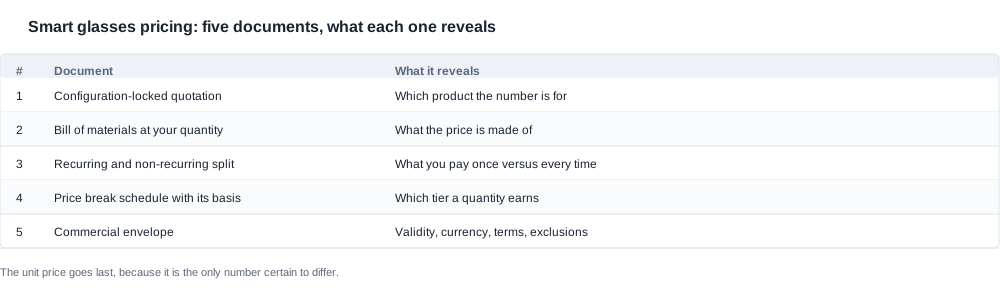
The first document is the anchor for the other four, because every line that follows refers to a configuration. A quotation that names a model family rather than a model code leaves the priced bill of materials with nothing to attach to, and the whole set collapses into a comparison of unit prices between suppliers who may be building different products.
The second is the one most often declined and the one that most repays the asking. A component list tells you what is in the product. A priced bill of materials at your quantity tells you what the product costs to build in the quantity you intend to order, and only the second explains a quotation. Not every factory will release a full bill of materials on a first order, and that refusal is itself information, but a partial version covering the major line items is usually available and is enough for this purpose.
The third separates what you pay once for a configuration you may abandon from what you will pay on every reorder. That separation changes the shape of the deal: a high unit price with a low setup can be the better total position than a low unit price with an unmentioned fixture charge, and a setup charge that is not visible in the quotation is a line that appears on the first invoice regardless.
The fourth and fifth are smaller and faster, and they are where the drift happens. Split across a quotation, a specification annex and an order acknowledgement, validity, configuration and payment basis drift apart, and the drift always surfaces as a line nobody expected.
Which cost lines a unit price is allowed to hide
A unit price is a summary, and the question a buyer should ask of it is which cost lines it is standing in for. The categories worth naming are the ones that behave differently as volume rises.
Component cost is the part that genuinely moves with volume, because component pricing is usually quantity-based and because the material lots that support a run have to be bought in one size. This is the mechanism behind most honest reductions.
Assembly and test labour behaves differently: it falls with volume but much more slowly, because it is a rate rather than a purchase. A price that is mostly assembly and packaging therefore improves far less as quantity rises than a price that is mostly electronics, and a buyer who assumes a linear discount is assuming the wrong shape.
Packaging and artwork is usually closer to fixed per configuration than per unit. Colourways and case options multiply this line, because each one is a separate artwork and packing operation rather than a print run.
Tooling and setup is the line most often absent from a quotation and most expensive to discover later.
Testing, certification and documentation are amortised in some quotations and charged in others, and the difference between the two treatments can be a whole order of magnitude across a programme.
Freight, duty and destination charges are outside the unit price more often than inside it, which is why a landed cost is a different number and the comparison has to be made at that level.
The configuration is the price
The case, the charger in the box and the sensor tier
The published catalogue data makes the configuration question concrete, because in this category the options are published model by model and each one moves the bill of materials.
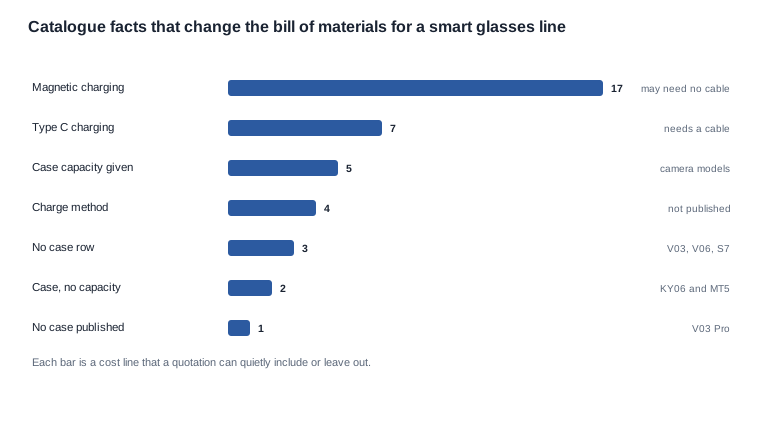
The charging case is the largest variable. A 1400 mAh case is published on the CY05 and the L1 Pro, and the CY03; the L2 Utral is published with either a 900 mAh or a 1400 mAh case, which are two different objects in the box with different packaging and different volumes; and the MT6 is published with a 1200 mAh folding case. The KY06 and the MT5 ship with a case whose capacity is not published, the V03 Pro has no charging-case row, and the catalogue contains no case row at all for the V03, the V06 or the S7. Two quotations for the same model that differ on the case are not comparable, and a quotation that does not mention the case has left the most variable line unstated.
The charger in the box is the second variable, and it is smaller but almost as consequential for comparability. The charging method is published as magnetic on seventeen models and as Type C on seven, which means a cable is a line in the box for some configurations and not for others, and the method is not published at all for four camera models — the CY05 and the CY03, and the MT6 and the L1 Pro. For those four, a buyer cannot know from the catalogue whether a cable is inside the quoted price, which means the question has to be asked rather than assumed in either direction.
The sensor tier is the third. Eight camera models are published at 8 MP and three at 13 MP, and the tier is the largest single line in the bill of materials rather than a specification option. It also explains why a price difference between two camera configurations is rarely proportionate to the visible difference between them.
There is one more published fact that bears on price and is worth asking about. The ingress marking appears on two models only, the V06 and the S7, so sealing is a cost line on those two configurations and simply is not a cost line on the others. A buyer comparing a sealed configuration with an unsealed one is comparing two products, and the difference in price is doing exactly what it should.
The published rows that move a bill of materials
The point of the published data for a pricing conversation is that it lets a buyer name the cost drivers instead of gesturing at them. A quotation that names a model code, a case option and a charger lets a buyer ask whether the price includes the case, whether the cable is in the box, and whether the sensor tier is the one quoted. A quotation that says "AI camera glasses with case" allows none of that.
This also gives a buyer the vocabulary to ask a sharper question about a reduction. "Is the reduction a component-lot effect at my quantity, or a labour-rate effect, or a one-off commercial concession?" has three distinct answers with three distinct behaviours at reorder. A concession is renegotiated at the second order. A component-lot effect repeats. A labour-rate effect partly repeats and partly does not. The single most valuable document in this whole list is the one that lets the buyer ask the question and see which answer comes back.
Comparing two quotations on a like-for-like basis
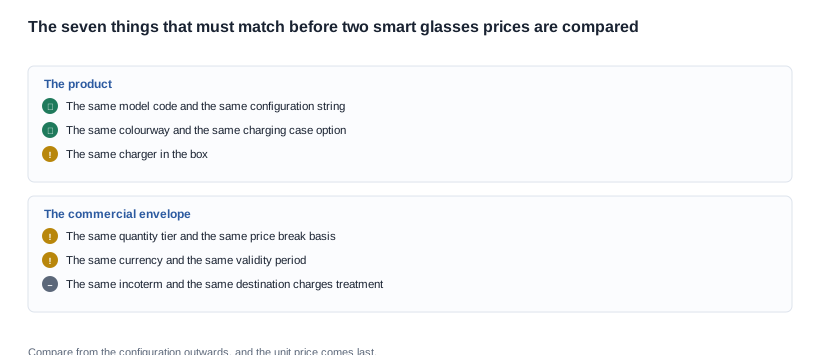
The seven things that have to match
- The model code and the configuration string. Not the family, the code, including the suffix.
- The colourway and the case option. Both appear in the bill of materials and both are published model by model.
- The charger in the box. Ask where the charging method is not published.
- The quantity tier. Both quotations must be at the same tier, and the basis of the tier must be stated.
- The currency and the validity period. A number without both has a short half-life.
- The incoterm and the treatment of destination charges. One quoted ex-works and one delivered are two different offers.
- The scope of the price. Samples, tooling, artwork, certification, freight, duty, warranty provision and returns either in or out.
The order in which to compare them
Compare in the reverse order of how tempting each is. The unit price goes last, because it is the only number that is certain to differ and the only one that carries no information about the others.
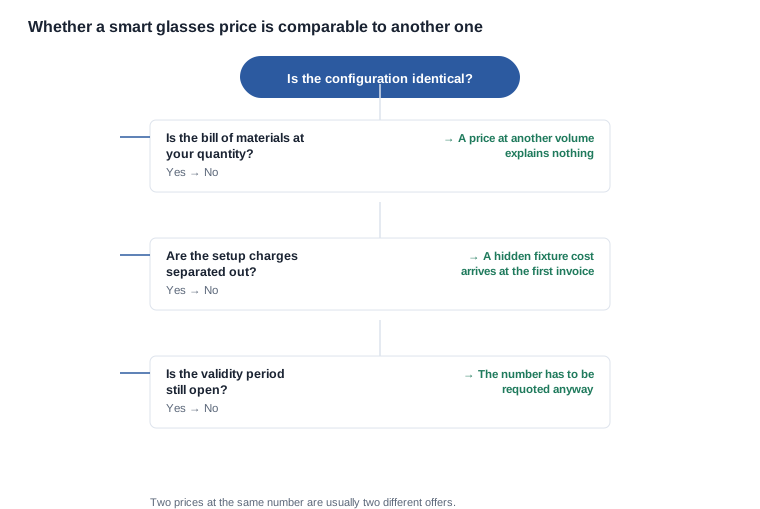
Start at the configuration and work outwards: model code, case option, charger, then the quantity tier and its basis, then the commercial envelope, then the scope, and only then the number. If two quotations differ at any step, the comparison stops there and the difference is named, because a price comparison that continues past a configuration mismatch produces a number that means nothing.

The two quotations that survive that process are then genuinely comparable, and the remaining difference is the actual commercial gap — the thing worth negotiating.

Where pricing disputes come from
Three pricing disputes and their causes
The line that was never in the quotation. A setup charge, an artwork fee or a certification cost appears on the first invoice. The cause is a scope difference between what the buyer assumed was included and what the supplier assumed was chargeable separately. The control is the exclusions list, requested with the price rather than discovered on the invoice.
The price that moved between quotation and order. The supplier requotes on the basis that the validity has expired, or that a component cost changed, or that the configuration changed after the quotation was issued. Some of these are legitimate and some are not, and the distinction is whether the configuration or the validity changed first. The control is a validity period with a stated review point, and a configuration lock at the moment the price was issued.
The reduction that did not repeat. A price reduction is granted at a large quantity, and the same quantity is ordered at a later date at a different price. The cause is usually that the reduction was a commercial concession rather than a volume effect, and it was never recorded as one. The control is to ask which of the two it is, and to keep the previous order's quotation for the same configuration so that the comparison can be made at reorder.
The reductions that hold and the ones that do not
A reduction that holds has a mechanism behind it that repeats. A component-lot effect holds, because the material pricing at a given volume holds. A tooling amortisation holds across the number of runs the tooling is amortised over, provided the buyer knows the denominator. A learning-curve effect on assembly holds, but only to the extent that the rate is actually being reduced rather than the volume simply spreading a fixed cost.
A reduction that does not hold is a commercial concession, and it is worth very little to the buyer who does not know which of the two they have been given. The way to find out is specific and easy to ask: is the reduction a function of the quantity, the configuration or the relationship? A supplier who answers clearly has usually thought about the structure. A supplier who answers vaguely has probably applied a number.
There is a trade-off here too. A buyer who pushes hardest on the unit price and never asks about the mechanism may obtain a larger discount that does not survive the reorder, while a buyer who asks about the mechanism obtains a smaller discount that does. The total cost of a price negotiation is not the difference between two numbers; it is the difference between two numbers multiplied by how long the programme runs.
A price comparison worked through, and what we will itemise
A price comparison reasoned through
The scenario below is constructed for the sake of the argument rather than reported from a client engagement. No customer, order or engagement is described; the models, the quantities and the market are assumed so that the reasoning can be followed from the first quotation to the final comparison.
A brand-side buyer is comparing two suppliers for a camera model with a charging case, into a European market, at a first-order quantity that sits in the middle of a price break table.
Step one is the configuration, and it immediately disqualifies one of the quotations. Supplier A has quoted the model with a case and Supplier B has quoted it without, and the case is published as a 1400 mAh case for that model. The two prices were never comparable, and the buyer's first task was to ask B for a quotation with the case included.
Step two is the charger. The charging method is not published for that model, so the buyer asks both suppliers whether a cable is in the box and at whose cost. One of them confirms a cable in the box; the other says the charger is sold separately, which is not a problem but is a line that now has to be added to the comparison.
Step three is the priced bill of materials, which is what turns the two remaining numbers into an argument the buyer can have. Supplier A's price is weighted towards components, and the reduction at the buyer's quantity is a component-lot effect. Supplier B's price is weighted towards assembly and packaging, and its reduction is much smaller, because assembly does not scale like a purchase. On the buyer's own volumes and with its own sell-through rate, A is the better position, and the reason is structural rather than a matter of negotiating harder.
Step four is the recurring and non-recurring split, which produces the one difference that negotiation can actually fix. Supplier B's setup charge for the case configuration is materially higher, and that is a one-off. The buyer trades it against the unit price rather than accepting it, because the amortisation denominator is small at the buyer's volumes.
Step five is the commercial envelope. The prices are in different currencies, the validity periods end on different dates, and one quotation is ex-works while the other is delivered to the destination. The buyer converts to a landed cost at its own destination charges, using the same basis for both, and only then compares the two numbers.
The result is a comparison that survives being written down, and a negotiation that has something to negotiate with.
What we will itemise, and what we will keep out
Stated plainly: we will provide the split between recurring and non-recurring lines, the validity period, the currency and the incoterm basis, and a configuration lock sheet naming the model code and options the price applies to. We will provide the major cost lines of the bill of materials at the quoted quantity where we are able to, and we will say so plainly when a line cannot be disclosed.
What we will not publish on this site is a list of unit prices, minimum order quantities or lead times, because none of them is a single number and a published table would misrepresent a commercial position that depends on the configuration, the quantity, the destination and the payment history. Any comparison has to start from a quotation, and we would rather issue a quotation that means something than publish a price that does not.
We will also tell a buyer when a reduction they are asking for is not available, because a component cost at a given quantity is not something that can be negotiated by argument. And we will not issue a quotation whose validity has already passed, and we will not hold a quoted price against a specification that changed after the quotation was issued — that is not a pricing position, it is an oversight.
What to send us for a quotation
Send the model, the colourway, the case option, whether you need a cable in the box, the quantity, the destination and the currency you intend to pay in, and we will tell you what the quotation will be itemised as, which lines are one-off and which repeat on the reorder, how long the price will hold, and what it excludes. If you already hold two quotations, send both and we will mark the assumptions that have to be equal before the two numbers mean anything.
Related reading
- pricing section
- How pricing works — the structure behind the number
- How to reduce it — the moves that hold
- SOP template — your own internal process
Send the model, the configuration, the quantity, the destination and the currency, and we will show you what a smart glasses price assumes and which parts of it are worth negotiating.


