A price you can sign is not a number. It is a number with a build attached to it, a validity period, a delivery basis and a remedy, and the difference between those two things is where most of the money in this category is lost. This is the sequence that gets a buyer from an enquiry to a price that can be committed to, written as stages, because each stage produces an artefact and each artefact depends on the one before it.

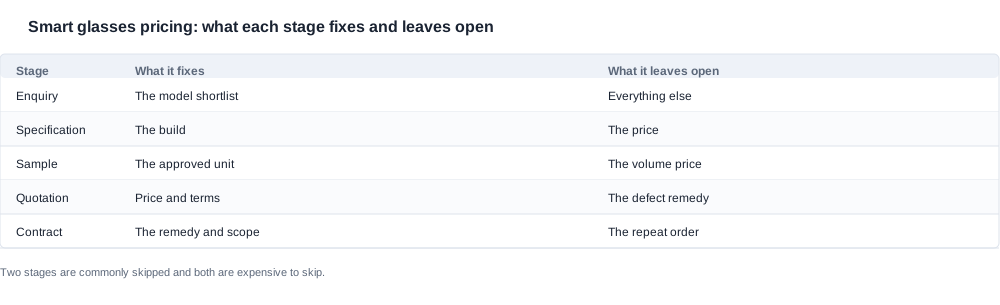
The seven stages below are: enquiry, specification, sample, quotation, comparison, contract, and repeat order. Two of them are routinely skipped and both are expensive to skip. A buyer who moves from enquiry straight to quotation without a written specification is negotiating against a build that does not exist. A buyer who moves from comparison straight to goods without a remedy in the agreement is settling that argument after the delivery rather than before it.
Smart glasses pricing: what to settle before each stage
Why the stages are worth separating
The stages separate because each one removes a different kind of uncertainty, and the uncertainties are not interchangeable. The enquiry removes uncertainty about whether the supplier can serve the programme at all. The specification removes uncertainty about what will be built. The sample removes uncertainty about whether what will be built matches what was described. The quotation removes uncertainty about what it costs. The comparison removes uncertainty about which of two options is better. The contract removes uncertainty about what happens if it goes wrong.
A buyer who compresses the stages is not saving time. They are moving uncertainty from a stage where it is cheap to resolve to a stage where it is expensive, and the most common compression is the one that removes the specification, because the specification feels like paperwork when the supplier is already asking for model names.
The two stages teams skip
The specification stage and the contract stage are the two that get compressed, and they are compressed for opposite reasons. The specification gets compressed because it feels like the supplier's job, and the supplier is perfectly willing to propose one, which means the buyer ends up accepting a build it did not choose. The contract stage gets compressed because the commercial terms feel like boilerplate, and the remedy clause is exactly the part that boilerplate leaves out.
Both compressions move cost forward. A build chosen by the supplier is a build whose specification the supplier can quote efficiently and build consistently, which is not always the build that serves the channel. A missing remedy clause is a cost that reappears when a unit comes back, and it reappears in a channel's returns process rather than in a negotiation you still control.
What each stage produces
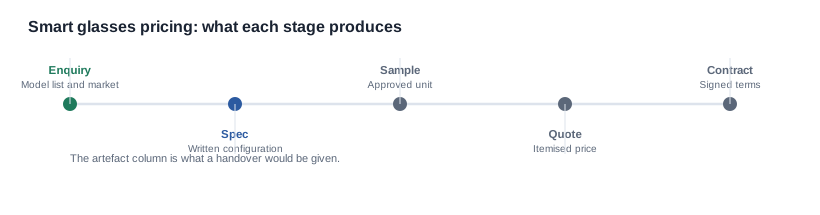
The artefacts are:
- Enquiry. A list of candidate models, a volume, a destination and a requirement list.
- Specification. A configuration string per model, with every build decision written down.
- Sample. A built unit matching the specification, plus a record of what it was.
- Quotation. An itemised price with a validity period and a delivery basis.
- Comparison. One sheet, one basis, every line normalised to landed cost.
- Contract. The configuration, the scope, the remedy and the tolerances, in binding form.
- Repeat order. A re-quote against the same specification, or a deliberate change to it.
The point of naming them is that each artefact can be produced by a different person and handed over. A specification does not have to be written by the person who negotiates, and a comparison does not have to be built by the person who wrote the enquiry.

The enquiry that produces a comparable smart glasses pricing quotation
What to send and what to withhold
The first message should carry enough for a quotation to be comparable and not enough to lock the buyer in. Send the models you are considering, the order quantity or quantities, the destination market, the number of colourways, and the compliance scope you need. Withhold the artwork files, the final packaging specification and any internal cost target, because none of them are needed to quote and all of them give away negotiating position.
A common mistake is the opposite one, sending a complete specification with the first enquiry. It produces a fast quotation and a slow negotiation, because the supplier has quoted something fixed and the buyer still wants to move three of the variables.
The enquiry as a written brief rather than a list of models
A list of models is the weakest possible enquiry, because it asks the supplier to do the specification work and then accepts the result. The stronger form names the models you are considering together with the constraint each one has to satisfy, so that the supplier's response is a comparison rather than a proposal.
The useful pattern is one line per candidate. For each model: the model, why it is on the list, the quantity you would buy it at, and the one published row you are unsure about. A supplier who answers all four lines for every candidate has done a technical evaluation for you, and the answer is directly comparable across candidates because it was produced in the same format.
Why the destination belongs in the first message
Destination changes the number, and it changes it in two directions. It changes the compliance scope, which changes the work attached to the order. It changes the freight basis and the duty treatment, which change the landed cost even when the unit price is unchanged.
Asking for a price at the factory gate and adding freight afterwards is a negotiation on the wrong number, and it is the reason two quotations with identical unit prices can support completely different commercial decisions. Freight on a product this size is usually settled by the volume of the box rather than by the product's own weight, and our catalogue publishes one product weight only, 158 g for the MT6 glasses body including the battery and camera and excluding the folding charging case. The box contribution cannot be derived from published data, so it has to be asked for.
What a supplier can only quote once these four things are fixed
A quotation is buildable when four things are settled: the configuration, the quantity, the destination and the compliance scope. Where those four are open, a supplier is obliged to return a range or a catalogue figure, and a buyer who reads that as a firm price is the source of the problem rather than the supplier.
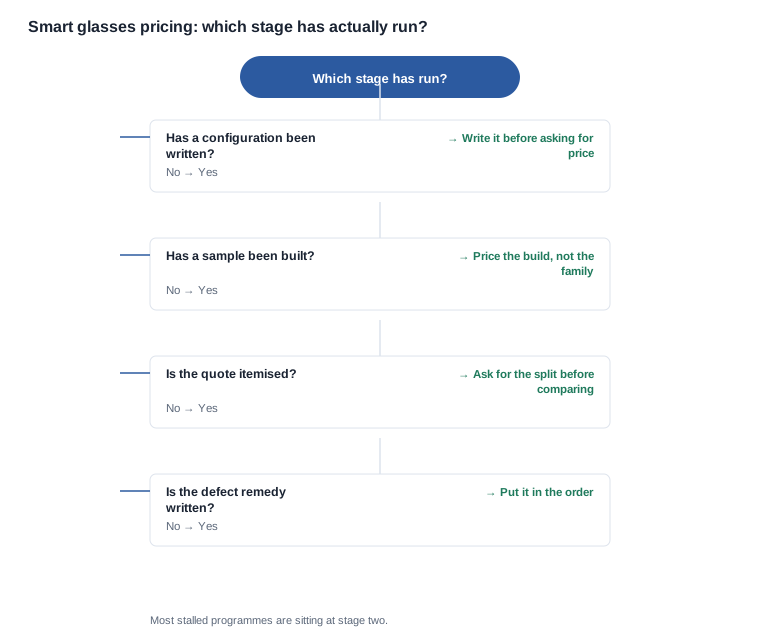
The test of a good first message is whether it produces a quotation that carries a configuration string on every line. If it does, the enquiry was sufficient. If it produces a quotation naming model families, the enquiry left the build open, and the price that came back belongs to the cheapest build in the family rather than to the one you want.
The sample stage and what it settles about smart glasses pricing
What a sample actually proves
A sample proves three things, and it is worth being precise about which three. It proves that the configuration can be built. It proves that the built configuration matches the written specification. It proves that the supplier can produce the thing it said it would produce, at least once, under supervision.
It does not prove that the unit price attached to it is the unit price you will pay, and it does not prove that the production run will match the sample. Both of those are common assumptions and both are wrong often enough to matter. The sample price usually carries a one-off that the bulk order will not, and the production run is built by a different team under a different schedule from the one that built the sample.
The observation that is worth recording while the sample is in front of you
A sample in the room is a rare opportunity to ask questions that will be impossible later, because the unit is present and the supplier is present at the same time. Four things are worth establishing while that is true: which charging method the unit uses, which case capacity is fitted, what the unit weighs with and without the case, and what is in the box.
Two of those are open in our own catalogue. The charging method is not published for the four camera models that publish a case capacity without publishing the method, and the product weight is published for one model only. A sample answers both questions in a way that no product document can, and the answer should be written into the sample record on the day.
What it does not prove
There is a third thing a sample does not prove, and it is the one that causes the most expensive disputes: it does not prove that the documentation covers the sample. A technical file is written for a model and a configuration, and a sample built in a hurry can differ from the file in a detail nobody checked, such as a component change or a supplier substitution inside the module.
The practical control is to require that the sample record and the specification travel together, and that any change to the build between the sample and the production run is treated as a new sample rather than as a minor revision.
The sample record that makes it useful later
The record is short and it is the most reused document in the file:
- The configuration string of the sample.
- The date it was built and by whom.
- The charge time and the endurance as observed, with the conditions recorded.
- The photographs of the unit and the box contents.
- The list of what was checked and what was not.
The fifth line is the one that stops the sample being treated as proof of everything. A sample that was checked for fit and finish and never checked for the charging method is evidence about fit and finish.

Decomposing the smart glasses pricing quotation you actually received
Taking it apart line by line
The decomposition is mechanical. Write down what the unit price is said to include, and then ask the supplier to confirm it in writing. The gap between the two documents is where the budget goes missing.
Then take the non-recurring block apart. Each item should have an amount and a trigger, so that you can tell what you are paying for and whether it will appear again on the reorder. A single bundled line for tooling, artwork and firmware work cannot be evaluated at all, and it is the line most likely to be re-quoted later.
A quotation and an indication are different documents
A document that prices a named configuration, with a validity period, is a quotation and it can be compared. A document that gives a rate for a model family, or for "our AI camera glasses", is an indication, and it is useful only as a starting point for the specification stage.
The distinction is easy to lose because indications often arrive in the format of quotations: they have a document reference, a signature block and a date. What distinguishes them is not the form but the content. If the configuration string cannot be read off the document, it is an indication, and the right response is to write the specification and ask again rather than to place the number on a comparison sheet.
The four lines that are always missing
In our experience of quotations in this category, four lines are absent more often than any others, and they are the same four every time:
- The freight and duty treatment, because the quotation stops at the factory gate.
- The returns and warranty reserve, because nobody builds it into a quotation.
- The documentation route for the destination market, because it is assumed to be included.
- The charge method for the SKUs where it is not published, which in our own range means the L1 Pro and the CY05, and the CY03 and the MT6.
The fourth of these is worth noting. Those four camera models publish a case capacity of 1400 mAh, 1400 mAh, 1400 mAh and a folding 1200 mAh, and none of them publishes the charging method. A buyer who inherits a value from a neighbouring model in the range will find the difference at the dock rather than on the specification sheet.
Rebuilding the comparison on one basis
Align the configuration, the incoterm, the destination, the compliance scope and the payment terms first. Only then compare the unit cost, and only on lines that mean the same thing. Two quotations that answer the same questions can be compared on total cost; two that answer different questions cannot be compared at all, however similar their unit prices look.

The contract stage: which lines decide the final smart glasses pricing
The lines that change the final number
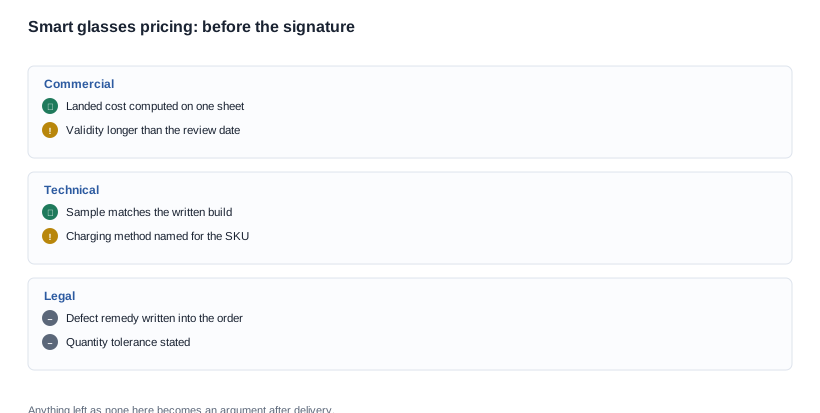
Four lines in the agreement change what the programme actually costs, and all four belong in the contract rather than in an email:
- The configuration string, so that the goods shipped are the goods quoted.
- The quantity tolerance, so that a short delivery is a defined event rather than an argument.
- The specification tolerance, so that a measurement question has an answer.
- The validity period and the re-quote trigger, so that a price does not silently carry over to a changed build.
The lines that change the risk
Three more lines change what happens if something goes wrong rather than what the number is:
- The documentation handover, listing the files that arrive with the goods.
- The defect remedy, including whether a replacement ships with the next production run or separately.
- The returns condition for each channel, so that a unit coming back has a defined route.
Payment terms usually follow a deposit and a balance against the pre-shipment inspection report, and the part worth negotiating is the inspection window and the split ratio rather than the existence of the deposit. Incoterms belong in the contract as well, because a price that stops at the factory gate and a price that arrives at your warehouse are two different commercial products.
What to put in the agreement
The agreement should carry the configuration, the scope, the remedy and the tolerances, in that order of importance. It does not need to carry the reasoning, and it should not carry any expectation that was never written down during the quotation stage. A clause that appears for the first time in a contract is a clause that will be disputed, because neither side has had the chance to price it.
What happens to smart glasses pricing when the order repeats
The reorder is a new quotation against an old specification
The repeat order is a fresh commercial event, even when the specification has not moved. The component market may have moved, the supplier's own volume assumptions may have changed, and the validity period on the original quotation has long since expired. The correct practice is to re-quote against the same configuration string, and the correct expectation is that the number may differ.
That expectation is worth setting in advance, because it changes the tone of the conversation. A buyer who expects the reorder price to be identical will read any movement as a failure of the relationship, and will spend the meeting arguing about a component market rather than about the terms. A buyer who expects movement will read the new number as information about the market and will spend the meeting on the lines that are actually within the supplier's control.
What the first order settles for the second
The first order settles more than the specification. It settles the configuration string, the compliance scope for the destination market, the box contents, the payment terms and the remedy. Those are the parts of a smart glasses pricing answer that do not need to be renegotiated, and they are the reason a repeat order should be faster than the first.
The reorder checklist that takes five minutes
Before placing a repeat order, five questions settle whether the terms still hold: does the configuration string match the one on the original order; is the quote still inside its validity period; is the compliance scope for the destination market unchanged; has the box contents specification changed; and is the quote still on the same incoterm.
Three of the five are about things that have not changed and one is about something that has. That asymmetry is the point: a repeat order that re-confirms four settled things and refreshes one volatile thing takes an afternoon, and a repeat order that renegotiates everything from scratch takes a month and produces a worse specification.
How to know the second order is on the same terms
There is a quick check. Compare the configuration string on the second order against the one on the first. If they match, the comparison sheet for the reorder is the comparison sheet for the original with the unit price and the validity period replaced, and the whole cycle compresses to a day. If they do not match, something changed, and the question worth asking is which of the three record fields in the file records that change.
For the worked version of this sequence, the pricing case example takes one order from the first message to the signature, the verification method covers how to test a quotation once it has arrived, and the pricing common mistakes article covers the errors that recur at each of the seven stages. The procurement pricing section sets out the structure behind the quotation.
Send the models, the quantity and the destination, and we will tell you which configurations exist for that combination and what each quotation for them would have to itemise.