
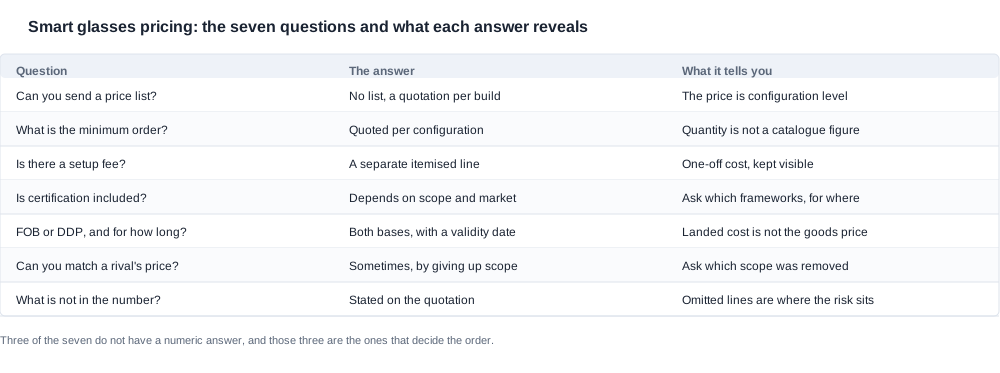
Seven questions come up in almost every smart glasses pricing conversation, usually in the first call, and three of the seven do not have a numeric answer at all. That is not an evasion; it is the shape of the category. The published position here is precise about product and completely silent about commercial terms, so there is no price list to send, no minimum order quantity to quote from a catalogue and no standard lead time to build a plan around. What there is instead is a set of quoted answers, each one attached to a configuration, and a buyer who knows which of the seven to ask first gets a comparable number faster. This article works through all seven, in the order they should be asked, and ends with what we will and will not put in a price.
Smart glasses pricing: the seven questions, and who owns the scope
Seven questions to ask a supplier
The seven questions are: can you send a price list; what is the minimum order quantity; is there a setup fee and is certification included; is the quotation on a delivery basis and how long is it valid; can you match a rival's price; what is not included in the number; and how should these answers be used to make a decision. The three that do not have a numeric answer are the price list, the minimum order quantity and the certification question, and they are the three that decide the order.
The reason is that a price in this category is a scope, not an amount. The same model with a different case option, a different colourway, a different packaging specification or a different destination is a different product with a different supply chain behind it, and a standing list would be wrong for most of its entries. The published catalogue makes this visible rather than hiding it: 28 models with cell capacities from 40 mAh on the children's protection models up to 290 mAh on three of the camera models, two camera classes, a charging case published for some models and explicitly absent for others, and colour options published for only two models in the whole range. Each of those is a price axis, and a price list that flattened them would be a fiction.
Who is asking, and what the comparison has to survive
The reader is a brand-side purchasing manager, a channel buyer or an importer, and the usual situation is two or three quotations on the desk and a programme to choose between them. The thing being managed is not the unit price. It is the total cost of getting a sellable unit into a channel at a specific volume, and the reason the comparison keeps failing is that the quotations have been made against different scopes, sometimes by accident and sometimes by the other supplier's design.
That is the central practical point about smart glasses pricing: most price gaps in this category are scope gaps, and they are invisible on a specification sheet. Two quotations for the same model can differ because one includes a charging case and the other does not, because one assumes a private-label colour and the other assumes a stock colour, because one includes the documentation work and the other leaves it to the importer, or because one is priced to a destination and the other is not. None of those shows up in a unit price column, and all of them show up in the invoice.
What the catalogue settles, and what the quotation has to carry
The catalogue publishes the product detail and none of the commercial terms. It publishes 28 models with their cell capacities, charge times, run times, charging interfaces where a row exists, camera classes, Bluetooth versions where they are published, charging case capacities where they are published, the ingress marking on the two models that carry it, and the colour options for the two models that publish them. It publishes no unit price, no price tier, no minimum order quantity, no setup fee, no sample cost and no lead time.
So the quotation has to carry the commercial terms, and the first thing a buyer should send before asking for one is the configuration string: the model, the charging case option, the colourway, the packaging, the quantity and the destination market. The pricing section sets out the structure behind each answer, the pricing myths article covers what a low quotation is usually missing, the comparison template is the column set, and the pricing FAQ is the longer version of this page.

Why a price list would be wrong here
The axes that move a price, in the published data
The chart below is not a price chart; it is a configuration chart, and it is the reason a price list cannot be published. The cell capacity spread across the range is wide enough that a buyer who assumes a single bill of materials is assuming a product that does not exist.
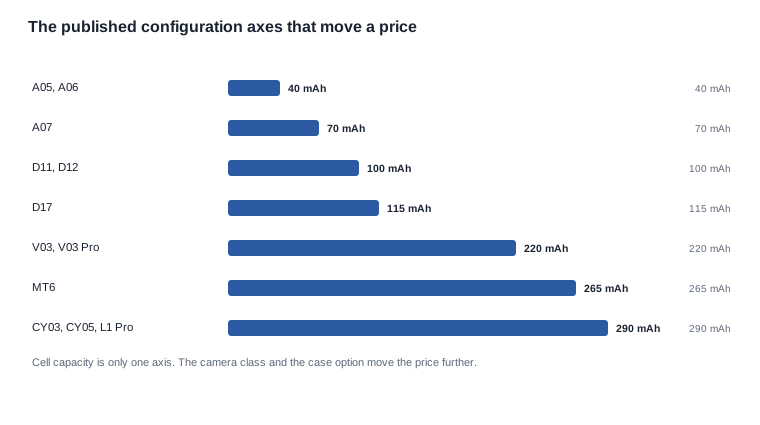
Three axes sit on top of it, and each one is a separate material set inside a single model. The camera class is the first: 8 of the 11 camera models publish 8 MP and three publish 13 MP, the S7 and the L1 Pro, and the L2 Utral, and the camera module behind those two classes is not the same purchased part. The charging case is the second, and it is genuinely mixed. Among the 11 camera models, five publish a case capacity, two publish a case with no capacity stated, and four publish no case row at all — the V03 Pro and the V03, and the V06 and the S7. The colourway is the third, and it is published for only two models: the V03 Pro with three options and the V06 with four, which means any other colour in the range is a new material set and a changeover rather than a catalogue entry.
The three answers that are not numbers
Can you send a price list? No. A standing list would have to assume a case, a colour, a packaging specification and a destination for every one of the 28 models, and every one of those assumptions would be wrong for most of the entries. Unit prices are not published and we will not publish one to make a first contact easier, because a number that cannot be used is worse than no number: it anchors the conversation on a figure that has to be withdrawn later, and it does that in front of the person who will have to trust the eventual quotation.
What is the minimum order quantity? It is quoted per configuration, because the floor is set by the purchased parts behind that configuration and by the changeover that configuration implies. There is no catalogue figure to quote, and a buyer who is told a single range-wide number has been told something that does not apply to the order in front of them.
Is certification included? It depends entirely on scope, so the answer has to be per quotation. What determines it is the destination market, whether the product is being placed on the market under the buyer's own name, and how many model designations are involved. The useful question is which frameworks are included and for which markets, not a yes or a no. The published position makes this concrete: the catalogue carries a company-level export-certification page and no per-model certification row for any of the 28 models, so what a programme needs is model-specific evidence that has to be scoped and quoted.
The tier table, and the question underneath it
A related question that is not one of the seven but decides a great many of them is what the unit price does at volume. The answer should be a tier table with its step boundaries stated, not a single price and a promise of a better one later, and the check a buyer applies is simple: does the quantity the programme intends sit on a published step, or between two? A quantity between steps is the most common reason a landed cost turns out higher than it looked, and it is a predictable outcome rather than a bad supplier.
The second question worth asking is what the tier boundaries are tied to. Where they are tied to the quantity alone, they are straightforward. Where they are tied to a combination of quantity and configuration — one case option, one colourway, one destination — the step a buyer is aiming at may not be reachable in the configuration they actually want, and the price at the step has to be requested for that configuration rather than assumed from the table.
Setup, tooling and certification: the lines that are not unit price
The one-off costs, and why they have to be visible
The setup fee is a separate line from the unit price, and keeping it visible is what lets a small first order be compared honestly against a production run. Custom moulds, first-article approval, artwork and firmware integration are one-off costs, and the reason to itemise them is not tidiness. A first order of a few hundred units and a production order of tens of thousands can have the same unit price and a completely different total cost, and the difference sits in those one-off lines. A buyer who cannot see them is comparing a total cost with a unit price.
The published data gives a good illustration of where one-off cost hides in this category. Colour options are published for only two models, so a buyer who wants a private-label colour is asking for a changeover on any other model in the range, and a changeover is a setup cost, not a volume discount. The same applies to a bespoke packaging specification and to a market-specific configuration.
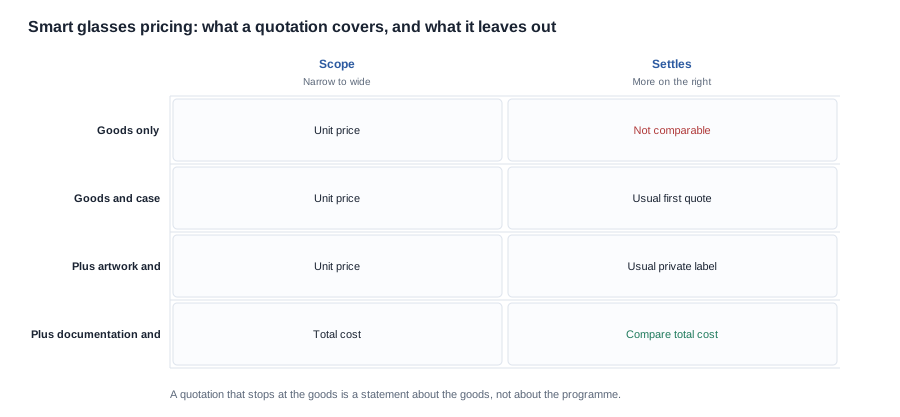
A scope table is worth more than a price table
The matrix below is the practical tool for this category, and it is worth building before any supplier is contacted. It turns a quotation into a comparable object by asking what it settles.
The four costs a unit price does not contain
A unit price in this category is one line of a total, and the other three lines are the ones that decide whether a programme works. Naming them explicitly is the most useful thing a buyer can do before comparing quotations, because each one has a different behaviour at different volumes.
- The one-off cost. Moulds, first-article approval, artwork and firmware integration. It does not scale with volume, so it is proportionally enormous on a small first order and negligible on a production run. It should be a quoted line, not an adjustment.
- The documentation and compliance cost. Per model and per market rather than per unit, which means it behaves like the one-off cost and is amortised across the programme. In this category it has to be scoped, because the catalogue carries a company-level export-certification page and no per-model certification row.
- The per-order cost. Documents, packing preparation, inspection and paperwork. It is fixed per shipment, so it penalises a small order and a split delivery far more than it penalises a large one.
- The carrying cost of anything above what the channel absorbs. A configuration built for a brief that has passed is not a configuration that can be sold next season, and in this category the cells age, so the cost of holding stock is not a storage charge alone.
The reason to name them is that they move in opposite directions. The one-off cost falls per unit as volume rises, the per-order cost falls per unit as the order grows, the compliance cost is flat, and the carrying cost rises when the minimum forces an order larger than the market can take. A buyer who only looks at the unit price sees one of those four moving and misses the direction of the other three.
There is a fifth line that sits outside the price entirely and is worth flagging because it is often forgotten: the cost of the evidence. A programme that has to close a documentation gap, because the catalogue publishes no per-model certification row and no weight for all but one model, pays for that in requests, samples and waiting. It is small relative to the unit price and it is what decides whether a first order is realistic.

Delivery basis, validity, and the landed cost nobody negotiated
Ask for the basis, every time, and ask for both
A buyer should ask which basis the price has been quoted on every single time, and should ask for the other one as well, itemised. This matters more in this category than in most because the goods are small and the destination charges are not proportionate to them: a shipment of a few thousand units of a lightweight device still has a freight, an insurance, a clearance and a documentation component, and those can be larger than the difference negotiated on the goods themselves.
The practical rule is to ask for both the goods-only basis and the delivered basis, labelled, with the lines that move with the destination identified separately from the lines that do not. A buyer who then compares two quotations on the same basis stops comparing accidents.
The validity window is short, and that is information
Quotation validity in this category is measured in weeks rather than months, and the reason is not caution but arithmetic: component costs, freight and compliance requirements all move, so a price held for a year is a price held by someone who has not checked. A short validity window is also useful to a buyer, because it means the price attached to a programme is recent. The right response is to ask for the validity date on the quotation and to note the currency clause, because a quotation with no validity date and no currency is a quotation that will be argued about twice.

Matching a rival's price: what usually comes out of the comparison
Sometimes, and usually by giving something up on scope
A supplier can often match a rival's price, and when it happens it is nearly always by giving up scope rather than by finding a cheaper way to build the same thing: a different case configuration, a different colourway, a different compliance assumption, a different delivery basis, or a different level of documentation. The question to ask is which one, and the answer belongs in writing, because a price matched by removing scope is not a match and it is the most expensive saving in this category.
A higher price than a competing listing has three legitimate explanations: a different configuration, a different compliance scope, and a supplier who will itemise the unit price when the other will not. A fourth explanation is invisible on a specification sheet and shows up only in behaviour, which is what makes it worth asking about directly. The published data is a good place to look for it. A rival quoting a lower price on a camera model may be quoting a different camera class, since 8 MP and 13 MP are separate modules with separate economics. It may be quoting a different case, and in this range the case options are genuinely different products: the L2 Utral is published with a 900 or a 1400 mAh case, and those are not the same purchase. Or it may be quoting a configuration whose charging interface is simply unknown, because four of the camera models publish no interface row at all and the connector on a unit with a published 1400 mAh case is still a question to be asked.
The order to ask the questions in
The sequence below is the working order. It starts from the configuration, because everything else is priced against it, and it deliberately ends with the comparison, because a comparison made before the scopes are aligned compares two different products.

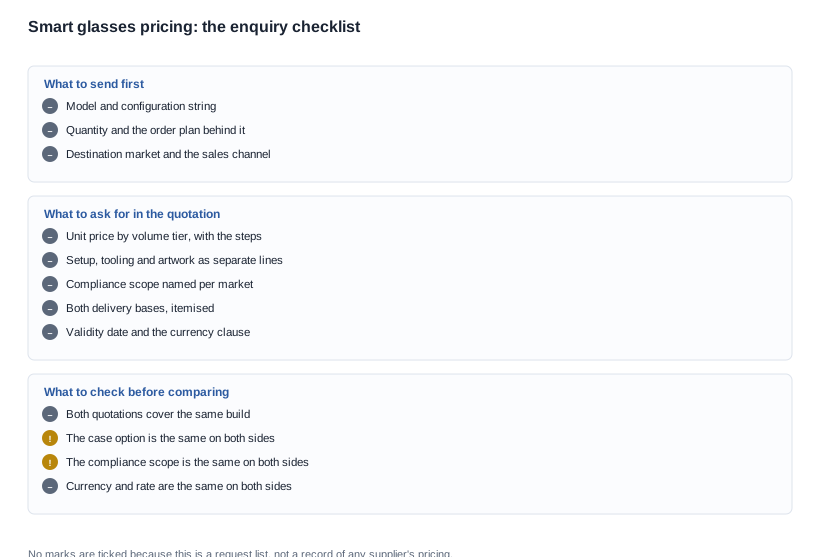
The enquiry checklist, and what to check before comparing
The checklist below is the same seven questions as a request that can be sent, and the last group is the one that catches the errors that matter. Two quotations that cover different case options or different compliance scopes will produce a wrong answer no matter how carefully the numbers are compared afterwards, so those lines are checked before the comparison rather than after it.
How to use the answers, and what we will not price
Take the questions in this order rather than in the order the sales conversation reaches them: configuration and scope first, because everything else is priced against them; then the commercial terms, because they determine what is actually being bought; then the delivery basis and the validity; then the comparison, and only then the negotiation on the unit price itself.
We will not quote a price that assumes a compliance position we cannot evidence, and we will not price a configuration we have not built. Send a configuration and a quantity and we will tell you what it costs and what is not included in that number, which in this category is usually the larger half of the answer.
On the three questions that have no numeric answer, deliberate rather than cautious. A published price list for 28 models with two camera classes, four case states, two published colourway sets and twenty-four published charging interfaces would be a list of averages, and averages in this category are the thing that causes a buyer to order the wrong product. Send us the model, the configuration, the quantity and the destination, and we will tell you what the configuration is, what it costs, and which lines of the quotation are fixed and which move with the destination. That is the whole of what buyers most often ask about smart glasses pricing: not a number on a list, but a number with its scope attached.