

Smart glasses pricing is not one number, and the cheapest quotation you receive is usually the one that describes the least. Before you rank three supplier prices against each other, you have to settle what each one covers: the configuration, the non-recurring work, the destination market, and the delivery basis. Once those four are aligned, most of the apparent price differences in this category either shrink to something manageable or turn out to be the correct signal. This is the list of questions that does that alignment before the order, not after it.
Smart glasses pricing is settled by the configuration before the number
The buyer reading this, and the comparison on the desk
The reader is someone buying on the brand side, a channel buyer or an importer who has quotations in hand and has to decide which one to proceed with. The thing they are actually managing is not a spreadsheet of unit prices. It is the risk of committing to a price that describes a different product from the one they intended to buy, and then discovering it in the first shipment rather than in the quotation.
That risk is specific to this category because the range of configurations inside one catalogue is wide. Our catalogue runs to twenty-eight models. Within the eleven camera models alone, the published camera resolution splits into eight megapixels across eight models and thirteen megapixels across three. The charging-case position splits three ways — a published capacity for five of the camera models, a case without a published capacity for two more, and no charging-case row at all for three, with one model has no charging-case row. Only two models in the whole catalogue carry an IP54 marking, the V06 and the S7.
These are not minor variants. A camera model with a thirteen-megapixel sensor and a 1400 mAh charging case is a materially different bill of materials from an eight-megapixel model with no case row published, and the two can be quoted against each other at a difference that looks like margin until the buyer realises the specifications are not the same.
Why two quotations at the same unit price cannot be ranked
A price comparison fails quietly when the two numbers are not measuring the same thing. The four things that most often differ are the configuration, the non-recurring costs, the destination market and the delivery basis. Two of those are visible on the face of the quotation. Two are not.
The delivery basis is the one buyers forget. A quotation delivered to a named place carries freight inside the unit price; a quotation on an ex-works basis does not. The difference between the two is not the freight line — it is the whole shipping, insurance, customs and handling chain, and on a consumer-electronics consignment it is routinely larger than the difference the buyer was comparing in the first place. When a buyer compares an ex-works quote from one supplier against a delivered quote from another, they are not comparing prices; they are comparing a product against a product plus a service.
The destination market is the other one. A programme aimed at a market with radio-equipment requirements will need test work that a programme aimed at a purely domestic channel does not, and that work is per product family and per market rather than per unit. If one supplier has already run that assessment for the model and the other has not, the second quotation is lower because the work is not in it yet, not because the work is cheaper.
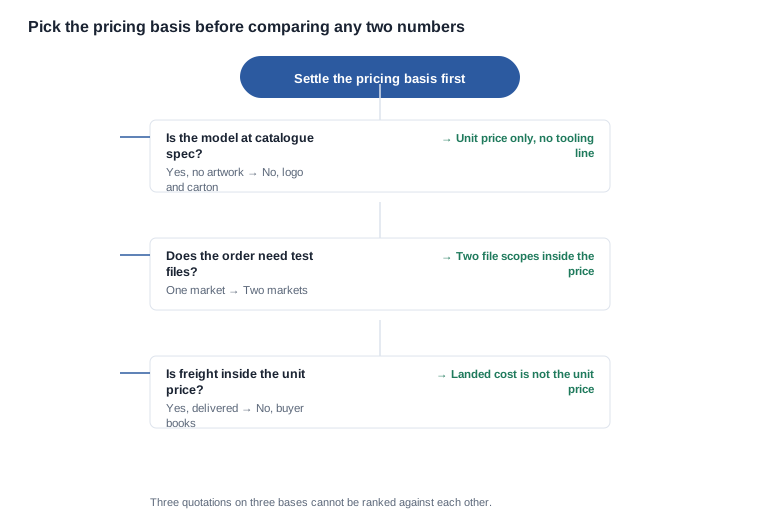
The decision chart above is the sequence to run before any spreadsheet. The point of settling the basis first is that you cannot un-mix the numbers afterwards. A buyer who compares first and adjusts later is doing arithmetic on mismatched quantities, and the adjustment always favours whichever quote was less complete.
The three price tiers that exist in this category
Structurally, quotations in smart glasses fall into three tiers, and the tier a buyer ends up in is a decision rather than an accident.
The catalogue-configuration tier is where the unit price is closest to a straight multiple of a bill of materials. The product is a published model with no branding, no custom packaging and no custom firmware. This tier has the shortest route to a landed cost because almost everything is amortised across the order, and it is the right place for a buyer who wants a first production run without committing to a private-label programme.
The private-label tier adds the things that make a product yours: artwork on the temple or the temple tip, a branded carton, a specific accessory in the box, a firmware configuration and a serial or barcode scheme. Each of these is a non-recurring cost that appears as a separate line rather than inside the unit price, and each of them also changes the assembly and packaging steps, which is where the schedule risk enters.
The regulated-market tier adds the test and documentation work needed for the destination market, per product family and per market. It is the tier where the difference between a quote that includes the work and a quote that excludes it is widest, because the excluded work is not optional and does not get cheaper because it was left out of the quotation.
Most first orders sit across two of these tiers at once, which is exactly the situation that makes an unadjusted comparison misleading. The pricing buyer checklist is the short version of the alignment, and the pricing model reference sets out why the tier determines what the buyer is really buying.

What sits inside a quoted unit price and what arrives after it
Tooling and non-recurring engineering
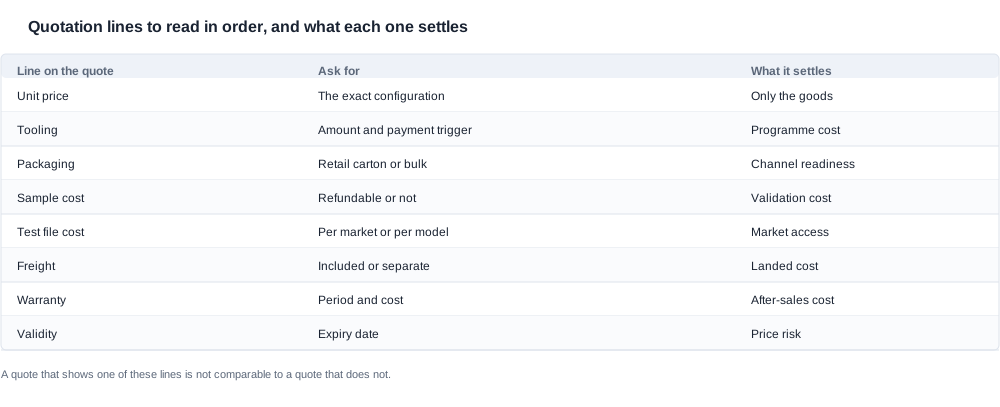
Tooling is the cost that belongs to the programme rather than to the unit, and the commercial question is whether it is amortised into the unit price or invoiced separately. Both are normal, and both are legitimate depending on the programme. What is not legitimate is a quotation that shows a low unit price and leaves the tooling invisible, because the buyer's total outlay then depends on a line nobody quoted.
Ask for the tooling amount, ask what it covers — which parts of the product it is specific to — and ask what happens to it if the programme is cancelled or the model is discontinued. Those three answers together tell you whether the tooling is an asset you own or a cost you have absorbed. The MOQ supplier verification guide covers the ownership question in more detail, and the MOQ guide explains why the minimum order quantity and the tooling decision are usually taken together.
Packaging, artwork and the retail carton
Packaging is where a programme quietly expands. A bulk carton that goes into a distribution centre is a different item from a retail carton with a printed sleeve, and the difference is not only the print — it is the tooling, the minimum print run, the dimensions that determine the shipping cube, and the manual handling at the retail end of the chain.
The question worth asking is whether the packaging cost is inside the unit price or on a separate line, and whether the packaging minimum is higher than the product minimum. Where it is, the packaging becomes the real constraint on the order quantity, and a buyer who negotiated the product minimum down has not actually solved the order-size problem.
The sample cost, and whether it comes back
A sample is a validation purchase, and it is the only stage where the buyer can change its mind cheaply. Its cost should be stated separately from the production unit price, and the refund conditions should be written down.
The distinction that matters is between a sample at catalogue specification and a sample of the custom configuration. The first tells you what the product is; the second tells you what your product is. Buyers who pay for a catalogue-configuration sample and then commit to a private-label production run have bought the cheaper form of evidence and are using it to support the more expensive decision. The sample order checklist and the sample cost breakdown set out what to establish before the sample is ordered.
Test file and market access cost
Here is the part of this category where a buyer is most likely to be working from incomplete information. Our catalogue holds a company-level export certification page, and it does not publish a per-model certification row for any of the twenty-eight models. It does not contain the text of CE, FCC or RoHS anywhere in it.
That does not mean the products lack the documentation a regulated market needs. It means the catalogue is not where that documentation lives, and the buyer has to request it as part of the quotation rather than assume it. This is an unusually good position for a buyer to be in, because the request is ordinary and the answer is verifiable: ask which model designations are covered by which file, ask for the file reference, and ask whether the designation on the file matches the designation on the purchase order.
The commercial consequence is that a quote which excludes the file is not cheaper — it is incomplete. The certification buyer checklist is the document-request list that closes this gap, and the shipping red flags article covers what happens when the file turns out to be missing after the goods have been booked.
Freight and the landed cost that is not the unit price
Freight, insurance, customs duty, handling and the cost of capital over the transit period are all landed cost, and none of them are in the unit price on an ex-works quotation. A buyer who is ranking an ex-works quote against a delivered quote is effectively ranking two different products.
The lead time glossary is worth reading at the same time as the freight line, because the two are connected: the transit period is not just a cost, it is a period during which the buyer's money is committed and the goods cannot be inspected. A cheap unit price with a long transit is a schedule risk, and a schedule risk has a price even when it does not appear on the invoice.
Warranty, returns and the cost nobody quotes
The warranty line is the most frequently absent line in a quotation in this category, and the absence has a reason: for the supplier, warranty is a contingent cost that only appears if something goes wrong, and for the buyer it is often not a cost at all until it is. But it is a cost, it is quantifiable in a way that is difficult to do after the fact, and it is worth asking for because the answer tells you how the supplier sees the product.
Ask three things: the warranty period, which party services it, and whether it runs from the shipment date or from the date the goods enter the channel. That third one is where the money is, because the difference between the two dates is a month of warehousing on every unit in the order.
Comparing quotations that do not describe the same thing
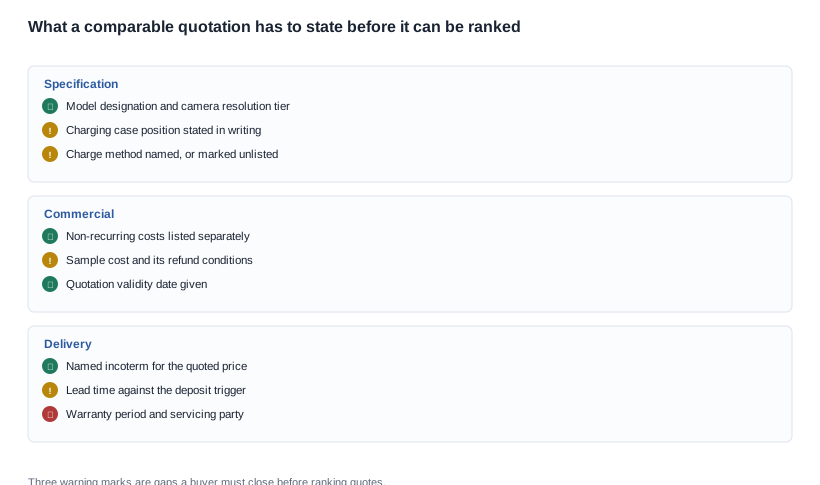
The order of the four alignment steps below matters, because each one removes a variable that would otherwise distort the next.
- Align the configuration first. State the model, the camera resolution tier, the charging-case position and the charge method, and send the same written specification to every supplier. If a supplier asks a clarifying question that reveals the catalogue does not publish the answer, that is valuable information: it means the configuration is genuinely open, and it should be resolved before the number is discussed rather than after.
- Separate the non-recurring from the unit. Ask for the total programme outlay and the unit price as two numbers, plus the break-even quantity at which the first would be repaid. Without the break-even, a supplier can always win on whichever figure the buyer is looking at.
- Put every quote on one delivery basis. Choose ex-works or delivered and have every supplier quote on it. Then compare the delivered figures against each other, and treat the freight and duty as your own line rather than as the supplier's advantage.
- Read the validity date as a price risk. Every quotation carries an expiry, and the expiry is there because component pricing moves. If the programme will take longer than the validity, the price is a memory rather than a price, and the buyer should ask what happens at the expiry — whether the quote is held, indexed, or simply lapses.
After those four steps, what remains is a genuine comparison, and it is worth doing on a page rather than in a spreadsheet that hides which line the difference came from. The AI camera glasses range is where the configuration options are set out, and the pricing pillar holds the structure reference.

The published facts you can use to test any quotation
The most useful thing about a published catalogue is that it gives a buyer a fixed point. Whatever a supplier says about their product, the published rows are the same for everybody, and a quotation that cannot be reconciled with the published specification is a quotation about a different product.
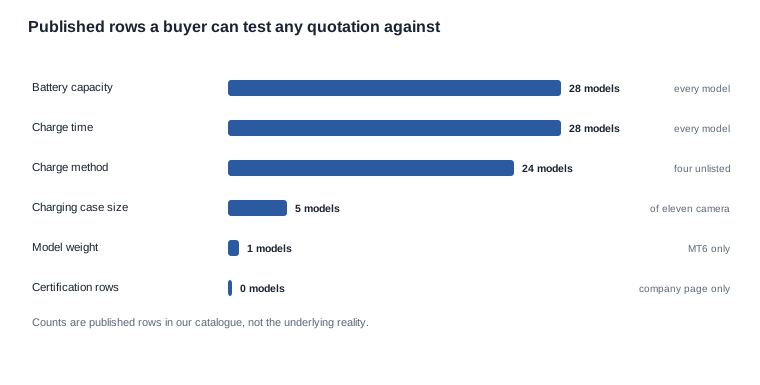
The chart counts published rows, not the underlying reality — the gap between what is published and what exists is exactly why a buyer still has to ask.
Battery capacity, runtime and charge time are published for every model
Every model in the catalogue publishes a battery capacity, a runtime and a charge time. That means a buyer can compare the electrical position of two quotations directly, and it means a supplier who quotes a configuration whose battery does not match the published row for that model is describing a variant. Ask which variant.
The published runtimes also carry a caveat worth understanding rather than ignoring. The catalogue publishes runtime and charge time, but not the state of charge the measurement started from, nor the criterion that ends the charge. Without those two, a runtime figure cannot be converted into a shift-length interruption and a charge-time figure cannot be read as a case turnaround. That is a reason to ask for the test condition, not a reason to discount the published number.
Charge method is published for twenty-four of the twenty-eight models
Magnetic charging is published for seventeen models and a Type C charging interface for seven. Four camera models — the MT6, the CY03 and the CY05, and the L1 Pro — publish no charge method at all, and this is an unpublished item rather than a different method. All four of those models do publish a charging-case capacity.
That combination matters commercially. A model whose charge method is not published is a model where the packaging, the carton design and the accessory in the box are partly open questions, and those questions land in the non-recurring section of a quotation. A buyer who has not asked will find them in the schedule instead.
Charging-case capacity is published for five of the eleven camera models
The L1 Pro and the CY05, and the CY03 publish a 1400 mAh case. The L2 Utral publishes either 900 or 1400 mAh. The MT6 publishes a 1200 mAh folding case. The KY06 and the MT5 publish a case without publishing its capacity. The V03 and the S7, and the V06 publish no charging-case row.
The MT6 case is a good illustration of why the position has to be quoted rather than assumed. The catalogue publishes the MT6 glasses body at 158 grams, which is the only model weight published anywhere in the catalogue, and that figure covers the glasses with the battery and camera but excludes the folding case; the weight of the case itself is not published. A buyer who quotes the MT6 configuration must therefore quote the case as part of the configuration while being explicit that its weight is unknown — which is a legitimate position for a quotation, and a much better one than assuming a weight that was never published.
Weight is published for one model
The MT6 is the only model in the catalogue with a published weight, and it is the only model whose weight can be quoted without a footnote. For every other model, the buyer should ask for the weight against the specific configuration rather than carry over a figure from a different model, because the weights in this category differ with the battery, the camera and the accessory configuration together.
Certification is a company-level page, not a per-model row
The catalogue's export certification page is a company-level capability and carries the design patent certificates. It is not a per-model certification matrix, and the catalogue text contains no CE, FCC or RoHS marking for any model.
The rule that follows from all of this is simple and worth stating as a discipline: a quotation cannot be cheaper than a fact you are able to check. If the published specification and the quotation disagree, the discrepancy is where the margin is, and it is legitimate for the supplier to hold a position on it — but it must be a position they can state, not one you discover in the first carton.

Where the cheapest quotation becomes the most expensive order
The quote that excludes the accessory
What happens. The buyer specifies a camera model and gets a unit price. The production run arrives with a case configuration that was never quoted, or without the case that the programme design assumed. The difference is either a rework or a channel problem.
Why it happens. The accessory position is often left out of the request because it feels like a detail rather than a specification, and because in a conversation the two parties believe they mean the same thing. The catalogue makes the ambiguity visible: the same camera family can be published with a 1400 mAh case, with a case of unpublished capacity, with no case row at all, or explicitly without a case.
How it is avoided. Put the accessory position into the written specification sent to every supplier, and make the unit price conditional on it. A quote that says "with case" when the catalogue row is silent is a quote whose basis you cannot audit.
The quote that excludes the file
What happens. The programme is aimed at a market with radio-equipment or other conformity requirements, the file was never scoped, and the cost appears after the programme is designed, priced and committed.
Why it happens. The file is invisible in the catalogue, so it does not appear in the buyer's cost model, and it is per product family rather than per unit, so it does not scale with the order in the way the unit price does.
How it is avoided. Ask for the file scope as a priced line at quotation stage, and ask which model designations it covers. A supplier who has already run the assessment will answer in a day; a supplier who has not will answer with a scope and a price, which is equally usable.
The quote that excludes the freight
What happens. The unit price wins the comparison, the landed cost does not, and the margin the programme was built on disappears in transit.
Why it happens. The delivery basis is not usually a variable the buyer thinks to standardise, so each supplier defaults to their own.
How it is avoided. Fix the basis before you ask for prices, and build the landed cost into the comparison rather than treating it as a footnote. The pricing pillar sets out the structure, and the shipping material in the logistics pillar covers the transit side.
The quote tied to a volume the buyer cannot use
What happens. The quoted unit price assumes a quantity the buyer cannot place in a first season, and the price the buyer can actually pay is the next tier up, which is materially worse.
Why it happens. Tier pricing is usually quoted down to a break point rather than up to it, and the break point is rarely the same for different suppliers.
How it is avoided. Ask for the tier table, not for the best price. The number that matters is the unit price at the quantity you will actually order, and the second-best tier is often the one a first programme should be priced against, because it leaves room to grow without re-opening the whole commercial discussion.
The quote with no warranty line
What happens. A defect rate appears in the channel, the supplier's response is discretionary, and the buyer carries the cost and the customer relationship.
Why it happens. Warranty is a contingent cost, and contingent costs are the first thing left out of a quotation.
How it is avoided. Ask for the warranty terms as a line, and put the returns path in the same conversation. A supplier who answers the warranty question precisely has usually answered the quality question precisely too.
What we publish about price, and what we keep off the page
We do not publish a price list, a "from" price, or a tier table for our models, and we are not going to start, because none of those numbers would be true for a specific configuration, quantity and destination. Smart glasses pricing in this category is quoted against a written specification and a stated quantity, and the quotation is the only honest form of the number.
What we do publish is the physical and electrical specification that a quotation should be reconciled against: the battery capacity, the published runtime and the charge time for every model, and the charge method for twenty-four of the twenty-eight; the camera resolution tier; the charging-case position and, where it is published, the capacity; the IP54 marking on the V06 and the S7; and the MT6 glasses body weight of 158 grams, which covers the glasses with battery and camera and excludes the folding case.
What we do not publish, and will not invent, is a capacity figure, a yield figure, a lead-time commitment as a standing number, or any certification claim. Our catalogue contains no per-model certification row and no CE, FCC or RoHS marking, so when a buyer asks us what documentation exists for a model, we answer with the files we hold rather than with a claim we cannot substantiate. We will also tell you when a figure is an open question — the charging method on four camera models, the case capacity on two, the case row on three, and the weight on twenty-seven.
Those gaps are not weaknesses in the quotation process; they are the questions a buyer should be asking. Send us the configuration, the quantity and the destination market and we will tell you what exists, what does not, and what the number looks like against a written specification.
Related reading
- Pricing buyer checklist
- Pricing model reference
- MOQ and configuration discussion
- MOQ supplier verification guide
- Lead time glossary
- Certification buyer checklist
- Sample order checklist
- Sample programme cost breakdown
- Shipping red flags
- AI camera glasses range
Tell us the configuration, the quantity and the destination market and we will quote against a written specification.


