
Smart glasses production capacity is not a number you look up. It is a position in a queue that somebody either reserves for you or does not, and the difference between those two outcomes is worth more than every capacity figure quoted in a first meeting. If you take one thing from this guide, take this: track four dates, not one, and do not accept a duration where you need a date.
That is the short answer. The longer answer is below, in the order a buyer who is new to this category needs it — what the four dates are, which part of the chain usually binds a first order, the three questions to ask before you compare anybody, and the mistakes that cost first-time buyers the most time.
Smart glasses production capacity: what to ask for instead of a number
A capacity figure tells you what a factory does when nothing else is competing for the same week. That is a real number and it is worth having, but it is a property of a building and a shift pattern, not a property of your order. What you actually need to know is what happens to your order when the week is full, and that question is not answered by an output rate at all.
The published range makes the reason concrete. The catalogue covers 28 models, and it is not one product repeated: eleven of those models carry a camera, eight are audio models with a Bluetooth version published for each, and three are sport models. Within the camera models alone, the charging case differs five ways — a 1400 mAh case on the L1 Pro and the CY03, and the CY05; a 900 or 1400 mAh case on the L2 Utral; a 1200 mAh folding case on the MT6; a case of unpublished capacity on the KY06 and the MT5; and no case at all in the V03 Pro box. The charging method splits three ways as well: magnetic on seventeen models, a Type C port on seven, and no published charging-method row at all on the L1 Pro and the CY05, and the CY03 and the MT6.
Any factory running that catalogue is running at least five materially different assemblies of the same product family. A daily figure quoted without a configuration is therefore not comparable with any other daily figure, and the correct first question is not how many but how many of what.
The reader this guide is written for is a procurement manager working for the brand, a channel buyer or an importer meeting this category for the first time, or meeting it for the first time with a particular supplier. The situation is usually one of three: two quotations to compare, a programme to open against a launch date somebody has already committed to a retailer, or a market to enter where nobody has been chosen yet. Underneath the enquiry is rarely the number. It is a consignment that is other than the unit the buyer signed, a customs trail that holds the goods at a border, or an opening run that becomes a returns problem nobody costed.
The correct unit of management for a first order is the date. Not the lead time, not the duration, not the quoted weeks — the date. A duration is an average assembled from runs that went well and it cannot be renegotiated when it slips, because there is nothing in it to renegotiate. A date can be re-planned, because it has a stage behind it. This is the difference that a first-time buyer can learn in one conversation and which most of them do not.

The four dates your first order has to pass through
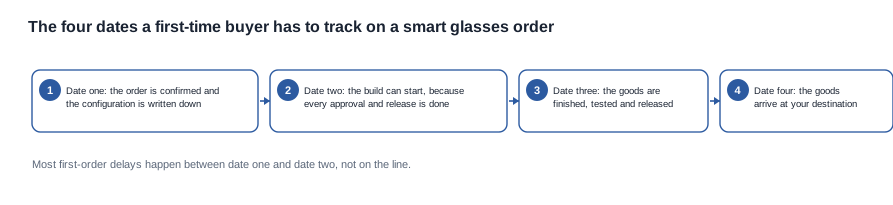
Every first order in this category moves through four dates, and most confusion comes from a buyer tracking only one of them. The four are not in the factory's language, which is why they are useful: they are in the buyer's language, and each one answers a question the buyer has to answer anyway.
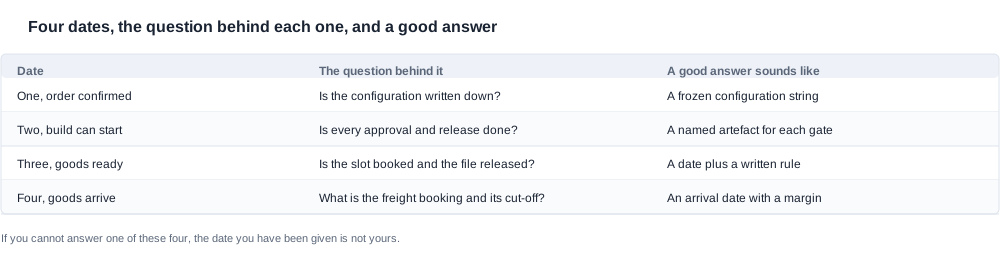
Date one is the order confirmed. This is the date the configuration is written down — model codes, case option, colourway, packaging, regional firmware and destination market — and both sides agree it. Until this exists, the other three dates are guesses, and any date offered before it is a placeholder rather than a commitment. It is the cheapest date in the whole programme to get right and the one most often skipped.
Date two is the build can start. This is the date every approval and every release is finished: artwork and packaging approved, the firmware build signed off, and the documentation file released for the target market. It is usually the most uncomfortable of the four, because it exposes how much of the programme sits on the buyer's side of the line. A first-time buyer who expects the factory to own date two will be disappointed by how much of it is artwork approvals.
Date three is the goods ready. This is the factory's own commitment, and it is the one that depends on a slot actually being reserved rather than estimated. Ask for it with the mechanism attached: which stage is binding, what is booked ahead of your order, and what happens to the slot if a stage slips.
Date four is the goods arrive. This is the commercial date, and it is the only one the customer cares about. It is never the same as date three, because a carrier booking has cut-offs that fall earlier than the goods-ready date and a missed cut-off costs a full sailing cycle rather than a few days. A buyer who plans backwards from date four will discover that date three needs a margin against it, and that margin is the whole of the schedule risk.
The most common beginner error is treating date two or date three as the delivery date. It is a natural mistake, because those are the dates the supplier is willing to quote, and the freight conversation usually happens later and separately. The fix is procedural rather than analytical: write all four dates down on one line, with one owner each, and refuse to discuss a price until the line exists.
What to do when the four dates do not line up
Sooner or later the four dates will not agree, and the usual cause is that the buyer quoted date four to somebody else before date two was even a real date. When that happens, the right move is not to compress the programme. It is to find which date is actually binding and move the others around it.
The procedure is short. Take date four, the arrival date, and work backwards. The arrival date needs a freight booking, and the booking needs a cut-off, and the cut-off needs goods ready, and goods ready needs a build slot, and a build slot needs a configuration, an approval set and a released file. Whichever of those is missing is the constraint, and everything in front of it has to be pulled forward. Working forwards from date one instead produces the opposite error: you discover that the programme cannot be delivered and the fix is to ask for a better price.
There is a second reason the dates disagree that is not anybody's fault, and it is worth recognising because it changes what you negotiate. If the configuration is frozen late because the buyer's own approvers are slow, no amount of factory capacity helps, and the negotiation is not with the factory at all — it is with the approval process inside your own organisation. A buyer who understands this can stop paying a supplier for a delay that sits on their own side of the line.

Which part of the chain will bind your order first
The binding constraint for a first order is usually decided by the configuration rather than by the factory, and the published catalogue is enough to narrow it down before you ask anybody.
The first question is whether the build carries a camera, because a camera build adds a module, a firmware step and often a packaging step to a line that an audio build does not need. The second is whether the build carries a charging case, because that is the assembly that differs most between models. The third is whether the order is new in a way that adds an approval, which usually means a new colourway, a new packaging print or a new destination market.
Some published rows are worth understanding properly, because they are the ones a buyer tends to over-read. Charge time is published for all 28 models, with 26 at up to two hours and the D17 and the ZH12 at around one hour, and it is tempting to treat that as a shift-interruption figure. It is not one. The published charge time carries no starting state and no termination criterion, so it cannot be used to compare how long a mid-shift recharge interrupts work, and it is certainly not the turnover time of a charging case. Runtime is published for every one of the eleven camera models — 5 to 8 hours on the V03 and the V03 Pro, 6 to 8 hours on the KY06 and the MT5, around 7 hours on the MT6 and the CY05, and the L1 Pro and the L2 Utral, and the CY03, and 5 to 8 hours on the V06 and the S7 — which tells you the size of the cell the factory chose, not how long a shift will run.
Two published rows are worth flagging because they are commonly over-claimed. IP54 appears on two models only, the V06 and the S7, so a requirement for a specific ingress rating is a specification decision rather than something to be assumed across the range. And the camera tier is published as two discrete classes rather than a continuum: 8 megapixels on eight models — the V03 and the MT6, the CY03 and the V03 Pro, and the KY06 and the MT5, and the V06 and the CY05 — and 13 megapixels on three, the S7 and the L1 Pro, and the L2 Utral. Both are real constraints on a plan, and both are settled before the quotation rather than during it.
The other thing a first-time buyer should not assume is that a company-level certification page means every model carries it. Our catalogue has export certification material at company level and no per-model certification row, so the certification scope for a specific model is written material you request rather than a fact you read off a specification sheet. Buyers will be asked about CE, FCC, RoHS and UN38.3 in every market, and it is fair to say that our catalogue does not carry the answer on that line.

The three questions to ask before you compare anybody
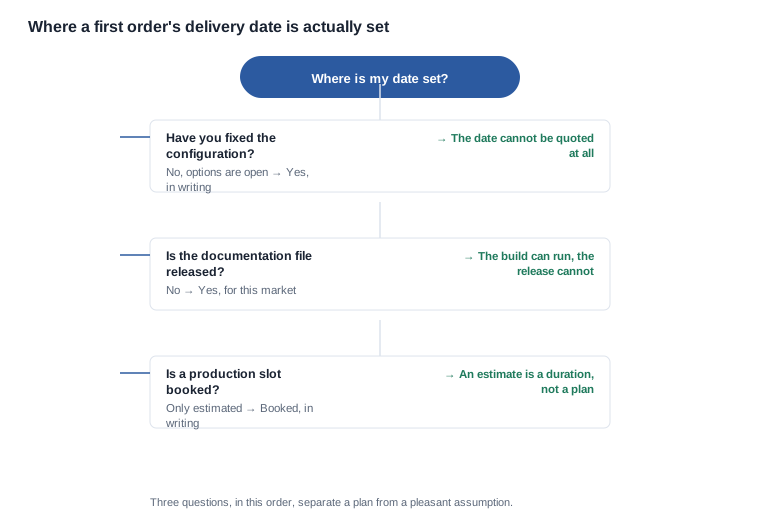
If you remember nothing else from this guide, remember that these three questions, in this order, settle more than a long capacity questionnaire settles.
Which configuration does this date cover? Not the range, and not "a smart glasses model" — the build, written as a configuration string that names the model codes, the case option, the colourway and the packaging. A supplier who answers this precisely has done the work of costing your product. A supplier who answers "the model" has a price for a product that does not exist, and the comparison that follows is between two different things.
Which stage is binding for my order? This is the question that turns a duration into a schedule. It is a small question, it is easy to answer honestly, and it tells you which of the four dates is the one to worry about. It also tells you which part of the chain you should be managing yourself, which is often not the part the factory is worried about.
What happens if that stage slips by two weeks? Not what the remedy is in the abstract — what the mechanism is, who owns it, and what date the order is re-planned to. This is the question that separates a schedule from a hope, and it is the one most often answered with an assurance rather than a mechanism. A supplier who can name the person and the process has a real answer.
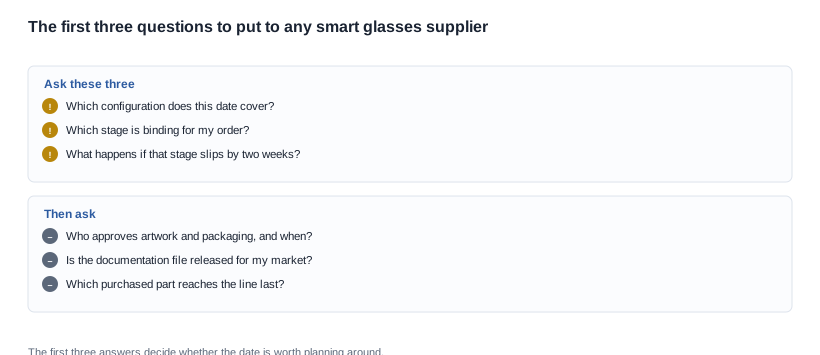
The order matters. The first question establishes the subject, the second establishes the constraint and the third establishes the remedy, and a buyer who starts at the third — asking what happens if things go wrong — before the subject is fixed is negotiating about a programme that has not been defined.
There is a fourth question worth adding once the first three have been answered: what would move the date by one week? The answer is usually something the buyer controls — an approval, a configuration change, a smaller first run — and knowing which lever is available is more useful than any capacity figure. If the answer is that nothing moves it, you have learned that the date is entirely dependent on the factory's queue.
Preparing the first supplier call
A first conversation goes badly when the buyer arrives with a general product description and a quantity, because the supplier has to spend the meeting discovering what is being bought. Arriving with a written configuration is the difference between a quotation and a set of follow-up questions. Before the call, have these ready:
- The model codes, with the case option, the colourway and the packaging decided rather than open.
- The quantity for the first shipment and the quantity for the year, because the two produce different answers.
- The destination market, since it decides which documentation route applies.
- The date the goods have to arrive, not the date they need to leave the line.
- The freight basis you intend to use, because it decides who carries duty and insurance.
- Any packaging, labelling or artwork requirement, including how many rounds of proofing you expect.
- The name of the person in your organisation who approves artwork, so that the approval stage can be dated rather than hoped for.
- A written note of what you are asking the supplier to confirm: the binding stage, the position in the queue, and the mechanism if a stage slips.
Items one to four are the commercial facts, and a supplier cannot answer without them. Items five to seven are the programme facts, and they are the ones a buyer usually forgets to mention, which is why the first answer they get is a generic range rather than a plan. Item eight is the one that converts a conversation into a due diligence record, and it is what lets you compare two suppliers at the end of the round rather than at the end of the quarter.
The red flags to watch for in the answers are the same across all eight. A figure for the range rather than for the build. A date given as a week. A binding stage described as "the schedule". An owner described as "the team". A mechanism for a slip described as "we will handle it". None of these individually disqualifies a supplier, and each one is a prompt to ask the same question again in a more specific form.
The mistakes that cost a first-time buyer the most
Five mistakes account for most of the avoidable delay in a first order, and none of them requires experience to avoid.
The first is asking for a price before a configuration exists. It feels efficient, because it feels like progress, and it produces a figure that has to be redone. The second is accepting a duration where you needed a date, and then building a launch plan on it. The third is assuming that a range of models shares a rate, which is what a quoted monthly figure implicitly claims.
The fourth is not asking about the case option. It sounds trivial, and it is the line that changes the assembly most often: the L2 Utral is published at two case capacities, the MT6 carries a folding case that is a different assembly from a fixed one, the V03 Pro has no case in the box, and the KY06 and the MT5 case capacity is not published. A quotation that does not name the case is not a quotation for your product.
The fifth is assuming that a company-level certification page settles a per-model question. It does not, and discovering that at the pre-shipment review is an expensive way to learn it.
There is one more that is specific to first-time buyers and that experienced buyers never make, which is treating the first order as a rehearsal. A first order is not a trial run; it is a production run with a customer attached to it, and the samples, the paperwork and the first shipment all carry the reputational risk of the launch. The correct stance is to run the first order with the same rigour as the hundredth, which means the same four dates, the same written configuration and the same questions. The only thing that should be smaller on a first order is the quantity.
It is worth being precise: deliberately narrow, and it belongs here because a first-time buyer deserves to know it before the first meeting rather than after the first refusal. We publish what the catalogue contains: the 28 models, the charge times, the case capacities, the charging methods, the pixel tiers and the electrical rows. We do not publish a capacity figure, a line count, a shift pattern, a daily output number, a lead time, a price, a minimum order quantity or a certificate number, because every one of those is meaningless without a configuration, a quantity and a date range, and every one of them moves with the order book. We would rather tell you that than quote you a figure you cannot check.
What we will do is answer the configuration questions without a commercial conversation, and tell you which of them are the ones that actually move your date.
The framework behind the assessment is set out in production capacity. For the longer version of the question, see the twelve-item checklist. For the costs that appear after the goods ship, see hidden costs. And for the same topic from the lead-time side, see lead time for beginners.
Send the model codes, the option set, the quantity, the destination market and the date the goods have to arrive, and we will tell you which of the four dates the catalogue settles for you and which have to be answered by the factory.


