

Capacity is cheap to claim and expensive to be wrong about, because the costs of a capacity problem do not appear when the order is late — they appear much earlier, in the negotiation you enter with a supplier whose real constraint is a purchased part rather than a line. A buyer who prices only the unit price is pricing the part of the cost that was visible at the quotation, and the part of the cost that is invisible is usually the larger part. This page works through the five costs of smart glasses production capacity in the order they actually land, shows where each one comes from, and sets out the question that pre-empts each of them.
Smart glasses production capacity carries costs that never reach the quotation
The conclusion, stated before the detail
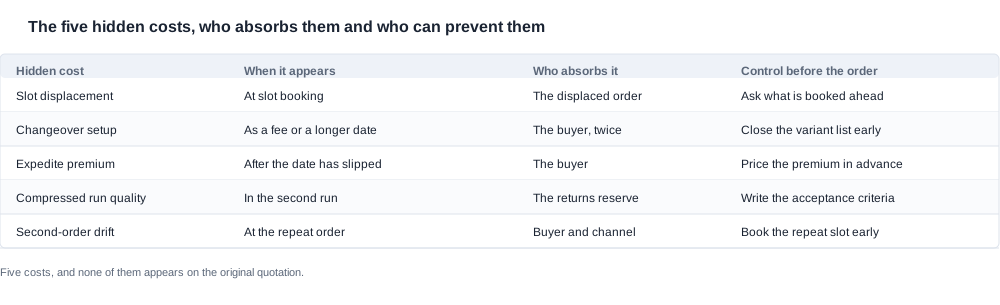
The cheapest capacity conversation a buyer can have is the one that happens before the order, and the most expensive one is the one that happens after a date has moved. Between those two points sit five costs that a quotation does not contain: the slot you did not know you were competing for, the changeover that arrives as a fee and a delay at the same time, the expedite premium that is offered rather than quoted, the quality drift that a compressed second run produces, and the difference between the first order and the second. None of them is exotic and none of them is a reason to change supplier. Each one is a reason to ask a specific question, and each question can be asked before a deposit is paid.
Why these costs sit outside the quotation
A quotation is built from what the supplier knows at the moment it is written. The five hidden costs are all either unknown at that moment or known but not priced into the line. The slot is unknown because queue positions are assigned later. The changeover is unknown because the variant list is usually still open. The expedite premium is unknown because it depends on a disruption that has not happened yet. The quality drift is unknown because it appears in the second run rather than the first. The first-order difference is unknown because the supplier's attention has not yet been tested under load.
That is the structural reason these costs behave the way they do: they are all costs of decisions that were deferred. Each one is cheaper to prevent at the point where the decision was deferred than to absorb afterwards, and the gap between prevention and absorption is much wider than buyers usually assume. A changeover requested before the build is a priced line item; the same changeover requested after the build has started is a delay plus a fee plus a quality exposure, and the three of them arrive together.


The five hidden costs, in the order they land
Cost one: the slot you did not know you were buying from
Capacity commitments are sequences, and a sequence means every order occupies a position that was previously occupied by something else. An order placed late in a period displaces work, and the displaced work is usually another customer's order. If you have not asked what your slot competes with, you do not know what you are costing anyone else, and you have no basis for predicting how quickly the question will be asked of you.
The mitigation is a question rather than a clause. Ask what was booked ahead of your order, and whether your slot would displace another order. A supplier who answers directly — another customer's order, due in three weeks — is giving you the information you need. A supplier who answers in general terms about the season is telling you the allocation rule does not exist, which is itself the finding. This is the conversation that the capacity negotiation article develops in full.
Cost two: the changeover
Changeover cost is the hidden one because it lands on the unit price rather than on the schedule. A custom colourway, a different charging interface, a different case configuration or a firmware variant each require a run setup, and setups are charged either as a setup fee or as a longer lead time — frequently as both. Buyers who add a variant late pay for it twice: once in the fee, once in the line time that the fee was covering.
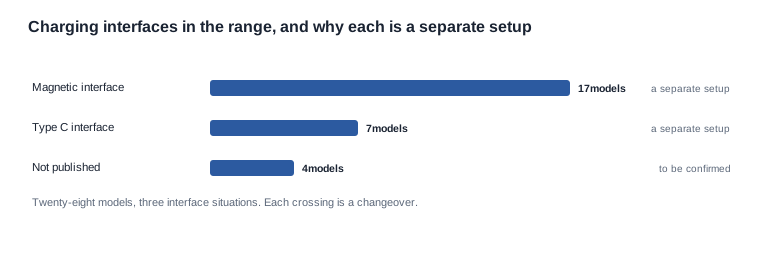
The scale of this in a product like ours is easy to underestimate, because the range contains configurations that differ in ways a buyer may not consider to be different builds at all. The catalogue carries twenty-eight models. Seventeen use a magnetic charging interface and seven use a Type C interface, and four camera models — the MT6 and the CY05, and the CY03 and the L1 Pro — have no published charging method row, so the interface on those is something to establish rather than assume. On the case side, the L1 Pro and the CY05, and the CY03 carry a 1400 mAh case, the L2 Utral carries either 900 or 1400 mAh, the MT6 carries a foldable 1200 mAh case, the KY06 and the MT5 have a case whose capacity is not published, and the V03 Pro has no case at all. A single order that crosses more than one of those lines is crossing more than one setup, and each crossing is a changeover with a time and a cost.
Cost three: the expedite premium nobody quoted
When a date slips and someone offers to expedite it, the price of that offer is rarely discussed in advance, and that is precisely what makes it expensive. Expediting in this category means a slot that displaces someone else, and it may also mean a rushed setup with a higher defect rate. The premium is real, and it is avoidable only by not needing it — which means it has to be priced before it is needed, not negotiated after.
Cost four: compression, and the quality it creates
A compressed schedule does not compress the same way twice. The second run after a compressed first is where substitutions and skipped checks appear, and the buyer discovers this through a return rate rather than through the factory. Any capacity conversation should therefore include what happens to the acceptance criteria when a slot is expedited. The quality consistency checklist sets out the criteria that have to be fixed before a run rather than negotiated during one.
Cost five: the second order is a different question
The first order is built with attention because it is small and novel. The second is built while other work runs, and the difference is visible in finish consistency and in firmware revision. Capacity that comfortably absorbed the first order is not evidence that it will absorb the second at the same quality. Which means your capacity conversation should include the second order and not only the first — the repeat slot, the repeat configuration and the repeat acceptance criteria.
Where each hidden cost comes from
Tracing a cost back to a deferred decision
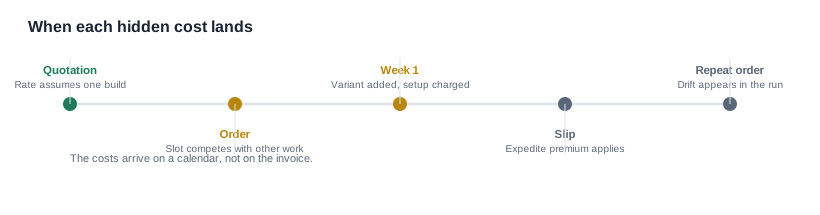
Each of the five has a root cause that can be located, and locating it is worth more than negotiating the cost afterwards. The slot displacement comes from a capacity figure quoted without a priority rule — without a rule, the queue is assigned case by case and each case is a fresh argument. The changeover comes from a variant list that was still open when the quotation was written, which is a purchasing decision deferred, not a factory failure. The expedite premium comes from a plan with no slack, which means the plan treated the quoted lead time as a commitment rather than as an estimate of a duration.
Compression comes from a slot that was accepted without asking what was displaced to make room for it. And the second-order difference comes from a specification written for the first order, where the second order was assumed to be the same thing repeated. Each of these is visible in the documents before the order is placed, and each has a question attached to it. None of them is visible in a unit price.
The cost that is hardest to see
One category deserves separate attention because it does not appear as a cost at all: the cost of the assumptions a buyer carries privately. When a buyer holds a supplier's capacity figure privately and does not test it, the cost of being wrong is deferred into the future, where it is indistinguishable from ordinary supply friction. A delayed programme is easy to explain and hard to attribute, which is exactly why an untested capacity claim is more expensive than it appears. The discipline that removes it is not a negotiation technique — it is writing the figure down, recording what it was derived from, and noting the date.
Putting a number on the second order
The second-order cost is the one most buyers never calculate, because calculating it requires a quantity and a rate they do not yet have. It can be calculated anyway, approximately, and the approximation is enough to change behaviour. Take the first order and the second order as the same configuration. The difference between them is not the bill of materials; it is the attention. On the first order the build is small and novel and it receives a disproportionate share of the factory's attention. On the second order it runs alongside other work, and the things that get squeezed are the ones invisible in the finished unit — the time allowed for a setup, the position of the sampling point, the patience applied to a borderline unit at the end of a batch.
The cost of that squeeze lands in the returns reserve, and it lands there late enough that a buyer who has not reserved for it discovers it as a channel problem rather than a manufacturing problem. The practical control is not a prediction, it is a reserve and a sampling position: decide in advance what fraction of the second order you will inspect at the line rather than at the end of the batch, and what you will do with the first indication of drift. Buyers who set those two things before the repeat order tends to find that the second order behaves much like the first. This is the trade-off to decide before you order rather than to discover in the returns data.

The premium nobody quotes
Why the expedite price is always higher than expected
An expedite premium is the sum of three things, and buyers usually anticipate only the first. The first is the priority — the slot has to move ahead of other work, and whoever is displaced does not get compensated, so the supplier absorbs a cost it will eventually recover. The second is the setup — an expedited build frequently needs a new run configuration, and setups are not compressed by urgency. The third is the yield — the run that is hurried is the run with the highest chance of a skipped check, and the cost of that chance lands on the buyer.
The way to handle this is to price the premium in advance, which sounds impractical and is not. The useful version of the exercise is a single sentence in the enquiry: what is the additional cost and the additional lead time if the order has to be brought forward by a stated period, and what changes in the acceptance criteria if that happens. A supplier who answers with a number has an expedite mechanism that has been thought about. A supplier who answers with a refusal has not, and you will find out at the moment you need it.
Why a premium on a fixed date is cheaper than a slipped date
The arithmetic is worth stating plainly, because it is the single clearest commercial argument in this area. A slipped date on a fixed launch window is not a delay, it is a lost season: the product misses the shelf, the campaign runs against nothing, and the inventory either sits or is written down. The premium for certainty, whatever it is, is bounded by the cost of the alternative. The bound is a real number for the buyer to compute, and the computation belongs in the negotiation rather than in a footnote.
There is a second reason to price the premium in advance rather than discover it later. A premium that has been quoted is a number you can model; a premium that is offered under pressure is a number you have no ability to evaluate, because the alternative at that moment is worse than the price. Buyers who have agreed the expedite mechanics in advance — the additional lead time, the additional cost, and what changes in the acceptance criteria — keep their leverage at exactly the point where they would otherwise lose it. That is the real argument for putting the clause in the order rather than relying on goodwill.
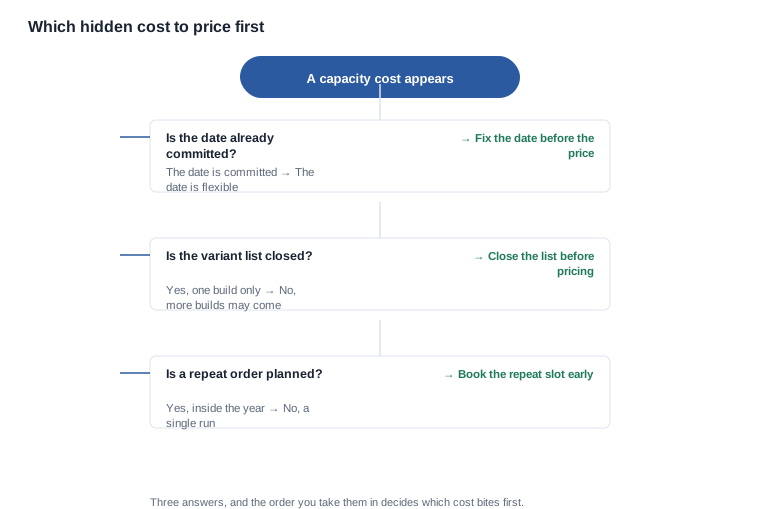
This is also why the date has to be settled before the price is discussed. A quotation that arrives without a committed date is a quotation for something else, because the supplier's exposure to your schedule risk is one of the reasons it is priced where it is. When the launch window is fixed, say so at the request stage, and ask for the premium to be quoted as a separate line rather than absorbed. A separate line can be compared against the cost of a slip; an absorbed one cannot.

Putting a cost ceiling into the order
The four clauses that carry the costs
The commercial conversation around capacity is narrow, and the narrowing is deliberate. Four clauses do most of the work. The first is a configuration lock, so that a variant added later is a priced change rather than a change absorbed by the factory. The second is a setup time and setup cost for your build, so that the changeover is a number you can plan against. The third is the priority rule and the notice period, so that a slot has a defined life. The fourth is the acceptance criteria for an expedited build, so that compression does not silently redefine what a defect is.
Each of these converts a hidden cost into a visible one, which is the only way a buyer can manage it. None of them asks the supplier to give something away — they ask the supplier to state something that is almost certainly already true internally. A factory that cannot say how long a changeover takes for your build has not measured it, and a factory that has not measured it cannot tell you what your variant will cost.
The clause about the second order
One clause belongs in the agreement even if nothing else does: the repeat order. Specify that a repeat of the same configuration on the same terms is scheduled on the same basis as the original, and state what changes if it cannot be. That clause is worth more than it appears, because it converts the first order from a bespoke event into a repeatable one — and it forces the question of what "the same configuration" means to be answered in advance, which is a question that is very hard to answer after a variant has quietly changed.
Which clause to prioritise when you cannot have them all
Buyers rarely have the negotiating position to win all four clauses, and it is worth knowing which one to spend the position on. The priority order is not the one most people assume. The configuration lock comes first, because it protects the other three: without it, the set-up fee, the slot and the acceptance criteria all apply to a build that may no longer exist. The priority rule and notice period come second, because they are the only clauses that do anything in the month when the queue is full, and that is exactly the month in which the other clauses are irrelevant.
The set-up time and cost comes third, and it is the one most likely to be conceded, because a supplier will argue that setup is fast and is not the issue. The argument is usually right on speed and usually wrong on cost, which is why the clause asks for both: the time is what the buyer can plan around, and the cost is what the buyer can model. The acceptance criteria for an expedited build comes last in priority and first in drafting, because it costs nothing to agree in advance and is nearly impossible to agree once a date has already slipped. Write it in calm conditions, even though you will use it in difficult ones.
What we do not price, and why
Where our own numbers stop
We do not publish production capacity, line counts, daily output or stage durations, because none of them is meaningful without a configuration, a quantity and a date range, and a standing figure would be wrong for most of the orders a reader compared it against. All are not published in our documentation, and a capacity figure quoted at first contact is the least reliable number in the conversation. Our position is that the hidden costs on this page are better prevented by a well-specified configuration and a written slot than negotiated one at a time.
What we will tell you is what your configuration requires, which stage is currently binding, what has to be true to hold a slot, and which parts of the schedule are ours and which are yours. The production capacity section covers the assessment framework, and the industry benchmark article explains why we do not offer an external benchmark in place of our own figures.
The rows we do publish
Some rows do settle, and they are worth having in the file:
-
The catalogue carries twenty-eight models: eleven camera models, eight audio models, three sport models and six further entries — the AR frame, the three children's models, the electrochromic model and the bone conduction model — and each tier follows its own component and setup path.
-
Charge time is published for every model in the range, with twenty-six at two hours or less and the D17 and the ZH12 at around one hour. That figure has no starting state of charge and no completion criterion attached, so it is a published number rather than a usable one, and we would rather say that than let you derive a shift interruption from it.
-
The unit weight is published for one model only, the MT6 at 158 grams for the glasses body including the cell and the camera and excluding the foldable case, which is 1200 mAh with no published weight of its own.
Send the models, the quantities and the target market, and we will tell you which configurations exist, which parts of the schedule they require, and which of these five costs the configuration you have chosen is most likely to produce.


