

Twelve items, grouped by what each one settles, in the order they should be asked. Each item is paired with the artefact its answer has to produce, because an answer that produces no artefact is an opinion, and an opinion cannot be scheduled around, negotiated with, or audited later.
The list has one job: to tell you when you have enough. That matters more than it sounds, because the most expensive habit in a capacity conversation is continuing to ask after the decision is already determined. Once a supplier has named the binding stage, told you what is booked ahead of your order, and described what happens if a stage slips, the remaining nine items refine an estimate rather than gate a decision.
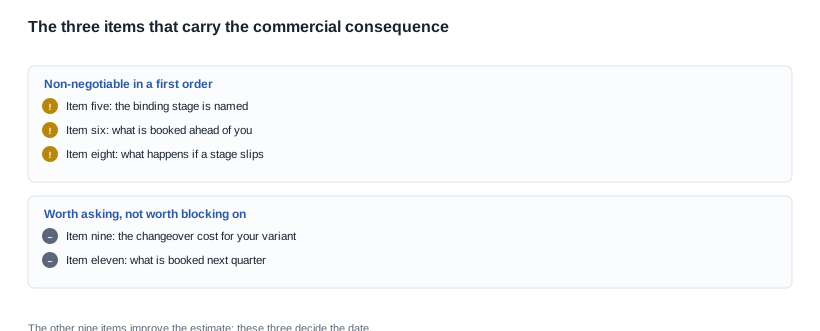
The checklist above isolates the three items that decide the outcome of a first order. Everything else on the twelve-item list is verification, and verification is valuable in a different way: it protects you at the second quotation and at the review, when the relationship is established and the answers are less likely to be scrutinised.
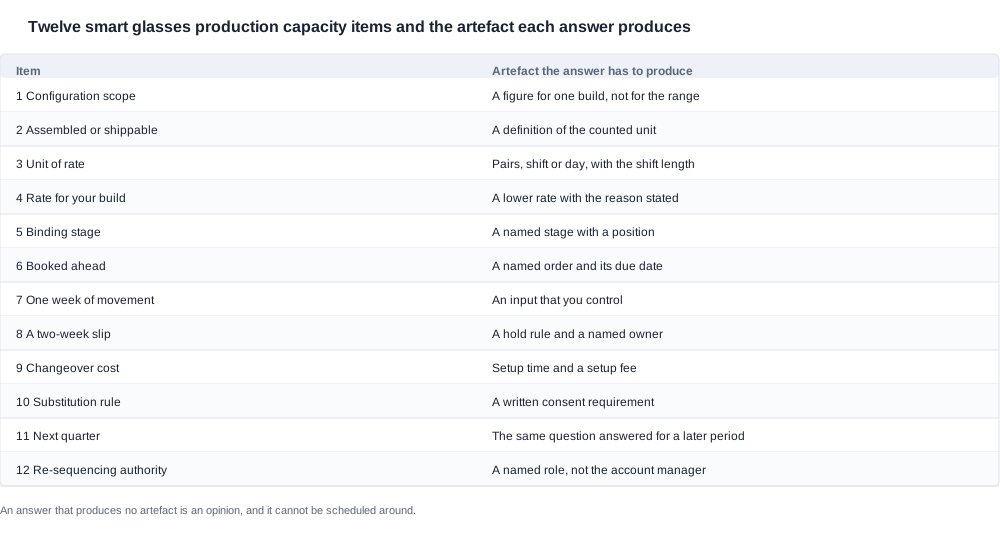
Smart glasses production capacity: twelve items in asking order
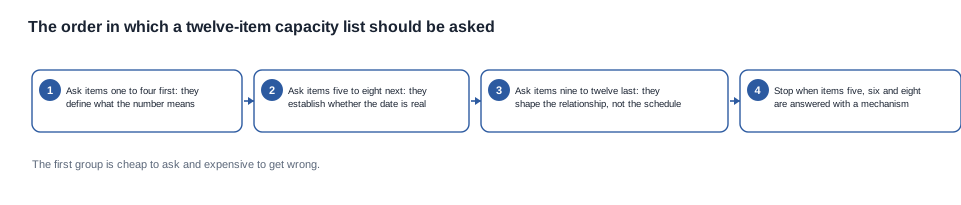
The first four items settle what the number means. They are cheap to ask and expensive to get wrong, because a buyer who skips them ends up comparing two answers to a question nobody asked.
- Is this figure for camera configurations, audio configurations, or both? A satisfying answer separates them and names the units.
- Assembled units, or finished shippable units? Packaging, firmware flashing and final test sit after assembly and consume capacity.
- What is the unit — pairs, shift, or day? And is a shift one or two?
- What does the rate become for my configuration and packaging? This is the number you plan against, and it is usually lower than the average.
The next four settle what the date depends on. These are the items that change a decision.
- Which stage is currently binding? Assembly, components, artwork approval, firmware, documentation or transport booking.
- What is booked ahead of my order? A supplier who will name it is being straight; one who says nothing is telling you the same thing more faintly.
- What would move the date by one week? The answer is usually an input that you control.
- What happens if a stage slips by two weeks — is the slot held or rebooked? And what mechanism holds it.
The last four settle what the relationship becomes once the order is placed.
- What does the changeover cost for the variant I want? Setup time, a setup fee, or both.
- Is there a component substitution rule, and is it contractual? A same-capacity substitution is invisible on a specification sheet.
- What is booked for the same period next quarter? A capacity conversation covering only the first order is incomplete.
- Who at the factory can re-sequence, and what triggers them? Not the account manager.
Items five, six and eight carry the commercial consequence and should be read first in any reply. Item five tells you whether your date is set by the factory or by a component. Item six tells you whether you are first in a queue or somewhere inside it. Item eight tells you what happens when reality disagrees with the plan, and it is the only one of the three that protects a date you already hold.
What the list costs to run, and what it saves
Running a twelve-item list is not free. It takes an hour of drafting, an hour of scoring, and an hour of reading the replies — and it has to be repeated for every supplier in contention. That is a real cost, and in a category where the unit price differences between suppliers are often a matter of a few per cent, it is worth being explicit about the return.
The return is not saved time. It is avoided schedule failure, and schedule failure in this category is not a small number. A first order that arrives three weeks late against a launch date that was committed to a retail channel produces a set of costs that are difficult to price and impossible to argue away: a launch that starts late, a channel conversation that has to be had, a second shipping route, and a returns reserve that was never in the budget. The list is due diligence in the literal sense — it is the work that establishes whether the date is a plan — and the total cost of the delay it prevents is normally larger than the cost of the enquiry.
The strongest argument for running the list anyway is comparative rather than financial. A buyer who asks twelve questions of three suppliers in the same order learns three things that a price comparison cannot produce: which supplier knows where the constraint is, which supplier has a documented process rather than a person, and which supplier will tell you when the answer is "we do not know". Those three facts determine how the second order, the third order and the difficult conversation in year two will go.

The artefact each answer has to leave behind
The table above pairs every item with the artefact it has to produce, and that pairing is the whole discipline. An answer that produces nothing cannot be checked by anyone, including the person who gave it. This is what turns a question from a conversation into evidence.
Four artefact types cover almost everything on the list. A written figure is any number that names its unit, its scope and its configuration — a rate for one build, in pairs per shift, rather than a rate for the range. A named stage with a position is a stage plus a place in it: the cell position for a build that is waiting on a module, the queue for a build that is waiting on a slot. A date with a mechanism is the pair that item eight demands, and it is the only artefact that survives a constrained month. A named role is any answer that assigns an action to a person or a function rather than to a department.
The distinction between a date and a date with a mechanism is the one worth labouring, because so many replies contain a date and are scored as though they contained a mechanism. "If the slot is missed we will re-plan to the next available week" contains a date and no mechanism, because nothing in it says what triggers the re-plan, who announces it, or how much notice you get before the original date is missed. A mechanism is what converts a delay into a scheduled event, and it is what you write into the order once the answer has convinced you.
The same distinction applies to the artefacts in the other two blocks. A configuration scope that arrives as "for the model" rather than as a configuration string has produced nothing, because it has not identified the thing being discussed. And a re-sequencing authority that arrives as "the factory" has not produced a named role, because a factory cannot re-sequence anything.
One useful consequence of naming artefacts is that you can tell in advance whether an answer is going to be checkable. Before you ask, you know what a good answer contains and what artefact it leaves. After you ask, you are no longer adjudicating quality — you are checking for the artefact. That is a much healthier position to negotiate from, and it is the reason to write the criterion down before the round rather than decide afterwards.
Answers that arrive in the wrong shape
Three answer shapes are common enough that the list should assume them, and a buyer who cannot recognise them will score them as answers and lose the information they carry.
The first is the answer in the wrong unit. A rate given in units per month for a factory whose quoted rate elsewhere is units per shift will be scored as a specific answer and used as one, and the resulting error is large enough to change a shortlist. The test is simple arithmetic: convert everything to the same unit before comparing anything, and notice when the conversion is not possible because the shift length was never stated.
The second is the answer in the wrong scope. "We can build that in a week" is a scope error when the build includes a charging case and the factory's week figure was measured on audio models, because the case is a different assembly. This is the same error that the advanced stage-by-stage view of a production plan exposes, and it is why the scope question has to come before the rate question.
The third is the answer that arrives in the right shape but with the wrong sign. A supplier who answers item eight with "the slot will be rebooked" has produced the artefact for the wrong branch. The question asked whether the slot is held or rebooked; an answer that says rebooked, without saying what triggers the rebooking and what the recovery date is, describes a process without describing a protection. The signs that an answer has drifted this way are easy to spot in the wording: past tense where future tense was needed, and a reference to what happens rather than to what will happen.

Designing the enquiry so the answers arrive
The list is only as good as the way it is sent, and there is a fairly consistent pattern in how capacity enquiries fail. They fail by arriving as a conversation, which produces spoken answers with no owner, no date and nothing to compare between suppliers.
The first design rule is that the enquiry is one numbered message, sent to every supplier in the same order and with the same content. Not a summary of the list — the list. If the message is shortened for one supplier, the comparison is lost, because the shortened message will have lost a different item.
The second rule is that the configuration string and the quantity go into the message. A list of twelve questions with no build attached produces twelve answers about the range, and the buyer has to start again.
The third rule is that written answers come first and the call comes second. A call is where a written answer gets explained, refined and occasionally improved; it is not where the answer is produced. When the order is reversed, the written record that survives is a set of notes, and a set of notes cannot be scored, compared, or produced three months later when the slot is being questioned.
The fourth rule is to set a response window and to say what you will do with a partial answer. "Please answer what you can and mark the rest as to be confirmed" produces more information than "please answer all twelve", because it separates the two states instead of blurring them into silence.
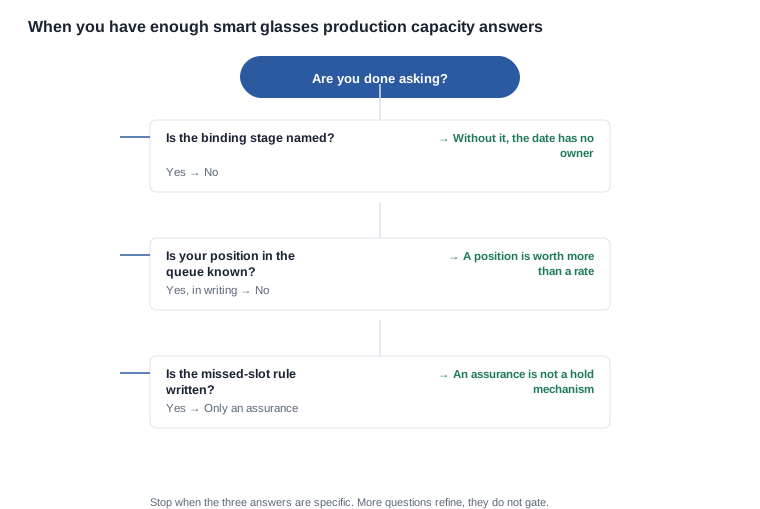
The decision tree above is the stop rule, and it is worth setting in advance rather than negotiating in the moment. If the binding stage is named, your position in the queue is known and the missed-slot rule is written, then the date is a plan and the remaining items refine it. If any of those three is missing, the date is a hope, and no amount of additional questioning will change that — it will only produce more of the same material.

What changes on the second order
The list is built for a first order, and on a repeat order three of the four blocks stop being questions and become checks. Items one to four become a verification that the configuration has not drifted, and that check is worth doing carefully, because the most common cause of a changeover in this category is a configuration that was edited after approval rather than one that was mistyped on the order form.
Items five to eight become a re-forecast. The right question is no longer "which stage is binding" but "what has changed in your plan since our first order, and does the binding stage for us still hold". A supplier that names a different binding stage for the same configuration on the second order has either had a supply problem or has changed its mix, and the buyer needs to know which, because the answer determines whether the second order's date can be relied on.
Items nine to twelve are where the second order is actually negotiated. The changeover cost is now a live number rather than a hypothetical, the substitution rule is now something that will either have been honoured or not, and the re-sequencing authority is either a name the buyer has used before or a name they are still learning. These four items are worth more in the second round than in the first, and a buyer who spends the whole second round re-asking items one to four has wasted the round.
There is a measurement that makes the second round much more productive: put the first round's answers beside what actually happened, date them, and read the two columns together. A supplier whose binding stage was correct both times has confirmed something the buyer can act on. A supplier whose binding stage moved between the two rounds has told you that their answer was a forecast rather than a fact, and the buyer now knows how much of the second date to trust. This is the difference between a capacity change and a reporting change, and from inside a supplier's order book the two are indistinguishable.
Turning the answers into an order
The twelve answers are worth nothing until they are in the order, because an answer that lives in an email has no remedy attached to it. The conversion is straightforward once the artefacts have been named, and it follows the same three-block structure as the list itself.
From the first block, the configuration string and the counted unit go into the order as definitions, so that the rate in the order means the same thing as the rate in the quotation. From the second block, the binding stage goes in as a stated fact with a date, the queue position goes in as a reservation with a reference, and the missed-slot rule goes in as a clause with a recovery date and a notice period. From the third block, the changeover cost goes in as a quoted number, the substitution rule goes in as a written consent requirement, and the re-sequencing authority goes in as a named role.
What goes into the order is a decision about which of the three blocks to make binding. The first block belongs in the order unconditionally — it is a definition, it costs nothing, and it removes a class of dispute entirely. The third block is where the trade-offs live, because a substitution rule and a re-sequencing commitment both cost the supplier flexibility, and a supplier that has been asked for all of them at full strength on a first order will usually answer all of them worse. The second block is the one that deserves the most attention, because it is the block whose absence causes the delay that a delay costs the most.
Before you order, it is worth reading the finished order once with the twelve answers beside it and asking a single question: if the same constraint reappears in month three, what in this document tells either of us what happens? If the answer is nothing, the answers did not become terms.
One further question belongs in the second round and nowhere else: how many models, markets and variants were actually added since the first order. Each addition is a schedule event rather than a commercial one, and the buyer who knows the cost of an addition before making it will make fewer of them.
The limits of what we can publish about capacity
The short answer: deliberately narrow, and it is stated here because a buyer running a twelve-item list needs to know which of the twelve the supplier's own catalogue already answers and which have to come from the factory.
We publish the 28 models, the charging methods, the charge times, the electrical rows, the case capacities and the pixel tiers. Charge time is published for every one of the 28 models, with 26 at up to two hours and the D17 and the ZH12 at around one hour. Runtime is published for every one of the eleven camera models. The camera tier is published as two discrete classes, 8 megapixels across eight models and 13 megapixels across three. The charging method splits three ways: magnetic on seventeen models, a Type C port on seven, and no published charging-method row at all on the CY03 and the CY05, and the MT6 and the L1 Pro. IP54 is marked on two models, the V06 and the S7. Those rows settle items one and two on the list without a supplier.
What we do not publish is a capacity figure, a line count, a shift pattern, a daily output number, a stage duration, a lead time or a certificate number, because none of them means anything without a configuration, a quantity and a date range, and every one of them moves with the order book. There is no per-model certification row either; the export certification material in our catalogue sits at company level, so the certification scope for a specific model is written material to request rather than a published fact.
What we will do is answer items five, six and eight for your configuration, and say plainly where the answer is that a slot is unbooked rather than confirmed. That distinction is the one this whole list is built around.
How the assessment is scored is described in production capacity. For the slot conversation that follows a completed list, see how to negotiate capacity. For what a claim has to contain to be comparable, see industry benchmarks. And for the costs that surface after the goods ship, see hidden costs.
Send the model codes, the option set, the quantity, the destination market and the required arrival date, and we will answer items five, six and eight for that configuration in writing.


