

Ten questions, ordered so that the ones which change a decision come before the ones that only confirm it, and each one paired with the answer that would satisfy it. A checklist without an acceptable answer is a list of topics, and a list of topics is what most capacity conversations already are.
The second thing this checklist is for is comparison. Run it identically against every supplier in contention, in the same order, in the same round. What you learn from that is not primarily the answers — it is their shape. Two suppliers naming different binding stages tells you far more than either supplier's rate does, because it means the difference between them is a difference in constraint rather than a difference in capability.
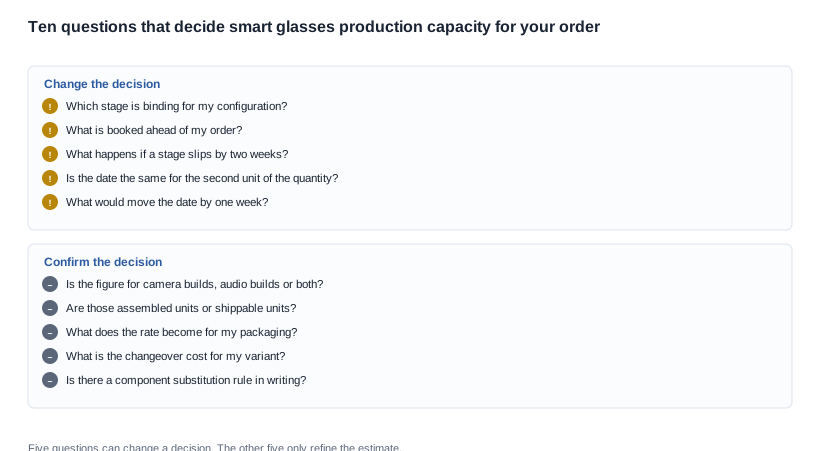
Smart glasses production capacity: ten questions that change the decision
The first five questions are the ones that can move your delivery date. They are worth asking first because they are the ones a supplier can answer quickly, and the answers arrive as concrete facts rather than as descriptions.
- Which stage is binding for my configuration? A satisfying answer names a stage and produces evidence — a component position, a slot queue, an artwork date.
- What is booked ahead of my order? A satisfying answer is a straight one, even when the answer is that another customer's order is due in three weeks.
- What happens if a stage slips by two weeks? A satisfying answer describes a mechanism and names the person who can re-sequence.
- Is the date the same for the second unit of the quantity? A satisfying answer either distinguishes the first from the rest or explains why it does not.
- What would move the date by one week? A satisfying answer is something you control — an approval, a configuration change, a smaller first run.
The second five confirm the decision rather than make it. They are worth asking because they are cheap, and because a refusal to answer one of them is itself information about how the supplier works.
- Is the capacity figure for camera configurations, audio configurations or both? Satisfying: separated, with the units defined.
- Are those assembled units or shippable units? Satisfying: a straight answer, and a note of what happens after assembly.
- What does the rate become for my packaging? Satisfying: a lower number than the average, and an explanation of the difference.
- What is the changeover cost for my variant? Satisfying: a setup fee, a schedule effect, or both.
- What is the component substitution rule? Satisfying: written sign-off required before a change.
The ordering is not cosmetic. Questions one to three can be answered by a factory with a real production system, and they are answered in minutes. Questions six to ten are answered by a factory with a documented configuration process, which is a rarer thing than a production system and a more useful thing to know about. The question is which of the two a supplier has.
Which stage each question actually tests
The ten questions are not an arbitrary list, and a buyer who understands the mapping can diagnose a supplier's answers more precisely than one who is simply marking pass or fail. Question one tests the production plan: a factory that knows its own binding stage has a plan, and one that does not is quoting from an average. Question two tests the queue: knowing what is booked ahead of your order is a different capability from knowing how much can be built, and it is the capability that decides a constrained month.
Question three tests the mechanism rather than the intention. It is the only question in the list that asks about a failure rather than a success, and it is the one that separates a schedule from an assurance. Question four tests the costing discipline of the first run, because the first run of a build is nearly always slower than the steady state and a supplier quoting one date for the whole quantity has not costed the difference. Question five tests whether the supplier understands the buyer's side of the programme, and the answer tells you what a later recovery conversation will look like.
The confirming questions test different things again. Question six tests whether the supplier thinks in configurations or in catalogue ranges, which is a revealing distinction. Question seven tests the definition of the counted unit, and a supplier who counts shippable units rather than assembled units has told you the rate is already net of packaging and firmware. Question eight tests whether the supplier has costed your packaging or merely accepted it. Question nine tests the setup discipline. Question ten tests change control, and it is the one that protects you against a component substitution that arrives after approval.

The passing answer and the failing answer for each question
An acceptable answer has to be specific enough to act on and attributable to somebody. That combination is what separates a real answer from a fluent one, and it is worth writing down before the round rather than deciding afterwards, because judgement about which answer was "good enough" is contaminated by how the commercial conversation is going.
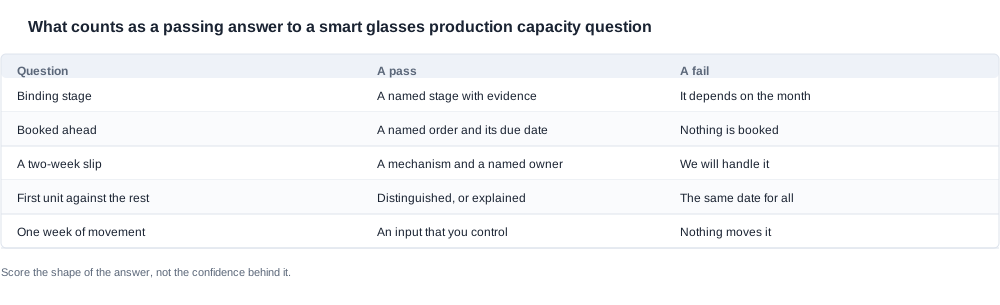
The failing answers in the last column are worth recognising individually, because each one is common and each one conceals a different problem. "It depends on the month" means no allocation rule exists. "Nothing is booked" means the queue is not managed, or not managed for you. "We will handle it" means there is no mechanism, only an intention. "The same date for all" means the supplier has not costed the first run separately, and the first run is usually the slow one. "Nothing moves it" means the date depends entirely on the supplier and you have no lever.
Three answers that look specific and are not
Three failure patterns pass a casual reading and fail a careful one, and all three are common enough to be worth naming.
The first is a date with no object. "We can start on the 14th" sounds specific and may mean the order enters the queue on the 14th rather than the build starting on the 14th. The distinction is the whole of the difference between a date and an intake date, and it is resolved by asking what happens between the two. The second is a quantity with no scope. "Three thousand units a week" sounds specific and says nothing about which configuration, which packaging or which count — assembled or shippable — is being counted. The third is a mechanism with no date. "If the slot is missed we re-book at the next available slot" contains a process and contains no commitment, and it is the answer most likely to be mistaken for a remedy.
There is a fourth pattern that is harder to catch because the sentence itself contains a date: an answer that gives a recovery date without giving a recovery rule. A date with a rule behind it says what will happen; a date without one says what happened last time. When a supplier offers a recovery date, the follow-up that settles it is simple — what triggers the recovery, who announces it, and how much notice you get before the original date is missed.
Scoring the round is worth doing while it is still fresh, because the shape of the answers is easiest to recall immediately and hardest to reconstruct from an email thread a month later. A simple scheme works: score two for a specific answer with a named owner and a date, one for a specific answer without the owner or the date, and zero for a vague answer or a refusal. Score the five decision-changing questions separately from the five confirming ones, and do not add the two totals together, because a supplier with eleven points across the confirming questions and a zero on question two is not an eleven-point supplier.

The process above is deliberately unremarkable. Send all ten as one numbered list rather than as a conversation, because a written list produces written answers and a supplier who answers seven and says the rest will be confirmed has shown you exactly which parts of their process are documented. Ask for the answers in writing, because an answer that exists only in a call has no owner attached to it. Score the replies, then read the shape of the replies before you read the totals.

Scoring several suppliers on one page
Once two or three suppliers have answered, the comparison is the valuable part and it needs a format. A single sheet with one row per supplier and one column per question is enough, with three states in each cell: a specific answer, a partial answer, and no answer. The score is a summary; the sheet is the evidence, and the sheet is what you take to the meeting where the slot is actually booked.
Two findings come out of the sheet that do not come out of a total. The first is a supplier who answered the first four questions precisely and stalled on the rest. That is a supplier who has analysed the first order and not the relationship. It is a normal position, and it is worth knowing before you rely on it, because it predicts how the second order will be handled.
The second is a supplier who scored badly on the confirming questions but well on the first three. That supplier may be running a small operation with good visibility and no documented configuration process, which is a very different proposition from a large operation with a documented process and a queue you cannot see into. Neither is automatically better. Which one is right depends on whether your programme needs capacity or predictability, and that is a decision about your own risk, not about the supplier.
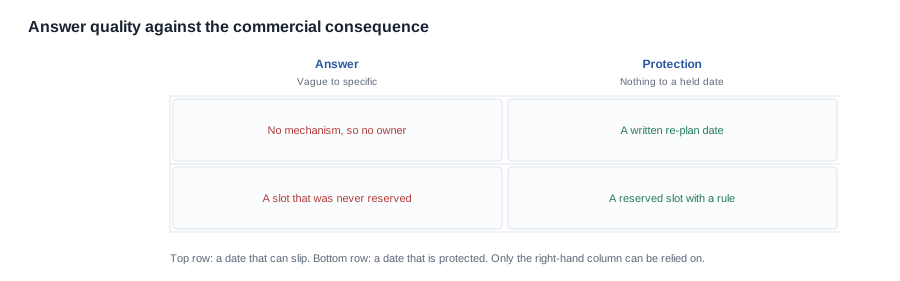
The matrix above is the reason the first three questions are weighted more heavily than the rest. In the bottom-right cell — a specific answer about a date that is protected — the reply is worth more than everything else in the round combined, because it is the only one that survives a constrained month. In the bottom-left cell, a supplier who has answered precisely but whose slot was never reserved has given you a good answer to the wrong question: the plan is excellent and the position does not exist.
There is a third failure mode that the matrix makes visible, and it is the one experienced buyers watch for. A supplier can answer all three of the first questions specifically and still be describing a ceiling rather than a plan, if the mechanism in question three is "we will re-plan the next available week" rather than a named date. The answer passes every test in the table and protects nothing. When you read question three, read the date in it.
What to do with a score you did not expect
Two score outcomes usually produce a wrong next move, and both are worth having a rule for in advance.
The first is a supplier who wins on the confirming questions and loses on question one. The instinctive reaction is to discount the whole reply, which is wrong. A supplier who can explain its rate for every configuration but cannot name a binding stage may be a factory with excellent costing and thin planning — and planning can sometimes be supplied by the buyer, because the buyer knows its own launch date and its own approvals. Before discarding the supplier, ask a different question: what would you need from us to plan around, and who in your factory would own the plan. That question often converts a zero into a usable answer.
The second is a supplier who wins on the decision-changing questions but loses badly on the confirming ones. The instinctive reaction is to treat the round as a success, which is also wrong, because the confirming questions are about how the second order will be handled. A supplier that cannot tell you how its changeover is costed, or whether it will substitute a component without asking, is a supplier that will handle your repeat order by improvisation. The correct move is not to drop the supplier but to write the missing items into the order as conditions, so the gaps become the buyer's controls rather than the supplier's habits.

What a disagreement between two suppliers tells you
Disagreement is the most valuable output of running the list against several suppliers, and it is worth knowing how to read it. Two suppliers naming different binding stages is not a contradiction to be resolved by asking again. It is a finding: the schedule difference between them is a difference in constraint, and the negotiation should move to whichever stage is actually binding for you, because that is the stage that will determine the outcome.
The same applies to every other point of disagreement. If one supplier says the case is the constraint and another says the module is, ask each what they would do about the other's answer. A supplier who has only ever run a build without a case will not have a view on a folding case, and that is information rather than a failure. If one supplier publishes a rate for your exact configuration and the other only publishes a rate for the range, the first has quoted from a costed build and the second from a catalogue average, and the two numbers are not competing — they are answering different questions.
Running the round: what is in front of the supplier
The list works better when every supplier receives exactly the same thing, and that requires more discipline than it sounds. The configuration string must be identical, including the case option and the packaging, because a difference in any of them makes the answers incomparable. The quantity must be identical, because the rate for a first run and the rate for a repeat run are different numbers. The destination market must be identical, because it decides which documentation route applies. And the required arrival date must be identical, because a supplier answering for a different date is answering a different question.
There is a further discipline about who is in the room, and it matters more than the list itself. A procurement manager asking alone will get the answers that survive an accountability test, which is to say the safe ones. A procurement manager asking with the person who will own the launch date present will get the answers that survive a schedule, which is to say the specific ones. Where that is possible, the person who owns the date should be in the round even if they do not speak.
Two further questions are worth raising because they occasionally change a decision, and neither needs a specific answer. What did you refuse to build last quarter, and why? A factory that has a boundary can describe it; one that builds anything is telling you its compliance decisions are made after the order. Who at the factory can re-sequence, and what triggers them? Not the account manager. Both are useful, neither is a gate, and each costs one question.
Where our own capacity position stops
Here, deliberately narrow, and it belongs in this list because a buyer should know where the supplier's answers stop and the catalogue's rows begin. We publish the 28 models, the charging methods, the pixel tiers, the electrical rows, the charge times and the case capacities, because those are the facts that decide which configurations exist and therefore which of the ten questions above are worth asking at all.
Two published rows make the confirming questions answerable without a supplier at all. The camera tier is published as two discrete classes — 8 megapixels across eight models, and 13 megapixels across three — so question six can be checked against a supplier's configuration rather than taken on trust. And the charging method splits three ways across the range, with magnetic on seventeen models, a Type C port on seven and no published charging-method row at all on the CY03, the CY05 and the MT6, and the L1 Pro, which is precisely the kind of open row that question ten exists to close.
We do not publish capacity figures, line counts, daily output, shift patterns, stage durations, lead times or yield percentages, and the reason is that none of them is meaningful without a configuration, a quantity and a date range. All of them move with the order book, and a number published once and quoted back for months is worse than no number at all. We would rather tell you that than give you a figure you cannot check.
What we will answer is questions one to three for your configuration, and we will say plainly where the answer is that a slot is unbooked rather than confirmed. That distinction — between a slot that is reserved and a slot that is possible — is the one the whole list is built around.
The list earns more of its value on the second order than on the first, because the answers are already on file and can be compared against what actually happened. A supplier whose question-one answer named the same binding stage both times has told you something more useful than either answer alone: the stage really is binding, and knowing it early is what allows a buyer to move the thing that matters. Save the first round's answers, date them, and put the two side by side at the second quotation. A capacity change is then distinguishable from a reporting change, and those two look identical from inside the supplier's order book.
For how the assessment is structured, see production capacity. For the longer twelve-item version, see the twelve-item checklist. For checking the scope of a claim, see how to verify production capacity. And for the slot conversation that follows the scoring, see how to negotiate capacity.
Send the model codes, the option set, the quantity, the destination market and the required arrival date, and we will answer the first three questions for that configuration in writing.


