

Smart glasses production capacity: the claim behind a production schedule
The conclusion a buyer can act on
A production capacity figure tells you almost nothing until you know three things about it: the unit it is expressed in, the period it covers, and what happens to your order when the period is full. A factory with spare capacity in a month you are not ordering in has nothing to offer you. What a buyer is actually buying is a slot, and a slot is only real if it was allocated in advance, in writing, with a rule for what happens when it is missed. So the test is not whether a capacity number exists — numbers are easy, and they are usually annual — but whether the supplier can show how the figure was derived and what your order's position in it is. Verify that and the schedule becomes plannable. Skip it and the schedule is a preference that gets renegotiated in the month it matters.
The second half of the answer is about where the constraint actually sits. In this category the limit on output is rarely the assembly line. It is the component that arrives late, the case that is not finished, the firmware that has to be built for a new radio version, or the documentation that has to exist before the units can be released. A capacity claim that names none of these has described a building, not a production system.
The question behind the capacity question
The reader is someone buying on the brand side, a channel buyer or an importer. The situation is one of three: a quotation to compare, a programme to open on a date that is already fixed, or a market to enter with a launch window a channel has been promised. In each case the same underlying question is being asked — which of the two or three suppliers in front of you can build the configuration you have written down, and what happens to your date when they cannot.
What is being managed underneath is not a price gap. It is a delivery that does not match the sample that was approved, a customs file that halts the consignment at the frontier, and an opening run that becomes a returns liability nobody carried, and a launch date that was promised to somebody else. None of those are manufacturing failures in the usual sense. They are schedule failures that a capacity conversation either prevented or failed to prevent.

The conditions a capacity number has to carry
Why the unit is the first thing to settle
The most common defect in a capacity claim is not inflation, it is ambiguity. "We can do 50,000 units a month" may mean 50,000 units of a single configuration off a single line, or 50,000 units spread across the whole published range with the mix determined by whoever ordered first. Those are entirely different production systems and the second one is the usual reality for a factory running a broad catalogue.
The published catalogue makes that concrete. The range covers 28 models, of which 11 carry a camera and 9 are audio models with Bluetooth published per model, and 20 of the 28 carry an AI function. Across the camera models alone, the charging-case position splits five ways: a 1400 mAh case on the L1 Pro and the CY05, and the CY03; a 900 or 1400 mAh case on the L2 Utral; a 1200 mAh folding case on the MT6; a case of unpublished capacity on the KY06 and the MT5; and no case at all on the V03 Pro. The charging method splits three ways across the full range, with magnetic on 17 models, a Type C port on 7, and no published charging-method row at all on the MT6, the L1 Pro and the CY05, and the CY03.
Any factory running that catalogue is running at least five material configurations of the same product family, not one. A capacity number that does not say which configuration it refers to is therefore not comparable with any other capacity number, and the correct first question is not how many but how many of what.
The table of conditions a capacity claim has to meet
| Condition | How it is tested | The line it has to meet | How a generic figure shows up |
|---|---|---|---|
| Unit of capacity | Ask for the unit and the period it covers | Line, shift and month are named | One annual number with no unit |
| Configuration scope | Ask which builds the figure is for | The configuration and its options are named | A total for the whole range |
| Allocation rule | Ask who has priority in a full month | A stated priority exists | A total with no priority rule |
| Component constraint | Ask which bought parts cap the output | Constrained parts named with lead times | Capacity with no material view |
| Changeover cost | Ask how long a setup takes for your build | Changeover given for that configuration | Changeover treated as free |
| Documentation readiness | Ask whether the file exists at production start | Status confirmed in writing | Capacity claimed before the file exists |
| Your slot | Ask what happens when the slot is missed | A rule for a missed slot is written | The answer is that it depends |
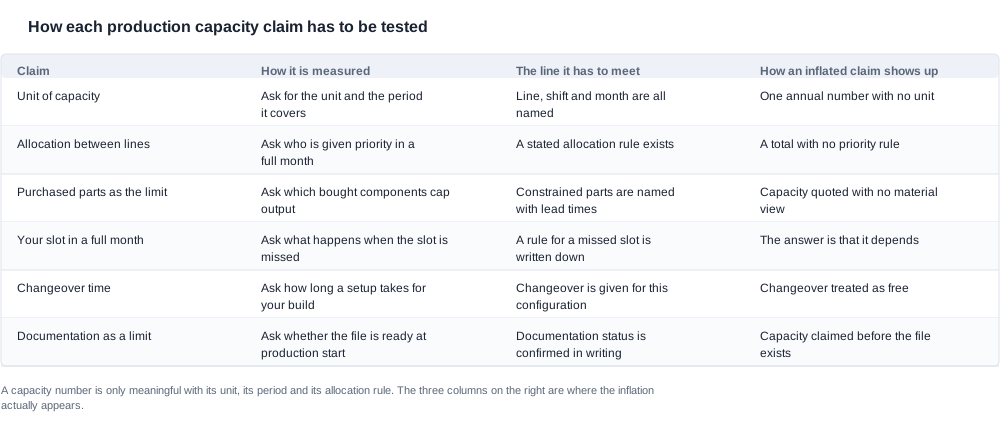
The last column is where inflation actually appears. It is also the column that a buyer can test most easily, because each of those symptoms is visible in the first reply.
Checking the claim against the build you ordered
Asking for the derivation rather than the number
There is a direct way to separate a derived capacity figure from an aspirational one. Ask the supplier to walk back from the monthly number to a daily number, then to a per-shift number, then to a per-line number, and ask what the changeover allowance is inside each step. A supplier with a real production system does this without hesitation, because the answer is arithmetic. A supplier with a brochure does not, because the number came from somewhere else.
The same walk-back applies to the constraint. Ask what the factory stops doing when your order is running. If the answer is a purchased part with a quoted lead time, the capacity figure has a physical basis and you can check it against the supplier's own component schedule. If the answer is that other customers get priority and the schedule flexes, the capacity figure is a ceiling rather than a plan, and your order's real position has to be established separately.
The three questions that expose a generic figure
Which configuration is this number for? Not the range, and not "a smart glasses model" — the build. The camera models differ from each other in ways that change the work: the MT6 has a folding charging case, which is a different assembly from a fixed case and cannot share the same line time; the V03 Pro has no case in the box at all; the L2 Utral exists in two case capacities. A capacity number for a build with a 1400 mAh case is not a capacity number for a build with a folding case.
What is the changeover, and how many changeovers are in the month? A factory with high product variety and short runs is limited by setups rather than by stations. Asking how many changeovers the month contains turns a capacity claim into a schedule, and a schedule is something a buyer can plan a launch date around.
Which purchased part stops the line first? Cells, the camera module, the case, the hinge on a folding case, the packaging insert — each has its own lead time and each one can be the true constraint. A supplier who names one has done the work; a supplier who says "we have plenty of everything" has not checked.
A useful cross-check exists in the published data itself. The catalogue publishes a charge time for every one of the 28 models, with 26 at up to two hours and the D17 and the ZH12 at around one hour, and it publishes a runtime for every model, from about six hours on the G07 and the YK12 up to about eight hours on several audio models. These are not capacity numbers, but they are the inputs a planner uses to size the cells, and a supplier whose answer on component lead times contradicts the catalogue's own cell choices has an internal inconsistency worth finding out about.
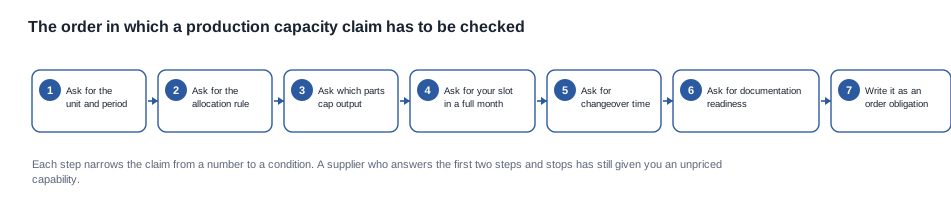
The questions to ask, in the order that produces answers
The order below is deliberate. Each question is easier to answer honestly than the one after it, because each one narrows the field the next one operates in. Asking them in this sequence also makes it obvious which question a supplier cannot answer, which is usually the one that matters.
- Which configuration and option set is this capacity figure for? A single build, or the range?
- Over what period, and on how many lines and shifts?
- What is the daily figure underneath it, and what changeover allowance sits inside the month?
- Which purchased part reaches the line last, and what is its quoted lead time?
- What happens to my order when the month is already full — who is displaced?
- What is the recovery date if my slot is missed, and how much notice do I get?
- Is the documentation file for my configuration already released, or does it depend on a component decision?
- What changes in the plan if the case option or the colourway changes?
Questions five and six are the ones a supplier usually answers with a sentence rather than a number, and they are the two that carry the commercial consequence. Question seven is the one that most often reveals that the capacity is real but the programme is not yet releasable.
The red flags, and what each one actually tells you
A capacity claim carries its own warning signs, and they are worth naming precisely because they are unremarkable on their own.
- A capacity figure quoted for "the model" rather than for the configuration. This is not a technical objection. It means the supplier has not yet costed your option set, and the option set is where the cost of a folding case, a two-capacity case or a colourway sits.
- A lead time given without a component schedule. The number has been produced from an average of past runs rather than from a plan for yours.
- "Capacity depends on the season." A true statement and a way of declining to allocate. The follow-up that gets a real answer is whether a slot can be reserved, and for how long.
- A very large number attached to a broad range. A factory that can build 50,000 units a month across a catalogue with five charging-case configurations is describing a building, and the allocation question is where the real answer is.
- No mention of documentation readiness. The production can happen and the release still cannot, which is a schedule failure that arrives looking like a compliance failure.
None of these is a reason to walk away from a supplier. Each of them is a reason to convert the gap into a written clause before a deposit is paid.

What happens when the month fills up
Two ways a full month can resolve
A capacity figure only becomes relevant on the day the month is full, and on that day there are exactly two outcomes: your slot was reserved, or it was not. If it was reserved, the schedule holds and the order moves as planned. If it was not, the order moves and the date slips, and the recovery date is whatever the factory feels like proposing that week.
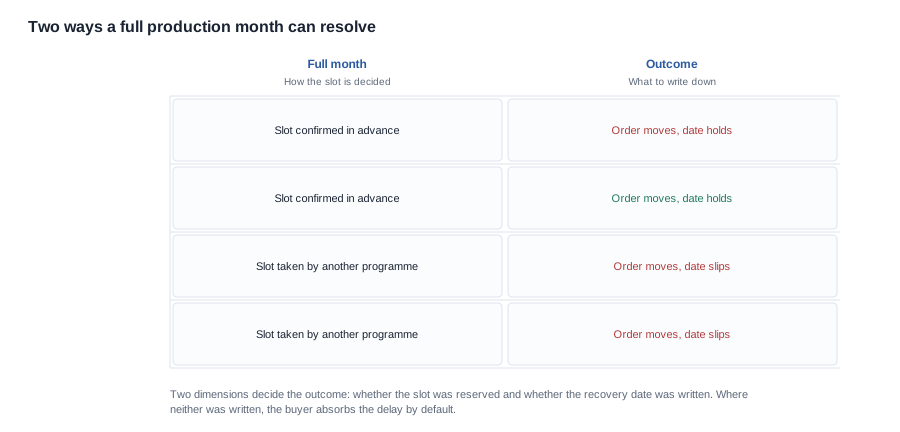
The second outcome is not a supplier failure in the moral sense; it is a normal outcome of a production system that allocates by whoever asked first. It becomes a failure only because nothing was written down. The two things that decide the outcome are whether the slot was reserved and whether the recovery date was agreed, and both are within the buyer's reach before the order is placed.
What to write down before the month fills
Three clauses do the work. First, the allocation rule: state how the factory will prioritise your order when the month is oversubscribed, and what evidence it will use to apply that rule. Second, the recovery date: state what date the order will be re-planned to if the slot is missed, and how that date is communicated. Third, the notice: state how much warning the supplier must give if the slot will be missed, and what the buyer may do if the notice arrives late.
There is a fourth clause that is easy to add and almost never present: the change-control notice period. When a component or a process changes inside the factory, the build can change in ways that were never priced, and a capacity promise made against one bill of materials does not survive a substitution. A notice period converts that from a surprise into a scheduled event.
The failure mode worth planning around is the one where the delay is discovered late and blamed on the wrong thing. A buyer who asks for a component-level schedule at the point of order is told that a cell is late. A buyer who asks after the goods should have shipped is told that the month was full. Both are true, and only the first one leaves the buyer with options.
Where the gap actually shows up in an order programme
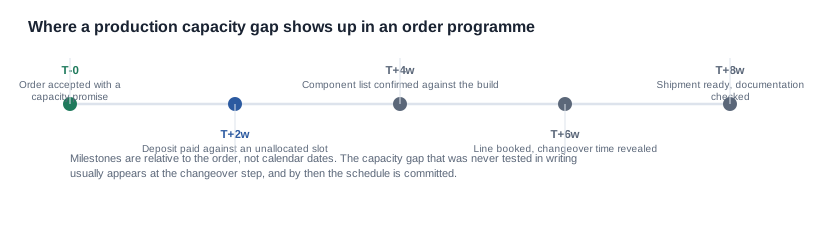
The milestones are relative to the order rather than to calendar dates, because that is how a capacity gap travels. It is invisible at the order, visible when the slot is taken, and expensive at the changeover, by which point the launch date has already been promised to somebody downstream.
Reading a lead time as a schedule rather than a number
What a quoted lead time is made of
A lead time quoted as a single number is the most misleading line in this category, because it hides the difference between the time the factory controls and the time it waits for other people. The part the factory controls is material availability, incoming inspection, assembly, test, packaging and the documentation release. The part it does not control is cell delivery, module delivery, case delivery, and the time a compliance file takes to be issued against a configuration that has just changed.
Ask for the lead time split into those two halves. The first half is a factory question and can be answered with a production plan. The second half is a supply chain question and can only be answered with the supplier's component schedule, which is worth seeing because it tells you where the risk actually sits and whether it will repeat on your second order.
The schedule you are actually buying
What a buyer wants from a capacity conversation is a dated plan, not a duration. The distinction matters because a duration is a property of the factory while a plan is a property of your order. Ask for the dated plan against your own order: the date the material is committed, the date the line is booked, the date the build starts, the date the first unit is tested, the date the documentation is released and the date the goods are handed to the carrier.
A factory that can produce a dated plan against a specific configuration has a production system. A factory that can only produce a duration is quoting from an average, and the average is made of the runs that went well.
The comparison rule that follows is straightforward: two lead times may only be compared once both have been split into the part you control and the part you do not, and once both have been attached to a configuration. A four-week lead time on a build with a folding case and a four-week lead time on a build with a fixed case are not the same claim, and neither is a four-week lead time quoted with a case that is not in the box.
The commercial terms that decide it
Two commercial terms sit directly on capacity. The first is the deposit structure: a large deposit against a slot that was never reserved buys the buyer nothing, while a smaller deposit against a reserved slot with a written allocation rule buys a real position. The second is the penalty and recovery structure, which determines what a missed slot costs the factory and therefore what the factory is willing to promise.
The terms worth resisting are the ones that commit the buyer to a volume and a date before the configuration is fixed. A capacity commitment against an unspecified configuration is a commitment to whatever the factory thinks the configuration is, and in a range with this many branches, that assumption will eventually be wrong. Fix the configuration, then take the capacity commitment against it.
The trade-off behind every capacity condition
Each condition in the table above has a cost on the other side, and a buyer who asks for all of them without acknowledging the trade-off will get a slower answer than one who asks for two of them clearly.
A written allocation rule costs the factory flexibility, so it will be resisted hardest on a busy line and granted easily on a quiet one. A reserved slot costs the factory a promise it cannot guarantee, so it will be priced or limited by duration. A dated plan costs the factory the ability to re-plan, which is its most valuable operational asset. A change-notification period costs the factory a reaction time, which is cheap in a stable configuration and expensive in a fast-moving one. The right question to ask is not whether to demand these things, but which one matters most for this programme, because a buyer who wants all of them at full strength on a first order will usually get a worse answer on all of them than a buyer who prioritises two.
There is a related trade-off in the total cost, which is the number most buyers skip. A schedule that is 20 per cent longer than the fastest one available can be cheaper in total cost than the fast schedule, because it may avoid the expedite premium, the overtime and the second documentation route that a rushed programme usually requires. Conversely, a schedule that is faster but has no allocation rule is not cheaper, because the cost of a slipped date appears in the launch, in the channel and in the return rate rather than in the invoice.
The same logic applies to the shortlist itself. A shortlist of three suppliers where only one has demonstrated the specific configuration is worth less than a shortlist of two where both have, because the evaluation cost of a supplier that cannot build the configuration is paid in the delay of discovering that. Before you commit to a shortlist, check that each candidate has produced the configuration at least once, or can show a run that would have produced it.
The boundary of what we publish about capacity
What we can and cannot tell you about our own production system
The working rule we apply: deliberately narrow, and it is worth stating plainly because capacity conversations are where suppliers are most often vague. We publish what the catalogue contains: the 28 models, the electrical rows, the pixel tiers, the charging methods, the case capacities and the charge times, because those are the facts that decide which configurations exist and therefore which production question is worth asking. We do not publish a monthly capacity figure, a line count, a shift pattern, a yield percentage or a utilisation rate, because those are operating data that change with the order book and a number published once is worse than no number at all.
We will not extrapolate a capacity answer from the catalogue either. The fact that the range spans five charging-case configurations and three charging-method positions tells you that the production plan for it is not a single build repeated, and it tells you the questions to ask — which configuration, which changeover, which component. It does not tell you how many units leave a line in a week, and we would rather be explicit about that than quote a figure you cannot verify.
What we will do is answer the configuration questions without a commercial conversation, and tell you which of them are the ones that actually move the delivery date for your build.
Model codes, options and the date that matters
Send the model codes, the case and colour options, the quantity, the destination market and the date the goods have to arrive, and we will tell you which configurations exist, which published rows constrain them, and which of the capacity questions above are worth putting to every supplier in the round.
- The capacity framework — production capacity pillar
- The benchmark article — production capacity industry benchmarks
- The comparison table — production capacity comparison table
- The lead time detail — smart glasses lead time typical range
Send the configuration and the required date, and we will tell you which parts of the capacity question are settled by the catalogue and which have to be answered by the factory.


