

There is no useful industry benchmark for smart glasses production capacity, and any supplier who offers you one is describing a company that assembles Bluetooth audio products rather than a company that builds camera products. What is useful is knowing what a capacity claim has to contain before it can be compared with another claim — and what its absence tells you about the company behind it. This page sets out why the benchmark does not exist, the five fields a claim must carry, how to convert a claim into a figure you can plan against, and how to read a claim that arrives verbally.
Smart glasses production capacity has no benchmark, and the absence is informative
Why the comparison everybody asks for cannot exist
Capacity in this category is not one number. A camera model needs a camera module line, a firmware integration step and a packaging line that runs at a different pace from assembly; an audio model needs none of the first two. The range makes the split concrete: of the twenty-eight models in our catalogue, eleven carry a camera module, eight are audio models, three are sport models, and the remaining six are the AR frame, the three children's models, the electrochromic model and the bone conduction model. A factory quoting a single capacity figure is quoting the audio case and implying that the camera case matches it, and in practice the two differ by considerably more than a buyer expects.
There is a scope problem underneath that as well. Daily output can mean units, or hours of line time, or completed pairs, and a factory quoting "units" without saying whether camera or audio has told you nothing at all. This is the same reason an external benchmark is worse than no number. A benchmark for a different product scope is not a rough version of the right number; it is a confidently wrong number with a source attached, and it is much harder to challenge than a supplier's own figure.
The reader and the decision in front of them
The reader is a procurement manager at the brand, a channel buyer or an importer comparing two or three quotations. The decision they are making is which of them describes a plan that will hold their order on the date they need it. What they are managing is not a price gap but the gap between a capability statement and a commitment — and, increasingly, the risk of anchoring on an external figure that was produced for a different product and then defending it internally as though it were their own data.
What the absence of a benchmark tells you
A supplier who declines to quote a benchmark is usually telling you something specific. In many cases the supplier's own scope is not settled — they have a rate for one line and a second number for the family, and a benchmark would force them to reconcile the two. In others, the supplier is a trading company rather than a manufacturer, and there is no production system behind the figure at all, which is a legitimate thing to be and a legitimate thing to notice. Either way, the refusal is not a gap in the information you have been given. It is information.

The five fields a capacity claim has to carry
What each field settles, and what a claim without it leaves open
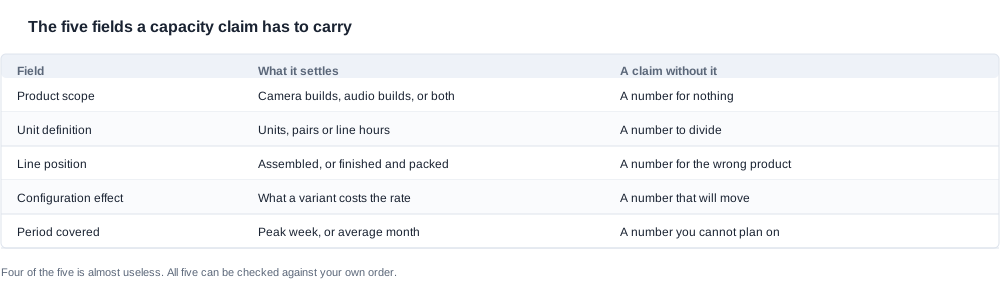
The table below names the five fields and, in the third column, what a claim is missing when the field is absent. The second column is the one to use when comparing two replies, because each field settles a different comparison.
| Field | What it settles | A claim without it |
|---|---|---|
| Product scope | Camera builds, audio builds, or both | A number for nothing |
| Unit definition | Units, pairs or line hours | A number to divide |
| Line position | Assembled, or finished and packed | A number for the wrong product |
| Configuration effect | What a variant costs the rate | A number that will move |
| Period covered | Peak week, or average month | A number you cannot plan on |
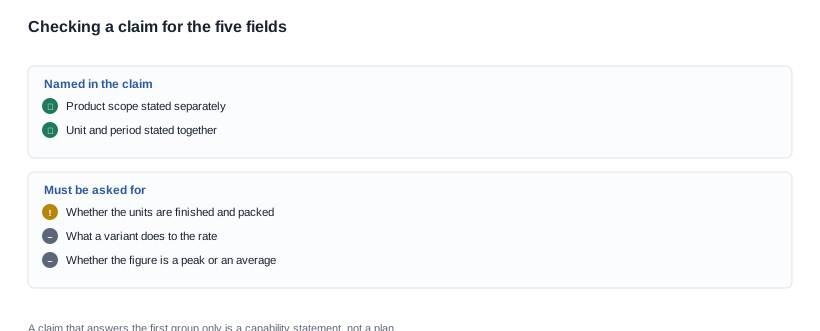
A claim with four of the five is nearly useless
A claim that carries four of the five fields can usually be repaired with one question, and a claim that carries three usually cannot. The distinction is worth making because it tells you where to spend the conversation. Where the missing field is the unit or the line position, one question fixes it and the claim becomes usable. Where the missing field is the configuration effect, the claim cannot be repaired at all — you cannot ask a supplier to quote a configuration they have not costed, and the answer you get will be a number that moves the moment the build changes.
That is the practical reason the five fields are worth holding in a fixed order. It is also why a supplier who volunteers all five unprompted has demonstrated something specific: that their own planning is done at the configuration level rather than at the product-family level. In this category that is not a small distinction, because the configuration is where the schedule risk lives.
The two fields that decide most comparisons
Product scope and line position are the two that decide most comparisons, and they fail in opposite directions. A scope that is too wide — one figure for camera and audio — gives you a number that is comfortable and irrelevant. A line position that is too generous gives you a number that is small and pessimistic, because assembly capacity is higher than finished output, since packaging, programming and inspection all sit after it.
The third field is the one that catches buyers most often in this particular category, because the configurations differ in ways that affect set-up rather than in ways that affect the bill of materials. The charging interface alone splits the range into seventeen models with a magnetic interface and seven with a Type C interface, and four camera models — the MT6 and the CY05, and the L1 Pro and the CY03 — where the charging method is not published at all. The case configuration splits it further: 1400 mAh on the CY05 and the L1 Pro, and the CY03, either 900 or 1400 mAh on the L2 Utral, a foldable 1200 mAh case on the MT6, an unpublished capacity on the KY06 and the MT5, and no case at all on the V03 Pro. A rate quoted without the configuration effect cannot be applied to an order, because you do not know how many set-ups your order will contain.

Turning a claim into a figure for your own order
Six steps from a capability statement to a usable number
The flow above converts a claim into a number for your order. The first step is the one that catches the most common error: take the finished and packed rate, not the assembly rate, because the two describe different products and the finished one is the one that determines when the goods can ship. The second step is the one that catches the most common optimism: divide by the number of comparable orders the site runs, because a factory's average assumes it is not full, and your order is one of several.
The third step deducts your own variant and packaging specification, the fourth multiplies by your quantity to get the days the build needs, and the fifth adds the component lead time that runs before the slot opens. The sixth is the one with the most value: compare the total against the lead time the supplier quoted. If the two agree, capacity really is the constraint and the conversation is about the rate. If the quoted lead time is much longer, then capacity is not what is limiting the date, and any negotiation about the rate is a negotiation about something that does not matter.

The arithmetic to keep, and the arithmetic to discard
Two checks are worth keeping in your file permanently. The first is the ratio between the rate and the quoted lead time, applied to your own quantity. If the number of days implied by the rate is materially shorter than the quoted lead time, the rate is either describing a different stage or describing a different configuration. The second is the implied utilisation: if the quoted rate, multiplied by the number of working days in the period, produces a number close to your order quantity, then your order is essentially the only thing on that line, and the price you have been quoted for a large-order tier is not the price you will pay.
Neither check requires any data you do not already have, and both of them convert a quotation into a testable proposition. That is the practical replacement for a benchmark: not a number from somebody else's factory, but a way of establishing whether somebody else's number can be true for your order.
Building a benchmark for your own programme
The absence of an industry benchmark is not the end of the exercise. It means the benchmark has to be built, and in practice a small programme is enough to build one. Take the first order you placed with a supplier, and record five things: the configuration as ordered, the quantity, the date the order was confirmed, the date the goods were received, and the set-up charges that appeared on the invoice. Do the same for the second order. Two data points will not give you an average, but they will give you the shape of the relationship — how much of the elapsed time was before the order, how much was set-up, and how much was the queue.
That shape is the useful output, because it is specific to the product scope and the configuration you actually buy. A buyer who has done this twice knows more about their own supplier's schedule than any external benchmark could tell them, and knows it in terms they can act on. The same exercise also exposes the thing that most often surprises people at the second order: that the elapsed time does not scale linearly with quantity, and that the second order of the same size frequently takes a different fraction of the first one.
The one thing not to do is to let the recorded figures become an internal standard that is applied without checking. The point of the exercise is to know your own supplier's behaviour, not to build a number that stops being examined.
What a verbal claim costs you to accept
Three questions, asked in this order
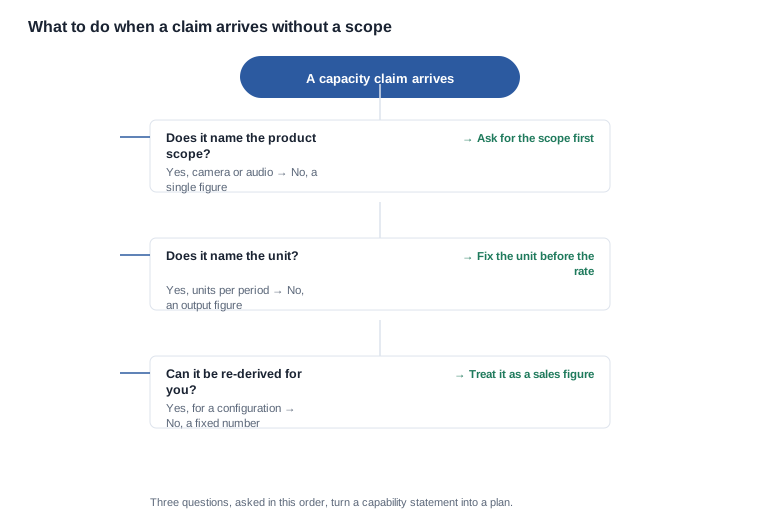
Three questions, asked in this order, convert a capability statement into something you can plan against. Is that figure for camera configurations, audio configurations, or both? Is it assembled units or finished units? What does it become for my configuration, with my packaging?
The third question is the one that finds the real number. A factory quoting an average will re-derive it for a specific configuration when asked, and the gap between the average and the specific figure is usually the thing that decides the schedule. A factory that cannot re-derive it has quoted an average it cannot decompose, and the average has to be treated as a marketing figure rather than a planning figure.
There is a fourth question worth asking, and it is the one that saves the most time. Ask what the figure becomes at your quantity rather than at the supplier's typical volume. A claim that holds at a typical volume and falls apart at yours is not a claim about your order, and finding that out in the first round is worth more than a further round of price negotiation.
Comparing two claims that describe different scopes
Two quotations describing different scopes is the normal condition rather than the exception, and the comparison is still possible — it just has to happen at the level of the scope rather than at the level of the number. The method is to restate each claim in a common frame before comparing anything, and the common frame is the one in the table: product scope, unit, line position, configuration effect and period. Restating a claim is a small amount of work — it is a sentence per field per supplier — and it is the step that turns a price comparison into a capability comparison.
Two outcomes are possible and both are useful. If the restated claims align, you have a genuine comparison and the price difference means what it appears to mean. If they do not align, you have discovered that the two suppliers are answering different questions, which is a finding you would otherwise have made after a deposit.
The reason this matters more in this category than in most is that the scope is not obvious from the document. A factory quoting for camera models and a factory quoting for audio models may both use the phrase "daily output" and may both use the unit "units", and the difference between them is not visible anywhere on the quotation. It is visible only if somebody asks.
When the refusal is the answer
If a supplier declines all three — for instance by saying capacity is not the issue at this volume — that is a legitimate answer and it is informative. It means your order will be scheduled around other work rather than given its own slot, which changes the conversation you should be having about priority rather than about rate. The distinction to draw is between a refusal to answer and an inability to answer. A refusal with a reason attached is a position; an inability expressed as a general statement about the season is a gap in the supplier's own knowledge, and it is worth asking about a second source rather than pressing the same question harder.
The same distinction applies to a supplier who offers a benchmark. A benchmark offered with its scope, its date and its derivation attached is a usable data point. A benchmark offered as a round number without scope is a substitute for the question you should have asked, and accepting it means accepting the conversation it displaces.
Why we publish no benchmark either
Where our own figures stop
It is worth being precise: the published material is the part of the specification we can stand behind, and the rest is a question for the supplier's own file. We publish what our documentation states, we mark the rows that are open, and we will not fill an open row with a typical figure taken from a supplier's general data. Production capacity, line counts, daily output and stage durations are not published in our documentation, and we will not offer an industry benchmark as a substitute for our own, because a benchmark for a different product scope is worse than no number at all.
The rows we do publish settle some of the scope questions for themselves. The catalogue carries twenty-eight models, with camera resolution published across the eleven camera models at eight megapixel on eight of them and thirteen megapixel on three. The ingress marking IP54 appears on the V06 and the S7 only. Charge time is published for every model, with twenty-six at two hours or less and the D17 and the ZH12 at around one hour — a figure with no starting state of charge and no completion criterion attached, which is why it cannot be converted into a shift interruption. The unit weight is published for one model only, the MT6 at 158 grams for the glasses body including the cell and the camera and excluding the foldable 1200 mAh case, whose own weight is not published.
Minimum order quantities are not published, because the threshold changes with the model mix and a published figure that changes with the mix becomes a commitment nobody intended to make. We would rather show you the gaps than fill them.
Why our own figures are also a set of five fields
It is worth noticing that our catalogue obeys the same five-field discipline that we ask of a supplier, and that the fields where it does not comply are the fields where we mark the row as open. The product scope is stated. The unit is stated on every row that carries a figure. The configuration effect is stated where it exists — the L2 Utral is published at both a 900 mAh and a 1400 mAh case, which is a configuration rather than a single value. The period is stated where it exists, and the charge-time row shows exactly what happens when the condition is missing: the number is published without a starting state or a completion criterion, and it is therefore usable as a published fact but not as a schedulable one.
The remaining row, the line position, is the one our catalogue does not carry at all, because it is a statement about a factory rather than about a product. That is the honest place for the boundary of a product catalogue to sit, and it is also the reason the capacity question has to be answered by the factory that owns the line. We can tell you exactly which product exists, which configurations of it are published, and which of the fields in the table above are settled for your build. The rate, the period it covers and the position of the sampling point are the factory's file, and we would rather ask for them than estimate them.
What we will tell you instead
What we will tell you is what your configuration requires, which stage is binding, and whether your quantity can be scheduled with existing work or needs its own set-up. The production capacity section sets out the full assessment, the capacity negotiation article covers the slot conversation, the hidden costs article covers where a capacity problem actually lands on the invoice, and the production capacity checklist lists the verification items. Send the models, the quantities and the target market, and we will tell you which configurations exist and which parts of the claim are settled.
Related reading
- Capacity negotiation — the slot conversation
- Hidden costs — where a capacity problem actually costs
- Production capacity checklist — the verification items


