

Most advice on smart glasses production capacity is written for a buyer with no order in hand, which is the buyer with time to think and no leverage to act. This page is written for the buyer in the middle of a live comparison: quotations on the desk, a date that cannot move, and a decision to make this week. The advice below is sequenced the way that work actually happens — what to settle before you write the request, what to do in the first ten working days, how to choose between two suppliers who both said yes, and what to write down so the decision is still defensible six months later.
Smart glasses production capacity advice that survives the first meeting
The short version
Fix your own side first. A buyer who arrives with a written configuration, a quantity per build, a named market and a list of eight questions gets a different answer from a buyer who arrives with "how much can you make and when can you ship". The second buyer gets a rate and a date; the first gets a derivation, a slot and a set of documents. None of this is negotiating technique — it is simply the difference between a question that can be answered and a question that can only be received.
Who reads a capacity answer
The reader is a buyer working for the brand, a channel buyer or an importer with two or three live quotations and a decision to make inside a working week. They are past the stage of deciding whether to enter this category and are now deciding which supplier gets the deposit. What they are managing is not the unit price, which is the visible difference between the quotations. It is the set of things the quotations do not say, any one of which can move the date after the money has been committed.
The advice that does not transfer
Some advice in this category transfers to every purchase and some of it transfers to none. The advice that transfers is about process: write the configuration down, ask for the derivation, record the answer with a date, compare in a fixed order. The advice that does not transfer is about the numbers themselves — what a good capacity figure looks like for a given order size, how many days a camera build should take, what a reasonable set-up fee is for a case change. Those depend on a supplier's cost base, a buyer's market and a configuration, and any general figure applied to them will be wrong in a way that is expensive to discover late.

What to settle before you send a request for quotation
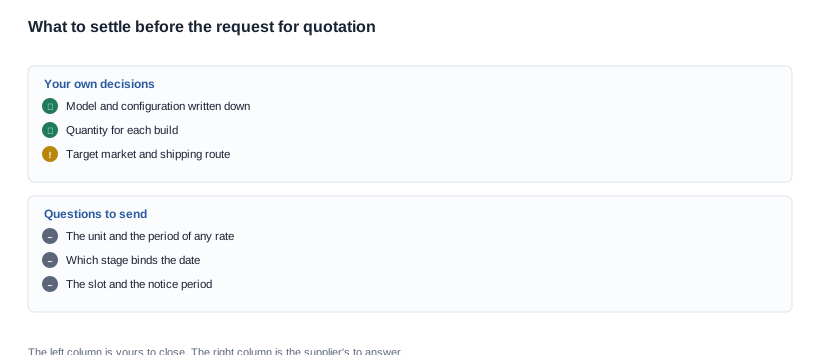
The left column is yours, the right column is theirs
The checklist below splits the work in two. The left column is entirely within your control and every item on it is a decision rather than an enquiry: the model and configuration written down, the quantity for each build, the target market and the shipping route. The right column is the set of questions to send, and each of them is written to be answerable in writing rather than in a call.
The reason to settle the left column first is that it changes the quality of the answers. A quantity that is not decided cannot be quoted against, and a quote against an undecided quantity is a range rather than a number. A market that is not decided means the documentation scope is unknown, which means the cost of the documentation is unknown, which means the total cost is unknown. Every one of these unknowns lands in the same place: the buyer is comparing two quotations that each include an undetermined amount.
The eight questions worth sending
Eight questions, in this order, do most of the work:
- For the configuration attached, what is the unit of capacity, the period it covers, and the product scope it applies to?
- Is the figure for assembled units or for finished and packed units?
- How was the figure derived, and which stage of the production sequence actually binds the date for this configuration?
- Which purchased parts could limit output below that figure, and what is their lead time?
- What is the set-up time and the set-up cost for each build on this order?
- What is the longest run length you will commit to for this configuration?
- What is the slot position for this order, what is the notice period for its release, and what is the priority rule in a constrained period?
- What does the quotation assume about packaging and artwork, and who approves it?
The eighth question is the one that is usually left out and the one that most often causes a delay, because artwork approval sits on the buyer's side of the line and a review cycle nobody has bounded is an unbounded stage in the schedule. The minimum order quantity guide covers the threshold questions that belong in the same round.
How to ask without sounding like an auditor
The framing that works is to make the questions about the supplier's own planning rather than about their compliance. The difference sounds trivial and is not. "Please provide your production capacity" asks for a disclosure; "for this configuration, please state the unit, the period and the stage that binds the date" asks for a working. Suppliers who have the second answer give it, because the second answer is a piece of their own information rather than a concession.
Two practical points make the difference. First, send the list to every supplier in the same order and with the same wording, so that the replies can be compared by reading across rather than by remembering — and so that a supplier who notices you are comparing is also aware that the comparison is structured, which tends to improve the answer. Second, ask for one thing at a time after the list, because eight questions in a list get answered with eight paragraphs and one question in a follow-up gets answered with the document you actually need. The list establishes the frame; the follow-up extracts the evidence.
The last point is about timing rather than wording. The best moment to send the follow-up is after the reply that engages with the derivation rather than the conclusion — because a supplier who has already explained how the number was reached has, by definition, been through the part of their own operation where the answer lives.
The first ten working days
A sequence that produces a decision
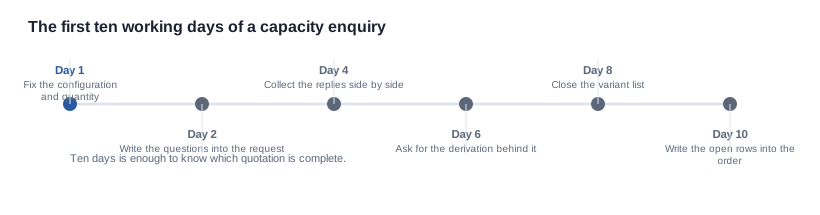
The timeline above is a working sequence rather than a target. Day 1 is fixing your own side, because nothing else can start until the configuration is a specific object rather than an intention. Day 2 is writing the questions, and the discipline here is to send the same list to every supplier — a different list to each one produces answers that cannot be compared, which defeats the purpose of asking.
Day 4 is collecting the replies side by side. The side-by-side arrangement matters more than it sounds: a column per supplier makes the gaps visible in a way that three separate documents never will. Day 6 is asking for the derivation behind each figure, which is the single step that most reliably distinguishes a quotation from a capability statement. Day 8 is closing the variant list, which is a decision only you can take and which changes the set-up cost of every quotation on the table. Day 10 is writing the open rows into the order, so that the remaining uncertainty is visible in a document rather than held privately.

What to do when the replies arrive incomplete
Completeness is rare in the first round and its absence is not a verdict. The practical rule is to sort the missing rows into three piles. The first pile is missing because the supplier has not asked you a question yet — these are usually the configuration and the market, and they resolve with a reply rather than a document. The second pile is missing because the supplier does not have the figure in that form — these need a re-derivation, and the re-derivation is itself informative, because a supplier who can re-derive a rate for your configuration has demonstrated something. The third pile is missing because it is genuinely not settled — typically the slot position, which cannot be fixed before the order is placed.
Only the third pile needs to survive into the agreement. The first two should be closed before a deposit is discussed, because a deposit placed against an un-re-derived rate is the point at which the buyer stops being able to compare.
What to do when a supplier is slow to answer
Slow replies are usually a symptom rather than a policy, and the symptom is informative. A supplier who has not answered after a week is often a supplier who cannot answer, because the document you asked for does not exist in the form you asked for it — which is a materially different situation from a supplier who has not prioritised your email.
The practical response is to narrow rather than to chase. Instead of repeating all eight questions, send the two that matter most for your decision and give a date by which an answer would still be useful. A reply to a narrowed question tells you something about the supplier's schedule, and a date that has already passed tells you something too: if the answer arrives after the date at which you needed it to decide, then the supplier's responsiveness is part of the risk you should have priced, and you should price it rather than be surprised by it.
There is one answer that should always be treated as final rather than as an opening position: a reply that says the question does not apply to your configuration. That is worth chasing immediately, because it usually means the supplier is quoting a different product from the one you intended — which is the one discrepancy that would make every other number in the reply meaningless.

Choosing between two suppliers who both said yes
Advice that changes with your position
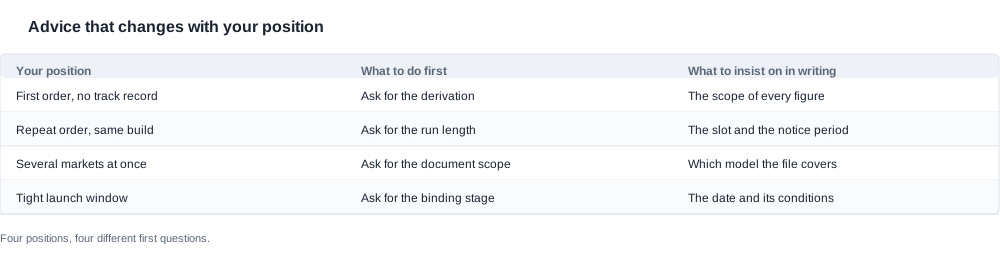
The table below is the part of this page that is specific rather than general. The right first question depends on where you are: a first order with no track record needs a different opening question than a repeat order, and a programme running into several markets at once needs a different one again. Getting this wrong is common and expensive, because the question you ask determines what the supplier tells you, and what the supplier tells you becomes your model of their operation.
| Your position | What to do first | What to insist on in writing |
|---|---|---|
| First order, no track record | Ask for the derivation | The scope of every figure |
| Repeat order, same build | Ask for the run length | The slot and the notice period |
| Several markets at once | Ask for the document scope | Which model the file covers |
| Tight launch window | Ask for the binding stage | The date and its conditions |
The reasoning behind the first row is the one most worth stating. A first order tells you almost nothing about a supplier's consistency, because it is small and gets attention. What it can tell you is whether the supplier can produce a derivation at all. That is the single most valuable thing to learn before a first order, and it is also the cheapest, because it is a document request rather than a negotiation.
Deciding between them on total cost, not unit price
Two quotations that both say yes are rarely decided on the unit price, because the unit price differences in this category are usually smaller than the differences in what the quotation silently assumes. The comparison that works is the total: unit price, plus the set-up fee for every build on the order, plus the documentation scope for every market, plus the cost of the slot if the date is fixed and the premium is quoted, plus a returns reserve you can defend. That last term is the one buyers tend to omit, and it is the one that separates a first order from a second.
The capacity mistakes article covers the failure modes this comparison is designed to catch, and the questions to ask before ordering sets out the wider list. The camera and audio range shows which configurations the assessment applies to.

What to write down so the advice survives the order
The file that makes the next order faster
Six things belong in a file that is opened at the start of every enquiry rather than reconstructed afterwards: the configuration, including the charging interface and the case configuration; the quantity per build; the rate that was quoted, with its unit and its derivation; the set-up cost per build; the slot date and the notice period; and the open rows, with an owner and a date against each one. That last item is the one that makes the file worth keeping, because it is the only record of what was known at the time rather than what turned out to be true.
The discipline is easy to state and hard to hold: every row carries a date and a source. A row with a source can be re-checked when something changes; a row with a plausible value is an argument waiting to happen, and it will be won by whoever is more confident rather than whoever is more correct. Two orders of the same configuration from the same supplier should produce a file that can be compared line by line, and the comparison is what tells you whether the supplier's performance is stable or whether the second order simply landed in a different month.
What to do with the sample order
The sample order is the most misunderstood step in this category, because it is usually treated as a formality — something to do so that the production run can start. Treated that way, it wastes money. Treated as an information-gathering exercise, it is the cheapest capacity assessment available.
The reason is that a sample is built through the same chain as a production run, at a scale that makes the chain's behaviour visible in a way a quotation never does. Ask the supplier to walk you through the sample order as a process rather than as a delivery: which stages did it pass through, how long did each take, which parts were on hand and which were bought, and what did the setup involve. The answers are the derivation you could not get in writing, expressed as a live instance rather than a description of one.
Three things are worth asking for specifically. The first is the elapsed time between the sample order and the first unit, broken down by stage — that is your binding-stage answer, obtained without a single question about rates. The second is which parts were bought for the sample and how long they took to arrive, which tells you whether the purchase stage is a formality or the constraint. The third is what the setup actually involved, which is the input you need for the set-up cost question later.
The discipline that makes this work is to ask the questions before the sample is made rather than after, and to record the answers in the same rows as the rest of the file. A sample order completed in silence teaches nothing; the same sample order completed as an interview gives you most of what a site visit would have taught you, at a fraction of the cost and the fraction of the time.
The parts of the advice that depend on your market
Where the sequence changes
Everything above is process, and process travels. Two things do not, and they are worth naming because buyers regularly carry an approach from one market into another. The first is the documentation scope, which differs by destination and can be a larger part of the programme cost than the goods themselves in a regulated market. The second is the freight and the route, which change the number of days that sit outside the factory's control and therefore change which stage is binding.
In the European market the radio conformity question for a device with a transmitter is governed by the Radio Equipment Directive, (EU) 2014/53/EU, and the electromagnetic compatibility requirements sit alongside it as a separate instrument rather than a second half of the same number. That distinction matters commercially because it is a scope question: which model the file covers, and whether the model you are ordering is the model the file names. Our catalogue carries a company-level export certification page and does not carry a per-model certification row, so this is a document to request rather than a line to read.
The advice that survives is still the same advice. Fix your side, ask for the derivation, compare in a fixed order, record the rows with a date. Only the list of documents changes. The production capacity section sets out the assessment framework, and we will tell you which configurations exist and which of the rows above are settled for your build once you send the models, the quantities and the target market.
Three things that are the same everywhere
There are three elements of the advice above that do not vary with the market, and it is worth naming them because they are the ones worth keeping when everything else has to be adapted. The first is the configuration lock: whatever the market, the build has to be frozen before it is quoted, and the fields that freeze it are the model, the colour, the charging interface, the case configuration and the firmware revision. The second is the derivation: a rate without a unit, a period and a scope is not a number you can plan with, in any market and for any product.
The third is the file. The discipline of writing every row down with a date and a source is the same in every market, and it is the reason a buyer who has kept files for two orders is able to negotiate the third one from a position of evidence rather than of impression. Everything else in this page — the sequence of the enquiry, the way the set-up cost and the slot premium are priced, the way the documentation scope is negotiated — adapts to the market and to the supplier. The file does not. It is the one piece of infrastructure that gets better every time you use it.


