

Almost every lead-time complaint in this category turns out to be a capacity misunderstanding, and almost every capacity misunderstanding comes from treating capacity as a number instead of as a queue. A factory that can build ten thousand units a week has delivered nothing to you if your job is sitting behind three changeovers and your artwork is still at the printer.
So this is written as a diagnostic rather than as a list of warnings. Read the four branches below, find the one that matches what actually happened to you, and repair the mechanism. A buyer who treats all four as "the factory is slow" ends up negotiating the wrong thing, and a buyer who treats them as "my specification was incomplete" ends up paying for the same mistake again on the second order.
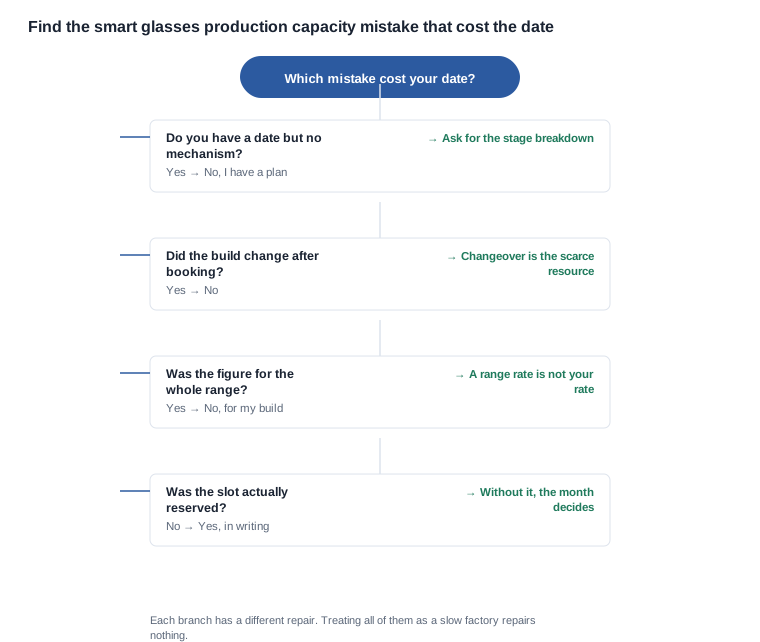
Smart glasses production capacity: find the mistake that cost the date
The four mistakes are worth separating because each has a different repair, and the repair is the only thing worth having. A duration that was quoted as a plan is repaired by asking for a stage breakdown. A configuration that was edited after booking is repaired by freezing it in writing before the slot is taken. A rate that was quoted for the range is repaired by asking for the rate on your build. A slot that was never reserved is repaired by putting the reservation and its rule into the order.
Notice what is not on this list. None of the four is "the supplier failed to deliver", and none of them is "the price was too low to produce properly". Both of those appear in the conversation after a delay and both are usually wrong. A factory that misses a date for a reason it cannot describe has one of the four problems below, and the way to find out which is to ask what the line was actually doing on the day the goods should have been moving.
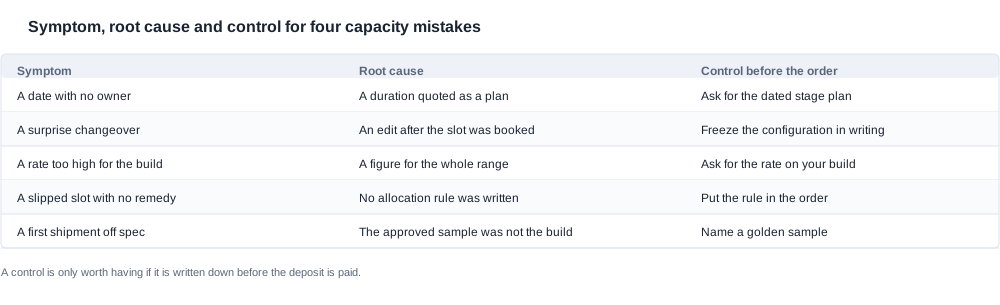
The table is organised as symptom, root cause and control, which is the order in which the repair has to happen. Working backwards from the symptom is what makes the difference between a control that prevents a recurrence and a complaint that does not. A complaint changes nothing about the next order. A control is a document, and a document is something a supplier can be held to.
The one question worth asking before you start is whether the same thing happened on any previous order with this supplier. If it has, the problem is a process rather than an event, and the repair is a standing control in the contract. If it has not, the problem is specific to this order, and the repair belongs in this order's documentation. Diagnosing which of these you are looking at takes one question and saves a great deal of argument.
The six questions that identify which branch you are on
These six questions are enough to place any slipped order on one of the four branches. They are designed to be answerable from documents rather than from memory, because memory attributes delays to the wrong stage.
- Does the order, as issued, contain a start date, and does it contain the stages that lead to it? A date with no stages behind it is branch one.
- Did the configuration change after the order was confirmed? Any change to the case, the colourway, the artwork, the packaging or the firmware after confirmation is branch two.
- Does the quoted rate name the configuration it applies to? A rate written against "the model" or "the range" is branch three.
- Does the order contain a reservation with a reference, and a recovery date? An order with an estimated date and no reservation is branch four.
- What was the line actually doing on the day the goods should have been moving? This is the question that ends the argument, because it replaces a claim about the factory with a fact about the schedule.
- Has the same symptom appeared on an earlier order? A yes moves the repair from this order into the contract.
Answering them in this order works because each answer eliminates a branch, and by the time you reach question five you are no longer diagnosing but confirming. In most cases the answer to question five is that the line was running something else, and the remaining work is to decide which of the four repairs applies.

A date with no mechanism behind it
This is the most common of the four and the hardest to spot in the moment, because the number you receive is a date and a date looks like a plan.
The symptom is that a duration was given and nothing else was. A number of weeks, a number of days, and no indication of what has to happen during that period. When it slips, there is nothing to renegotiate, because a duration is an average and an average has no owner. The root cause is that averages are assembled from the runs that went well, which means the quoted figure describes a month in which nothing complicated happened — a month with no changeover, no artwork revision, no component delay and no other programme competing for the same line time.
The repair is to ask for the stage breakdown rather than for the total. Six stages cover almost everything: materials, board and assembly, firmware and application, packaging, final test, and outbound. Then ask which of the six is binding for your configuration, and what would move it. That second question is the one that has an answer, and the answer is nearly always an input the buyer controls.
A booked slot is worth more than a fast estimate, and this is worth stating plainly because buyers are graded on schedule performance and rewarded for optimising the visible number. A factory that tells you your job starts on a specific date has committed to something a factory that tells you it takes six weeks has not. If you can have either a slightly slower date that is committed or a faster estimate that is not, take the committed one and manage the cost of the days in between.
The cost of leaving this one unrepaired is worth pricing, because it is invisible until it happens. A duration quoted as a plan becomes an argument at the point of failure, and the argument is about what was said in a meeting by someone who has since moved on. The buyer's fallback is a second request for a date, which consumes the same amount of time as the first request and produces a weaker answer, because the supplier now knows the first date is not going to be held. Two rounds of that and the relationship has learned something unhelpful: that dates are advisory here.
The repair is cheap to specify and expensive to omit. Six stage names in a schedule cost nothing to add and cannot be removed later without a change, which makes them the most durable form of protection available in this category. A buyer who has them in the order can re-plan when a stage slips; a buyer without them can only ask again.
A change made after the slot was booked
The symptom of the second mistake is a line that was going to be running your build and was not. Often the factory is not at fault in any ordinary sense — the build genuinely changed, and the change consumed the slot.
The root cause is that changeover, not assembly, is the scarce resource on a line that has capacity to spare. Every configuration edit is a changeover: a different logo treatment, a different colour, a new firmware build, a different charging case, a revised retail box. On a line running short runs across a broad catalogue, those changeovers consume the window the order assumed was free.
The charging case is the element that causes this most often in this category, and the published range explains why. The catalogue carries case capacities of 900 mAh, 1200 mAh and 1400 mAh, and the L2 Utral is published at two capacities, 900 and 1400. The MT6 carries a 1200 mAh folding case, which is a different part and a different assembly from a fixed case. The V03 Pro has no case in the box at all. The KY06 and the MT5 have a case whose capacity is not published. Each of those is a different build, and a case change made after the slot is booked is a changeover that nobody quoted.
The repair is to freeze the configuration in writing before the slot is taken, and to attach a change notice period with a schedule effect to it. The notice period is what converts a surprise into a scheduled event, and the schedule effect is what makes the cost of a change visible before the change is made rather than after the slot has gone. A buyer who wants a free change window is negotiating against the one resource the factory is actually short of.
It is worth being precise about what "frozen" means in a contract, because the phrase is used loosely and a loose version of it protects nothing. It means that the bill of materials, the case option, the artwork files, the packaging files, the firmware build reference and the destination market are all named and versioned, and that any change to any of them is a change event with a notice period and a stated schedule effect. A contract clause that freezes "the specification" without naming the artefacts leaves the buyer protected against a specification change and unprotected against a packaging change, which in this category is one of the most common changes there is.
There is a second part to this repair, and it is the part that catches buyers who have already been burned. The changeover cost has to be visible before the change is made, not after. A supplier who will quote the schedule effect of a case change before the order is placed is telling you something about how the line is managed; a supplier who discovers the effect after the change is made is telling you the line is managed by whoever is nearest it that week.

A rate quoted for the range instead of the build
The symptom of the third mistake is that the rate looked good on paper and the actual build ran slower than the plan. Often the supplier is entirely accurate — the rate was accurate, it was simply not the rate for your build.
The root cause is that a range figure is an average across builds with different work content, and the published range contains enough variation to make that average useless for planning. Twenty-eight models are covered, in four groups: eleven carry a camera, eight are audio models with a Bluetooth version published for each, three are sport models, and six further lines account for the rest — the AR frame, the three children's models, the electrochromic model and the bone conduction model. The camera models alone split five ways on the charging case. The charging method splits three ways across the full range: magnetic on seventeen models, a Type C port on seven, and no published charging-method row at all on the MT6 and the CY03, and the CY05 and the L1 Pro. The camera tier is two discrete classes rather than a continuum, with 8 megapixels across eight models and 13 megapixels across three.
The repair is to ask what the rate becomes for your configuration and your packaging, and to ask why the number is lower than the average. The question about why matters more than the number. A supplier who can explain the difference has costed the build; a supplier who simply lowers the figure without an explanation has applied a discount, and a discount applied to a rate is a rate that will move again.
There is a second correction to make here, and it is the one that gets missed most often. An assembled unit and a shippable unit are different counts, because packaging, firmware flashing and final test sit after assembly and consume capacity of their own. Before comparing any rate with any rate, establish which of the two is being counted.
A slot that was never actually reserved
The symptom of the fourth mistake is that the month filled and the order moved. The recovery date was whatever was proposed that week.
The root cause is that an estimate was treated as a booking. Capacity only becomes relevant on the day the month is full, and on that day there are exactly two outcomes: the slot was reserved in advance, or it was not. A factory that allocates by whoever asked first is behaving normally, and the second outcome is what normal looks like when nothing was written down.
The repair is to write four things into the order rather than to complain about the outcome. The reservation itself, with a reference. The priority rule that applies when a month is oversubscribed. The recovery date, agreed in advance for the case where the slot is missed. And the notice period the supplier must give if the slot will be missed. Four lines, and they turn a scheduling outcome into a contractual one.
It is worth resisting one temptation here, because it feels strong at the moment of failure. The temptation is to ask for a large penalty on a missed date, on the reasoning that the loss was large. A penalty does not create a slot. What creates a slot is a reservation made early enough to survive a busy month, and what protects it is a rule agreed before the busy month arrives. A penalty clause is worth having, but it is a remedy, not a mechanism, and a buyer who believes the penalty will prevent the miss has confused the two.
The order in which the four lines are written also matters, and it is the reverse of the order in which people want them. The priority rule comes first because it is the line that makes the reservation meaningful — a reservation without a rule about what happens in a constrained month is a hopeful note. The recovery date comes second because it is the line that gives the buyer something to plan around, and it can only be agreed once both parties accept that the miss is possible. The notice period comes third because it is the operational mechanism behind the recovery date, and it is the line a planner will use most often. The reference number comes last because it is administrative, and it is worth putting it last because a buyer who drafts it first tends to stop once the reference exists.
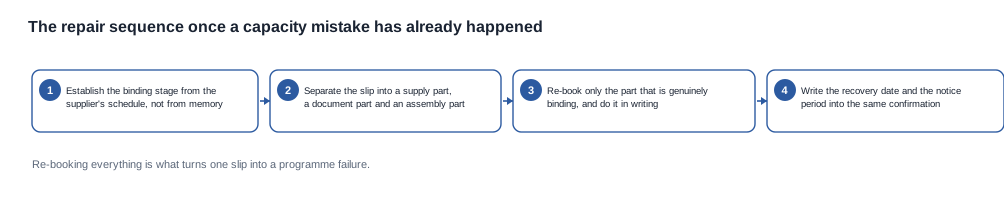
The sequence above is the order in which to work when the mistake has already happened and the goods have not shipped. Establishing the binding stage from the supplier's own schedule rather than from memory matters because memory attributes delays to the wrong stage almost every time. Separating the slip into a supply part, a document part and an assembly part matters because the three have different remedies and combining them produces a single useless number. Re-booking only the part that is genuinely binding matters because re-booking everything is what turns one slip into a programme failure.
What we publish, and what a repair requires
The boundary we hold: narrow and we will state it without hedging, because a buyer working a diagnostic needs to know which of the four branches is theirs. We publish what the catalogue contains: the 28 models, the electrical rows, the charge times, the case capacities, the pixel tiers and the charging methods. We do not publish capacity figures, line counts, daily output, stage durations or lead times, because none of them is meaningful without a configuration, a quantity and a date range, and all of them move with the order book.
What we will do is answer the questions that decide which branch you are on. Send the model codes, the option set, the quantity, the destination market and the date the goods have to arrive, and we will tell you which configurations exist, which published rows apply to them, and which of the four mistakes above your programme is most likely to repeat.
It is worth saying plainly that the repairs on this page are not things a supplier will volunteer. Every one of them asks the factory to carry a piece of risk that it currently carries by default — the risk of a missed date, the risk of an unquoted changeover, the risk of a range figure, the risk of a lost slot. That is why the right approach is to pick the two that correspond to the mistakes this programme has actually made, put them in the order, and leave the rest. A buyer who asks for all four on a first order gets a slower answer on all four than a buyer who asks for one and proves it.
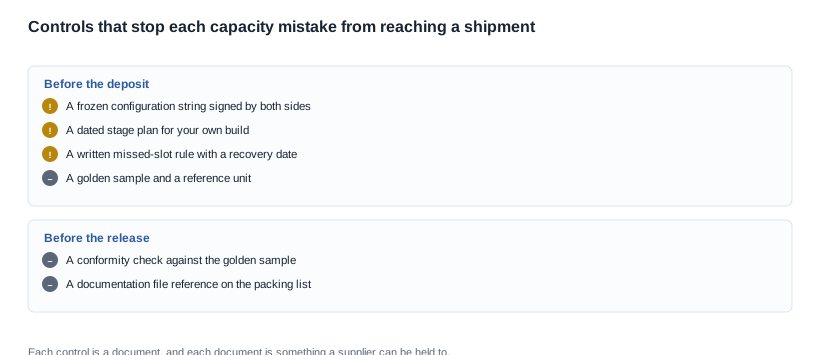
The controls in the checklist are the repairs, written as documents. None of them is difficult to obtain and none of them is free, because each one transfers a small amount of risk from the buyer to the supplier — which is exactly why a supplier that has never been asked for them may resist them. The negotiation that works is to ask for two or three of them rather than all of them, and to make clear that the ones being asked for are the ones that correspond to the mistakes this programme has actually made.
For the framework behind this assessment, see production capacity. For the warning signs in a supplier's own answers, see lead time red flags. For how a capacity constraint shows up in a delivery date, see how it affects lead time. For getting from samples to a bulk order without repeating the mistake, see requesting bulk samples. And for the camera configurations where the case option most often changes the build, see AI camera glasses.
Send the configuration, the quantity and the required date, and we will tell you which parts of the capacity question are settled by the catalogue and which are yours to control.


