

Smart glasses production capacity is almost never the number a supplier quotes and almost never the number a buyer needs. A capacity figure describes how much a factory can build in a period; a buyer needs to know when their own units will come off the line, which is a question about a queue, not a rate. The five questions below turn a capacity claim into something that can be scheduled against, and the last one is the one most buyers should ask first.
Smart glasses production capacity is a queue before it is a number
The buyer reading this, and the schedule they have to protect
The reader is a procurement manager working for the brand, a channel buyer or an importer with a launch date, a retail window or a marketplace listing date that they cannot move. They have asked for production capacity, and they have received a number. Their problem is that the number does not tell them where their order sits, and the number will not change by being asked about again.
This is the specific failure the myth-correction exercise has to fix: a headline capacity figure is not wrong, and it is not useless either. It is simply answering a different question from the one the buyer has. A factory that can build two thousand units a week may have forty percent of that week committed, may build on two shifts for one product family and one shift for another, and may have a line that stops for a tooling change every few weeks. None of that appears in the headline.
The thing being managed is a date. Everything else — the rate, the shift pattern, the number of lines — is only interesting because of what it implies about the date. Before you order anything, the question worth settling is which of the two you have been given: a rate that describes a line, or a date that describes an order.
Why a gross number cannot be scheduled against
There are three reasons a gross capacity figure fails to produce a date, and they compound.
It is gross rather than free. Capacity means the theoretical output of a line. Available capacity means the output left after other orders are placed. A factory quoting two thousand units a week for a camera model may have six hundred of that already allocated to a customer with a quarterly programme. The buyer is being offered the line, not a place on it.
It is an average rather than a rate at your quantity. Line output is not linear. A run of two thousand units may take three shifts, while a run of two hundred units may take a full setup and a full teardown for a fraction of the output. The unit cost of the small run is much higher, and so is the calendar time it occupies the line. A capacity figure quoted as a daily rate hides this completely, because the rate is only true at some other order's quantity.
It is company-wide rather than stage-specific. A factory that builds several product families has a total. The constraint on your order is rarely the total; it is one stage — a cell that arrives late, an optics module in short supply, a firmware build that has to be signed off before the pack-out step. Company-level capacity is the one number in this whole conversation that is guaranteed not to be the binding constraint.
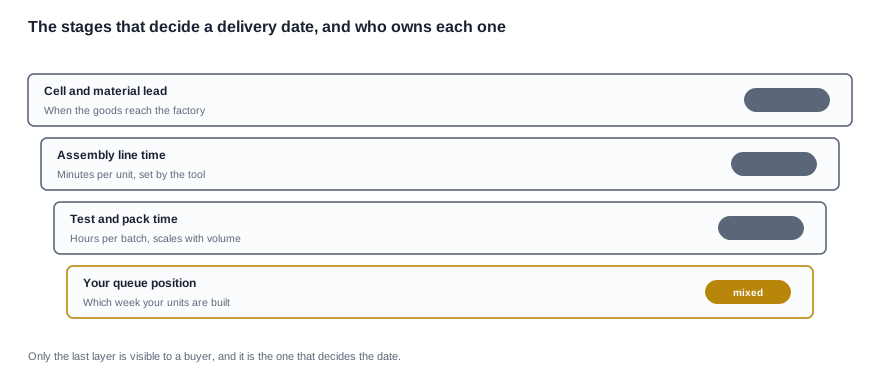
The layers chart is the working version of that point. Three of the four stages are entirely the supplier's to manage and entirely invisible to the buyer, and the fourth — where your order sits in the sequence — is the only one you can actually check. That is why "which week are my units built" is a better question than "how many can you build".

What a capacity answer has to specify before it can be scheduled against
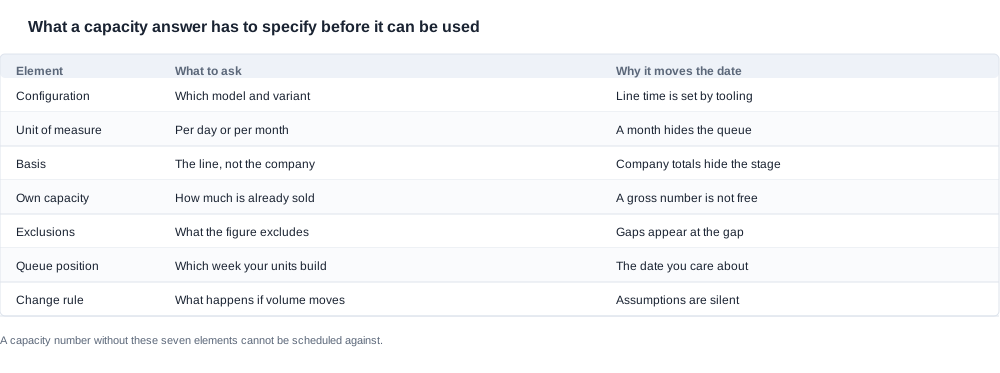
The table below is the specification a capacity answer has to meet. Each row is a request; the third column says what each one is protecting against.
| Element | What to ask | Why it moves the date |
|---|---|---|
| Configuration | Which exact model and variant the rate applies to | Line time is set by the tooling, not by the model name |
| Unit of measure | Per shift, per day or per month | A monthly average hides the setup inside it |
| Basis | The specific line or cell, not the company | Only one stage is usually the constraint |
| Own commitment | How much of that rate is already allocated | Gross capacity is not available capacity |
| Exclusions | What the figure does not include | Gaps appear exactly where the figure is vague |
| Queue position | Which build week your units are planned into | This is the only number that becomes a date |
| Change rule | What happens to the date if the volume moves | Assumptions are silent until they break |
Configuration, because the rate belongs to a build
A production rate in this category belongs to a specific configuration, because the line is set up for it. A camera model with a thirteen-megapixel sensor and a 1400 mAh charging case is not built on the same setup as an eight-megapixel model with no published case row, and a factory quoting a single rate for "camera models" is quoting a rate for whichever configuration they run most.
The same applies to the audio and sport tiers. Our catalogue publishes eight audio models, three sport models and eleven camera models, and the charge methods alone split into seventeen models on magnetic charging, seven on a Type C interface and four camera models where the catalogue publishes no charge method at all. A single rate across those is not a rate; it is an average of several unrelated setups.
Unit of measure, because the average is hiding the setup
Ask whether the figure is per day or per month, and then ask what the setup occupies. A monthly figure is the most common answer and the least useful, because a month absorbs a tooling change, a holiday shutdown, a maintenance slot and a material delay without any of them being visible.
Basis, because the company total is never the constraint
This is the question that most often produces a smaller number than the buyer expected, and it is also the one that makes the rest of the conversation useful. A factory that answers "that line is 60% committed in the period you asked about" has given you a number you can plan with. A factory that answers "we can build up to two thousand a week" has given you a number you cannot plan with.
Own commitment and exclusions, the two rows buyers skip
Own commitment is the gap between what the line can do and what is free for you. It is a normal question and it is answered differently by every supplier, because it exposes how the order book is actually arranged.
Exclusions is the more subtle row, and it is where the real dates are lost. A capacity figure that excludes firmware signing, excludes the packaging line, excludes incoming inspection, or excludes the time reserved for a customer-specific artwork approval, is not a small correction. Each of those excluded stages sits between the build and the shipment, and each of them is capable of consuming more calendar time than the build itself.
Queue position, the only row that is a date
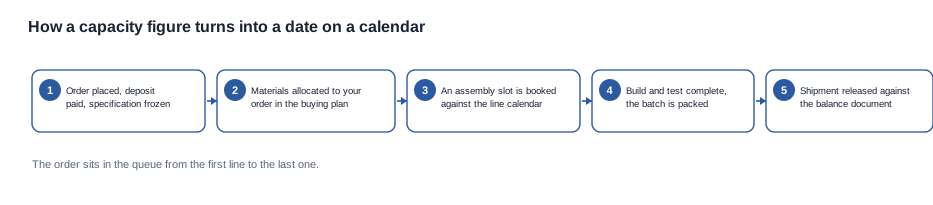
Everything in the table above is a condition that has to be satisfied before a date can be given. Queue position is the date. Ask for it in the form of a build week rather than a number of days from today, because a build week can be checked against a calendar and a number of days is a promise with no reference point.
It is worth asking what happens to the queue position if something upstream slips. A factory with a disciplined plan can tell you the answer in terms of which stage absorbs the delay. A factory without one will tell you the date holds, and that is how a delivery date becomes fiction.
The stages where a launch date is actually decided
The generic sequence below is worth walking through with any supplier, because the order of the stages is stable even when the durations are not. Knowing where the queue forms tells you which question to press on.
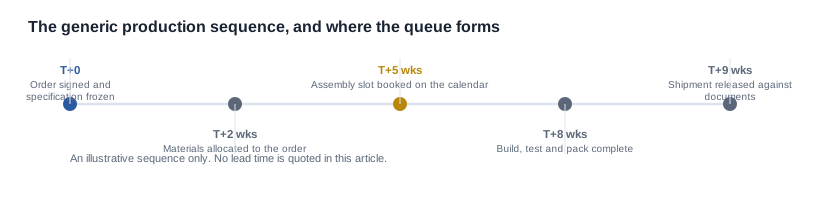
The sequence is illustrative, and no lead time is quoted in this article. What it shows is the shape: material allocation comes first and is the stage most often outside the supplier's control, the build slot is booked against a calendar rather than a queue of jobs, and the shipment is the last step rather than the only one.
Material allocation, the stage with the longest invisible lead
Cells, optics modules, main boards and packaging all arrive on somebody else's schedule. This is the stage that most often breaks a launch date, and it is the stage a buyer is least able to see.
The practical question is not "how do you expedite" but "what do you know about the supply position for my configuration". A supplier who can tell you the current allocation status of the specific components in your bill of materials has an answer; a supplier who says the materials are fine has given you an average.
The build slot, where the calendar does the deciding
Assembly is scheduled, not queued. A line runs a configuration for a period and then changes over to the next one. The consequence for a buyer is that the date depends on where the build week sits relative to other changes — and a small change in the order's quantity can move it across a changeover boundary, which is a much bigger schedule event than the quantity change itself.
This is the practical reason to confirm the queue position at the order quantity rather than at the tier quantity.
Test, pack and the packaging line
Test and pack are usually the shortest stages, and they are the ones most often excluded from a capacity figure. The packaging line is the one to watch when a programme is private-label, because a custom carton with artwork is a separate setup from a bulk carton, and a new artwork approval can sit in front of the pack-out step for longer than the build took.
Firmware and the software sign-off
A custom configuration in this category usually includes a firmware build and, often, a companion application build. Those are not assembly steps and they do not appear on a factory capacity chart at all, because they are engineering work. The question to ask is when the firmware build starts and who signs it off, because a firmware build that starts after the hardware build cannot be compressed into the schedule.
Capacity and the minimum order quantity, which are usually the same conversation
Capacity and minimum order quantity are treated as separate subjects and they are almost never separate in practice. The minimum order quantity exists because a setup has a cost, and the setup cost is why the line time per unit is not linear in the quantity. A quantity at the tier minimum may occupy a full week of the line to produce a few thousand units; twice that quantity may occupy the same week and leave the line idle for the difference.
That has two consequences a buyer should handle in the same conversation rather than in two. The first is that the price tier and the schedule move together, so negotiating a quantity down without asking whether it changes the build slot can move the date as a side effect. The second is that a buyer who is planning a second order inside the same year should ask whether the two orders can share a setup, because that question is worth more than the discount on the second one and it is rarely raised by the supplier, who has no incentive to suggest it.
Ask it plainly: "if we placed a second order of the same configuration in the same quarter, would it run on the same setup, and what would that do to the unit price?" The answer tells you whether the programme is one order with a follow-up or a recurring schedule with two setups in it.
The lead time guide covers how each of these stages propagates back into a date, and the capacity mistakes article sets out the failure patterns in more detail.

Testing a capacity claim against the catalogue you intend to buy
The most reliable check on a capacity claim is to reconcile it against the published specification of the model you have selected. The catalogue publishes, for every one of the twenty-eight models, the battery capacity, the published runtime, the charge time and, for twenty-four of them, the charge method. It publishes the camera resolution tier, the charging-case position for the camera models, and an IP54 marking on two models only.
A supplier's capacity answer has to be consistent with that specification. If the capacity figure assumes magnetic charging for a model where the catalogue publishes no charge method, the figure is describing a different configuration. If it assumes a case in the box for a model whose case row is not published, the pack-out step it is counting is not the pack-out step your order will use. If it assumes a thirteen-megapixel camera and your specification is an eight-megapixel one, the build time is wrong in a direction you cannot predict.
This is a cheap check with a real payoff, and it takes a single written specification and one careful reading of the quote. How to verify it is straightforward: put the published specification and the supplier's answer on the same page and mark every line that does not agree. A supplier who can reconcile the two is telling you something about how they work; a supplier who cannot is telling you something too. The camera and audio range is where the model options are set out, and the production capacity section holds the structure reference.
The catalogue is also honest about what it does not publish, which matters for the same exercise. It publishes no per-model certification row for any of the twenty-eight models, and the catalogue text contains no CE, FCC or RoHS marking at all. A capacity answer that assumes a test file has already been produced for your configuration is therefore an assumption about work that has to be requested, scoped and scheduled. For a programme aimed at a market with radio-equipment requirements, the relevant framework is the Radio Equipment Directive (EU) 2014/53/EU, and the documentation behind it is a schedule item, not a formality.
Why the published charge method matters for a capacity answer
The four camera models where the catalogue publishes no charge method — the MT6 and the CY05, and the L1 Pro and the CY03 — are a good illustration. All four publish a charging-case capacity, so the presence of a case is not in question. What is not published is how the goods get into it, which means the pack-out step and the accessory set are partly unspecified, and a capacity figure that counts a pack-out step is counting a step whose content has not been fixed.
Ask for the charge method as part of the written specification before asking for the rate.

Three capacity answers that sound strong and support nothing
"We can build up to two thousand units a week"
What it means. A line rate, quoted gross, without a configuration, without a commitment and without a date.
Why it is not usable. The number has no denominator the buyer can check against. It cannot be turned into a date for an order of a few thousand units, and it says nothing about what week the buyer's units would be built in.
What to ask instead. "How many units per week for my configuration, in the build week we would be scheduled into, and how much of that is already committed?"
"We have plenty of capacity this quarter"
What it means. A statement about a period, usually about the supplier's total across all products, frequently about the same quarter in which other customers' orders are being scheduled.
Why it is not usable. It is a statement about a total, and the constraint on the buyer's order is a stage. It is also the form most likely to be true and least likely to be relevant.
What to ask instead. "What is the free capacity for my model on the line I would use, and what is the queue position for my order?"
"We can usually hit our lead time"
What it means. An average over an unknown number of orders, with "usually" doing the work of a number.
Why it is not usable. It cannot be compared with a launch date, and it cannot be written into a contract. A buyer who relies on it has no remedy when the exception happens, because there was no commitment to be late against.
What to ask instead. "What is the date for my order, what does it depend on, and what happens to it if the quantity changes by the amount we are discussing?"
When the answer is a range, and what a range is actually saying
A supplier who answers "four to six weeks" is not being evasive. They are telling you that the date has a component they cannot compress, and the width of the range is the size of that component. The useful follow-up is not a request for the optimistic end; it is a question about which end the buyer is being promised against.
Three things make a range usable. The first is knowing which stage produces the spread — if it is material allocation, the buyer can sometimes improve it by accepting a different configuration; if it is the build queue, the spread is a queue and it is fixed. The second is knowing which end of the range the supplier will plan against. A supplier who plans against the optimistic end will miss a date and call it normal; a supplier who plans against the conservative end will deliver early, which is a cost to them and a benefit to the buyer. The third is having a decision rule: the point at which the programme switches to the conservative end, and what the buyer does about it, decided before the fact rather than after a missed date.
A range with those three things attached is more useful to a buyer than a single optimistic number, because it tells the buyer what to watch. A range without them is a way of not committing.
What we publish about capacity, and what we answer only per order
We do not publish a production capacity figure, a yield figure or a lead-time commitment as standing numbers, and we are not going to invent them. A capacity number without a configuration, a quantity, a destination and a date is not a fact about our factory; it is a rounding of the question. Stating it would look more confident and be less useful than saying what we can actually commit to.
What we do publish is the specification a capacity answer has to be reconciled against: the battery capacity, the published runtime and the charge time for every model; the charge method for twenty-four of the twenty-eight, with four camera models where the catalogue publishes no charge method; the camera resolution tier across the eleven camera models; the charging-case position, including the five camera models with a published capacity, the two with a case but no published capacity, and the four with no case row published — the V06 and the V03, and the S7 and the V03 Pro; and the IP54 marking on the V06 and the S7.
Against that specification, we will answer the six capacity questions for a specific order, in writing: which configuration, which build week, what the rate is at your quantity, what is already committed in that period, which stages the figure excludes, and what changes if the volume moves. Where a date depends on material allocation or on an artwork approval, we will say which, because a buyer who knows the dependency can plan around it and a buyer who does not cannot.
That is the honest shape of a capacity answer in this category: the specification is fixed and public, the rate is a consequence of the configuration, and the date is a commitment we will make against an order rather than a number we publish in advance.
Related reading
- Production capacity section
- How capacity shapes a lead time
- Capacity mistakes that cost lead time
- Quality gates and the schedule
- Camera and audio smart glasses range
Send us the configuration, the quantity and the target date and we will tell you what can be committed against it.


