

Smart glasses production capacity is the number a factory finds hardest to publish and a buyer finds easiest to accept at face value, which is exactly why the red flags matter more here than in most categories. A capacity claim can look precise, arrive in the right unit, and still describe a factory that cannot build your order in your month with your configuration. This article is written for the buyer who has a quotation in hand and needs to know which parts of it will survive contact with a purchase order. It works through the signals that give a capacity claim away, the question that replaces each one, and the line that belongs in the contract when a signal appears. The production capacity section covers the same subject from the supply side; what follows is the buyer-side diagnostic.
Smart glasses production capacity red flags in a supplier's answer
What a red flag is, and what it is not
A red flag is not evidence of a bad factory. It is evidence that a particular sentence in a particular answer will not survive being asked a second time. The distinction matters because the buyer who treats a red flag as an accusation gets a defensive reply, and the buyer who treats it as a documentation gap gets an answer. In this category the most common red flags are not lies; they are abstractions. A factory asked for its capacity across twenty-eight published catalogue entries may not have a single number, because the number depends on which model, which case option, which colour and which month, and a person under commercial pressure will produce a total rather than say so.
The second thing a red flag is not is a reason to stop. Every flag in this article has a matching question that resolves it, and in most cases the resolution is cheap. A buyer who drops a supplier over an unstated unit has thrown away the most useful conversation the ordering process ever produces. The alternative is to keep the supplier and force the answer into a form that can be planned against, which is what the red flags in a lead time promise does for the schedule that sits downstream of the capacity number.
The four signs that appear inside the number
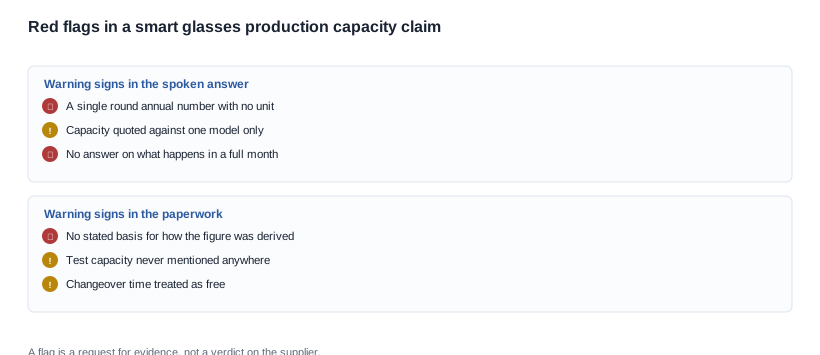
The unit is missing. A figure quoted as "a hundred thousand units a year" and a figure quoted as "a hundred thousand units in a month" differ by a factor of twelve, and a figure quoted as "a hundred thousand units per line" differs again. A capacity number without a unit is not an imprecise number; it is not a number. The question that replaces it is short: units per what, over what period, on which lines, in how many shifts. If the supplier cannot answer without a paragraph, that paragraph is the answer, and it should be written down.
The period is a year. Annual capacity is the single most common form of the claim, and it is the least usable, because the commercial problem in a launch is never spread evenly across twelve months. A factory that can build a hundred thousand units across a year may have the first quarter committed, a peak month with nothing left, and a second half that is mostly a different configuration. The question that replaces it: which month does this figure cover, and what is scheduled on those lines in that month.
The scope is one model. This is the flag that most often survives a careful reading, because the number is correct for the model quoted. The published range runs to twenty-eight entries, and the configuration space inside one model is already wider than the model name suggests. Eleven of the entries carry a camera, and across those eleven the case options alone move between a nine-hundred and a fourteen-hundred milliamp-hour case, a twelve-hundred milliamp-hour folding case, a case whose capacity is not published, and no case at all. Four of the eleven camera entries do not publish a charging method at all. One model is published with three colours and another with four. A capacity figure for "one model" that does not name the case, the colour and the charging method is a build rate for a configuration nobody has ordered yet.
The derivation is missing. A capacity number with no stated basis cannot be sanity-checked, and it cannot be re-derived later when the forecast moves. The useful form is a line count, a shift pattern, a cycle time and a test rate. The question that replaces it: what is this number made of, and what would have to change for it to be different.
The signs that appear in the answers around the number
The month was already committed. A factory with a real allocation rule will say what happens in a contended month, and it will say it without embarrassment. A factory without one will answer that the schedule depends on the season, which is not an answer, because a season is not an allocation rule. The question that replaces it: what is our slot in a contended month, what is the priority rule, and who decides. This is the flag with the most expensive consequence, because a slot you assumed and did not book is a slot that has been sold twice.
The test step was never counted. Capacity is usually measured at the point where units are made rather than the point where they are released, and the two are different numbers whenever a product has anything to test. A camera entry with a charging case is a different test proposition from an audio entry with none. The question that replaces it: how many units a day are released, tested and packed on the same lines, for our configuration.
The changeover was counted as zero. A line that stops between configurations produces nothing for the duration of the stop, and a buyer with four colourways in one month has four stops, not one. The question that replaces it: how long is a changeover for our configuration, and what is the longest run length that keeps the unit cost where the quotation assumed it.
Capacity is subject to component availability. This is the most comfortable sentence in the whole vocabulary, because it promises flexibility. In practice it moves the risk to the buyer, since a battery cell or a camera module that arrives late stops a build that was otherwise proven. The question that replaces it: which purchased parts could cap output below this figure, what are their lead times, and which of them are single-sourced.
A note on the order of the questions
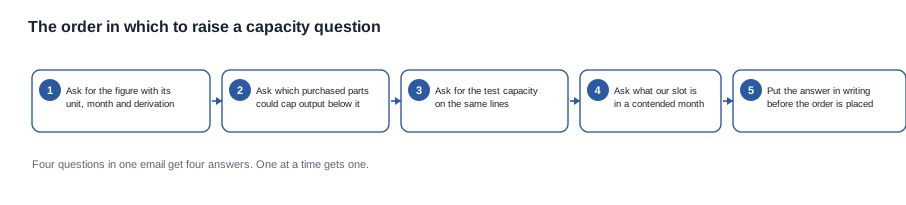
The eight flags above are worth asking about in a fixed order, because each answer determines the next question. Asking about components before the unit is known produces a component list for the wrong product. Asking about a slot before the month is agreed produces a priority rule for the wrong period. The sequence that works is in the checklist at the top of this section, and it starts with the derivation rather than the number, because the derivation is the part that can be checked and the number is the part that can only be believed.

Why one capacity figure turns out to be three different things
The build rate
The build rate is the number of units the line can assemble in a period, and it is the easiest number to produce and the least useful one to plan a launch against. It assumes that everything upstream arrives, that nothing is held for test, and that the configuration does not change. A build rate is a real measurement and quoting it is not dishonest; the problem is that a buyer who receives a build rate as a capacity statement will plan the launch against a date the factory never intended to commit to.
The release rate
The release rate is the number of units that are finished, tested, packed and cleared for shipment. It is lower than the build rate by whatever the test step and the queue absorb, and for a category where the test step includes pairing, function checks and a case assembly, the gap between the two is not a rounding error. This is the number that determines whether a dispatch date is real. A supplier who will state the release rate for a specific configuration has told the buyer something they can plan against; a supplier who states only the build rate has described the operation before the part that makes it a product.
The available rate
The available rate is the release rate minus what is already committed, and it is the only one of the three that the buyer's order actually occupies. It is the number that changes every week, which is why it is rarely published, and it is the number a buyer should be asking for when a slot is booked. The gap between a quoted figure and an available rate is usually an order book, and the order book is not a secret: a factory that will describe its committed load in general terms is a factory whose plan you can sanity-check.
The distinction between the three is the single most useful thing a buyer can carry out of a capacity conversation, because it tells the buyer which of the three numbers a supplier has been quoting. The way to find out is to ask for the same quantity in all three terms in one message, and to see whether the three answers are consistent with each other. They usually are not, and the inconsistency is the finding.
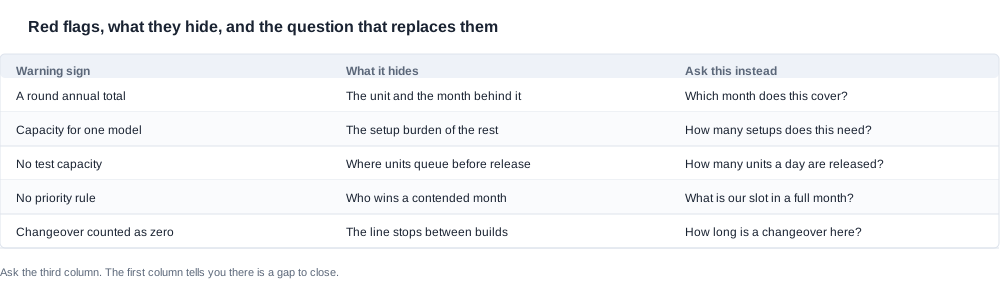
The table sets out the eight flags in the order they usually surface. The third column is the useful one. The first column is only there to tell the buyer that there is a gap to close, and a supplier who answers the third column properly will usually close the first column as a side effect, because the answer to "which month does this cover" contains the unit and the basis that the original sentence omitted.

How to test a capacity claim without starting a factory audit
The four questions that settle most claims
A full factory audit is expensive, slow and out of proportion to the question in most procurement situations. It is also usually the wrong instrument for a first-order capacity doubt, because the doubt is almost always about one configuration in one month rather than about the factory as a whole. Four written questions settle the large majority of capacity claims, and they can be asked before a sample has even been approved.
- What is the unit of the figure, and what is the period it covers?
- How was the figure derived, and what assumptions does it rest on?
- How many units a day are released, tested and packed for our configuration?
- What is our allocation in a month that is already contended, and who decides?
The order is not arbitrary. The first two questions determine whether the number means anything. The third determines whether the number describes a product. The fourth determines whether the number applies to the buyer's order specifically. A supplier who answers all four in writing has given a capacity statement; a supplier who answers two has given a capacity advertisement.
The one request that exposes an unstated assumption
Beyond the four questions there is a single request that is more productive than the rest, and it is this: ask the supplier to write the capacity statement in the buyer's own format. The buyer's format is a table with the model, the configuration, the month, the quantity, the rate, the test rate, the setup burden and the assumptions. A supplier who can fill that table has a plan. A supplier who cannot fill that table has a general capability, and the buyer now knows which one it is dealing with before the first order is placed.
The request sounds pedantic and is not. It is the difference between comparing two suppliers and comparing two adjectives. Two suppliers who both describe themselves as capable cannot be compared at all, and the buyer will default to the one that answered fastest. Putting the same form in front of both suppliers changes the basis of the comparison, and the form is exactly the one the buyer's own planning system needs, which means the effort of filling it is not wasted even if the supplier is rejected.
What to do with the answers
The answers arrive in three shapes, and each one has a different consequence. A complete answer that matches the buyer's own plan lets the buyer proceed to a schedule, a price and a slot, and the capacity conversation is finished. A complete answer that does not match the buyer's plan is the most useful outcome available, because it surfaces the gap while it is still cheap to close: the forecast is adjusted, the configuration is changed, the date moves, or a second supplier is brought in. A partial answer is the dangerous one, because it looks like progress and the buyer fills the remaining gaps with assumption, which is how a red flag becomes a late delivery.
The discipline is to write down the assumptions the buyer has made to fill a gap, and to carry them as explicit assumptions in the schedule. A buyer who knows that a slot is unbooked can plan around it. A buyer who has quietly assumed it is booked cannot.

What a red flag costs, and what it is worth handling
The three patterns behind a red flag
Almost every red flag reduces to one of three underlying patterns, and once the buyer can name the pattern, the remedy is obvious.
The commercial shorthand. A sentence written to avoid a difficult question, such as a figure that will move with the season or a statement that capacity is subject to availability. The remedy is a request for the number in a specific form, and the refusal or vagueness of the answer is itself the finding.
The capability copy. A description of the factory as a whole, pasted into a reply about a specific order. The remedy is to ask for the configuration and the month, every time, and to treat any answer that does not name them as an answer to a different question.
The optimistic rounding. A figure that is true as a ceiling and false as a plan, usually produced by the same person who set the sales target. The remedy is the derivation request, and the test of the derivation is whether the buyer could rebuild the number from it. If the buyer cannot rebuild it, it is a target, not a capacity.
Turning a red flag into a line in the order
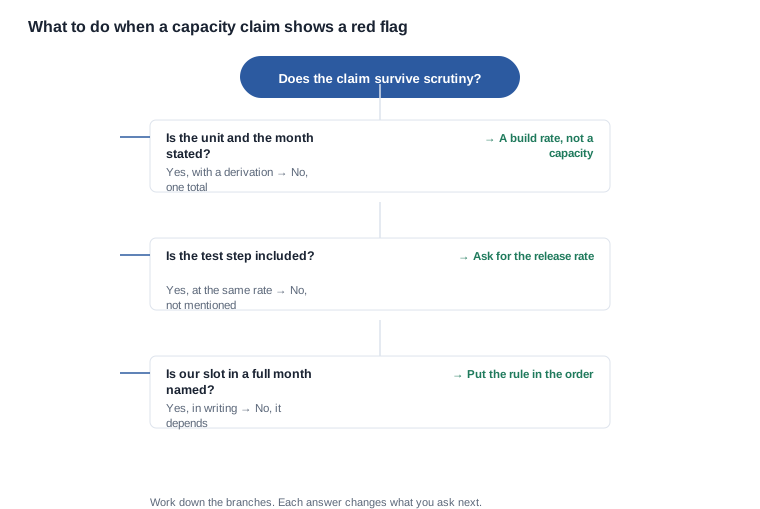
A capacity problem is easier to manage once it has an owner, a date and a remedy, and a contract is the cheapest place to put all three. The lines that earn their keep in a smart glasses order cover the configuration and the month the capacity was quoted for, the priority rule that applies in a contended period, the notice period for a slot release, the remedy if a slot is missed through the supplier's own scheduling, and the date by which a change in configuration invalidates the stated capacity.
The same lines sit naturally inside a supply chain agreement, and they are worth more there than in a purchase order, because an agreement survives the purchase order. They also sit alongside the commercial terms a buyer negotiates anyway, such as the deposit structure, the payment milestones tied to production rather than dispatch, the sample order that precedes the bulk order, and the warranty and returns terms that the buyer's own downstream customer will hold it to. A buyer who negotiates the priority rule at the same time as the unit price gets a better outcome on both than a buyer who treats the capacity conversation as a technical exchange separate from the commercial one.
The most common mistake here is to accept a priority clause that is open-ended. A supplier that reserves the right to reallocate a slot at its discretion has kept the risk and passed the consequence. Where a fixed priority cannot be obtained, the fallback is a written release notice and a defined re-sequence, with the schedule risk priced into the buyer's own model rather than assumed away. The production capacity section covers the supply-side version of the same arrangements, and how capacity shapes a lead time covers the schedule arithmetic that follows from it.
The cost of not handling it
An unhandled capacity flag usually surfaces on the dispatch date, and by then the buyer has three bad options and no good ones. Accepting late delivery costs the launch window, which usually means the next selling season, and a launch that slips by a month lands in a different commercial context than the one it was planned for. Accepting a non-conforming delivery is worse, because the units exist and the specification does not, and the buyer now owns a set of goods that cannot be sold in the channel they were built for. Accepting an incomplete shipment is the most common outcome, and it is the one that does most damage, because partial deliveries are usually accepted in the hope that the rest will arrive, and the returns and the customer conversations follow.
None of these requires a change of supplier. They require that the flag was noticed at the quotation stage and converted into a written question, and that the answer was put where the order and the schedule could see it.
What we publish about capacity, and what we will not quote
What we publish
We publish the configuration-level specification of every model in our catalogue, because that is the part of a capacity conversation that can be checked. The catalogue runs to twenty-eight entries covering camera, audio, sport, children, AR, photo-chromic and bone-conduction products, and within those entries the electrical rows, the resolution tier, the charging method, the charging case capacity and the charge time are set out model by model. For four of the twenty-eight the catalogue does not publish the charging method — the MT6 and the CY03, and the CY05 and the L1 Pro — and we would rather say that than publish a value we cannot trace. Charge time is published for all twenty-eight entries, and IP54 appears against two models only.
We also publish the size of the configuration space honestly, because it is the reason a capacity claim has to name a configuration. The camera and audio smart glasses range is where that range is described.
What we will not do
We do not publish a standing daily output figure, a line count, a shift pattern, a defect rate, a rework rate or a capacity number for the range as a whole, and we will not quote one to a buyer who has not fixed a configuration and a month. Every one of those figures is a function of the mix and the current order book, which means a published number would be true for a configuration that does not exist and misleading for the one that does. We do not publish a typical range either, because the range that a typical figure describes is wide enough to hide the constraint the buyer is trying to find.
We will not quote a capacity figure from a photograph, a brochure page or an old quotation. What we will do is take a use case, a configuration, a quantity and a target market, and tell the buyer which parts of the plan are settled, which are open, and which have to come from a sub-supplier. The eight questions buyers ask most covers the same ground from the buyer's side.
A capacity question
Send the model, the configuration, the quantity, the month the goods have to be in stock and the destination market, and we will return a build plan with the setup schedule, the test rate and the assumptions written into it, and we will mark the points where the answer depends on a purchased part rather than on our own lines. If the request is about whether we can absorb a volume step, tell us the current committed load and we will answer against it rather than against an empty order book.
Related reading
- Camera and audio smart glasses range
- Red flags in a lead time promise
- How capacity shapes a lead time
- production capacity section
- the eight questions buyers ask most
Send the configuration, the quantity and the market, and we will say which parts of a capacity claim are settled and which are yours.


