

Smart glasses production capacity is the question where a published figure and a useful answer are furthest apart, and understanding why saves a buyer a wasted month. The catalogue publishes what a company is: a production base of 20,000 square metres, more than 200 employees including a research and development team of more than 30, and a company founded in 2018. It publishes nothing about how many units a week come off a line, how long a stage takes or what is in front of your job in the sequence. That is not an oversight, and a footprint is not a capacity number. This article works through the eight questions that come up in every capacity conversation, the shape of the answer each one gets, the three that reveal the most, and the two lines that have to be in the answer before a buyer can plan a season around a delivery date.
Smart glasses production capacity: the eight questions, and whose slot it is
Eight questions about capacity
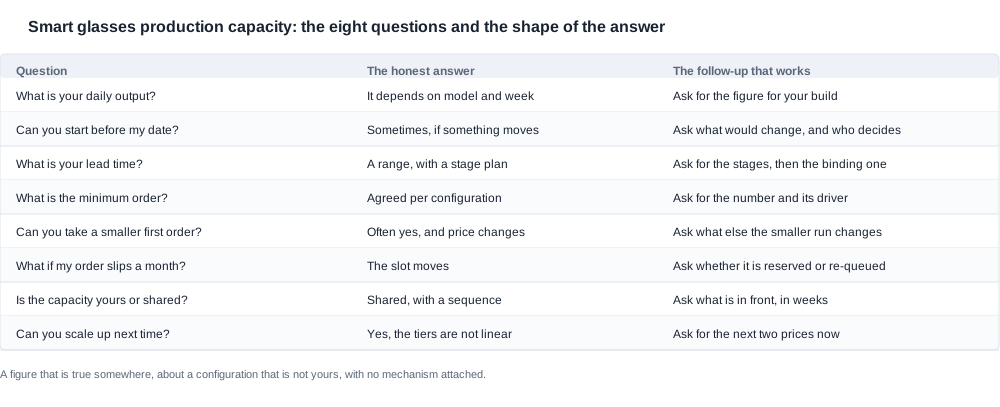
The eight questions are: what is your daily output; can you start before my date; what is your lead time; what is the minimum order; can you take a smaller first order; what happens if my order slips a month; is the capacity mine or shared; and can you scale up next time. Almost all of them get a version of the same reply — a figure that is true somewhere, about a configuration that is not yours, with no mechanism attached.
The four that decide the programme are the third, the fourth, the sixth and the seventh, and they are the four that can only be answered with a number attached to a condition. A lead time without a stage plan is an estimate. A minimum order without a driver is a number that cannot be traded. A slot without a statement of whether it is reserved or re-queued is a queue position rather than a commitment. And a capacity answer that does not say what is in front of your job, in weeks, is a figure about a week that has already passed.
Who is asking, and what the answer has to be good enough for
The reader is a buyer working for the brand, a channel buyer or an importer, and the decision is usually a date. A retail season, a listing window, a tender, a trade show or a channel onboarding cycle all need a quantity in a place by a date, and the capacity answer is the only thing that tells the buyer whether the date is real.
What the buyer is actually managing is not the supplier's output. It is the confidence with which they can commit a launch to a third party, and the exposure if they commit to a date that was never reserved. That is why the most valuable capacity information in this category is not a units-per-week figure but a statement about the sequence: what is in front of the job, whether the slot survives a slip, and which stage binds.
What is published, and what has to be asked
The published position splits cleanly in two, and the split is worth understanding before the first call, because it decides which questions are information requests and which are quotation requests.
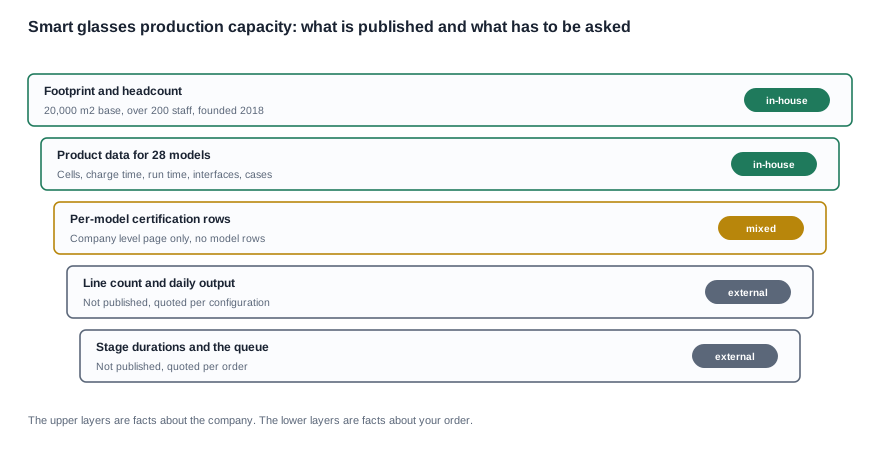
The upper layers are facts about the company and they are published: the footprint, the headcount, the research and development team, the year of founding, and the full product data for 28 models. The lower layers are facts about a particular order, and they are not published because they are different for every configuration and every week. A buyer who understands this stops asking for standing figures and starts asking for quoted answers against a named configuration, which is a much more productive conversation.

The eight questions, and the shape of the answer they get
The three questions that reveal the most
"What is your daily output?"
The answer will be a number, and the number will be about a line running a model you are not ordering. The configurations in this range are far enough apart that a single output figure is nearly meaningless. The catalogue covers a 13 MP platform on a 290 mAh cell with a 1400 mAh charging case, an 8 MP platform on a 220 mAh cell with magnetic charging, a pair of 55 mAh-per-cell audio models, and a 40 mAh children's protection model, and the changeover between those is a different amount of work each time. There is also a model that ships with a 1200 mAh folding case and one has no charging-case row, and the case work is part of the same run.
The follow-up that gets a usable answer is to ask for three things together: the output for your exact model, the output with your exact options, and what is in front of your job in the sequence. The third is the one that makes the first two meaningful, because an output figure without a queue is a rate rather than a date.
"Can you start before my date?"
This is where the capacity conversation usually turns into a negotiation, and the useful part is the condition rather than the answer. Ask what would have to change, and who decides. Sometimes the answer is that a slot is free. Sometimes it is that the material order has to be placed by a certain date, which means the buyer is being asked to fund a risk. Sometimes it is that another order has a prior claim on a shared component, in which case the buyer now knows that their date depends on somebody else's programme, and that is a different kind of risk to carry.
The same three answers apply in a different order to the case, and they are worth putting into the enquiry explicitly. A case that is published at 900 or 1400 mAh on the same model is a different purchase, and a model published with a case of unstated capacity is a different purchase again, and a model published with no case row at all is a third. Whichever of those applies, the constraint is a purchased part, and the constraint has to be named before the date means anything.
"What is your lead time?"
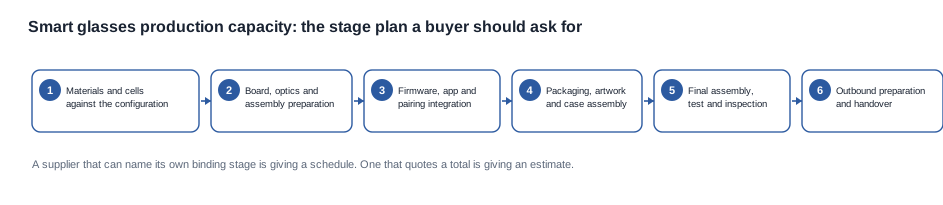
A range is fine, if it comes with a stage plan. Ask for the stages — materials and cells, board and assembly preparation, firmware and application integration, packaging and case assembly, final assembly and test, outbound preparation — and then ask which one is binding for your order right now.
A factory that can name its own constraint is giving a schedule. A factory that quotes a duration is giving an estimate, and the difference shows up the first time the date moves.
What the published product data tells a buyer about capacity demand
Before a buyer asks a supplier anything about output, the published catalogue already shows how much changeover a programme is likely to create, and this is the part of the capacity question that can be answered without a single conversation. The range covers 28 models across four form factors: 11 camera models, 8 audio models, 3 sport models, and the remainder spread across two children's protection models, a children's audio model, an AR model, an electrochromic model and a bone-conduction model. A supplier running that many models is running many changeovers, and the amount of capacity consumed by changeover is the reason a units-per-week figure for one build does not transfer to another.
The multiplication happens inside the models as well. The 11 camera models alone carry two camera classes, with 8 MP on eight of them and 13 MP on three, and the camera module is a different purchased part in each class. The charging case splits those same 11 models four ways: five publish a case capacity, two publish a case with no capacity stated, three publish no case row at all, and one has no charging-case row. The charging interface divides the range almost evenly, with magnetic charging published on 17 models, Type C on 7, and no interface row at all for four. And colour options are published for only two models in the entire range, which means every other colourway in a programme is a new material set.
A buyer who multiplies those axes out before the first call arrives with a much better question than "what is your daily output". The better question is how many distinct builds the programme is actually asking for, because a programme with one model, one case option and one colour is a different capacity conversation from a programme with three models, two case options and a private-label colour, and the difference shows up in the queue rather than in the rate.
The order to ask the eight questions in
The sequence matters more than the list, because four of the eight questions are only useful once the answer to an earlier one has been given.
- Fix the configuration first, in writing: model, case option, colourway, packaging and destination market. Every capacity answer after this point is an answer about that build.
- Ask what the minimum order is and what drives it, because the driver decides whether the minimum can move and what the buyer trades to move it.
- Ask for the output for that configuration, and ask for the queue in front of it in weeks. A rate without a queue is not a date.
- Ask for the stage plan, and then ask which stage binds for this order now. The binding stage is the one to watch for the rest of the programme.
- Ask whether the slot is reserved or re-queued, and what happens to the date if it slips. This is the question that decides whether a season can be planned around the delivery.
- Ask what a smaller first run changes besides price, and what a larger second run changes besides price, and get both numbers now.
- Ask what would have to change to start earlier and who decides. This is the only version of the acceleration question that produces a usable condition.
- Only then compare the answer against the other supplier's, because a capacity answer for one configuration cannot be compared with a capacity answer for another.

The questions about the order itself
"What is the minimum order?" The number is agreed per configuration and is not published as a standing band, because the floor moves with the purchased parts behind that configuration and with the changeover the configuration implies. Ask for the number and for the driver behind it. The driver is usually a component supplier's minimum pack, a one-off tooling cost, a print run or a colour batch, and once you know which one it is you know whether it can move.
"Can you take a smaller first order?" Often yes, and the useful follow-up is what the smaller run changes besides the unit price, because a first order at half the volume often carries the same setup cost and a different material price, and that difference is what makes a second order cheaper. A smaller run also tends to lengthen the schedule, because the fixed stages do not compress, so the buyer is trading margin for time and should know which one they are buying.
"Can you scale up next time?" Yes, but the tiers are not linear, and the numbers are worth getting now rather than at the second negotiation. Ask for the price at the next quantity and the one after it while the first order is still being discussed. A supplier who gives those two figures without being pushed is telling the buyer that the tiers are real and that the second order will be priced on the same basis.

The question about failure: reserved, or re-queued
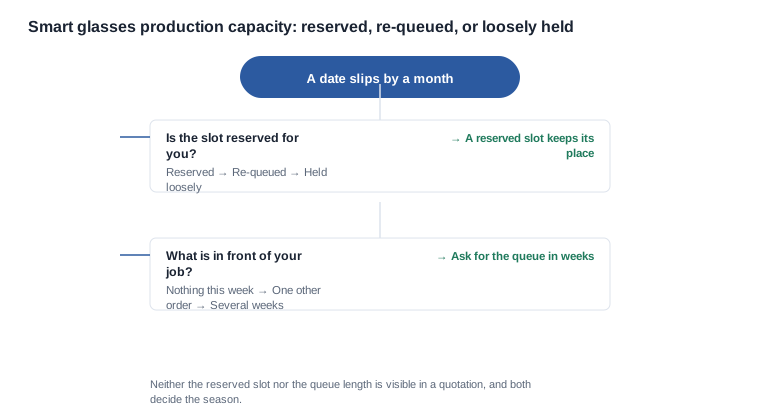
"What if my order slips a month?" This one is worth asking explicitly, because the answer determines whether the date is a commitment or a queue position. If the slot is reserved, the job keeps its place and everything else moves around it. If it is re-queued, the job goes to the back of the sequence and the date becomes a hope. The distinction is not visible in a quotation, and it is the single most valuable thing to establish before planning a retail season around a delivery.
"Is the capacity mine or shared?" Shared, with a sequence. A factory that owns its lines exclusively for one buyer's product does not exist in this category, and a buyer who assumes exclusivity is the one who gets surprised. What matters is the length of the queue, and that is a question with a number attached: how many weeks, how many other orders, and whether the sequence is by order date or by first ready date.
There is a fourth failure that is specific to this category and worth naming, because it is the one that costs a season rather than a week. A capacity answer given against a configuration that is not the one being ordered. The published data makes this easy to do: the catalogue has 28 models, 11 of them camera models, and the configuration axes multiply inside a single model — two camera classes, four case states across the camera models, a charging interface published for 24 of the 28 models and absent for the other four, and colour options published for only two models. A capacity figure quoted for a stock build tells the buyer very little about their private-label build with a case in the box, because the changeover is the work that capacity is consumed by.
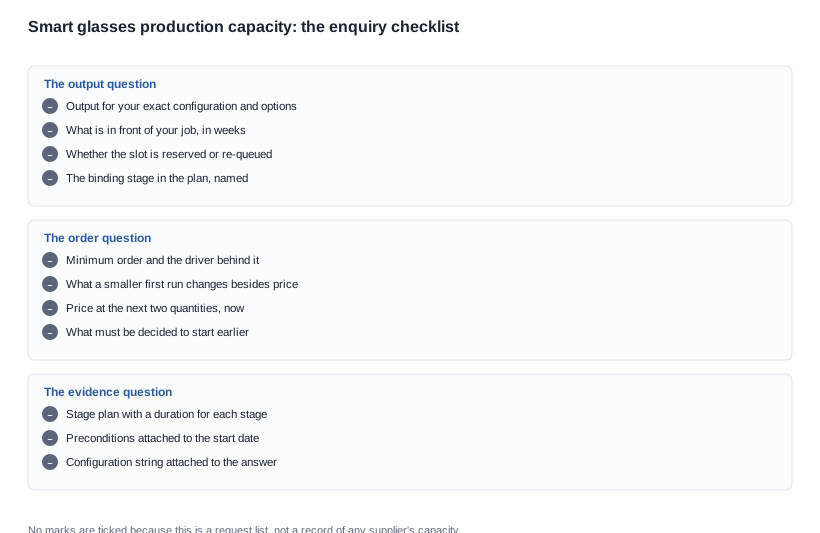
Three ways capacity gets over-promised, and how to catch each one
The rate quoted for a build the programme is not ordering. The tell is a figure that arrives without a configuration attached, or attached to a stock build while the programme wants a private-label one. The control is to require the configuration string on the answer itself, so that a rate quoted for the wrong build is visibly the wrong build.
The queue that exists only in the good week. A weekly output figure read against an empty week is a best case, and best cases are what get quoted. The control is to ask for the queue in weeks at the same time as the rate, because a queue of two weeks and a queue of ten weeks are both compatible with the same rate and they are not compatible with the same launch date.
The slot that is held rather than reserved. A date offered with a verbal hold on the line, and no statement of what happens if the programme moves. The control is to ask the question directly and to write the answer into the order, because a hold that is not reserved disappears the moment a larger order appears with a firm date.
None of these three is a reason to change supplier. They are reasons to put a line in the order, and they are the reason a capacity answer without a mechanism attached should never be the basis of a launch commitment.
Planning the second order before the first has shipped
The second order is where capacity is usually lost, because it is planned against a memory of the first rather than against the sequence. Three things are worth doing early, and all three are cheap.
The first is to get the price at the next two quantities in writing during the first negotiation, while the volume discussion is still open. Tiers in this category are not linear, because the one-off costs amortise while the per-order costs do not, and a tier boundary that looked attractive at the first order may not be reachable in the configuration the second order needs.
The second is to ask what the second order's build will be, and to have it confirmed in advance. A second order that adds a case option, a colourway or a destination is a different build with a different queue position, and a buyer who assumed the second order would follow the first through the same route is planning a date that has not been asked for.
The third is to book the second order's slot at the point where the first order's material is ordered, not at the point where the first order ships. In a shared-capacity factory, a slot requested early is a request against a real sequence, and a slot requested after the first shipment is a request against whatever has accumulated.
What we will and will not do about capacity
Our line count, daily output and stage durations are not published as standing figures, because they move with the order, the configuration and the week, and a published figure would be wrong for most of the orders it was read against. The same applies to the minimum order quantity, the capacity slot and the lead time. The figures we do publish are the ones that are true regardless of the order: the 20,000 square metre production base, the more than 200 employees and the research and development team of more than 30, the 28 models, and the product data behind each of them. Those are real, and they are also not an answer to a capacity question, and we would rather make that distinction clearly than let a footprint be read as a unit count.
What we will do is take a quantity, a configuration and a ship-by date, and give a written answer to all eight questions above: the output for that configuration, the queue in front of it, the binding stage, the start date and its preconditions, the minimum order and its driver, what a smaller run changes, whether the slot is reserved or re-queued, and the price at the next two quantities.
The production capacity section sets out the commercial structure, the questions to ask before ordering is the shorter version of this list, the camera and audio range is what the configurations are built from, how capacity shapes a lead time is the arithmetic behind the stage plan, and the capacity mistakes that cost lead time is the list of things that go wrong when the stage plan is skipped. Send us the model, the configuration, the quantity and the ship-by date, and we will tell you which of the eight questions has a real answer for your programme and which one is still an estimate.


