

A typical range is not a number. It is a number plus a set of conditions that the number depends on, and a range that arrives without those conditions is two numbers with a gap between them, not a plan. The practical conclusion for a buyer is short: plan to the low end of the range, ask for the basis, the period and the committed load behind it, and treat any range whose width spans more than one month as a statement about the factory rather than about your order. This article is written for the brand-side procurement manager, the channel buyer and the importer who has been handed a range, or who has been offered one, and who needs to know what to do with it. It works through what a range actually contains, why two suppliers' ranges disagree, how to convert a range into a figure you can order to, the test for a range that is too wide to use, and the commercial terms the range feeds into. The production capacity assessment section covers the same subject from the supply side.
What a typical smart glasses production capacity range actually means
The conclusion, and why a range is not a number
When a supplier quotes a range, one of three things has happened, and the buyer needs to know which before the range is used in a plan.
The first is that the supplier knows the answer and has expressed it as a range because the answer depends on something the buyer has not fixed. This is the good case, and it is common in this category because the configuration space inside a single entry is wide. The second is that the supplier has measured one point in the range and generalised the rest of it, which is the ordinary case and is recoverable with two questions. The third is that the supplier is describing what the factory could do under ideal conditions, with the conditions left out, which is the case that does damage.
A range of the second kind is a summary and it is legitimate, the way a catalogue figure is a summary. A range of the third kind is a ceiling, and ceilings are the most dangerous numbers in procurement, because a schedule built on one has no margin at all. The distinction is visible in the range itself: a range whose ends carry conditions is a summary, and a range whose ends carry nothing is a ceiling.
The four conditions a range has to carry
For a range to be usable, it has to state four things, and each of them is a condition rather than a number.
The unit and the period. A range without a period is not a range, it is an impression. A factory quoting "eight to twelve thousand units a month" has already told the buyer which period, and the buyer should be able to say which month. The month matters as much as the period, because a range in a peak month and a range in a quiet month are the same range attached to two different realities.
The basis. The range has to be built from something: a line count, a shift pattern, a cycle time, a test rate. Without the basis, the two ends of the range are two claims rather than two measurements, and the buyer cannot tell which end was measured and which was estimated.
The committed load. What is already scheduled on the relevant lines in the relevant month. A range quoted against an empty order book describes a factory that does not exist in the buyer's month.
The configuration. What was built to produce the range. This is the condition most often left implicit, and in this category it changes the answer more than any other. The published range runs to twenty-eight entries, eleven of them camera entries, and across those eleven the charging case option alone moves between a nine-hundred milliamp-hour case, a fourteen-hundred milliamp-hour case, a twelve-hundred milliamp-hour folding case, a case whose capacity is not published, and no case at all. Four of the eleven do not publish a charging method. A range produced for a build without a case and a range produced for a build with a fourteen-hundred milliamp-hour case are not the same range.
A published figure is the same kind of object
There is a useful parallel in our own catalogue, and it is worth making because it shows what a condition-bearing figure looks like in practice. Across the twenty-eight published entries the runtime figures are not one number. Ten entries are published at about seven hours, seven at about eight hours, four at five to eight hours, three at about twenty hours, two at six to eight hours, and two at about six hours. Those are not inconsistencies; they are twenty-eight different products with twenty-eight different conditions. Each figure is attached to a model, a battery and a charge method, and it is only meaningful when those conditions travel with it.
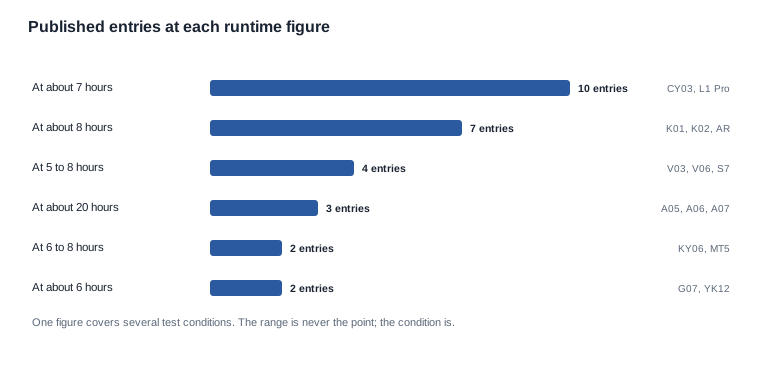
A capacity range is exactly this kind of object. It is meaningful when the model, the period, the basis and the load travel with it, and it becomes a number with no meaning the moment it is separated from them and written into a schedule on its own.

Why two suppliers' ranges disagree
Different basis, different period, different load
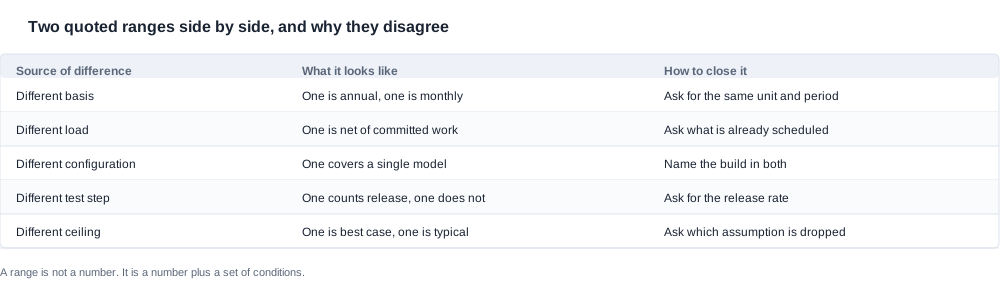
Two ranges that disagree are not automatically a red flag. They are frequently two correct answers to two different questions, and the buyer's first job is to find out which question each one answered. There are five usual sources of divergence, and the table sets them out with the question that closes each one.
The first is a different basis. One range is built from a line count and a cycle time; the other is built from a recent shipment. The second is a different period. One is a month, the other is a quarter. The third is a different load. One is net of the work already committed; the other is not. The fourth is a different configuration, and the fifth is a different test step, where one range counts units released and the other counts units assembled.
Which divergence matters most
The divergences are not equally serious, and sorting them by consequence saves a great deal of negotiation. A difference in period is easy to close, because the buyer simply asks for the range in its own period and most suppliers can produce it. A difference in configuration is easy to close in the same way, as long as the buyer has fixed its configuration. A difference in the test step is important, because it changes which number the range refers to, and it can be closed by asking for the release rate inside the range.
A difference in the committed load is the one that matters most, and it is the hardest to close, because a supplier is often unwilling to disclose its order book in detail. There is a workaround that works more often than a direct request: ask for a yes or no on the specific slot the buyer wants. A supplier that will not publish its load will frequently still answer whether the buyer's month is available, because the answer is a commitment rather than a disclosure.
When the disagreement is not a difference of basis
There is a divergence that no amount of questioning will close, and it is a difference in what the two factories consider a normal month. One factory has a stable order book with a predictable seasonal shape; the other runs project work, so its output in any given month depends on what else is in the building. Both ranges are internally consistent, and the buyer has to choose which kind of factory to build a programme around. This is a strategic judgement rather than an analytical one, and the honest way to handle it is to plan against the more conservative of the two ranges rather than against the average of them.

Converting a quoted range into a plan
Planning to the low end
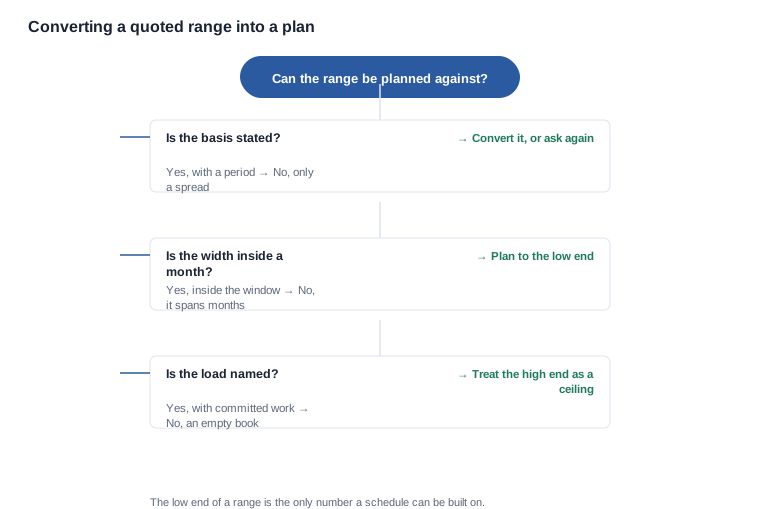
The rule that resolves most range problems is simple and slightly counter-intuitive: the number a schedule is built on is the low end of the range, and the high end is treated as a ceiling that may or may not be reached. A buyer who plans to the middle of a range is planning to a number that was never measured, and a buyer who plans to the high end is planning to a number that was probably measured on a different month.
The reasoning is about who absorbs the difference. If the programme plans to the low end and the factory delivers the middle, the programme is early and the problem is a carrying cost. If the programme plans to the high end and the factory delivers the middle, the programme is late and the problem is a launch window. The asymmetry is obvious, and it is the reason the low end is the right planning figure even when the buyer expects the middle.
There is one exception, and it is the case where the low end is the exceptional case rather than the normal one. A range that is wide because the supplier is describing a range of configurations rather than a range of outputs has a low end that is not a realistic planning figure for the buyer's configuration at all. That is a different object, and the way to tell the two apart is to ask which end was measured for the buyer's build.
The steps that turn a range into a figure
The conversion itself is a short sequence, and each step has a defined output.
- Ask for the basis, the period and the committed load behind the range, in one message.
- Ask which end of the range was actually measured, and for which configuration.
- Ask for the release rate inside the range, because a range that counts assembled units is not the number a dispatch date depends on.
- Run the low end against the buyer's own order, using the buyer's real quantity and the buyer's real configuration.
- Write the planning figure into the schedule, with the conditions attached to it.
- Note the events that would invalidate the figure, so that the file records what the number was resting on.
Step four is the one that most often changes the answer, because it is the first time the supplier's range meets a real quantity. A range that comfortably covers the buyer's order on paper and does not close when the setup burden and the test step are applied is a range that was produced for a different build.

A hypothetical range, converted
Take a quoted range rather than a quoted figure, and walk it through. A supplier quotes "between eight and twelve thousand units a month for the camera range" against a build window of twenty-six working days, with no basis, no load statement and no configuration named.
The first conversion step is the period and the basis. Twenty-six working days is the build window, but the range is a monthly rate, so the two are not the same measure and the supplier has to be asked which one the range refers to. The basis is missing, and asking for it produces the more useful information: how many lines, how many shifts, and what the test rate is for a camera build with a charging case.
The second step is the load. The supplier confirms that one line is committed to another customer for the second half of the month, which moves the range down for the buyer's window. The third step is the configuration, and here the range splits, because the camera entries in the range are not one build: the entries with a folding case and the entries without a case are different test propositions, and the range applies to one of them.
The fourth step is the buyer's own order. The low end of the applicable range, tested against the buyer's quantity and the buyer's real number of configuration changes, closes with a shortfall in the last week of the window. That shortfall is the finding, and it is worth more than the original range, because it is a specific number that can be planned around: the window has to start earlier, the configuration set has to be narrowed, or the quantity has to be split across two months. Each of those is a decision the buyer can make. The wide range was not a decision at all.
What the planning figure has to carry with it
A planning figure that enters a schedule without its conditions becomes a number that nobody can challenge later, and the conditions are the only part of it that protects the buyer. The minimum set is the configuration it was produced for, the month it applies to, the basis it was built from, the load it was measured against, and the date after which it must be refreshed. A schedule entry that carries those five things can be re-checked by a colleague in a year. A schedule entry that carries only the number cannot be checked at all, which makes it indistinguishable from a guess.
The procurement lead time section covers the same principle applied to a schedule commitment, and the discipline is identical: a date without its conditions is a hope with a date format.

The range that is too wide to plan against
The test
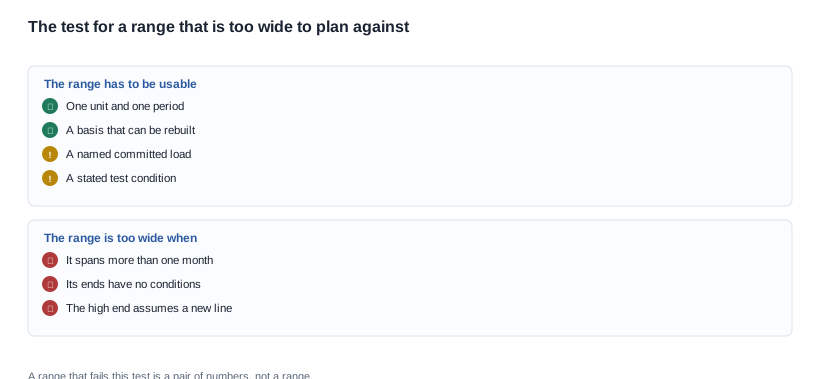
A range is usable when it has one unit, one period, a basis that can be rebuilt, a named committed load, and a stated test condition. When it has all five, it can be converted into a planning figure by the method above. When it is missing one of them, the conversion produces a number with a hole in it, and the hole has to be closed by a question rather than by an assumption.
There is a second test, which is about width rather than content. A range whose width fits inside a single build window is a measurement. A range whose width spans more than one month is usually a statement about the factory's spread of activity rather than about the buyer's build, and it cannot be narrowed without a configuration and a month. The pragmatic treatment is to plan to the low end, ask for a narrower range for the buyer's specific month and configuration, and treat the wide range as the outer bound of what the supplier believes is possible.
What to do with a range that fails the test
A range that fails the test is not a reason to reject the supplier, and it is not a reason to accept the midpoint. It is a reason to convert the question. The useful move is to ask for a single figure for a single configuration in a single month, with the basis attached, and to see whether the supplier will produce it. Most suppliers can, because most suppliers know their output for a build they have run before; what they cannot do is generalise it, and the generalisation is what failed the test.
If the supplier cannot produce a narrower figure, the range has to be carried as a risk with an owner, and the risk has to appear in the contract. The terms that reduce it are the ones that commit the supplier to a specific configuration and a specific month, with a release rate and a notice period. A range that is narrowed by contract is a range that has been converted in the only way that actually binds.
The commercial terms, and what we publish about ranges
What a range costs to negotiate against
A range gives a buyer less to negotiate with than a figure does, and the reason is that a range leaves everything open. The buyer cannot trade against an upper bound, so the leverage has to come from somewhere else, and the most reliable place is the configuration and the commitment. A buyer who freezes a configuration on a date removes the uncertainty that makes the range wide in the first place, and a supplier can convert that into a narrower range, a better slot or a price. A buyer who can commit to a monthly quantity has the same lever from the other side, because a firm order removes the reason for the range to exist at all.
The trade-offs are the same on both sides. A narrower range costs the supplier flexibility and buys the buyer a date. A firmer commitment buys the supplier predictability and costs the buyer the ability to react when the market moves. The total cost of the arrangement is the unit price plus the returns reserve plus the documentation route plus the inventory held against a schedule the buyer does not control, and a range is the reason the last two of those are usually the larger numbers. The procurement risk management section covers how those four combine in a landed-cost model.
A range is quoted with its basis, its load, and its assumptions
We will quote a range for a named configuration, month and quantity, with the basis, the committed load and the assumptions stated next to it, and we will say which end of it was measured. We will also say when the range is wide because the configuration set is wide, rather than pretending it is a measurement of the buyer's build.
We will not publish a standing daily output figure, a line count, a shift pattern, a defect rate, a rework rate, or a capacity number for the range as a whole, and we will not quote a typical range to a buyer who has not fixed a configuration and a month. All of those are functions of the mix and the current order book, so a published figure would be true for a configuration that does not exist and misleading for the one that does. We will not quote a range whose conditions we cannot name, because a range without conditions is a ceiling and a ceiling is not an offer.
What we will do is take a use case, a configuration, a quantity, a month and a target market, and tell the buyer which parts of the plan are settled, which are open, and which have to come from a sub-supplier.
Related reading
Send the configuration, the quantity and the month, and we will say which end of the range was measured.


