

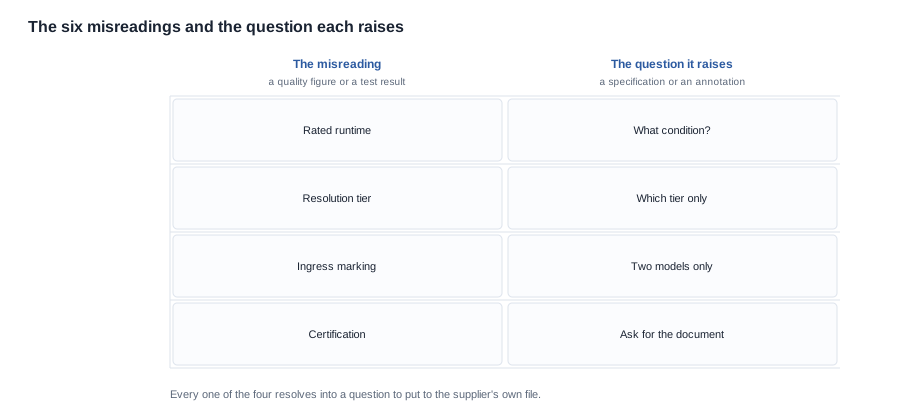
Most of the mistakes in a quality conversation are made while reading a number, not while reading a batch. A rated runtime, a resolution tier, a catalogue marking, a cell capacity — each of these is a specification, and each of them is regularly treated as though it were a quality figure. This is a method for reading a number before you trust it, with the six most common misreadings set out along the way, because a smart glasses quality consistency conversation that starts with a misread number ends with a control aimed at the wrong cause.

Smart glasses quality consistency: what to confirm before you trust a figure
The reader is a brand-side sourcing manager, a channel buyer or an importer sitting in front of a quotation, a specification sheet or a supplier's catalogue, trying to work out which figure will tell them something and which figure will only produce a dispute later. The specific anxiety is rarely the price. It is that the supplier's number and the buyer's expectation are not describing the same thing, and nobody will discover it until the goods are in the channel.
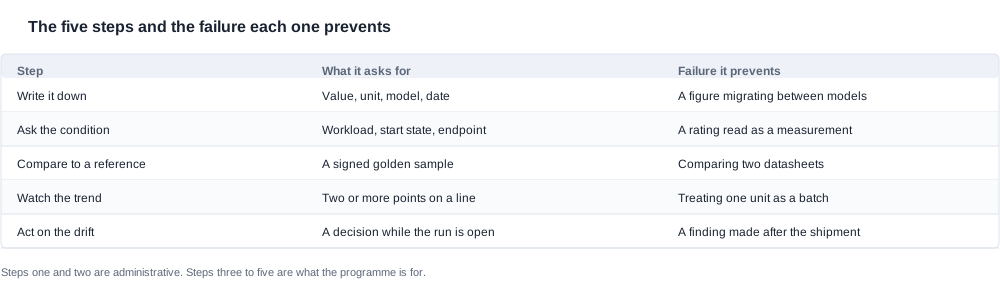
The method is five steps, and each one exists because of a specific failure it prevents.
Step one is to write it down. Value and unit, on the same line, in your own notes, with the model it belongs to and the date you were told it. A number in a conversation is not a number you have. The single most common failure in this category is a figure that migrates from one model to another, because it was never written against a model at all.
Step two is to ask for the condition. How was it measured, on what sample, under what workload, from what starting state. A published rating without its test condition is a label, and the difference between continuous playback and mixed use is large enough to change which model a buyer should pick.
Step three is to compare it to a reference. A signed golden sample, or a retained unit from a previous run, rather than another supplier's datasheet. A datasheet comparison tells you what two suppliers claim; a reference comparison tells you what the unit in your hand does.
Step four is to watch the trend. One unit is a sample; a batch is a distribution. A consistency claim needs at least two points on the line, which is why the first run has to be recorded even when it passes.
Step five is to act on the drift while the run is still open. A trend that is moving is a finding while the run can still be influenced, and an argument afterwards, once the goods have shipped and the channel has re-ordered.

Misreading one: a rated runtime treated as a quality figure
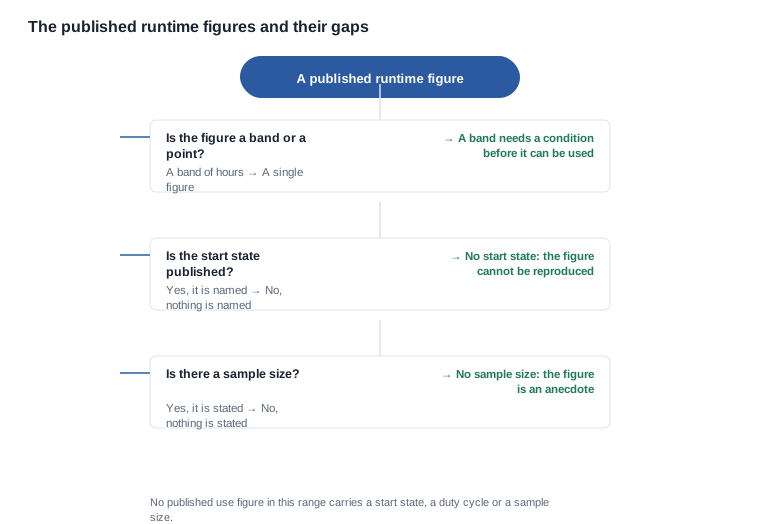
A rated runtime is the number most often quoted and least often examined. The published use figures in this catalogue cover a wide range, and none of them is a measurement of quality: about twenty hours on the A05, the A06 and the A07; about eight hours on the AR glasses, the LC-105-2 and the K02, the LC-105-1 and the ZH12, and the K01 and the YKC02; about six hours on the G07 and the YK12; about seven hours on the MT6 and the CY05, and the L1 Pro and the L2 Utral, and the CY03, the D11, the D12, the D17 and the electrochromic model; six to eight hours on the KY06 and the MT5; five to eight hours on the S7 and the V03, and the V06 and the V03 Pro; and about seven hours on the bone conduction model.
The test condition behind each of those figures is not published. No starting state of charge, no duty cycle, no termination criterion and no sample size appears against any of them, which means the numbers cannot be compared with one another even where they appear comparable. Two units can both be "correct" at eight hours and differ by more than an hour on the bench, and a protocol that omits the start state will produce a rejection rate that has nothing to do with the supplier's process.
The specific mistake is assuming that a lower figure means a worse product. A six-hour model measured under continuous playback may outlast an eight-hour model measured under a mixed workload. A buyer who selects on the published number alone is selecting on an unknown condition, and the gap between the two selections is the gap between a product that works and a product that generates a return.
There is a second trap in the same row, and it is about the two figures that are written with a range. A band is not a number, and a band cannot be passed or failed. A buyer who writes "5~8 h" into an acceptance rule has written a rule with no limit in it, and the range has to be converted into a stated condition and a stated threshold before it can be used at all.
Misreading two and three: a resolution tier, and a catalogue marking, both read as test results
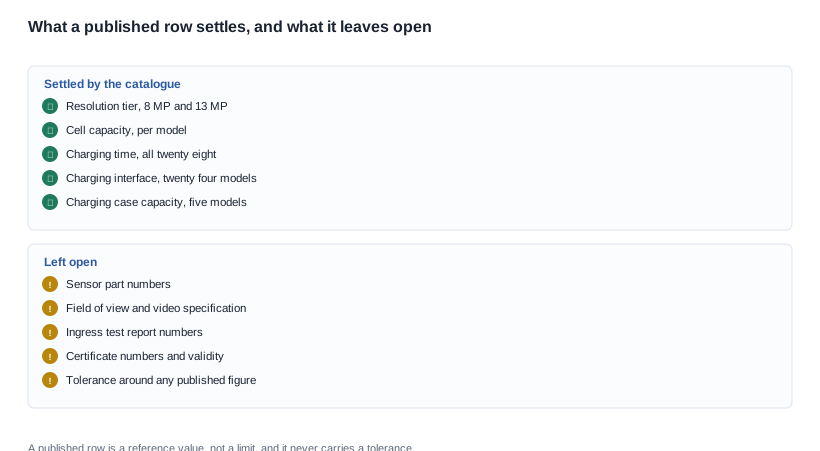
A resolution tier says which tier you are buying, and nothing about the picture. The catalogue publishes two camera tiers: eight models at 8 MP — the V03 Pro and the CY05, the V06 and the KY06, and the MT6 and the MT5, and the V03 and the CY03 — and three at 13 MP — the L1 Pro and the L2 Utral, and the S7. It publishes no sensor part number, no aperture, no field of view, no video specification and no frame rate for any of them, and it does not publish the Bluetooth version for the camera models at all.
So a 13 MP platform and an 8 MP platform cannot be compared on image quality from the specification. The published figure tells you the tier and, usefully, it tells you that a comparison between two units of the same tier is a within-tier comparison, which is a meaningful thing to know when you set up an acceptance test.
A catalogue marking is a statement, not a test report. The IP54 marking in this catalogue appears on two models only, the V06 and the S7, and it is an annotation on the product page. No third-party test report number is published against it, and no ingress figure exists for any other model. A buyer who treats the annotation as a measured result is making a claim that no document supports, and a supplier asked to support it will have nothing to send.
The same discipline applies to the certification question, and it is worth being precise because the wrong answer here is expensive in both directions. Our catalogue does not carry a CE, an FCC or a RoHS marking, a certificate number or a conformity declaration for any model, and it does not publish a per-model certification row. That is not a statement that such documentation does not exist; it is a statement about what our published material contains. So the correct use of those three names in a procurement conversation is as a question: ask which model holds which certificate, ask for the number, the issuing body and the validity date, and ask which laboratory report sits behind it. The answer belongs in the supplier's own file and should be obtained as a document before an order is released.
The mistake in the certification area is usually not a false claim but a false confidence: a buyer who assumes the catalogue's silence means the paperwork is routine, and who therefore does not ask, and who therefore discovers in month nine that nobody can produce the document for the market the goods are in.

Misreading four: the average used in place of the spread
One unit tells you what happened to that unit. A quality system is about the distribution, and the distribution is invisible in a single sample. The published cell capacities across the catalogue run from 40 mAh to 290 mAh and the published use figures run from about six hours to about twenty hours, but that spread is between models, not within a batch, and it is the within-batch spread that a consistency programme is actually about.
Within a batch, the number that matters is the spread rather than the centre. Two units from the same run that behave very differently is a finding, and a supplier who has a sampling plan will already know it, which is why asking for the spread is also a way of finding out whether a sampling plan exists.
The two questions to ask are specific. Ask for the minimum and the maximum observed in the batch against the agreed criterion, not the mean. And ask how many units were tested, because a spread computed from three units is an anecdote with a range attached. The cost of asking is a sentence in the inspection form; the cost of not asking is that a programme built on a mean will accept a batch with a tail in it, and the tail is what the channel finds.
There is a second averaging error that appears in commercial discussions rather than in inspection: the average unit price across a configuration, the average runtime across a tier, the average certification cost across a market. Each of those averages hides the row that determines whether the order is viable, and in each case the row that matters is the worst one rather than the typical one.
What the spread means when the catalogue publishes only one number
The spread problem is harder in this category than in most, because the catalogue publishes a single figure per model rather than a distribution, so a buyer cannot compare the published spread against anything.
That constraint does not make the spread irrelevant; it changes what the buyer compares it against. The reference is the retained unit or the approved sample, which is the only artifact in the chain that carries a distribution of its own once two or three of them have been measured. A first run of three retained units measured on a written protocol gives a crude range, and a crude range is still enormously more useful than a published point figure, because it is the first number in the programme that describes the process rather than the design.
There is a second reason the spread matters commercially, and it concerns the channel rather than the factory. A batch whose units cluster tightly is a batch a channel partner can sell without fear of a surprise. A batch with a wide spread produces a wide spread of customer experiences, and a channel partner who has seen that once will ask for a narrower batch on the next order, whether or not they can articulate why. The spread is therefore a commercial specification and not only an engineering one, and it belongs in the acceptance criteria as a number: the minimum and the maximum observed, against a stated limit, over a stated number of units.

Misreadings five and six: the firmware build ignored, and the first article mistaken for the batch
Ignoring the firmware build is the most likely source of a batch that does not match the sample, and it is the least likely to be caught by a physical inspection. It is a build change, an app update, or a component substitution that nobody wrote down. A firmware baseline, a change-notification commitment and a golden sample signed against a named build are three clauses, and together they are what turn "the product" into a defined thing that two parties can argue about.
Treating the first article as the batch is the second half of the same problem. A first article is built with attention, by the people who know the product best, with material drawn preferentially. A production run is not. That is the entire reason a pilot batch exists, and it is the reason a buyer who has approved a first article and skipped the pilot has approved a unit rather than a process.
The remedy for both is the same in structure, and it is the reason this article ends with a contract section rather than a testing section. These are not measurement problems. They are definition problems, and a definition problem is closed with a document.
What an agreement that avoids the six misreadings contains, and what Cynrin publishes
The six things a quality agreement has to contain
A quality agreement that avoids the six misreadings contains six things, and every one of them is a document that can be checked. A clause that cannot be checked is a clause that will be interpreted in a dispute, and the party that interprets it is the one holding the evidence.
-
The published specification for each model in the order, stated as the catalogue states it, with the model and the configuration named. A specification that names a family rather than a buildable configuration is the root of the configuration drift problem, because the V03 Pro is published in three colours, the V06 in four, and the L2 Utral in two charging case options at 900 mAh and 1400 mAh.
-
The test condition behind every quoted rating, written by the buyer if the supplier will not write it, with a start state, a workload and an endpoint for each measurement.
-
A golden sample retained by both parties, identified by configuration and firmware build, with a rule for where it is stored.
-
A defined defect classification, with the acceptance limit, the base it is measured from, and a statement of which classes trigger rejection, which trigger rework and which trigger a concession.
-
A sampling plan stated in units and method, not in a letter code alone, including who draws the units and from where in the shipment.
-
A change-notification commitment with a notice period, naming what triggers a notice, who receives it and whether the buyer can refuse the change.
The list is short because each item is doing real work. It is also, in this category, the difference between a quality conversation and a quality dispute, because every one of the six can be checked by either party without an argument.
The two clauses buyers skip, and why they are the expensive ones
If a quality agreement is going to be incomplete, it will almost always be incomplete in the same two places, and both are the clauses that cost the most when they are missing.
The first is the test condition behind the quoted ratings. It is skipped because it feels pedantic: the figures are published, the order references the catalogue, and adding a method to each rating appears to be second-guessing a supplier's own documentation. The result is that a dispute about runtime becomes a dispute about the supplier's process rather than a dispute about the units, and the buyer has no way to establish which side is measuring what.
The second is the change-notification commitment with a refusal right. It is skipped because a notice period and a right to refuse sound like a demand for control over the supplier's operations, and a buyer who is not confident about their own specification prefers not to be told about changes. The commercial reality is the opposite: a notice period is worth more to the buyer than to the supplier, because a change that is notified can be evaluated, while a change that is not notified can only be discovered in the field. The right to refuse is the part that will be negotiated hardest and it is the part that is worth the most, because it converts a change from a fact into a decision.
What we publish, what we mark as not published, and the action to take
The working rule we apply: we will quote a figure only in the way that it can be defended, and the caveat travels with the number rather than being left for the reader to find. We publish the per-model figures the catalogue holds: resolution tier, cell capacity, charging time, the rated use with its caveat, the charging interface, the case configuration, the Bluetooth version where the catalogue states it, the colour options and the customisation scope. We mark as Not published the frame weight of every model, the sensor part numbers, the field of view, the video specifications, the ingress test report numbers, the certification numbers, the cell grade and the cell supplier, and the tolerance around any published figure.
The one published weight is the MT6 glasses body at 158 g, including its 265 mAh cell and its camera, and excluding the 1200 mAh folding charging case, whose own weight is not published. That is a whole-unit weight for one model; no frame weight is published for any model, and no other model's weight is published at all.
We will not quote a figure in a way that implies a quality level it does not carry. If you ask us for a runtime, you will get the published rating and the caveat with it. If you ask for an ingress rating, you will get the marking exactly as the catalogue states it, on the two models that carry it, and a note that it is an annotation. If you ask for a certificate number, you will get the number or an honest statement that it is not in our published material, and a list of the documents we will provide on request.
The quality consistency section covers how these terms sit together, the glossary defines the vocabulary the agreement is written in, the AI camera glasses range lists the published baseline, and the commercial side is covered at negotiating quality consistency and at how quality consistency affects lead time.
The action to take now. Send us the models and the figures you are working with, and we will mark each one as published, published with a caveat, or not published in our material, and tell you what question to put to a supplier for the third category. A number you cannot source is worth less than a number you can defend, and the buyer who can defend the number is the one who wins the argument four months later.
Related reading
- The camera and audio range the published rows come from — AI camera glasses
- The commercial negotiation — negotiating smart glasses quality consistency
- The schedule impact — how quality consistency affects lead time


