

Smart glasses quality consistency is not a property of the product and it is not a quality control department. It is what a process produces when four stages each leave a document behind: inputs checked against a fixed bill of materials, versions frozen before the build starts, results judged against a limit that was written in advance, and records retained long enough to settle a dispute. Any one of the four can be skipped and the programme will still run, which is exactly why the failure is usually invisible until a claim is made. Understanding the mechanism is what lets a buyer ask the right question of a supplier, because each stage has a document that proves it happened and each missing document is a specific, nameable gap.
Smart glasses quality consistency and the four stages behind it
The process question this page answers
The reader is a brand-side buyer, a channel buyer or an importer who has been told that a supplier has a quality system, and who cannot tell from the outside whether the system produces anything a buyer can rely on. This is a normal situation in a category where the process is invisible by construction: the product is a small consumer device assembled from a bill of materials, and the difference between a good lot and a bad lot is a difference in the way the same steps were executed on different days.
That invisibility is what makes the question worth asking properly. A buyer who asks "do you have a quality system" gets an answer that distinguishes nothing. A buyer who asks which document proves each of the four stages gets an answer that distinguishes a supplier who controls its process from a supplier who inspects its output, and the difference between those two is the difference between a programme that scales and a programme that grows its returns.
The mechanism is not complicated, and that is the useful part. Every stage produces an artifact. Stage one produces an incoming check against a named bill of materials. Stage two produces a frozen configuration with version numbers. Stage three produces a result with a limit attached to it. Stage four produces a retained record that ties a unit to a lot. The stages are sequential and each depends on the one before, which is why the order of attack matters: a lot that is checked against an unfrozen configuration produces a number that cannot be compared with anything, and a buyer who adds a stage at the front rather than resolving the one in front of it buys rework rather than control.
What a process has to produce to count
A stage counts as controlled when three conditions hold together. The condition has to be stated before the result is known, the result has to be recorded against a unit or a lot rather than against a person, and the record has to survive the person who made it. Remove any one of the three and the stage becomes an activity.
This is the distinction that separates a quality programme from a quality system, and it is why the request to see a procedure is a poor test. A factory can hold a documented procedure for incoming inspection, acceptance sampling and record retention, and still fail all three conditions on every one of them, because the procedure may name a condition that is defined after the result is known, may record the result on a sheet that never reaches the lot, and may live in a binder that leaves with the technician. The useful request is a record, not a procedure: show the incoming record for a named lot, show the configuration sheet that was signed before the build, show the result that carries a limit, and show the file that ties the unit to the lot.
The four stages below are the version we would want to see described in a supplier's own process, and they are the version a buyer can audit remotely using documents that already exist.
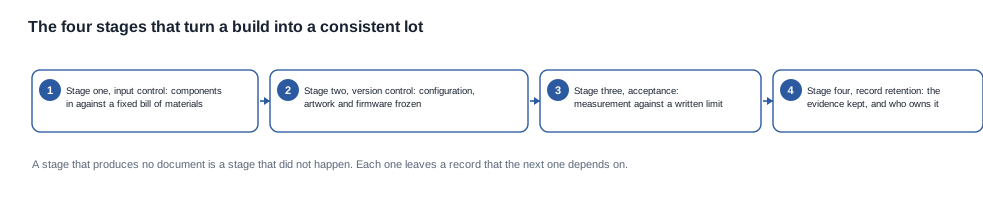
Stage one and stage two: fixing the inputs
Input control, and what it actually checks
The first stage answers a narrow question: did the right components go into this lot? It sounds trivial and it is where a surprising amount of variation originates, because the components in a smart glasses unit are numerous, cheap, individually inconsequential and individually substitutable.
The catalogue shows how many distinct decisions this stage has to cover. Across the twenty-eight models there are at least nine published cell capacities, and the camera models alone carry four of them — 220 mAh, 260 mAh, 265 mAh and 290 mAh. There are two published charging interfaces and a third practice of not publishing the interface at all on four camera models. There are two case options on one model, a 1400 mAh case on three others, a 1200 mAh folding case on one, cases of unpublished capacity on two, and no case on one. There are three colours on one model and four on another. Every one of those is a value that can be substituted without changing the appearance of the finished unit, which is precisely why input control has to be a document and not an inspection.
A good input control record is short. It names the lot, the bill of materials version, the cell capacity that went in, the case capacity and the interface, and it is signed by a named person on a named date. A weak one lists everything that was received, which sounds more thorough and tells a buyer nothing about what went into the product.
Version control, and the document that ends the argument
The second stage freezes the things that can change without anyone deciding to change them: the configuration, the artwork, the packaging and the firmware build. Its output is a single document with version numbers on it, signed by both parties before the build starts.
This is the stage with the highest return per hour in the whole process, and it is where most programmes skip straight to stage three. The reason is that stage one and stage two look administrative while stage three looks like quality control, and buyers tend to buy the thing that looks like quality control. The result is a programme that measures a moving target.
The catalogue gives a concrete illustration. The L2 Utral is published with a choice of a 900 mAh or a 1400 mAh case, so "the L2 Utral" names a family rather than a specification, and a lot that pairs the 1400 mAh unit with the 900 mAh case contains two correct components and one wrong combination. The V03 Pro publishes three colours and the V06 four, so a two-colour plan is two configurations. The four camera models whose charging method is not published — the CY05 and the CY03, and the MT6 and the L1 Pro — need the interface written in words, because it cannot be read from a line. A frozen configuration sheet that names the cell, the case, the interface, the colour, the firmware build and the packaging converts all of these from open questions into specified values, and it does so before any money is spent on inspection.
Stage three: acceptance, where most programmes stall
Why a limit has to exist before a result
The third stage is the one everybody recognises as quality control, and it is the one where a written protocol separates a control from an opinion. A protocol for a characteristic has to state five things: what is measured, the condition before the measurement starts, the number of samples, the limit, and what happens to a unit that fails. Without the condition, the measurement is not repeatable. Without the sample number, a result is an anecdote. Without the limit, a result is a preference. Without the consequence, a result changes nothing.
The published rows in this category make the point about conditions rather than about limits, because the catalogue publishes reference values and no tolerances at all. Charge time is published for every model — up to two hours on twenty-six of them and about one hour on the D17 and the ZH12 — with no starting state of charge and no termination criterion, so two units can both be "correct" and differ on the bench by an amount that has nothing to do with the supplier's process. Runtime is published as a band rather than a figure on the camera models: about seven hours on the CY03 and the L2 Utral, and the CY05 and the L1 Pro, and the MT6, six to eight hours on the KY06 and the MT5, and five to eight hours on the V03 and the V03 Pro, and the V06 and the S7. A band without a duty cycle cannot be turned into a pass or a fail.
So the practical structure of stage three in this category is: take the published value as the reference point, write the measurement condition yourself, agree the limit with the supplier, and record the result against the lot. The limit is not in the catalogue, and that is the honest position — a supplier that quotes a tolerance the catalogue does not contain is quoting something the buyer cannot check.
The measurement that cannot be repeated
Two characteristics in this category are systematically mis-measured, and both failures end as a dispute. The first is camera output. Our catalogue publishes the resolution tier for eleven camera models, eight at 8 MP and three at 13 MP, and it publishes no sensor model, no exposure profile and no image measurement for any of them. A camera comparison without a fixed scene, a fixed lighting condition and a fixed set of settings produces two different pictures and no information, and the buyer who receives a specification sheet that says "13 MP" with no scene has received a number rather than a characteristic.
The second is ingress. The IP54 marking appears on two models, the V06 and the S7, as a catalogue annotation, with no third-party test report number published against it. It can be carried into a configuration sheet as a marking. It cannot be carried into an acceptance rule as a measured protection result, because there is no measurement to point at and no report to cite. The same logic applies to weight, where exactly one model in the range has a published figure: the MT6 glasses body at 158 g, including its 265 mAh cell and its camera and excluding the 1200 mAh folding charging case, whose own weight is not published. It is a whole-unit figure for one model, not a frame weight, and no model in the range has a published frame weight.

Stage four: records, and the disputes they settle
What a lot record has to contain
The fourth stage retains the evidence, and its output is the thing that decides whether a dispute is a conversation or a trial. A usable lot record ties a unit to a production window, ties that window to the components that went into it, and ties both to the results that were measured. That is three links, and a record that contains only the date and the quantity establishes none of them.
The value shows up in the two situations that recur in this category. The first is a complaint: a unit comes back, and the question is whether it belongs to the lot that matches the complaint pattern or to a lot nobody has seen. Without a lot identifier the question cannot be asked at all, and a buyer who cannot ask it has to respond to every complaint on a unit-price basis, which is the most expensive possible response. The second is a drift: behaviour changes gradually across several shipments, and the question is whether there was a break point. A dated set of lot records turns a suspicion into a timeline.
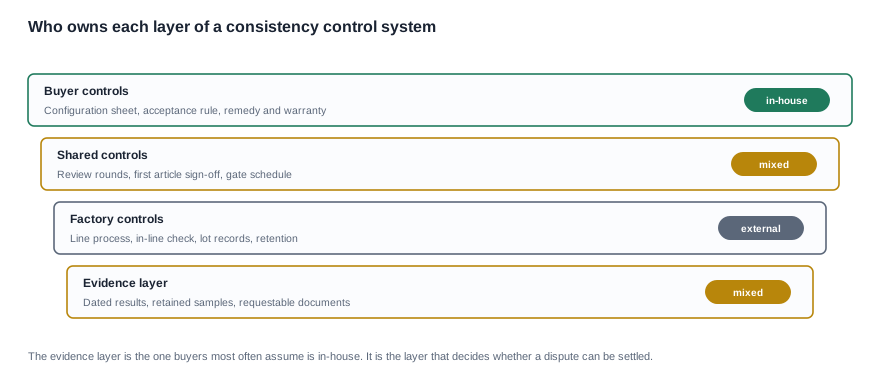
The layers chart is the ownership picture a buyer should insist on, because it is the one most often misread. The controls are not all in one place. The configuration sheet, the acceptance rule and the remedy are the buyer's. The line process, the in-line check and the lot records are the factory's. The approval rounds and the first article sign-off sit between the two. And the evidence layer — the dated results, the retained samples and the requestable documents — is shared, which means it is shared by default rather than by agreement, and shared-by-default evidence is exactly the evidence that cannot be produced when it is needed.
Retention, ownership and the request you can make
Three questions settle stage four, and they are the questions to ask because they have documentary answers. What is retained from each lot, and for how long? Who owns the retained material — the factory, the buyer, or a third-party laboratory? And can we have the record for a named lot without giving notice? A supplier that answers all three has a stage four. A supplier that answers the first and not the other two has a filing system.
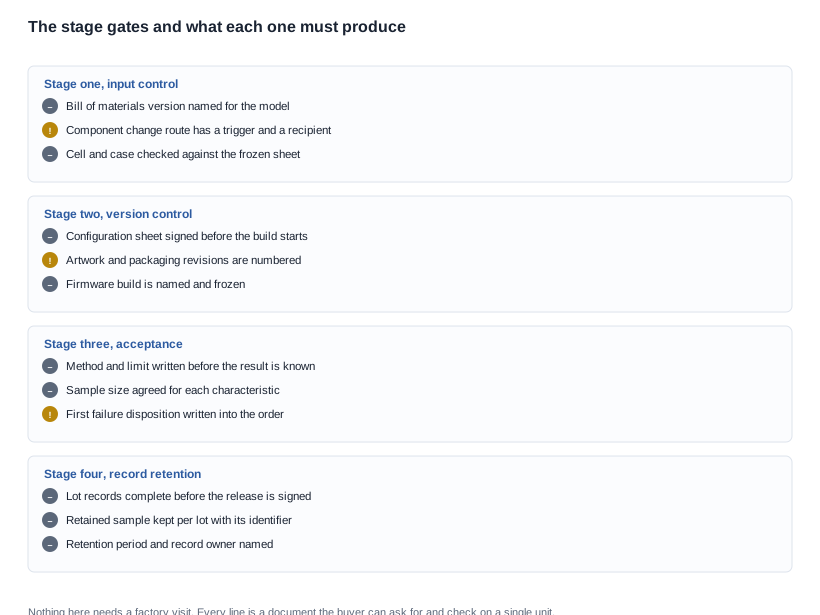
The checklist above is the version to send with a purchase order. Every line is a document, and every line can be checked on a single unit or a single lot without a factory visit, which is what makes it usable as a remote audit rather than an aspiration.

Where the process usually weakens
The five weak points
Five points account for nearly all of the weakness in this category, and they fail in a consistent order. The first is that stage two is skipped, so stage three measures an unfrozen configuration and produces a reject rate that reflects ambiguity rather than workmanship. The second is that the limit is agreed after a result is seen, so the acceptance rule becomes a negotiation and every result becomes an argument. The third is that stage one checks what arrived rather than what went in, so a substitution inside the factory is invisible until the field. The fourth is that stage four exists as a file rather than as a record, so nothing ties a unit to a lot. The fifth is that a configuration change re-enters the system at stage three instead of stage one, so the change is measured but not controlled.
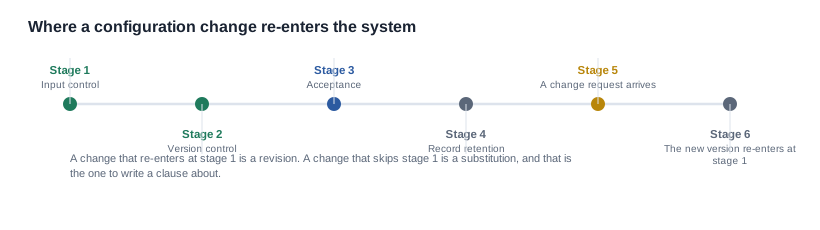
The timeline is the fifth weak point drawn out, and it is the one that separates a revision from a substitution. A change that re-enters at stage one is a revision: the inputs are re-checked, the version is re-frozen, the acceptance rule applies to the new version, and a new record set is opened for it. A change that skips stage one is a substitution, and no amount of measurement afterwards will make the change controlled, because the bill of materials was never re-established against it.
The failure modes that follow from each
The consequence of a weak point is a recognisable failure, and a buyer who knows the sequence can recognise it early. When stage two is skipped, the symptom is a reject rate that rises for reasons nobody can name, and the cause is that the units were never compared against a specification. When the limit is agreed late, the symptom is a first failure that becomes a discussion about what the limit should have been, and the cause is that the rule was fitted to an answer. When stage one checks arrivals rather than inputs, the symptom is a drift across several shipments with no break point, and the cause is a component substitution with no notification route. When stage four is a file, the symptom is a complaint that cannot be attributed to a lot, and the cause is that the lot record was never assembled. When a change skips stage one, the symptom is a gradual difference between two shipments of the same model, and the cause is a change nobody announced.
The commercial form of these failures is always the same. The unit price is irrelevant to all five, and the returns reserve absorbs all five, which is why a programme that is failing at stage two is usually reported as a returns problem and negotiated as a discount request.
A process worked through, and what we publish
A process worked through, not reported
The sequence below was constructed to show how a process works, not to report an engagement. No customer is named and no order is claimed; the camera model, the two shipments and the missing lot records are all assumed, so that the sequence from a complaint to a working process can be followed step by step.
A brand has received two shipments of a 13 MP camera model. The channel reports that a number of units will not hold a charge. There is a good approved sample, a written purchase order, and no lot records. The published configuration for this family includes a 290 mAh cell across the CY03 and the CY05, and the L1 Pro and the L2 Utral, a choice of a 900 mAh or a 1400 mAh case on the L2 Utral, and rated use of about seven hours.
Step one is to work out which stage failed, and the evidence points at stage two. The brand has no configuration sheet, so it cannot say whether the two shipments were ordered with the same case option. If they were not, the cause is a pairing error that every inspection would have passed. Step two is to request the four artifacts rather than the procedures: the incoming record for a named lot, the configuration sheet that was signed before the build, the result that carries a limit, and the lot file. A supplier that can produce all four has the process; a supplier that can only describe one has stage three. Step three is to rebuild the process for the next order, with the four stages in the order above, and with the configuration sheet naming the cell, the case, the interface, the colour, the firmware build and the packaging. Step four is to write the acceptance rule with the condition, the sample size, the limit and the consequence, and to include the first-failure disposition so a failed result stops a lot rather than the line. Step five is to set the lot record requirement, including a retained sample per lot, because the retained sample is what makes a future claim answerable.
The reasoning matters more than the outcome. Not one of those steps required a factory visit, and each of them produced a document that outlives the person who wrote it.
What we publish, and what we will not manufacture
The short answer: the published rows are the part of the specification we can stand behind, and a process is something a buyer verifies rather than something a catalogue asserts. What the catalogue publishes is the input the first two stages work on, and we publish it without trimming: the charging interfaces, the case options, the colour availability, the cell capacities and the resolution tiers, the published runtime bands, the charge times and, for one model, the whole-unit weight with its exclusions. The tolerances, defect rates, cycle life ratings and capacity data are not in it, and a stage three built on an assumed tolerance is a stage three that fails on its first result. We do not publish a defect rate because a process has to be measured on the process, not estimated from a category average, and an estimated rate is a number nobody can act on.
Several of the things a supplier's own file would contain are not in ours, and the difference is worth naming because it decides what a buyer can audit remotely. There is no sensor model, no acoustic measurement or threshold, no ingress test report number, no certificate number or validity date, no cycle life rating, no factory or line capacity, and no weight for any model other than the MT6. Where a model has no published figure, the useful answer is a question to the supplier, and the answer belongs in the same stage of the process as the artefact that will later support it. Two limitations decide what a remote audit can conclude. The IP54 marking on the V06 and the S7 is a catalogue annotation rather than a report-backed claim, and the catalogue text carries no CE, FCC or RoHS marking for any model, so a stage three that assumes either of them is holding a characteristic with nothing to point at. Both belong in the record request rather than in the acceptance rule.
What we can do is take a complaint file and a configuration, work out which stage the evidence points at, and then tell you which documents belong in the next purchase order and which controls belong in the next quarter rather than the next order. The document list is at the quality consistency checklist, the traps are at common mistakes to avoid, and the specification comparison is at the comparison table. The pillar page is quality consistency.
The action to take now. Send us the model, the configuration and the complaint categories, and we will tell you which of the four stages the evidence points at, which four documents to ask for, and which controls belong in the next purchase order. A process that produces four documents is worth more than a quality system that produces a presentation.
Related reading
- The document list — smart glasses quality consistency checklist
- The traps — common mistakes to avoid
- The specification — the comparison table
Send us the model and the complaint categories, and we will show you which stage produced them — the mechanism behind smart glasses quality consistency, described as four documents rather than a system.


