

Six mistakes account for most of the drift a buyer discovers between the first and the second order in this category. None of them is a supplier failing to try, and none of them is a supplier delivering a product of a different quality. Each is a process that was never written down, and the useful property of all six is that they are visible at the moment they are made — which is exactly why they are worth writing down before the order rather than after the complaint.
Smart glasses quality consistency: six mistakes to prevent before they happen
The reader is a procurement manager on the brand side, a channel buyer or an importer who has noticed something in the last delivery or has heard a question from a channel partner, and who wants to know whether the cause is worth worrying about. The short answer this article gives is that in this category the cause is almost never the hardware. The hardware is what the catalogue publishes, and the catalogue is consistent for a given model and configuration. The drift is in the parts of the chain that nobody wrote a criterion for.
The six mistakes share one property, and naming it is the fastest way to recognise them in your own programme: each of them leaves no record. A mistake that leaves a record is recoverable, because the evidence exists somewhere and can be found. A mistake that leaves no record is unrecoverable, because when the drift appears in month nine there is nothing to point at except the passage of time. That is why the fixes below are all about retaining something rather than inspecting harder.
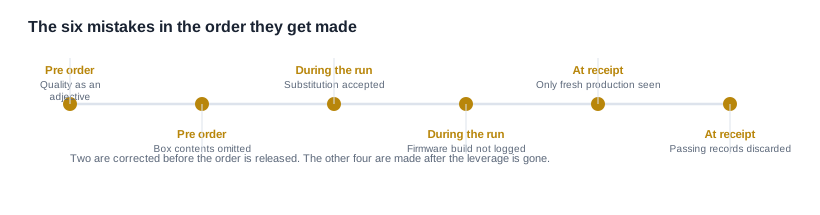
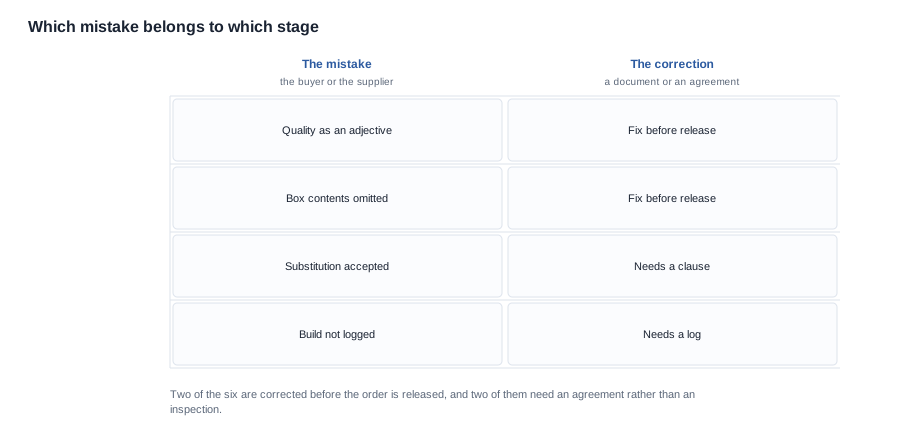
The six also fail in a characteristic order. The first two are made in the paperwork stage, before the order is released, and they are the most expensive in the long run because everything downstream inherits them. The next two are made during the run and are invisible until much later. The last two are made at the point of receipt, where they are still correctable and almost always are not corrected.
What the six mistakes have in common commercially
None of the six is expensive to prevent, and all six are unrecoverable afterwards. That asymmetry is the whole argument.
The preventive action for the first two is a page of acceptance criteria with methods attached, written once and reused. The preventive action for the next two is two lines in a spreadsheet: a part-number list with a sign-off requirement, and a build identifier recorded against each run. The preventive action for the last two is a retention rule and a drawing instruction to the inspection team.
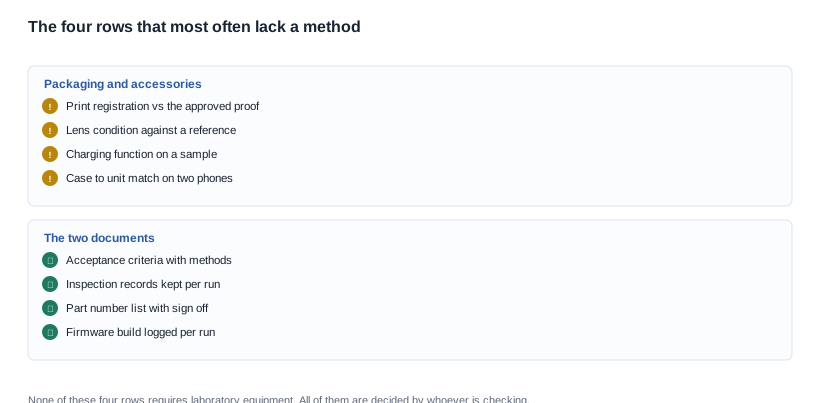
Put together, the six preventive actions are the two documents every consistency programme needs — an acceptance criteria sheet with methods, and inspection records retained per run. Both take an afternoon to create, neither requires laboratory equipment, and neither can be reconstructed at month nine.
The cost of getting this wrong is not linear either. A mistake made before the order is released is usually free to fix. A mistake made during the run costs a production slot, a shipment delay and a channel conversation. A mistake made at receipt costs the units, the reverse logistics and the relationship with the channel partner who reported it.
The six mistakes in one view
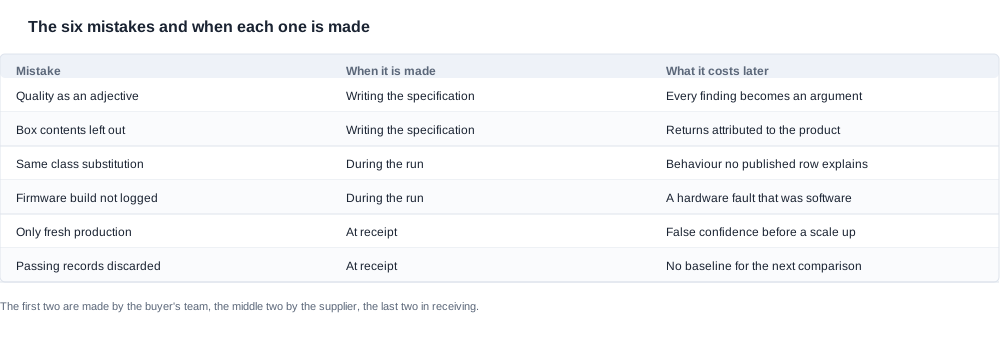
The table below is the working set, and the column that matters is the third one. The first column names the mistake, the second says when it is made, and the third says what it costs when it is discovered later rather than when it is prevented.
| Mistake | When it is made | What it costs later |
|---|---|---|
| Quality defined as an adjective | Writing the specification | Every finding becomes an argument |
| Box contents left out of criteria | Writing the specification | Returns attributed to the product |
| Same class substitution accepted | During the run | Behaviour that no published row explains |
| Firmware build not recorded per run | During the run | A hardware fault that was a software fault |
| Only fresh production inspected | At receipt | False confidence before a scale up |
| Passing records discarded | At receipt | No baseline for the next comparison |
Read as a sequence, the table says something that a list of six items does not. The first two mistakes are made by the buyer's own team and are visible in the buyer's own file, which is why they are also the easiest to correct before the order is released. The middle two are made by the supplier and are invisible to the buyer, which is why they need an agreement rather than an inspection. The last two are made in the buyer's receiving operation and are visible to the buyer, which is why they are the ones most often left uncorrected for no better reason than that the shipment is due to be released this afternoon.

Mistake one: defining quality as an adjective instead of a method
An adjective cannot be applied by two parties who disagree, which means every quality conversation becomes an argument about interpretation rather than a decision about the product. "Acceptable", "good", "consistent" and "within specification" are not criteria; they are placeholders for a conversation that has not happened yet. A criterion with a method attached produces a decision, and a criterion without a method produces a discussion.
The test is simple. Take the word a supplier and a buyer would both use to describe a good unit, and ask what has to be measured to decide whether a given unit is good or bad. If the answer is a second adjective, the criterion is not finished. If the answer is a method, a sample size and a limit, it is.
The rows in this category most often missing a method are packaging print registration, the condition of the lens, charging function on a sample of units, and the case-to-unit match across at least two phone models. None of them requires laboratory equipment. A print registration is compared against an approved proof at a stated distance under a stated light. A charge function is a bench observation with a start state and an endpoint. The case-to-unit match is a two-minute check per unit.
What makes these four rows common is that they are all visible to somebody and invisible to the specification. They are decided by whoever happens to be checking, which is why they vary between lots, and why the supplier's own answer to the question is often that the units are acceptable.
Writing a criterion that survives a dispute
A criterion that will be applied in good faith is not the same thing as a criterion that will be applied in a dispute, and the difference costs a buyer real money in the quarter it matters.
Five elements separate the two. The characteristic has to be named so that both parties examine the same thing. The condition has to be stated, because "the print registration" means nothing without a viewing distance and a light source. The method has to be given, so that the result is repeatable. The limit has to be written down as a number or a named reference, not as a judgement. And the consequence has to be attached, so that a result changes something.
The fourth element is where most criteria fail. A limit written as "within acceptable tolerance" has moved the decision back to the adjective, and the buyer will discover that in the first dispute, at which point the whole criterion set loses credibility. A limit written as a comparison against a named reference — the approved proof, the approved sample, the reference unit from the previous run — is checkable by either party without an argument, and it works even when no numeric tolerance exists for the characteristic in the catalogue, which is the normal case in this category.

Mistake two: leaving the box contents outside the acceptance criteria
Accessories are the components nobody inspects carefully, which is exactly why they get substituted. A cable, a case, a manual and a language insert that differ between runs produce returns attributed to the product rather than to the batch, and they produce them at the point of sale, in a channel partner's warehouse, where the buyer has no visibility at all.
The commercial cost of this mistake is larger than it appears on a purchase order. A substituted cable is a returned unit, a reverse logistics movement, a customer conversation and a channel partner asking why the product keeps failing in ways the specification does not describe. None of those costs sit on the accessory line of the bill of materials, and all of them arrive at the same time as a complaint about the product.
The fix is unglamorous. Put the accessory list into the acceptance criteria explicitly, with the same method and the same limit structure as the device rows, and check them in the same sampling pass rather than as a separate operation. In a category where the charging case option differs by model — the CY05 and the L1 Pro, and the CY03 are published with a 1400 mAh case, the L2 Utral with either 900 mAh or 1400 mAh, and the MT6 with a 1200 mAh folding case — the accessory set is not a minor detail, because a case from the wrong option is a functional fault rather than a packaging one.
The box is where three separate things meet
The reason the box contents deserve a line in the acceptance criteria rather than a general instruction is that three different things meet on the carton, and each of them has its own owner and its own failure mode.
The artwork is one of them, and it is the version-controlled part. The market-access content is a second, and on a European destination it includes the manufacturer information and the responsible economic operator details required under Regulation (EU) 2023/988, applicable since 13 December 2024, which travel on the same print revision as the registration and the colour. The accessory set is the third, and it is the part that is not printed on anything, so there is no artwork revision to catch a change in it.
A drift in the first of these is a returns problem. A drift in the second is a market-access problem, and it does not wait for a customer to report it. A drift in the third is a returns problem that arrives with a description pointing at the device rather than at the box, which is why it takes so long to diagnose correctly. A single acceptance criteria line covering the box contents and the printed artwork revision closes all three, and it is the cheapest line in the whole document.

Mistakes three and four: the substitution and the firmware build nobody wrote down
Mistake three is accepting a same-capacity substitution. A component swap within a capacity tier is invisible on a specification sheet, because the published rows — cell capacity, charge time, rated use, Bluetooth version, charging method and case capacity — do not change. It is visible in behaviour. This is the mistake that most often gets rationalised, because the substituted part genuinely is equivalent on paper, and the buyer's own specification is what made it invisible.
The correction is not to refuse every substitution; that instruction is ignored and it teaches a supplier that the clause is decorative. The correction is to require written sign-off before any critical component changes, with the sign-off naming the part number, the reason and the affected configuration. A buyer who asks for this once and then uses the answer is running a control; a buyer who refuses it and gets silence is running an argument.
Mistake four is not recording the firmware version per run. Uncontrolled firmware is invisible until a channel partner reports a behaviour that no longer happens, and by then nobody can tell which run it came from. A version record per run is one line in a spreadsheet, and it is the only thing that separates a hardware fault from a software fault when a customer calls.

Mistakes five and six: the sample that flatters the factory and the records that get thrown away
Mistake five is inspecting only fresh production. A factory will happily show you a line running for your configuration, and the line will be running correctly. The informative sample is finished goods pulled from stock, from at least two batches, and the reason is structural: a line visit tests the process against its own description, and a well-run line passes that comparison every time. Stock pulled from at least two batches tests whether the process has been stable, and only that comparison can fail.
The commercial version of this mistake is subtler and more expensive. A buyer who audits once, early, against fresh production, gets a result that supports a decision to scale the programme, and the scale-up is where the drift becomes visible in the channel. The audit has produced confidence rather than evidence, and the confidence is what gets escalated.
Mistake six is discarding the records when a batch passes. The passing runs are the ones you need. Without records from run one, you cannot compare run two against anything, and a drift conversation becomes a memory contest in which the supplier usually has the records and you do not. This is also the mistake that is most often accidental, because the incentive to file a passing run is negative: the run passed, the file has no finding in it, and there is always something else to do.
The fix costs almost nothing and has to be written down: retain the record for every run, passing or failing, for a stated period, in a stated place, with a named owner. The period should cover the length of the channel relationship, because the oldest useful comparison is usually the comparison against the first run.
The second-lot rule, and why one batch is never enough
The temptation behind mistake six is a reasonable one: a passing run produces no finding, and the administrative cost of filing a record with nothing in it is borne entirely by the buyer. The counter-argument is arithmetic rather than philosophical, and it is worth stating in the buyer's own terms.
A single passing run is a point on a line. A consistency claim needs at least two points, because a claim about consistency is a claim about the relationship between two things, and one thing cannot be related to itself. The cheapest possible demonstration that a process is stable is two runs on the same configuration, from different production windows, compared against each other. A supplier who has run one batch for you has shown that the process can work once; a supplier who has run two can show you that it worked twice, and the second run is the one that makes the first credible.
There is a commercial reason to insist on the second run rather than wait for a reorder. A first run followed immediately by a second run on the same configuration is a validation activity and it is treated as one; a first run followed by a reorder is a purchase, and a drift discovered in that purchase costs the channel rather than the programme. The two runs cost a shipment and an inspection. The drift costs the relationship.
The two documents that prevent all six, and what Cynrin will do
Every mistake in this list leaves no record, which is why the fixes are all about retaining something rather than inspecting harder. Our defect rate, our consistency figure and our component-vendor list are not published in our documentation, so we will not offer a percentage as reassurance; we will offer the records, and we will say which of them will exist for a given order size and which will not.
What we will do is agree acceptance criteria with you in writing before production, keep inspection records for each run, and tell you in writing when a component or a firmware version changes. We will not define quality as "acceptable" without a method attached, because a definition of that kind cannot be applied by anyone else, and we will not sign a clause that depends on a specification our source material does not contain.
Our published position on the configuration rows is the same as it is everywhere else in this category. The catalogue states cell capacity, charge time, rated use, the charging interface, the charging case option, the resolution tier and the colour availability per model, and it states them for a model rather than for a build. It publishes a unit weight for one model only, the MT6 glasses body at 158 g, including its 265 mAh cell and its camera and excluding the 1200 mAh folding charging case, whose own weight is not published. It publishes the IP54 marking on the V06 and the S7 as a catalogue annotation. It publishes no defect rate, no tolerance and no certificate number for any model, and a clause that depends on any of those has to be written differently or not at all.
The framework is at quality consistency. The five change points in detail are at the quality consistency checklist, the background to what consistency means in this category is at the beginner's guide, and the factory-side method of sampling finished stock is at the advanced factory audit guide.
The action to take now. Send us the models, the configurations and the number of runs completed so far, and we will mark which of the six mistakes your current documentation cannot detect, and which single document would close the largest gap. Six mistakes, two documents and an afternoon is the whole programme, and the expensive part of it is doing it twice.
Related reading
- The five change points in detail — quality consistency checklist
- What consistency means in this category — quality consistency beginner guide
- Sampling finished stock on a factory visit — advanced factory audit guide


