

Smart glasses quality consistency covers two different questions that share one word, and most of the difficulty in this category comes from buyers asking the second one when they needed the first. The first question is whether a production run matches the published specification, and that question is answerable because the catalogue publishes a precise, narrow set of rows for all 28 models. The second question is whether the units inside a run match each other, and that question is not answerable from any published data at all: it needs a golden sample, a test plan and a record, and a supplier who will produce the record.
This article works through both, in the order a programme actually needs them. It sets out exactly which rows a run can be held to and which cannot, what records make a run traceable, the loop that connects an approved sample to a dispatched shipment, and the four places a consistency programme usually breaks.
Smart glasses quality consistency: two different questions that share one word
Three questions that settle consistency fast
Three things settle most consistency questions before a buyer has to escalate. First, the acceptance baseline in this category is unusually thin, and a buyer should know it in advance: the published rows cover cell capacity, charge time, run time, camera class, charging interface where it exists, charging case capacity where it exists, an ingress marking on two models, and a unit weight on one. Everything else — the camera sensor, the field of view, the frame rate, the defect rate — is not published for any model, so a consistency programme can assert nothing about it from a figure. Second, a run that is internally consistent but wrong is entirely possible in this category, because the published rows leave four camera models with no charging interface stated and four with no charging case row stated, and a blank row is silence rather than a published decision. A configuration that is not pinned produces a run that is perfectly consistent and consistently wrong. Third, the record that does the real work is not a test result; it is the frozen configuration sheet with a date, because it is the only thing that connects a unit in a warehouse back to what was ordered.
Who is asking, and what the consistency claim has to survive
The reader is a brand-side procurement lead, a channel buyer or an importer, and the moment is usually either before a first order or after a problem. Before the first order the question is what to require, and the answer is a set of records rather than a reassurance. After a problem the question is what can be proved, and the answer is the same set of records, retrospectively.
What the buyer is managing is the gap between two claims: the claim the brand makes to a channel, and the claim the supplier can evidence. A retail buyer asked to substantiate a specification will ask for a document, and a document that does not exist cannot be created after the fact. A marketplace amplifies a return rate and the language of the reviews, so a consistency problem that would be a single returns line in a direct channel becomes a listing problem. The cheapest place to solve all of that is before the first shipment, when a frozen configuration sheet and a golden sample cost nothing and cannot be manufactured retrospectively.
What the catalogue supports, and what it cannot answer
The published position supports a consistency programme in a specific and limited way, and it is worth stating the limits precisely rather than approximately. The catalogue publishes a company-level export-certification page and no per-model certification row, and the published text carries no CE, FCC or RoHS reference for any model, so a consistency claim about certification is a document request rather than a published fact. It publishes a unit weight for exactly one model, the MT6 at 158 g for the glasses body including the 265 mAh cell and the camera, with the foldable charging case excluded and the case weight not published. It publishes an ingress marking on two models, the V06 and the S7, and on no other row in the range.
The quality consistency document request is the request list, the glossary is the shorter version of the record set, the advanced guide is the longer treatment, and the industry benchmarks article is the honest way to treat benchmarking in a category with no published test conditions. The production capacity quality effects article covers why the same process matters more when a line is under pressure.

What a production run can actually be held to
The ten rows, and what each one can carry
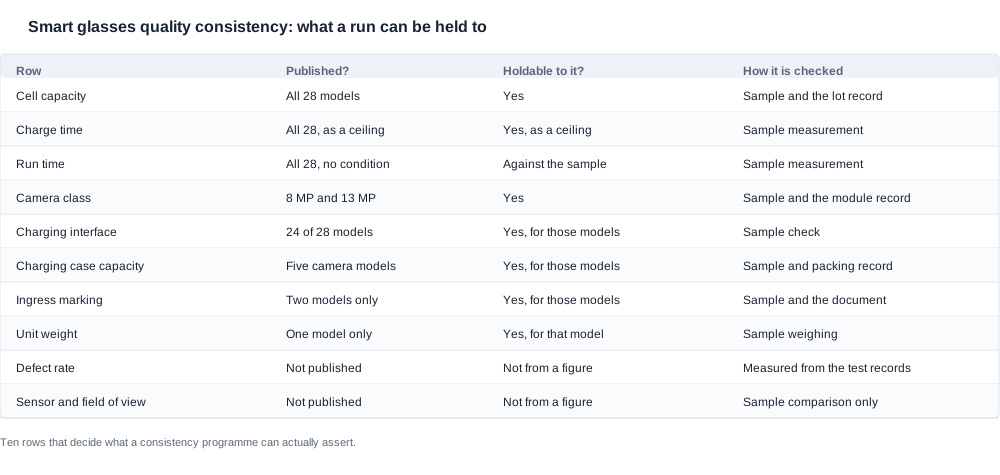
The table below is the acceptance baseline. The third column is the one that decides what a buyer can assert to a channel: a run can only be held to a published figure where one exists, and where the published figure comes with a condition, the condition has to be carried into the claim.
The rows that carry a condition, and what a buyer has to do about them
Three of the ten rows need more care than the rest, and each of them is a place where a consistency claim goes wrong quietly.
The charge time is published for all 28 models, and for 26 of them it is written as a ceiling of two hours or less, while the D17 and the ZH12 are written as about one hour. A ceiling is an upper bound, so a run can be held to it, and the claim a buyer makes has to be a claim about the ceiling rather than a claim about what the unit actually achieved. A buyer who writes "charges in under two hours" has made a stronger statement than the published row supports, and the gap between those two statements is exactly where a return claim comes from.
The run time is published for all 28 models and carries no test condition. A run can therefore be held to the approved sample and to the published figure, but not to a published endurance figure in the sense of a measured result, because there is no condition behind the number to measure against. The industry benchmarks article is the right treatment of that distinction.
The ingress marking is published on the V06 and the S7 only, with no third-party report number behind it in the published material. A consistency programme for those two models therefore has a row to check and a document to request, and for the rest of the range it has neither, which means an ingress claim made in a listing is a claim the published position does not support at all. The certification documentation requirements is the field-level version of the document request.
The four rows that are not published, and what to do instead
The camera sensor model, the field of view, the frame rate and the defect rate are not published for any model in this range. A consistency claim about any of them has to be made against a sample rather than against a figure, and that is not a weaker position than it sounds — it is a different one, provided the sample is approved, retained and retrievable.
The defect rate deserves particular care, because it is the row buyers ask for most often and the one no supplier can honestly publish. The reason is that a defect rate is a property of a run over a period, not a property of a model, so any figure quoted as a standing number is somebody's estimate rather than a measurement. What can be given instead is the test plan, the pass criterion and the record, and the rate then becomes measurable rather than asserted. A buyer who receives a defect rate as a figure in a quotation should ask what the denominator is and over what period, and a supplier who cannot answer that has quoted an average.
The records that make a run traceable
The eight records, and what each one is for
A run is traceable when eight records exist and can be produced together, and each of them answers a different question that a channel or a customer will eventually ask.
- The frozen configuration sheet, dated and signed. It answers what was ordered, and it is the document that links every other record to a specific build.
- The approved golden sample record, with a serial. It answers what the approved unit was, and without it there is nothing to compare a production unit against.
- The firmware build record, with a build identifier and a build date. It answers which software is in which unit, and it is the record most often missing.
- The cell and component batch record. It answers which lot a unit came from, and it is the link that makes a trace from a finished unit back to its parts possible.
- The unit and case pairing record. It answers which case goes with which unit, and it matters more here than in most categories because the charging case is a separate purchased part with its own capacity options.
- The test record, with a pass criterion. It answers whether a unit was checked against something or merely checked.
- The artwork and packaging approval, dated. It answers which version of the artwork went into which run, which is the only way to stop a packaging change reaching a channel by accident.
- The non-conformance and change log. It answers what went wrong and what was done about it, and it is the record that makes a second run better than the first.
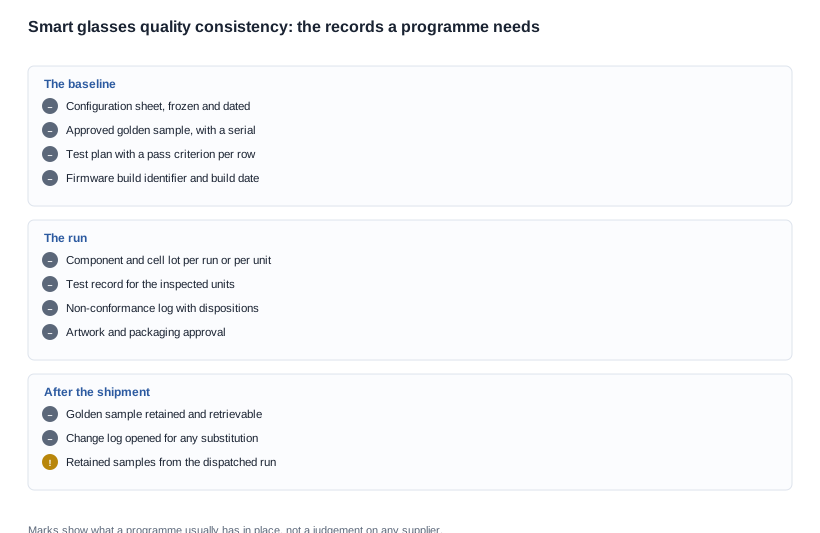
The three items in the last group are the ones most programmes leave to the end. A golden sample that has been thrown away cannot be produced retrospectively, a change log opened only after a substitution cannot describe the substitution, and retained samples from the dispatched run are the only way to answer a question raised months later by a unit that is already in a warehouse.

The golden sample loop, and where consistency usually breaks
The loop that connects an approved unit to a dispatched one
The loop below is the mechanism. It is short, it is entirely documentary, and it is the thing that turns a promise of consistency into something a buyer can demonstrate.

How many units to inspect, and when
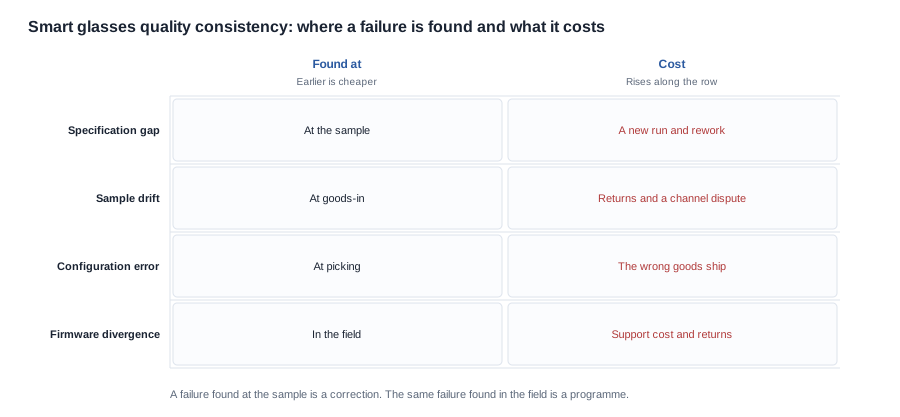
The practical version of the fourth step is a sampling rule, and it belongs in the order rather than in a conversation. The rule a buyer can defend is to inspect the first units of the run against the golden sample, to state the number and the selection method in the inspection instruction, and to keep the retained samples from the same point in the run. The reason to inspect early rather than late is that a defect found in the first units is a correction to a run that has not shipped, while the same defect found at goods-in is a return, a channel dispute and a re-order.
There is a second reason the selection method matters as much as the number. A sample drawn from the start of a run and a sample drawn from the end of it are different samples, because a run that changes process part-way through produces two populations. Asking for the method as well as the count is what stops a favourable sample from standing in for the whole run, and it is the cheapest possible protection against a consistency claim that is technically true and practically misleading.
Separating a specification problem from a process problem
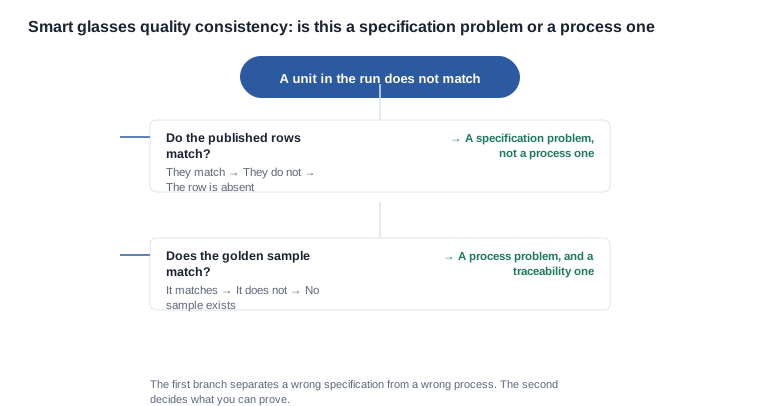
When a unit in a run does not match, the first question decides everything that follows. If the published rows for the model do not match, this is a specification problem and the fix is in the specification. If the published rows do match but the golden sample does not, this is a process problem and the fix is in the process. And if the row is absent — which in this category applies to four camera models with no charging interface stated and four with no case row stated, and silence rather than a published decision that a buyer could copy into a specification — then there is no specification to be inconsistent with, and the first action is to write one.
The four places a consistency programme breaks
The run that is consistent and wrong. The configuration was never frozen, so every unit in the run matches every other unit and none of them matches the order. This is the most common failure in this category precisely because the published rows are silent on several of the axes that matter. The control is the dated configuration sheet, and the check is the case pairing record, which is where a mismatch shows up first.
The change that reached the field without an identifier. A firmware update went out to units already shipped and there is no build identifier, so a support question cannot be traced to a version. The control is a build identifier on every unit and a stated policy on updating shipped units.
The packaging that changed and nobody noticed. A new artwork or a new box reached a channel after the goods were made, and the listing now describes something that was not in the carton. The control is the dated artwork approval, and the habit of comparing the run's artwork against the approved one before dispatch.
The inspection that measured nothing. Units were inspected, and the record says they passed, but there is no pass criterion behind the pass. The control is a test plan that states, per row, what was measured and what the line is, and a record that shows both.

When something goes wrong, and what to ask for instead
A unit that fails at goods-in
The answer is the non-conformance process, and it is worth asking for it in four parts: what is contained, who is told, what is recorded for the next run, and whether the failed unit is reworked or scrapped. The fourth part is the one that is usually left out, and it is the one that decides whether a failure becomes a traceability problem. A reworked unit that re-enters the same run has to be recorded as a reworked unit, because a run that contains a reworked unit is not the same run as a run that does not, and the difference is invisible unless it is written down.
A firmware change reaching units already in the field
The requirement is a build identifier, a build date, and a stated policy on updating shipped units. The policy matters as much as the identifier: a decision about whether already-shipped units are updated, and on what terms, is a commercial decision that has to be taken deliberately rather than inherited from whatever the application does by default.
A price that does not include a defect rate
Because no defect rate is published for this category, any figure in a quotation is the supplier's own estimate rather than a measurement, and the honest answer is to ask for the test plan, the pass criteria and the record instead. The rate then becomes measurable rather than asserted, and a measurable rate is worth considerably more to a buyer than an asserted one, because it can be tracked across runs.
What to ask for when the answer is "not published"
The general form of the answer is always the same shape: here is the record, here is the test, and here is what is not published. A buyer who receives "not published" for a row should ask two follow-up questions. The first is whether the row exists in the supplier's own records for this configuration, because a figure that is not published is frequently still measured. The second is whether the record can be supplied for the programme, which is a different question from whether it appears on a website, and in this category it is usually the question that produces the useful answer.
What we publish about consistency, and what we will not
Stated plainly: the questions buyers ask most are the ones the published material cannot answer, and the answer is always the same shape. We publish the model-level data — the cell capacity, the charge time, the run time, the camera class, the charging interface where a row exists, the charging case capacity where a row exists, the ingress marking on the V06 and the S7, and the unit weight on the MT6 — and we will supply the records for a production run, and we will also say plainly which of them we cannot hold a run to.
What we will not do is publish a defect rate, a yield figure, a certification reference for a model, or a weight for any model other than the MT6, and we will not hold a production run to a published figure where no test condition exists behind it. A run can be held to the published rows and to the approved golden sample, and to nothing else. That is a narrower claim than some suppliers make and a stronger one, because it is the claim a buyer can actually evidence to a channel after a unit fails.
If you tell us the models, the configurations and the run size, we will say which of these questions we can answer with a document, which needs a sample, and which needs the record to be kept during the run. The quality consistency pillar sets out the wider framework, and the AI camera glasses range lists the published data behind every row in the table above. The short version of the whole subject is this: smart glasses quality consistency is asserted against a frozen configuration and demonstrated against a retained golden sample, and a programme that has both can answer any question a channel asks.


