

A sample order is a specification instrument, not a purchase, and the cost of a sample programme is decided by what you measure rather than by what you are sent. Every attribute you test on a sample is an attribute you can fail later, and every attribute you settle on a sample is an attribute that does not need to be re-opened in production.
This guide is for the buyer who has not sampled in this category before. It covers what a sample can actually prove, the three tiers of evidence available to close a specification, the evaluation sheet that turns a unit into a decision, how to write the request so the answer arrives with the hardware, and what to do when the unit disappoints.
The single most common mistake in a first programme is treating the sample as the answer rather than as one of three inputs, and the cost of that mistake is a specification that never closes.
Smart glasses sample policy: the first things a new buyer should decide
Decide what the sample is for, before you ask for it
The first question is not which model. It is what the sample has to settle, and the honest answer narrows the scope of everything else.
There are three things a buyer can want from a sample, and they have different costs. A sample can settle whether a product is worth developing around at all, which is a question of direction. It can settle a specific attribute — the field of view, the charge behaviour, the case size — which is a question of specification. Or it can qualify a unit for a production order, which is a question of acceptance and which needs a different kind of evidence entirely.
Most first programmes mix the three and then wonder why the sample did not answer the question. A sample that was bought to explore cannot later be used to accept a production unit, because exploring produces an impression and accepting requires a criterion.
Write the requirement before the request
The requirement is one paragraph and it decides everything downstream: the job, the market, the volume, and the environment the unit has to work in. In this category it usually collapses to a tier, a configuration and a case, and getting that collapsed form written down is what prevents the conversation drifting into feature comparison.
The test of a written requirement is whether it disqualifies models. A requirement that every model in the range satisfies is not a requirement; it is a topic. A requirement that names a configuration, a case option and a volume disqualifies most of the range, and disqualifying models early is the cheapest way to shorten a sampling programme.
Decide the commercial shape of the sample
A sample is a cost, and the cost has three parts that buyers often blend together. There is the sample fee itself. There is the round's calendar time, which usually exceeds the fee in commercial terms because the schedule is the scarce resource. And there is the cost of the second round, which is higher than the first in both cash and time, and which arrives when nothing in the programme has been decided.
Agreeing the number of rounds, what triggers another, and whether the sample charge is credited against a first order, before the first round starts, is the cheapest control in this category. The samples section covers the commercial side, and the sample request SOP is a procedure you can copy for the request itself.
Accept that the sample will not close the specification
The most important decision is the one that sets expectations correctly before anything is ordered. A sample closes some attributes, some attributes close on a document, and some close only on production data collected after launch. A first programme that expects the sample to close everything will treat an honest gap as a failure, and will either reject a good product or sign an order against a risk it never priced.
How to choose between two models you have sampled
The most common first-round decision is not a decision about a supplier at all. It is a decision between two models in the same range, both of which passed. The way to make it is to score them against the requirement rather than against each other.
Write the requirement down as a small number of criteria, each with a line it has to meet, and then assess each model against the whole set. The criteria in this category are the ones that decide a programme: the configuration that will actually be ordered, the case option, the charge time against the turnaround the channel needs, the rated use against the shift length, the certification route for the destination market, the unit price at the planned volume, and the lead time at that volume.
Two things follow from that. First, the model that wins on the most criteria is not necessarily the model to buy; the model that fails on a criterion the programme cannot compromise is out regardless of its score elsewhere, and that test has to be run before the scoring. Second, the comparison is only valid if both models were assessed against the same criteria, which is the reason a written evaluation sheet matters more than a careful judgement.
The comparison you should avoid is the one that compares the two models on published rows alone. Two models that look close on the catalogue can be in completely different product tiers, and the figure that separates them is often the one that was not compared.
The red flags in a first sampling request
Four things in a request are worth treating as warning signs, because each of them quietly makes the sample less useful. A request for "the latest model" rather than a configuration, because the latest model is not an orderable thing. A request with no test list, because the answer will be an opinion. A request that asks for the catalogue figures, because the catalogue already settles those and the sample is being spent on them. And a request with no volume and no market, because the supplier cannot quote the sample scope and cannot say which documents the unit should arrive with.
None of these is a reason to stop sampling. They are reasons to spend five minutes before spending a week, and the return on those five minutes is the difference between a sample that produces answers and one that produces a second round.

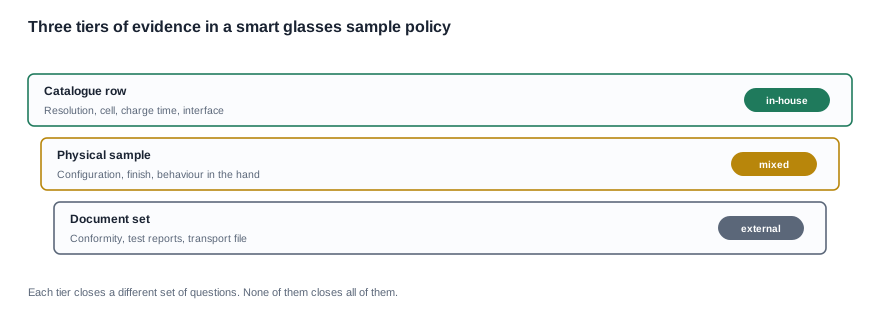
Three tiers of evidence, and what each one is good for
The catalogue, the hardware and the documents are three different kinds of evidence, and they are good at three different things. Confusing them is the source of most sampling disputes.
Tier one: the catalogue row
The published specification set is the cheapest evidence available and the best narrowing tool in the category. For our range it gives the resolution tier — eight of the eleven camera models sit in the 8 MP band and three sit in the 13 MP band — the cell capacity per model, the charge time for every model, the rated use, the charging interface for all but four models, the case capacity where one is published, the Bluetooth version for the audio, sport, children's and lens entries, and the colourways on the models that publish them.
What a catalogue row can do is tell you, before any money changes hands, which models can even be considered for a programme. It is fast, free, and it is specific enough to write a requirement against.
What it cannot do is tell you whether a specific unit in a specific box conforms. The catalogue is a description of a product line, and a description is not a measurement of an individual article.
Tier two: the physical sample
The sample is the only tier that produces direct physical evidence, and its value depends entirely on what you do with it. It is the tier that settles configuration, finish, packaging, the presence and behaviour of the interface, the general behaviour of the firmware and the assistant, and the unit's own dimensions and weight in the hand.
It is also the tier that is most often wasted, because a unit with no written test list produces an impression rather than a set of answers, and an impression cannot be defended, shared or compared with the next round.
Tier three: the document set
Documents close the attributes that describe a type rather than a unit: the EU declaration of conformity under the relevant directive, the Radio Equipment Directive (EU) 2014/53/EU where the product is in scope, the general product safety technical documentation where applicable, the battery transport paperwork for a unit with a cell, and any test report for a specific claim.
The critical point is that the catalogue does not carry these. It has a company-level export certification page, no per-model certification row, and no CE, FCC or RoHS text at all, and two models — the V06 and the S7 — carry the IP54 marking without a published test report number. Buyers ask about those marks because they matter, and the correct answer is that they are written materials to request and verify, not figures to read off a catalogue.
What each tier is good for, in one line each
The catalogue narrows. The sample confirms. The document authorises. A specification that is closed on all three is closed; a specification closed on only one of them has two open ends that will surface later, usually at the shipping stage.
What a sample settles and what it cannot
The table below is the working version, and it is worth reading as two columns of equal length: the attributes a sample can settle, and the attributes it cannot.
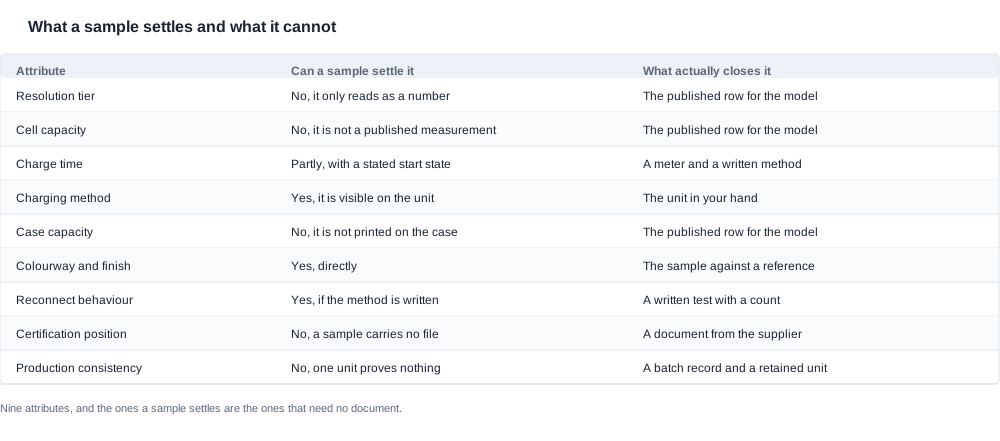
| Attribute | Can a sample settle it | What actually closes it |
|---|---|---|
| Resolution tier | No, it only reads as a number | The published row for the model |
| Cell capacity | No, it is not a published measurement | The published row for the model |
| Charge time | Partly, with a stated start state | A meter and a written method |
| Charging method | Yes, it is visible on the unit | The unit in your hand |
| Case capacity | No, it is not printed on the case | The published row for the model |
| Colourway and finish | Yes, directly | The sample against a reference |
| Reconnect behaviour | Yes, if the method is written | A written test with a count |
| Certification position | No, a sample carries no file | A document from the supplier |
| Production consistency | No, one unit proves nothing | A batch record and a retained unit |
The two rows worth pausing on are the ones in the middle of the table. Charge time is partly settleable, and the part that is not settleable is the important part: the catalogue publishes the charge time for every model, at two hours or less for twenty six of them and around one hour for two sport models, but it publishes no starting state of charge and no termination criterion. A sample can be measured, and a measurement without a stated start state is a number without a meaning.
Production consistency is the row that catches people. One unit proves that a product exists, not that a run will match it. If consistency is what the programme is buying, a sample is the wrong instrument and the answer is a first production run with a batch record and a retained unit, not a better-designed sample.

The evaluation sheet that turns a sample into a decision
An evaluation sheet is a one-page document that names every attribute you will judge, the method for judging it, the result, and who signs it off. A sample programme without a signed sheet ends with a subjective opinion and a second round, and the second round happens because the first result cannot be compared with anything.
The four columns that matter
The attribute, named specifically enough that a second person would test the same thing. "Battery" is not an attribute; "charge time from a stated start state, measured on the supplied unit" is.
The method, in enough detail that it can be repeated by someone who was not present. Where the method is a comparison, it is against a named reference. Where it is a measurement, it is a measurement with a named instrument and a stated condition.
The result, recorded as a value, a photograph or a written observation. Not a judgement. A judgement made during the test is a conclusion, and the conclusion belongs in the fourth column with a signature.
The signature and the date, from a named person on each side. A sheet signed on both sides is a document two parties have agreed, which is a fundamentally stronger position than two people who remember a conversation differently.
What the sheet does not need
It does not need a summary section, a recommendation section or a score. Those are written after the results, and they are written by the buyer, and the moment a sheet carries a conclusion it stops being evidence and starts being advocacy. The how to proceed from a sample to a bulk order article covers the method the sheet supports, and the running a sample before a bulk order piece covers the stage that follows it.

How to ask for a sample so the answer arrives with it
The request is the cheapest place to improve the whole programme, because everything asked for up front is a question you do not have to ask twice.

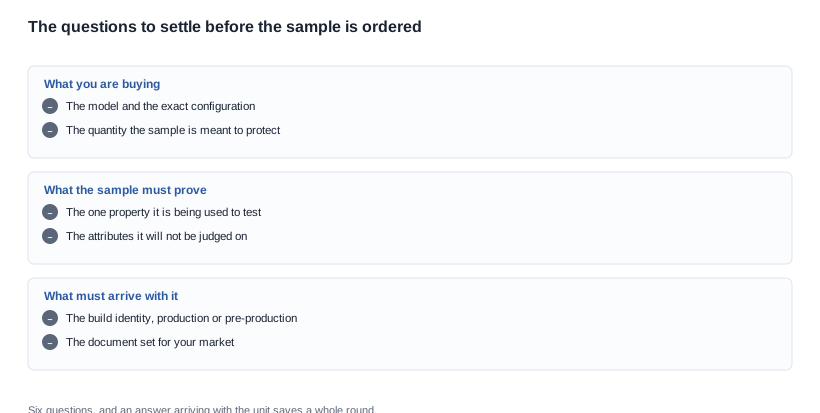
Six steps, and the fourth is where a first programme usually stalls.
Name the model, the configuration and the property
The request should specify the exact configuration rather than the model, because a model code is not always a shippable thing. In the camera family, L1 Pro and the CY03, and CY05 each ship with a 1400 mAh case, the L2 Utral is published with a 900 mAh or a 1400 mAh case, the MT6 ships with a 1200 mAh folding case, the KY06 and MT5 ship with a case whose capacity is not published, and the V03 Pro has no charging case. Each of those is a separate order line, and a request that says "a sample of the L2 Utral" has a fifty per cent chance of returning the wrong article.
The property should be stated as one testable thing with a method, because that is what makes the result usable and what makes the next round comparable with this one.
Ask for the build identity in the same message
Whether the unit is from the production line or a pre-production build, and the firmware build identifier. It costs the supplier nothing to state and it is the difference between a reference object and a curiosity. A pre-production unit looks almost identical to a production unit and behaves almost identically in a demonstration, which is exactly why it gets approved by accident.
Ask for the documents to travel with the unit
The specification sheet, a test report summary where one exists, a packing list naming the model code and the case configuration, and a written statement of what was not tested. A supplier that answers "there is no report for this model" has given you more than a supplier that sends a folder with a company-level certificate in it.
Ask the questions the sample cannot answer
This is the step most buyers skip, and it is the one that prevents the second round. Ask for the certification route for the destination market, the cell part number behind the published capacity, the test condition behind the published charge time, and the frame weight for the model. The catalogue publishes none of these for this range, so they are questions rather than look-ups — and the answers are documents or a written statement, not hardware.
What to do when the sample arrives and disappoints
A sample that fails is the cheapest failure in the category, and the response to it is procedural.
Separate the failure types before reacting
There are four kinds, and they have different consequences. The unit does not match the published row, which is a specification dispute and possibly a legal one. The unit matches the published row and does not meet your written requirement, which is a requirements problem. The unit performs inconsistently, which is a sample of one and therefore inconclusive. And the unit is simply not the product you expected, which is a communication failure on both sides and the most common of the four.
Sorting these before anything else is what keeps a disappointing sample from becoming a dispute with a supplier who has actually done nothing wrong.
Make the result a record, not an impression
Photograph the unit, the label and the packaging. Write down what was measured and what was observed. Date it and sign it. The reason is simple: a sample that produces a signed record can be compared with the next round, shared with a colleague and quoted in a conversation with the supplier. A sample that produces a strong opinion can be none of those things, and the next round starts from zero.
Use the gap list rather than the rejection
Write down every attribute the sample could not settle, and against each one decide whether it is a blocker, a caveat that goes into the product description, or something the programme will live with. That list is the difference between a purchase and a hope, and it is the document that tells the next supplier what to send.
The realistic outcome of a first round is not a go or a no. It is a specification that is now two-thirds closed, with a short list of items that need a document and a method, and a much clearer idea of which models the programme should be built around.
Put the total cost of the round on the page before you order
The sample fee is the part everyone quotes and the part that matters least. The total cost of a sampling round is the fee, plus the calendar time the round occupies, plus the cost of a second round, plus the cost of the specification work that has to be redone if the first round is wasted.
For a first programme the calendar is usually the largest term, because the time between requesting a sample and being able to place a bulk order sits directly in the launch schedule. That is the term a buyer can reduce by writing a sharper request, and it is also the term a supplier can reduce, so it belongs in the negotiation rather than in a corner of the model.
The negotiation points are short and specific: the number of rounds included, what triggers another, whether the sample charge is credited against a first order, who carries the cost of a round that was sent against the wrong configuration, and the lead time quoted for the bulk order that follows. A buyer who asks these in the first round establishes which quotation is complete, because a quotation that does not answer them has a hidden term in it.
The trade-off worth naming is between a wide first round and a narrow one. Three models tested against one property each is usually more informative than one model tested against ten properties, because a result you can act on is worth more than a result you have to interpret. Which model to pick is a question about your programme, and the criteria that settle it are the ones you wrote down before the samples were requested.
Related reading
- Camera and audio smart glasses range
- A sample request SOP you can copy
- Running a sample before a bulk order
- smart glasses sample policy
- How to proceed from a sample to a bulk order
- How to verify a sample policy before you commit
Send the configuration, the quantity and the market, and we will say which parts of smart glasses sample policy are settled by the catalogue, which need a unit, and which need a document — and which are yours to close.


