

There is no single kind of sample and no single kind of sample policy, which is why sample requests go wrong so often. There are four arrangements, they prove different things, and they cost different amounts of time and money. This smart glasses sample policy comparison table sets the four side by side, shows the three beliefs that push a buyer into the wrong one, and explains how to compare two suppliers' policies without comparing the wrong columns.
The single most useful column in the comparison is the one that says what the arrangement cannot prove. A buyer who reads only the first column will buy the cheapest arrangement and then find out that the question they needed answered was never on the table.
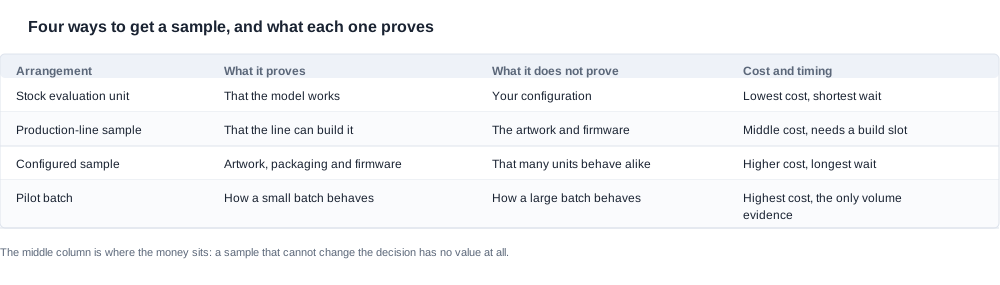
Smart glasses sample policy: comparing four ways to obtain a unit
The conclusion first. Price a sample by the decision it settles, not by the fee on the quotation, and the arrangement follows from the decision rather than from the budget. A buyer who needs to know whether the category suits the programme takes a stock evaluation unit. A buyer who needs to know whether their logo, carton and firmware exist as a set asks for a configured sample. A buyer who needs to know how a lot behaves asks for a pilot lot, and no arrangement of a single unit will substitute for it.
Two of the four arrangements also have a precondition worth stating. A production-line sample needs a build slot, and a configured sample needs artwork and firmware that already exist or a build to hold them. Neither is a problem, but both add a step to the calendar, and a buyer who plans around a unit arriving in a week and receives a unit in a month has mis-planned.
There is a fifth possibility that is not an arrangement at all, and it is worth naming because it is regularly mistaken for one. A supplier that sends a catalogue extract, a configuration statement and a written answer to a short list of technical questions has provided a documentation package, and for a buyer whose question is about published specification rather than about hardware, that package is the cheaper and faster instrument. It is not a substitute for a unit, but it is the correct instrument for a decision that does not need one, and recognizing that saves a shipment and a cycle. The documentation requirements article sets out what a good documentation package contains.
Who this is for, and what they are comparing
The reader is a procurement manager on the brand side, a channel buyer or an importer, and the question in front of them is which arrangement to request from a supplier, or how to compare two suppliers who have each proposed a different arrangement.
That second situation is the one that produces the bad outcomes. A supplier who proposes a stock evaluation unit and a supplier who proposes a configured sample are not disagreeing about price; they are answering different questions, and the buyer who treats the two quotes as alternatives is comparing a cheap answer to an expensive one rather than comparing answers. The fix is to write down the decision first and ask each supplier to address it, and the sample policy pillar covers the process that surrounds it.

The four arrangements, and what each one is able to prove
| Arrangement | What it proves | What it does not prove | Cost and timing |
|---|---|---|---|
| Stock evaluation unit | That the model works as a product | Your configuration, your artwork, your carton | Lowest cost, shortest wait, availability not guaranteed |
| Production-line sample | That the line can build the configuration | The artwork, the firmware and the packaging | Middle cost, needs a build slot on the line |
| Configured sample | Artwork, packaging and firmware as a set | That a volume of units will behave alike | Higher cost, longest wait, closest to the order |
| Pilot batch | How a small lot behaves when inspected | How a full lot will behave | Highest cost, and the only volume evidence available |
Read the third column across the four rows and the pattern is clear. Each arrangement removes one kind of uncertainty and leaves the others in place. The stock unit removes the uncertainty about the product and leaves the uncertainty about the order. The configured sample removes the uncertainty about the configuration and leaves the uncertainty about the volume. The pilot batch removes the uncertainty about the volume and leaves the uncertainty about the process at full scale.
Why the catalogue makes this choice necessary
The range is wide enough that "which model" is not a small question. The catalogue covers twenty-eight models, of which eleven are camera models, eight are audio models and three are sport models. The eleven camera models sit in two resolution classes, with eight models at 8 MP and three at 13 MP, and they run on cell capacities from 220 mAh to 290 mAh. The case configurations published across the range are 900, 1200 and 1400 mAh, and the L2 Utral is published at either 900 or 1400 mAh.
Charging is published on seventeen models as magnetic and on seven as Type-C, and it is not published at all for four camera models, which are the CY03 and the L1 Pro, and the CY05 and the MT6. The colour options are published for a handful of models, three on the V03 Pro and four on the V06, and the V03 Pro is also the one published with a photochromic lens configuration and no charging case.
A catalogue with that much variation is not a category where one unit settles the question. A buyer who wanted a single sample to represent "smart glasses" is asking a question the catalogue has already answered in twenty-eight different ways, and the arrangement that will actually settle it depends on which of those twenty-eight the buyer means.
Three beliefs that pick the wrong arrangement
"One sample is enough, because the product is the product"
The belief is understandable. Twenty-eight models of a recognisable category look interchangeable until they are named side by side, and a unit from one of them resembles a unit from another of them closely enough that the difference can seem academic.
It is not academic, because the difference is where the cost sits. A configuration with a 13 MP camera on a 290 mAh cell with a 1400 mAh case is a different product from an 8 MP configuration on a 220 mAh cell with magnetic charging, in cost, in packaging, in how the case is supplied and in what the unit can be used for in a shift. A sample of the wrong one answers a question about a product nobody is buying.
If a buyer takes one sample, it should be a sample of the configuration they intend to buy. Otherwise the evaluation is only worth the calendar time it consumed, which is to say not much. The test is simple and it can be applied to any request before it is sent: name the configuration the sample has to match, and if that name cannot be written down, the sample is not yet ready to be ordered.
"A sample proves the manufacturing quality"
A sample proves that a unit can be built and that it behaves in the buyer's hand. It does not prove what a thousand units will do, because a sample is not produced under a sampling plan and is not inspected against a defect classification.
This matters because a single unit can be flawless and a production run can still be inconsistent, and a buyer who concluded otherwise from a sample has no mechanism left to find out. The evidence for batch behaviour comes from a pilot lot or from an inspection on the production run, and it is the only line item on the comparison table that is expensive, which is why buyers are tempted to believe the sample covers it.
"The cheapest arrangement is the best-value one"
The cheapest arrangement is the stock evaluation unit, which is also the one least likely to be the buyer's configuration. The value of a sample is the value of the decision it supports, and a sample that cannot change the decision has no value at all.
The right way to price it is to ask what decision the sample de-risks, and then to ask what the cost of being wrong about that decision is. If the decision is "can this device carry our logo and fit our carton", then a configured sample is the cheap option, because a stock unit answers nothing about it and the mistake is discovered at the first delivery. If the decision is "does this category belong in our range at all", then a stock unit is the cheap option and a configured sample is an expensive way to answer a question that a brochure can raise.

The arrangement to pick, by situation
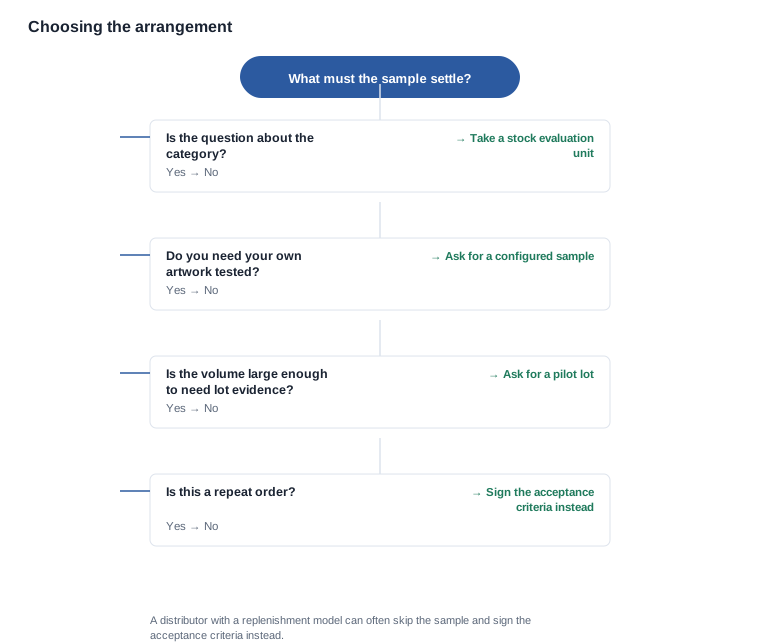
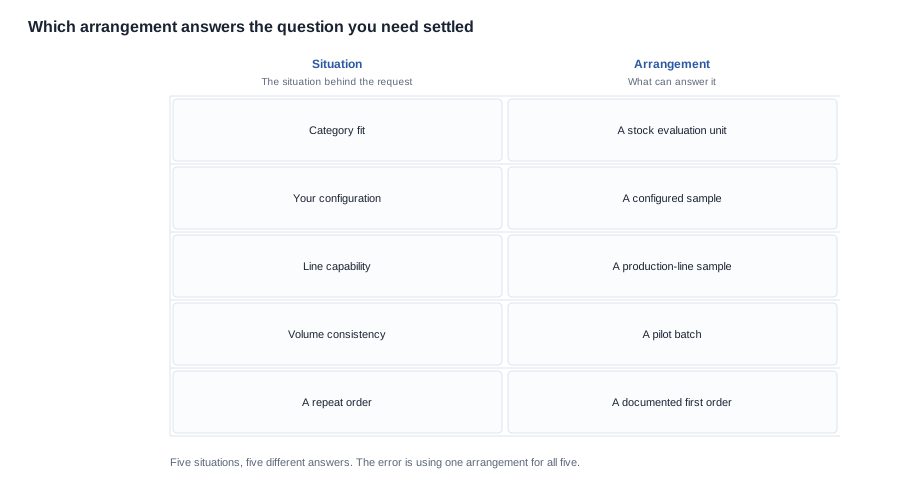
Evaluating the category for the first time. Take a stock evaluation unit. Its job is to let the category in or out of the plan, and it does that fastest, for the lowest cost, with the shortest wait. Nothing is lost by starting here, because a category that is ruled out at this stage costs nothing but the sample.
Chosen a model, ready to place an order. Request a configured sample. The build slot is worth it, because this is the only arrangement that tests the logo, the packaging artwork and the firmware together, and those three things failing together is the most common reason a first delivery cannot be booked into a retail plan.
A large order where the money is significant. Ask for a pilot lot and treat it as a production run with a smaller quantity, inspected against the same criteria. It is the only arrangement that produces evidence about consistency, and consistency is what determines whether the second order is cheap to place.
A distributor with a clear replenishment model. Skip the sample and go straight to a documented first commercial order with an acceptance procedure the supplier signs, provided the supplier will hold the configuration. For repeat business the paperwork is worth more than a unit, and the first order checklist is the shorter path for that situation.
Comparing two suppliers' policies without comparing the wrong columns

The sequence matters more than the format. Writing the questions down before reading either policy is what stops the comparison from becoming an argument about which arrangement each supplier prefers, and asking the vague lines of both suppliers in a single message is what stops a supplier's silence from being read as an answer.
A second rule follows from the first, and it is the one most often broken: compare the answers to the same question, not the total of each policy. A supplier whose policy is longer has not given more, and a supplier whose policy is shorter has not given less. What matters is whether the arrangement each supplier proposes can prove the decision the buyer needs settled, and that comparison only works if the decision is written down first.
A worked comparison, without naming a supplier
Take a buyer entering a new channel with an existing brand, who needs to decide whether a smart glasses line belongs in the range and, if it does, which configuration to launch with. This is a hypothetical scenario rather than a client project, and it is written to show the method.
The decision is written down in one line: which configuration to launch, and whether the line belongs at all. That single line immediately splits the two questions, because they have different arrangements. The category question is answered by a stock evaluation unit of the model with the best commercial fit. The configuration question is answered by a configured sample, because the buyer needs to know that the logo sits correctly on the temple, that the carton holds the unit and the case without pressure, and that the firmware behaves on the companion application.
Two suppliers respond. The first offers a stock evaluation unit of a different model, at a lower fee and with a shorter quoted window. The second offers a configured sample of the model the buyer actually intends to launch, at a higher fee, with artwork and firmware to be supplied. On the face of it the first is better value. It is not, and the comparison table says why: the stock unit of a different model cannot answer the configuration question, so the buyer still has a configured sample to buy, and now has paid for a unit that changed nothing.
The corrected comparison lists what each proposal can prove against the two decisions, not against the fee. The first proposal answers the category question only. The second answers both. That is the comparison, and it is the one a buyer should have run before asking for a fee.
The method generalises to any category where the catalogue is wide. Write the decisions down, count how many arrangements it takes to answer them, and then compare the proposals against the decisions. The number that appears most often in practice is two: a cheap arrangement for the question it can answer, and a paid arrangement for the question it cannot.
What we publish, and how we price a sample
We publish the configuration details a sample has to match: the cell capacity, the resolution class, the charge time, the rated endurance with its caveat, the charging interface, the charging case capacity where one is included, the Bluetooth version for the audio and sport models, and the colour options where they exist. We mark as Not published the frame weight of every model except the one published at 158 g for the MT6 glasses body, which includes its 265 mAh battery and camera and excludes the foldable charging case, and we also mark as Not published the sensor part numbers, the field of view, the video specifications, the ingress test report numbers and the certification numbers.
Our own sample fee, refund condition and dispatch window are not published as a fixed list, because they move with the arrangement, the configuration and the destination. What we will do is quote them in writing against an exact model code, and tell a buyer plainly which arrangement we would use in a given situation and why, including the cases where we would recommend a stock unit and the cases where we would recommend skipping the sample altogether.
We will not send a unit in a configuration that differs from the one intended for the order, and we will not present a single unit as evidence of batch behaviour. Where a buyer's real question is about consistency at volume, a pilot lot is the honest answer and we will say so before a fee is discussed.
What the arrangement decides about the buyer's own time
One column of the comparison is not in the table above, because it belongs to the buyer rather than to the supplier, and it is the column that usually decides the arrangement. It is the time the buyer's own organisation spends on the evaluation.
A stock unit needs a short session: open it, confirm the configuration, run a short list, write the gaps. A configured sample needs a longer one, because artwork, packaging and firmware all have to be checked against an approved proof, and because the buyer has usually supplied artwork that has to be verified rather than approved. A pilot lot needs the longest of all, because the buyer has to define an inspection scheme, witness or receive it, and then read a result that is a rate rather than a pass or a fail.
That time is a real cost and it is usually unpriced, which is why programmes in this category so often arrive at a supplier asking for a pilot lot when a configured sample would have answered the question, or the other way round. Writing the buyer's own hours into the comparison is the step that makes the arrangement choice honest. Two arrangements that look similar on a quotation can be very different once the evaluation effort is counted, and the arrangement with the higher fee is frequently the one that costs less overall.
The questions we ask before quoting an arrangement
When a sample request arrives, three things determine which arrangement we would propose, and we answer them before quoting anything.
The first is whether the configuration already exists. If the model code, the colour, the interface and the case are a combination we already build, a stock unit of that exact configuration is available, and that is the cheapest arrangement that answers the configuration question. If the combination is new, the answer involves a build slot, and the configured sample and the production-line sample become the realistic options.
The second is what the buyer is trying to settle. If the question is about the product, a stock unit is enough. If it is about artwork, packaging and firmware, it is not. If it is about consistency at volume, a pilot lot is the only honest answer.
The third is whether the sample will be retained. A buyer who intends to keep the unit as a reference against the production run should say so at the request stage, because it changes the freight arrangements and it is the condition that decides whether the evaluation is still useful in four months.
The sample policy section covers the questions to ask before a sample is ordered, and the hidden costs in a sample request covers what a request costs beyond its fee.
Related reading


