
The hidden cost of a smart glasses sample policy request is never the fee. The fee is quoted, the fee is comparable, and the fee is the line everybody negotiates. The hidden cost is the cycle: the second round, the unit that arrives wrong, the reference that went back with the courier, the consignment held at a border, the build slot taken from a real order. Each of them is small on a quotation and large on a schedule.
There is a decision behind all of it. Four questions, asked before the request is sent, locate the cost and remove most of it. A buyer who answers them has already decided how many units the programme needs and how many weeks it will take, and the quote that follows is a much smaller surprise than it would otherwise have been.
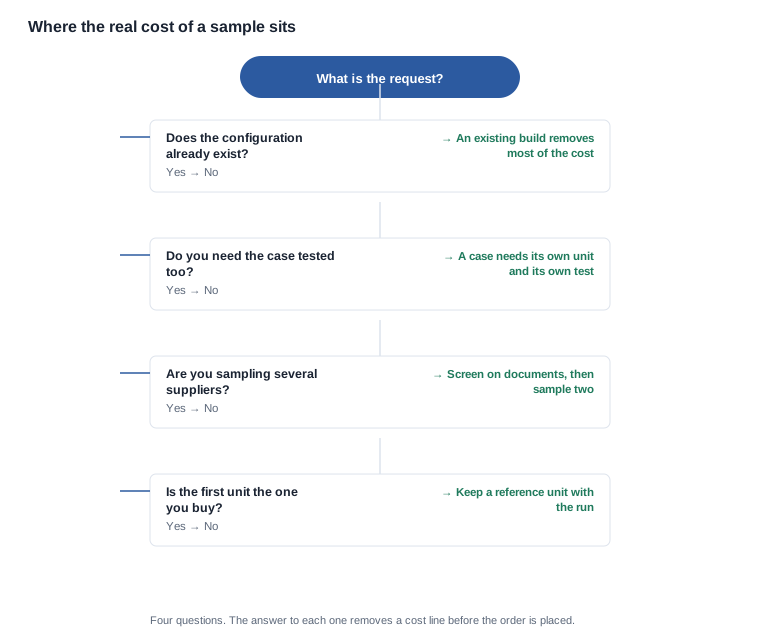
Smart glasses sample policy: where the cost of a request actually sits
The conclusion first. Answer four questions before the request goes out: does the configuration already exist, does the evaluation need the charging case as well as the unit, how many suppliers are being sampled, and will the first unit be retained as a reference. Each answer removes a cost line before it is incurred, and the four of them together account for most of what a sample request costs beyond its fee.
Two situations make the questions urgent. A buyer who has been given a date by a retailer or a distributor is carrying a deadline, and the hidden costs are exactly what pushes a programme past a deadline. A buyer who is running a supplier evaluation has a budget, and the hidden costs are what turn a two-sample programme into a six-sample one without anyone deciding to spend more.
Who this is written for, and what they are defending
The reader is a buyer working for the brand, a channel buyer or an importer, and the decision is whether the sample programme is bigger than it needs to be.
The defensible part of a programme is the part that answers a question. A buyer who can name the decisions the programme settles can say what it cost and what it bought. A buyer who cannot name them is defending a number that grew for reasons nobody can reconstruct, and that is an uncomfortable position in a budget review because the number looks like a series of bad decisions rather than a series of necessary ones.
What the reader is protecting against is a specific and common outcome: a programme that looked small when it was approved and arrived at the end with a second round, a credit note and a delay, none of which could be attributed to a single decision.

The decision that locates the cost
The four questions in the chart are ordered by how much they move the total, and the first one moves it most. They are worth asking as a numbered list, because a numbered list gets answered and a paragraph of questions gets acknowledged.
- Does the configuration already exist? If the model code, the colour, the interface and the case are a combination that is already built, the request can usually be served from stock and the cost of the programme is close to the fee plus the freight. If the combination is new, the request needs a build, and a build needs a slot on a line that is running real orders. The catalogue is what makes this question answerable: seventeen models are published with magnetic charging and seven with Type-C, and the four camera models whose interface is not published at all, which are the CY05 and the CY03, and the MT6 and the L1 Pro, are the four where a new build is a real possibility rather than a formality.
- Does the evaluation need the case as well as the unit? Where a case is published, the capacities are 900, 1200 and 1400 mAh, and the L2 Utral is published at either 900 or 1400 mAh. A case is a separate physical item and a separate supply line, and a case that connects unreliably is a rarity that one unit cannot demonstrate. An evaluation that includes the case therefore needs more than one unit, and the case decision is the one most often left out of the request because it looks like an accessory rather than a test.
- How many suppliers are being sampled? The cost of sampling is not only the fee. It is the freight, the transport documentation for a lithium cell, the evaluation labour repeated for each unit, and the comparison work. A buyer who screens on documents first and then samples two or three names has already removed most of that, and a buyer who samples everything has built a programme that is expensive in money and slower in calendar terms than the decision it supports.
- Will the first unit be retained as a reference? If it will, the freight arrangements change, the condition has to be agreed in advance, and the unit has to be stored somewhere it can be found. If it will not, the programme has no arbitration point for a later defect question, and a defect question is what the sample was supposed to prevent.
What each answer changes in the request itself
The four answers are not an interview to be run before the request; they are inputs to the request itself, and each one changes a line in it.
A yes on the first question means the request can name the configuration in full and ask for a dispatch window rather than for a build slot, which moves the expectation in the buyer's own planning from a production lead time to a despatch window. A no means the request should ask for a stage estimate that names the build slot as a step, so that the calendar is not discovered later.
A yes on the second question means the request has to name the case configuration, and where two cases are published for the model, it has to say which one and ask for a unit of each. A no means the request can drop the case line and be shorter.
A low number on the third means the request needs a screening step, and the screening step has a specification of its own: the published specification extract for the model, the list of the figures the catalogue does not publish, and a written statement of what a sample can and cannot prove. A high number means the request needs a budget for the freight and the labour, and a written cap on the number of rounds.
A yes on the fourth means the request needs a retention clause and a named place to store the unit. A no means the request needs a note that the unit will be returned, and an acceptance of the consequence, which is that a later defect question will have no reference point to argue against.
This is the point of asking the questions early. The answers are free, and each one removes a line from the request, a stage from the calendar or a question from the evaluation.
The six lines that do not appear on a quotation
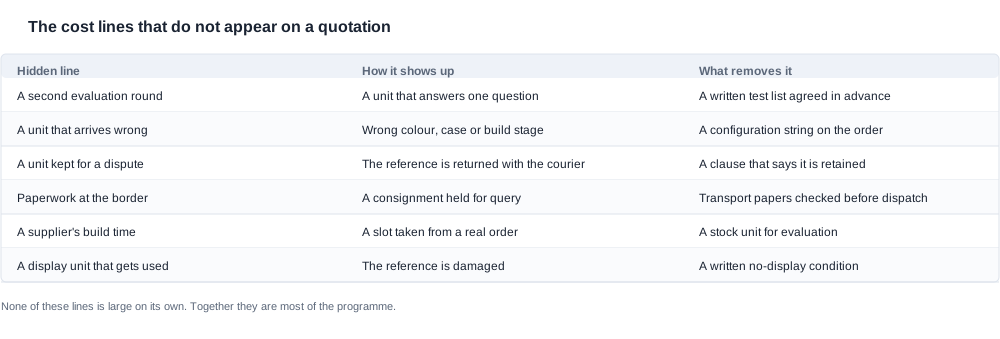
A second evaluation round. The unit answers one question and the buyer finds two more that it cannot answer. The symptom is a request for another unit, with the fee, the freight and the labour again, and the underlying cause is a test list that was written after the unit arrived.
A unit that arrives wrong. The colour, the case or the build stage is not what was ordered. The cause is a configuration agreed in conversation rather than in writing, and the consequence is a full cycle plus a conversation about who pays for the freight.
A unit kept for a dispute that was returned with the courier. The evaluation finished, the unit went back, and a defect question four months later has a specification row to argue with instead of the thing that was approved. The cost of this one is invisible until the dispute, and it is then the cost of the whole order.
Paperwork at the border. A consignment containing a lithium cell is held for a query, and the programme loses weeks for a technical reason that has nothing to do with the product. The battery transport compliance framework sets out the requirements, and checking them before dispatch is the control.
A supplier's build time. A slot on the line is taken from a real order for a unit that may never become an order. This cost does not appear anywhere, including in the sample fee, and it is one of the reasons a stock unit is cheaper than it looks.
A display unit that gets used. The only unit of a configuration for months is put on a desk, handled, and returned with marks on it. The cost appears later, when a defect question turns into an argument about whether the marks were there at delivery.
None of these is large on its own, and together they are most of a programme. That is why the sensible response is not to argue about the fee but to remove the conditions that produce them, and the four questions at the start of this section are the cheapest way to do that.

How a request becomes a multi-week cycle

The cycle above is not a worst case. It is the ordinary shape of a sample programme that was not specified, and each of its six steps is the direct consequence of something that could have been decided earlier at no cost.
The first step is asking for a configuration the supplier has to build rather than pick, which adds a slot. The second is waiting for that slot, while the line runs real orders. The third is receiving a unit whose colour and case were agreed in conversation, so the buyer cannot tell whether it matches the intention. The fourth is finding that the questions were never written down, so the criteria have to be set at the moment the unit is in front of them. The fifth is running the evaluation and writing the gap list, which is the work the programme was supposed to be. The sixth is going back for a second unit with the criteria finally agreed.
A buyer who reads that sequence and recognises it has already paid for a cycle that was avoidable. The prevention is not a better supplier; it is a specification, a test list and a configuration string, in that order, before the first request goes out.
Where hidden costs appear, and when
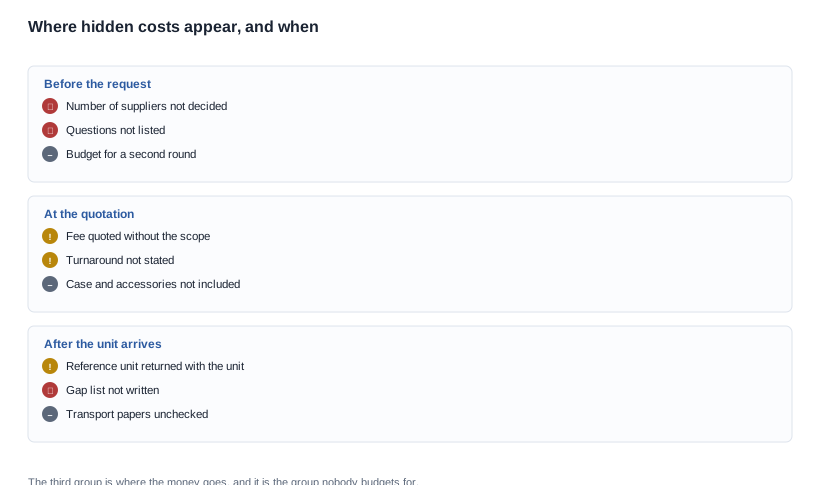
The fourth group in that checklist is the expensive one, because it is the stage nobody budgets for. A buyer plans the request, plans the fee, plans the freight, and then discovers that the money and the weeks were spent on the part of the programme that comes after the unit arrives.
There is a fifth group that is easy to add and is rarely added: the questions the programme will not answer. The catalogue leaves rows open across most of the range, and a buyer who has not listed them will meet each one during the session, in front of a unit, with no answer available. The range publishes a single weight figure, 158 g for the MT6 glasses body including its 265 mAh battery and camera and excluding the foldable charging case, and no bare frame weight for any model. It publishes no field of view, no video format, no frame rate and no sensor part number. It carries a company-level export certification page and no per-model certification row, and its text contains no CE, FCC or RoHS marking for any product. It publishes the charging interface for twenty-four of the twenty-eight models and not for the CY03 and the MT6, and the L1 Pro and the CY05.
Each of those open rows is a question that the sample answers with a measurement, or a document request that has to be made separately, or a decision the buyer has to take with the gap in place. A buyer who lists them before the request knows which of the three applies to each one, and that is worth more than a discount on the fee.
Two habits fix the rest, and neither requires a supplier to cooperate. The first is to keep the evaluation output as a file rather than as an impression, because a file is what stops a second round from being needed and what stops a dispute from being unanswerable. The eight checks before you approve a sample is the working version of that file, and it is the point at which the hidden costs become visible rather than hypothetical. The second is to write the reference and returns conditions into the request, so that the unit comes back to a place that can be found and a failure has a route. The returns and warranty process sets out what that route should contain once the order is in production.
The three costs the supplier carries, and why they are worth negotiating
Three of the lines in a sample programme are borne by the supplier rather than by the buyer, and a buyer who does not notice them is negotiating the wrong side of the transaction.
The first is the build slot. If the configuration is new, a slot on a line is reserved and the line is one unit short of real orders for the duration. Suppliers do not price this into a sample fee, and a buyer who does not ask for it will not know whether the wait is a queue or a queue behind a new setup.
The second is the documentation effort. A configuration sheet, a specification extract, a list of open figures and a test plan are real work, and in a small factory they are real work taken away from an order that is being built. A buyer who asks for the whole set on a request that could have been answered with a catalogue extract is asking for work that will be reflected in the next quotation, whether or not anyone says so.
The third is the engineering judgement. The question "what does this configuration need" is a question that has to be answered by somebody who knows the line, and for the four models whose charging interface is not published, the answer is not a lookup. A buyer who asks that question as part of a genuine enquiry gets a better configuration than a buyer who asks for a unit and asks the question afterwards.
None of this makes the supplier the wrong party to deal with. It makes the request better. A request that arrives with a named configuration, a decided scope and a list of the questions it will answer is a request that can be turned around in a day, and a request that arrives as "can I see one of your AI glasses" is a request that takes a week to interpret and still does not produce a decision.
What we will say about the cost of a request
Concretely, a sample programme is an information purchase, and the honest way to describe one is by the decisions it settles rather than by the money it consumes. We publish the model data and the case options that determine how many units a test needs, and we do not publish unit prices, minimum order quantities or production lead times, so a programme cost has to be built from the terms rather than read from a list.
Three things we will do without being asked. We will tell you how many units a configuration needs, because it follows from the published specification rather than from a sales figure. We will tell you which of your questions a unit can settle and which need a document or a pilot lot, because the catalogue defines that boundary: it publishes a single weight figure, 158 g for the MT6 glasses body including its 265 mAh battery and camera and excluding the foldable charging case, and no bare frame weight for any model, and it carries a company-level export certification page with no per-model certification row and no CE, FCC or RoHS marking in its text. And we will tell you when a programme is larger than the decision requires, which is a judgement we are better placed to make than a buyer is, because we can see the configuration.
What we will not do is quote a programme from a model name and a quantity alone, and we will not send a unit in a configuration that differs from the one intended for the order. We will also say plainly when a request is a documentation request rather than a sample request, because the first is free and the second is not.
One last thing is worth saying about the hidden costs, because it is the part that gets left out of every cost review. A sample programme that ends with a decision has cost the buyer a fee, a freight, a session and some labour, and it has bought a configuration, a set of measurements and a reference. A sample programme that ends with a second round has cost the same four things twice and has bought a revision. The difference between the two programmes is not the fee, and it is not the supplier. It is whether the request was specific enough to be answered the first time.
The samples pillar sets out the wider process, and the camera and audio range lists the published baseline the decisions are built on.
Send the configuration, the quantity and the market, and we will say which parts of a request are settled and which are yours.


