

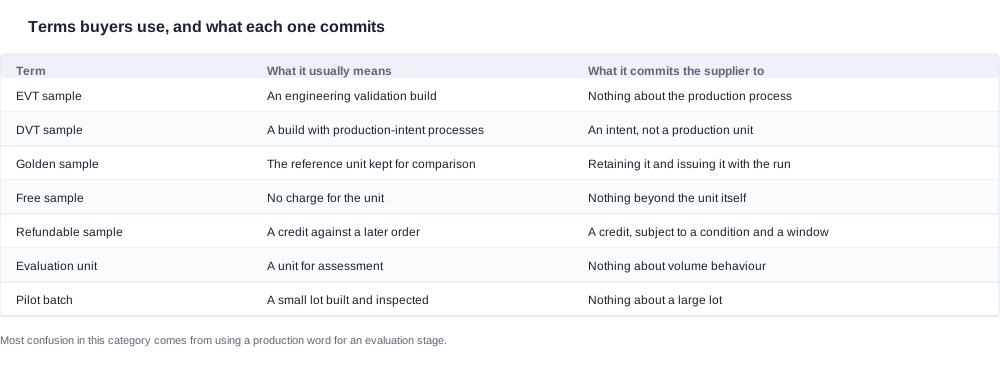
Sample terminology in this category is used loosely, and the looseness is not always accidental. A smart glasses sample policy glossary is not a list of definitions; it is a map of who carries which risk, because every term in this trade either commits one side to something or leaves the risk with whoever argues longest. Seven terms account for most of the confusion, and each of them moves risk rather than describing it.
The practical consequence is that a disagreement about a term is rarely a disagreement about meaning. Both sides usually understand the word. What they do not share is the assumption behind it, and the assumption is where the money is.
Smart glasses sample policy: the terms buyers use without agreeing on them
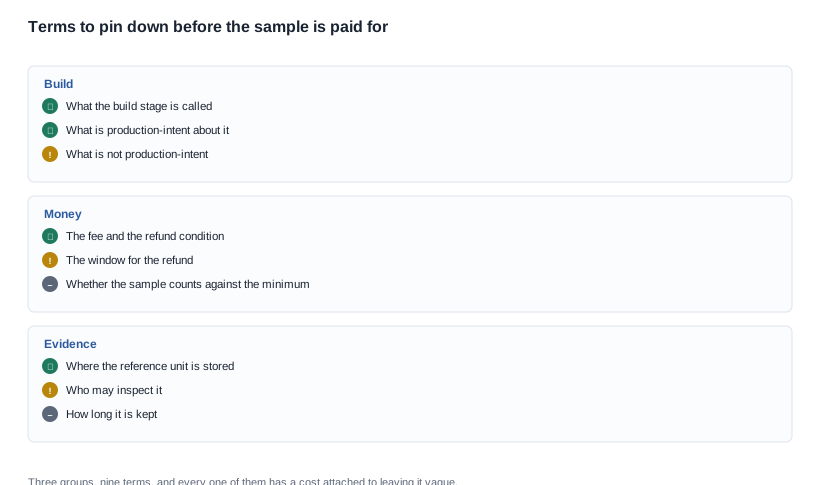
The conclusion first. Pin down three term groups in writing before a sample is paid for: the build terms, which decide what the unit is; the money terms, which decide who bears a failed evaluation; and the evidence terms, which decide who holds the reference afterwards. A term left vague does not remove the risk, it decides who pays when the risk lands, and in this category the default is the buyer.
Two situations make this urgent rather than tidy. A buyer who is comparing two suppliers is comparing their vocabularies as much as their numbers, and the supplier using the more precise terms is usually the supplier who has thought about the failure modes. And a buyer who is on a repeat order has already paid for one evaluation and cannot afford a second one, which is exactly when the terms need to be written down rather than assumed.
Who this is written for, and where the ambiguity does the damage
The reader is a brand-side purchasing manager, a channel buyer or an importer, and the situation is a conversation with a supplier in which both parties are using the same words and meaning different things by them.
The most common setting is a first sample request, where the buyer says "we will take a sample and a refundable fee" and the supplier hears "the fee is credited back when we order" and the buyer hears "the fee is credited if we order within ninety days". Both are reasonable readings. Only one of them is what the buyer wanted, and the difference is discovered at the point where the order is placed.
The other setting is a dispute, weeks later, in which the buyer says the unit was not what was approved and the supplier says the buyer approved a photograph of a specification. At that point the argument is not about the hardware. It is about which words were used at the request stage, and that is why the terms are worth a paragraph.

Build stage terms, and what they commit a supplier to
Three words do most of the work in this category, and they describe stages of a build rather than qualities of a product.
EVT is an engineering validation build: early tooling, hand assembly, and a unit whose purpose is to prove a design. DVT is a build made with production-intent processes, which is much closer to what will be delivered, though it can still precede final firmware and final packaging. A production sample is a unit built on the line that will build the order, under the processes that will build the order.
The mistake is treating a DVT build as a production unit and then finding a difference at the first bulk delivery. The correction is not a definition but a question: ask explicitly what is production-intent about the sample and what is not, and get the answer in writing rather than inferring it from how the unit is presented. A supplier that answers that question clearly is telling you something useful about how the order will be built.
A golden sample is the reference unit that later production is compared against, and it is one of the most valuable things in a quality dispute and one of the most commonly absent. If the supplier does not retain a golden sample and issue it with the production run, then a dispute four months later has no reference point, and the comparison available is against a specification row rather than against the thing that was actually approved. Two questions close it: where the golden sample is stored, and who has access to it.
An evaluation unit is a unit supplied for assessment, and it carries no implication about volume behaviour at all. A pilot batch is a small lot built and inspected, and it carries an implication about consistency within that lot, but none about a full lot. Buyers use these three words interchangeably, and the interchangeability is what turns a sample evaluation into a production decision it was never able to support.
Money terms, and the conditions hiding inside them
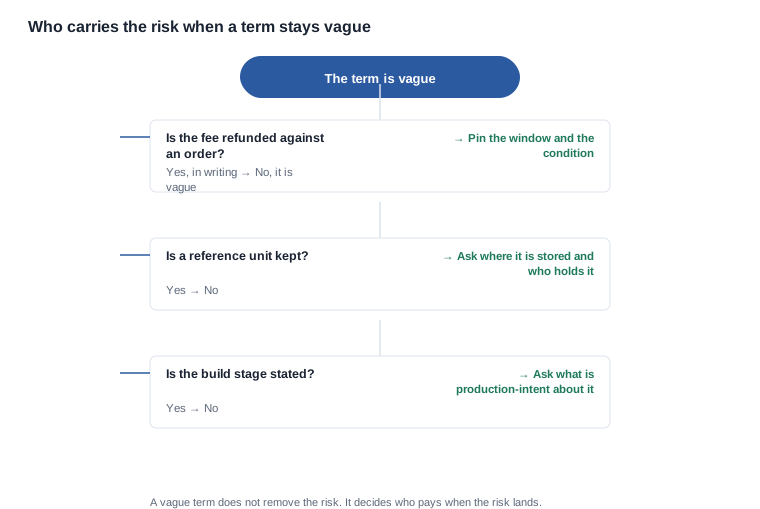
Free and refundable are different promises. A free sample costs nothing and commits nothing. A refundable sample fee is a commercial arrangement that normally applies the refund against a bulk order within a stated window, which means the refund depends on a later decision, and is therefore not a discount. It is a deposit with a condition.
Three questions close the ambiguity. Is the refund credited against the bulk order or paid separately. Is the window measured in days or in months. And what happens if the configuration changes between the sample and the order. A refundable sample fee is a reasonable thing for a supplier to offer; a vague one is not, because a vague one is an unconditional credit at a time of the supplier's choosing.
Two further questions belong in the same paragraph, and both are routinely left out. Does the sample count against the order minimum, so that agreeing to a sample does not quietly raise the floor on the first bulk order. And how many samples a buyer may take before the terms change, which is the point at which a supplier evaluation quietly becomes an unpaid development run.
A sample credit is the same idea under a different name, and it is worth separating from the refund because the two are settled differently. A credit is applied to the order invoice; a refund is money that comes back. A credit against an order you never place is worth nothing, and a buyer who has been offered a "credit" should establish whether the credit survives the buyer changing its mind about the order.
The sample fee itself is quoted per request in this category, because it depends on the model, the configuration, the branding and the destination. That is not a refusal to be helpful; it is a consequence of the fact that a sample is a build. The fee is therefore a poor negotiation target for a buyer, and a better use of the conversation is the refund condition and the number of rounds.

Evidence terms, and who ends up holding the reference
A retained unit is a unit kept by one party after an evaluation, for use as a reference. A returned sample is a unit that goes back to the supplier with the courier. The two are often treated as the same thing, and they are opposites: a unit that has been returned cannot arbitrate a dispute about a later batch, and a unit that has been retained but is not recorded cannot be found when it is needed.
The word that gets used for the retained unit in this trade is the golden sample, which is why the two terms collide. A buyer who asks "will you keep the golden sample" is asking a supplier to do something, and the answer is frequently yes, because a golden sample is normally kept for the supplier's own quality purposes rather than issued to the buyer. Asking for a retained unit for the buyer's own file is a different request, and it should be made explicitly.
An acceptance criterion is a condition that has to be met for a unit to pass. An acceptance procedure is the method by which the criteria are applied. The distinction matters because a criterion without a procedure is a wish, and a procedure without criteria is a ritual that produces a signed sheet nobody can act on. Both are needed, both have to be written before the unit arrives, and the second one costs an hour of the buyer's time.
A worked example from this range makes the point. "The unit runs for a full shift" is not a criterion, because the catalogue publishes a rated endurance of between five and eight hours on the S7 and the V03 Pro, and the V03 and the V06, and about seven hours on the CY03 and the L1 Pro, and the CY05 and the MT6, and the L2 Utral, without publishing the load behind any of them, so a buyer cannot tell whether a given number meets a shift. "The unit runs for six hours of continuous capture with the companion application connected over a mobile connection" is a criterion, because it names a load, a duration and a state. The procedure then says how it is measured, who signs it and what happens if it fails. Two lines of vocabulary, applied carefully, and the evaluation produces a number the buyer can use for the production order.
A build slot is a place on the production line reserved for a build. It is not a promise of a date, because a line running real orders will not hold a slot indefinitely, and a slot held against an undecided evaluation is a slot that is not being used. A buyer who asks for a slot to be held against a sample request is asking for something that works against their own interests.
Terms borrowed from the order, used as if they were sample terms
Five words that belong to a production order are regularly used during a sample conversation, and in each case the misuse is expensive because the two things mean different things.
Minimum order quantity. A sample has no minimum order quantity. The figure that matters at the sample stage is the number of samples a buyer may take before the terms change, and a buyer who assumes a sample counts towards the minimum has agreed to something that may not be true, and who does not ask may find the floor raised by a unit they were given free.
Non-recurring engineering cost. This is a tooling or engineering charge for a new mould, a new circuit or a new firmware platform, and it is amortised across an order rather than paid per unit. It is not a sample fee, and a sample request that triggers a tooling discussion is usually a sign that the request was not specific enough to be recognised as an existing configuration. The catalogue makes that recognition real: seventeen models are published with magnetic charging and seven with Type-C, and the four camera models whose interface is not published at all, which are the L1 Pro and the CY03, and the CY05 and the MT6, are exactly the four where a new build is more likely than a pick.
Unit price. A sample has a fee, and the fee is not a unit price at any volume. The two are quoted differently, they are calculated differently, and a buyer who uses the sample fee as an anchor for the order price has anchored on the smaller number and will find the volume price is a separate negotiation entirely.
Lead time. A sample lead time and a production lead time are different quantities measuring different things. The sample one covers the build and the despatch of one unit; the production one covers the build of an order. A buyer who uses a sample dispatch window as a production schedule has imported a number that was never about production, and the error usually surfaces at the point where a launch date is committed to a retailer.
Price tier. A tier describes where a quantity falls in a published or quoted price structure, and a sample of one unit is not in a tier at all. It is a standalone transaction. Where a supplier offers to credit a sample against the first order, the credit is applied at the tier price of that order, and the tier itself is part of what the sample conversation establishes.
The pattern is consistent. Every one of these terms describes a stage that comes after the sample, and every one of them is used at the sample stage to make a decision that actually belongs to the later stage.
Turning a vague term into a written clause

The method is the same for every term, and it is worth applying to all of them in one pass rather than one at a time as each disagreement appears.
Step one is to name the term in the supplier's own words rather than yours, because a clause written in the buyer's vocabulary will be read in the buyer's favour and resisted on that basis. Step two is to ask what the supplier will do under the term, rather than what the term means, because the second question produces a definition and the first produces an obligation. Step three is to write the answer as a sentence either party can be held to, in the present tense and with a named time window. Step four is to attach that sentence to the order confirmation rather than to an email, because an email is not a term of a contract in most jurisdictions and an order confirmation is. Step five is to check the sentence against the invoice and the packing list, because a clause that is contradicted by the paperwork is a clause that will be argued about later.
The reason this matters more in this category than in most is that the sample is a small transaction. A buyer who loses an argument about a sample fee loses a small sum. A buyer who loses an argument about whether the unit was the approved configuration loses the whole first order, because the unit on the shelf was never the thing the order was placed against.
The three-word test for a vocabulary problem
There is a quick way to find out whether a term is doing its job. Ask the supplier to restate a term as something the buyer will do rather than as something the buyer will receive. A term survives the restatement when it names an action with a time and a place; it fails when it names a category.
"Free sample" fails the test, because free describes a state rather than an action, and the restatement is "you will send a unit at no charge, and you will not require an order in return". That is a real commitment and it can be written down. "Refundable fee" fails the same way, and the restatement is "you will credit the amount against the first order if that order is placed inside a named window". "Golden sample" fails it too, and the restatement is "you will keep a unit from the production run and you will release it to us on request".
Each of those restatements is one sentence, and each of them converts a description into an obligation. A buyer who has converted the three terms that matter in a request has removed most of the ambiguity in a sample contract, and has done it in less time than it takes to read a quotation twice.
What we will state in writing before a sample is sent
When we send a sample, we will state which build it is, what is production-intent about it and what is not, and we will keep the corresponding records. We will also retain a production sample and a signed artwork proof with the run file, because a quality conversation four months after delivery needs a reference point and the factory is the only party that still has one. Our acceptance criteria are agreed with methods before production rather than asserted after it.
Our sample fees, refund windows and lead times are not published in our documentation, because they vary with configuration and quantity. What we will do is state them in writing at the point of quotation rather than leaving them to a policy page, and we will use the words precisely when we do it.
On the evidence rows, we will publish what our documentation states and mark the rest as open, rather than filling an open row with a typical figure. The range publishes one weight figure, 158 g for the MT6 glasses body including its 265 mAh battery and camera and excluding the foldable charging case, and no bare frame weight for any model. It publishes the charging interface for twenty-four of the twenty-eight models and not for the MT6 and the CY03, and the L1 Pro and the CY05. A single company-level export certification page appears in the catalogue and no per-model certification row, and its text contains no CE, FCC or RoHS marking for any product.
We will also use the vocabulary precisely in return. If a request says "we will take a DVT", we will confirm in writing what is production-intent about the unit and what is not, rather than accepting the label. If a request says "we will keep the golden sample", we will confirm which party holds it and where it is stored. Ambiguity in a term is usually a reasonable attempt to be helpful, and the way to remove it is to answer it rather than to correct it.
The samples section of this site covers how the sample relates to the bulk order, and the reading list below covers the calendar side of the same vocabulary, what a sample stage costs in weeks, and what a request costs beyond its fee.
Related reading
- Lead time effect — why samples run ahead
- Typical range — what a sample stage costs in weeks
- Hidden costs — what the sample does not reveal


