

A smart glasses sample policy is not one number, and the single most common mistake in reading one is to read only the number people quote — the sample charge — and treat everything else as settled. It is not settled. A policy is six elements, and each one moves on its own scale: the configuration can move from a model name to a full build string, the remedy can move from a full replacement to nothing at all, and the dispatch can move from one courier to a forwarder with its own paperwork. The ranges are wide, they are conditional, and in this article you will find which of them is widest, which moves on a different scale from the rest, and how to convert a range into a question that can be closed.
Smart glasses sample policy: the six elements that move
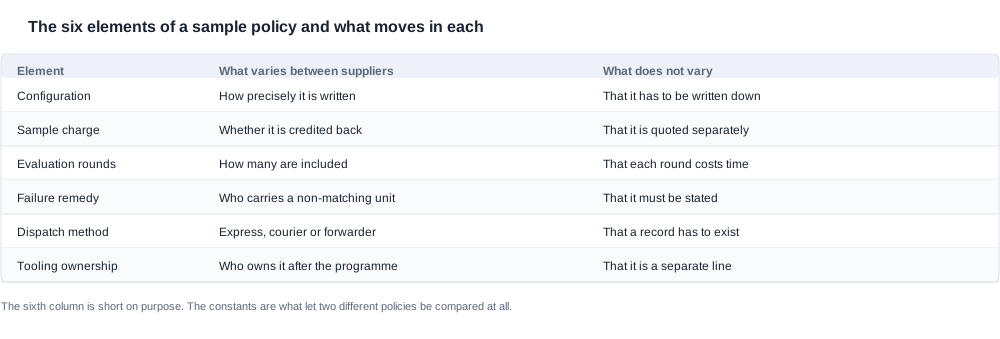
Every supplier's sample policy resolves into the same six elements, and the order they appear in varies while the set does not. The first is the configuration: what exactly is being sent to you. The second is the sample charge and the credit condition attached to it. The third is the evaluation rounds, meaning how many rounds are included and what starts another. The fourth is the failure remedy, meaning who carries a unit that does not match. The fifth is the dispatch method and the record that travels with the unit. The sixth is tooling ownership, and what happens to any mould or artwork if the programme stops.
What does not vary is much smaller, and it is the part worth memorising: all six have to be stated somewhere. A policy that leaves one of them out has not saved a question. It has moved the question to a place where it will be answered by whoever happens to read the order confirmation, and in a category where the delivered unit can differ from the ordered one in ways that are invisible until a customer uses it, that is a decision you do not want made for you.
The reason this matters more here than in many adjacent categories is that the specification rows themselves are not uniform across the range. A camera model in this category is published at 220 mAh, 260 mAh, 265 mAh or 290 mAh depending on the model, and the charging method row is absent on four of the eleven camera models. A case is published at 1400 mAh on some models, at 900 or 1400 mAh on one, at 1200 mAh as a foldable case on another, and not published at all on two that carry one. When the underlying rows are not uniform, the range in the policy cannot be uniform either, because a policy is only as precise as the configuration it is attached to.

Why a typical range is a boundary, not a price
A range, properly stated, is a boundary claim: it says the answer to this question lies between these two values, once these conditions hold. It is not a price, it is not an average, and it is not an opening offer. The difference is not academic, because the three uses collapse into one another in a quotation and the buyer who cannot tell them apart ends up paying for the assumption.
A range is conditional on at least three things: the configuration, the quantity, and the question of who absorbs the work. Change the configuration and the range moves, because a stock unit and a pre-production build are different objects with different costs. Change the quantity and it moves again, because sample charges usually carry a handling component that does not scale down. And the third condition is the one suppliers rarely state in the open — the range often assumes that the buyer absorbs something, such as the artwork preparation, the freight, or the second round, and the range is only true if the buyer absorbs it.
So the number to interrogate is not the midpoint of the range. It is the assumption underneath it. A buyer who receives a wide range with no stated assumption has received an estimate, and an estimate inside a quotation behaves exactly like a price the moment the invoice arrives.
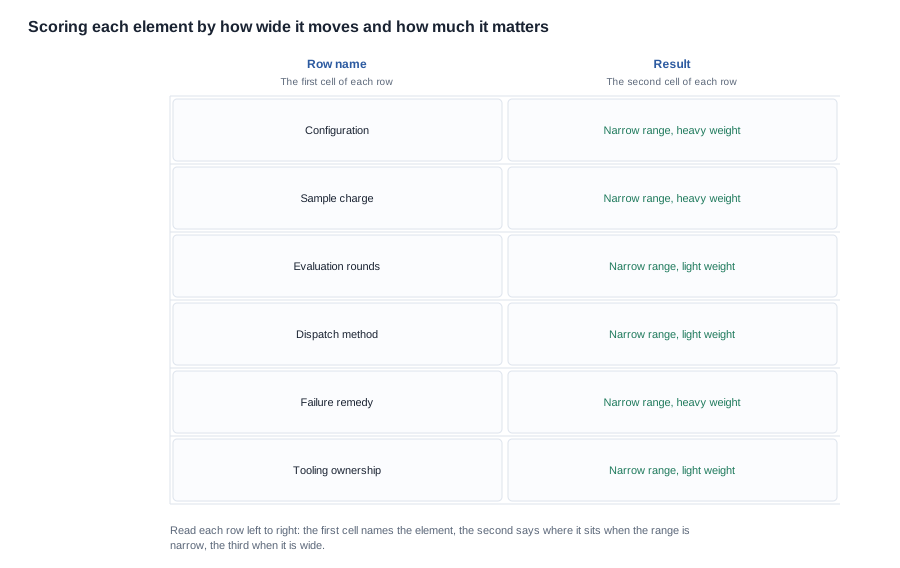
The matrix above scores each element on two axes: how wide the range moves, and how much the outcome depends on where in that range the answer lands. The two heaviest elements — configuration and remedy — are also the two where the range is widest, and they are the two most often left to a default. That is the pattern to watch for: a policy that looks complete and cheap is usually one where the two heavy elements have been left open.
The word "typical" is doing a lot of work
A published typical figure is a claim about other people's programmes rather than about yours. It is often produced by a supplier who has seen a hundred requests and is describing the middle of what they saw, which is a perfectly reasonable thing to say and a poor thing to plan against. The middle of what somebody else saw is not a prediction of what you will be quoted, because you are not the same request: your configuration, your quantity, your market and your schedule are all different inputs.
There is also a category error hiding in the phrase. A typical sample charge is a typical price; a typical evaluation window is a typical duration; a typical remedy is a typical allocation of risk. Putting all three under one word encourages a buyer to compare them as though they were the same kind of quantity. They are not, and the one that matters most to a programme that is about to go into production is the risk allocation, because it is the one that costs money when it goes wrong.

The configuration element has the widest range
Configuration is the element with the widest range because it is the one that can be specified at three completely different levels, and each level is a different commercial object. The lowest level is the product name — "a CY03" — and it settles almost nothing. The middle level is a model plus a build type, which tells you whether you are looking at a finished-goods unit or a build made to your specification. The highest is the full build string, which names every published row that applies to the unit: the cell capacity, the runtime, the charge time, the charging method where it is published, the case capacity, the resolution tier.
Each level is legitimate. The mistake is choosing a level without knowing what it is meant to prove. If the programme depends on a specific runtime in a specific configuration, a product name cannot carry that dependency, and the range around the resulting quotation will be wide enough to swallow the difference between the two suppliers' actual positions.
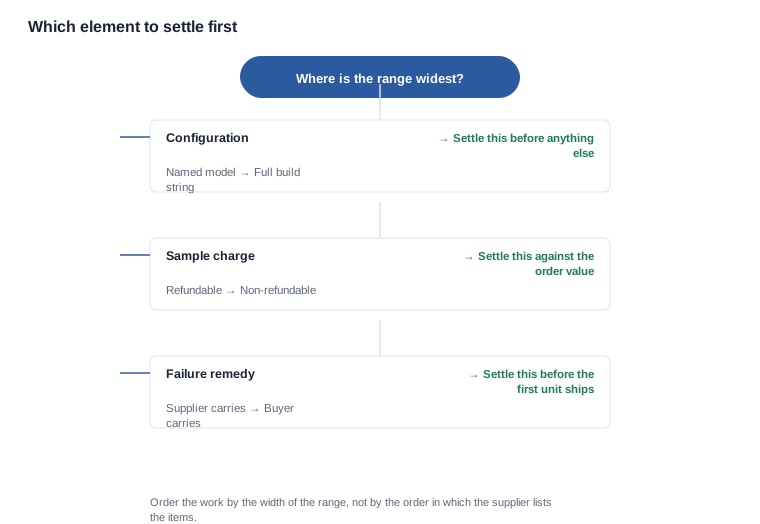
The decision diagram above turns that into an order of work. Where the range is widest and the weight is heaviest — configuration, sample charge and credit, failure remedy — settle it before anything else, because each of them changes what the other four are worth. Where the range is narrow and the weight is light — the dispatch method, the number of rounds — settle it afterwards, because a narrow range is a range you can read in one message.
A practical consequence for anyone comparing quotations: two quotations can look identical in unit price and be about completely different configurations. The unit price comparison is only meaningful once the configuration strings are laid out next to each other, and if they are not available, that is the first thing to request rather than the second.
Red flags that a range is really an estimate
Before you evaluate a range, it is worth checking that it is one. These are the signs that a quoted interval is an estimate wearing a range's clothes, and each of them has a cheap diagnostic question attached.
- No assumption is named. A range with no stated condition is an estimate. Ask which condition, and which end of the range applies when it holds.
- The two ends have no meaning. A low end and a high end that are not tied to a difference in configuration, quantity or scope are not the same product quoted twice. Ask what specifically is different at each end.
- The range has no owner. Nobody has said who would decide which end applies. Ask what triggers the move from one end to the other, and who signs it.
- It is quoted in units that do not match the question. A sample charge quoted per unit when the question was about the programme, or a window quoted in weeks when the constraint was a tooling slot, is the wrong quantity. Ask for the unit the constraint is actually expressed in.
- It covers a decision that has not been made. A range on an element you have not yet specified is not a range at all. Ask which of the six elements it belongs to, and whether that element has been decided yet.
These are the questions to ask, and they are the questions that convert a range into something you can act on. They are also the questions that separate a supplier who has priced the work from a supplier who has bracketed it.

The failure remedy moves on a different scale
The remedy element is the one that behaves unlike the rest, and the reason is that it moves money rather than time. A configuration choice moves scope. A dispatch choice moves days. A remedy choice moves the cost of being wrong, and it is the only one of the six that is priced by the supplier's own confidence in their build.
It is also the element most likely to be left to a default, and defaults here are written in a form that looks safe and does nothing. "Defective units will be replaced" is not a remedy for a configuration mismatch, because a configuration mismatch is not a defect — the unit may be perfectly manufactured and simply not be the unit you specified. A replacement clause written for defects does not touch that case at all, and the programme discovers this at the moment the mismatch matters most.
The forms a remedy can take are few. The supplier carries the loss entirely, which is the strongest form and the hardest to price, and a supplier that offers it freely is telling you something about its own build confidence before it has quoted anything. The buyer carries the loss, which is the default and should be recognised as a decision rather than accepted as a silence. And the loss is shared by a stated formula, which is the most common workable form, and the formula is where the real negotiation sits.
Three questions move a remedy more than anything else. The first is what counts as a non-matching unit, stated as a definition rather than a category. The second is who decides, and when — a replacement decision that waits for a laboratory result is a decision that waits for a laboratory result. The third is whether the credit survives the end of the programme, because a credit that expires when the production order is placed is worth a fraction of one that does not.
There is a second scale running underneath the money one, and it is the schedule. A remedy that refunds the sample charge costs nothing but a week of administration. A remedy that requires a new build costs a lead time, and a lead time at this point in a programme is not a delay to a sample, it is a delay to a tooling slot that is already booked. Where a programme is on a critical path, the remedy should be selected for its speed as carefully as for its cost.
What to ask before you accept a remedy
A remedy is the element most often accepted on trust, because it reads like a reassurance rather than like a commercial term. It is worth putting the same effort into it as into the unit price, and the due diligence is a short list.
- Ask for the definition, not the promise. "What, specifically, qualifies as a non-matching unit?" A definition written as a condition can be checked; a promise cannot.
- Ask who decides, and against what evidence. If the determination requires a laboratory result, ask how long that takes and who carries the cost while it runs.
- Ask what the remedy is in each of the three forms. Replacement, refund, or a stated split. Then ask which one is being offered, in those words.
- Ask about the return leg. Who ships the unit back, who pays the freight, and whether the return freight is credited with the replacement.
- Ask how long the credit survives. A credit that expires when the production order is placed, or that applies only to the first production order, is a materially different offer from one that survives the programme.
- Ask whether the remedy applies to the whole evaluation or only to the unit. "Replace the sample" is not a remedy for an evaluation that was set up wrongly.
The trade-offs that stay inside one quotation
Two trade-offs recur in sample programmes, and both are better decided explicitly than discovered later. The first is between schedule and cost of the evaluation: a single consolidated evaluation against one supplier is cheaper in freight and slower in calendar time than parallel samples against two suppliers, because the second arrangement means two build slots and two wait periods rather than one. The second is between breadth and rigour: an evaluation that tests eleven attributes will produce eleven observations and a weaker decision than one that tests four attributes against written pass conditions, because the observations are not comparable across attributes.
The mistake in both cases is to let the default decide them. The default for the first is parallel sampling, which feels thorough and is usually a week of schedule for a second opinion nobody asked for. The default for the second is a long checklist, which feels rigorous and produces a signed sheet that settles nothing. Both are the classic pitfalls of a sample programme, and both are avoidable by deciding which of the two you are buying.
What we publish, and what we will not estimate
On ranges, narrow and deliberate. We publish the rows our catalogue states, and we will not publish a typical value for any of the six elements, because a typical value is a claim about a programme that has not been specified. We would rather tell you that the range is wide and that it closes as soon as three things are named.
So here is what our own catalogue does settle, and these are the rows that remove a range from a sample request. Charging time is published for all twenty-eight models — at or under two hours for twenty-six of them, and around one hour for the D17 and the ZH12, which are the two sport models that publish a Type C interface. The charging method is published on seventeen models as magnetic, on seven as Type C, and is not published on four camera models: the CY05 and the MT6, and the L1 Pro and the CY03. Those four publish a charging case capacity — 1400 mAh for the first three, a foldable 1200 mAh case for the MT6 — and publish no charging interface row at all, which means the configuration string for those four has to say so explicitly rather than leave the buyer to assume the magnetic default used elsewhere in the range. Runtime is published for every camera model without exception. The resolution split is published as 8 MP on eight camera models and 13 MP on three. Bluetooth version is published for the audio and sport models and is not published for the camera models. Ingress marking appears on two models in the whole range, the V06 and the S7, and on no case and no other model.
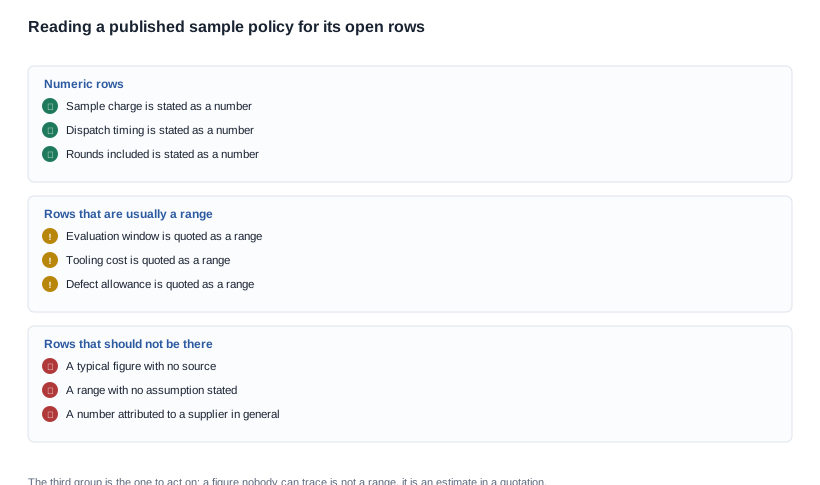
What we do not publish is as important. There is no per-model certification row anywhere in our catalogue, no test report number, no laboratory name, no detection data and no price list, and the export-certification page in the catalogue is a company-level page rather than a model list, so it cannot be used to infer that any particular model carries a particular approval. Of the twenty-eight models, one carries a published weight — the MT6 at 158 g for the glasses unit including the cell and the camera, excluding the foldable case, whose own weight is not published. We publish no typical sample charge, no typical lead time and no typical remedy, and we will not estimate them from a general market picture. A typical figure is the one number in a procurement file that nobody can trace, and it is the number that gets quoted back to you later as though it were an agreement.
What we will do is close the range against a named configuration. Give us the model, the build type, the quantity, the target market and the elements of the programme that are genuinely open, and we will tell you which of the six elements are settled on our published rows, which are negotiable, which are fixed by the laboratory rather than by us, and which require a document from our own file before they can be answered.
A short method for reading two policies side by side
The method below assumes you have two policies in front of you and a third element of work in your week. It is deliberately short, because the failure mode it is designed against is the request that takes a month.

- Lay both policies out in the same six rows, in the same order. Do not summarise; transcribe. A summary of a policy is a policy with the range removed.
- Mark the cell that states a number against the cell that states a range. You are looking for the rows where the two suppliers are not actually comparable.
- Flag every row where one policy is specific and the other is silent. Silence is not a narrow range; it is an unanswered question, and it is the more dangerous of the two.
- Convert each range into the question that would close it. The question is always of the form "what are the two ends of this range, and what assumption separates them".
- Send the six questions as one list rather than six separate emails. A supplier answering one question at a time will answer the easy one first and the hard one last.
- Record the answers in the comparison sheet, not in the inbox. A comparison that lives in correspondence is not a comparison, and it cannot be shown to the person who did not attend the meeting.
The output of the method is not a winner. It is a set of six closed questions, or an honest list of which ones remain open and who owns each of them. That is more useful than a ranking, because a ranking based on an open range is a ranking of how the quotations were written rather than of what they will cost.
What the comparison usually reveals
Two things recur often enough to name. The first is that the widest difference between two policies is almost never in the sample charge; it is in the configuration, because a supplier who has specified more precisely has priced more precisely, and a supplier who has not is borrowing the assumption from somewhere. The second is that the two policies most often differ on remedy, and that the supplier with the better remedy is frequently the one with the narrower configuration, because both are expressions of how much the supplier is willing to be held to.
If you want the surrounding detail rather than the comparison method, the hidden costs covers what tends to sit outside the quoted number, and Eight checks before you approve a sample is the operational version of the six elements. For the range of models a sample might cover, the AI camera glasses range is where the published configuration rows live, and Comparing four ways to get a sample sets the request routes against each other. The policy itself, and what each of its steps costs, is under sample policy section.
Where to look next
Name the configuration, the quantity and the market, and we will tell you which of the six elements are already closed.


