

Smart glasses sample policy has no published industry benchmark, and a buyer who goes looking for one will spend weeks and end up with a supplier's own fee schedule dressed up as a market rate. There is no registry of sample policies in this category, no reference price for a sample unit, and no published norm for how many evaluation rounds a supplier should fund. What does exist is a different kind of benchmark: a published row set that every competent supplier in this category can be measured against, and a set of commercial conventions that are common enough to be predictable even though nobody publishes them.
The distinction matters, because a buyer who is looking for a fee benchmark and a buyer who is looking for a specification benchmark are solving different problems, and only one of them is solvable. The fee is a commercial term of one quotation and has to be asked for. The specification is public, and a sample can be measured against it. Sorting those two apart is the first thing this article does; the second is setting out which parts of a sample policy are genuinely common practice and which parts only your programme can set.
Smart glasses sample policy benchmarks: when a benchmark is yours to set
The request that starts the search
The usual way a buyer arrives at the benchmark question is disappointment. A quote has come in at a number, another quote has come in at a higher number, and the buyer wants to know which one is reasonable. In a mature category with published reference prices this is a solvable question, and it is worth saying clearly that this is not that category. Sample fees in smart glasses are quoted per request, they differ by configuration, and the supplier's own cost structure is not published anywhere. There is no benchmark that tells you whether a quoted fee is fair.
What can be benchmarked is the structure of the programme around the fee. Seven elements of a sample programme behave consistently across suppliers in this category, and the behaviour of each one is predictable enough that a buyer can set expectations before the first quote arrives. That is the useful benchmark, and it is the difference between "is this fee reasonable" and "is this programme designed the way it should be".
The two kinds of benchmark a buyer can actually use
There are exactly two kinds of benchmark available in this category, and they are frequently confused.
The first is a specification benchmark, and it is public. The catalogue publishes, model by model, the camera resolution tier, the cell capacity, the rated use, the charge time, the charging method, the charging case option, the colour availability, and the ingress marking where one exists. Those rows are the same for every supplier working to the same published specification, which means that a sample can be checked against them and a supplier's unit can be compared with another supplier's unit without any of the comparison being subjective.
The second is a convention benchmark, and it is not published but it is stable. The way sample fees are structured, the way rounds are counted, the way credit conditions are written and the way build identity is disclosed follow patterns that are consistent across suppliers. A buyer who knows the pattern can tell in ten minutes whether a quotation has followed it, and can spot the supplier that has not.
There is a third thing that buyers sometimes look for and never find, which is a price benchmark. It does not exist in this category, and any source that offers one is offering an opinion rather than a market rate. The total cost of a sample programme is not the fee anyway; it is the fee, plus the rounds the specification did not prevent, plus the engineering cost the programme inherits, plus the reserve the quality assumptions generate on every unit it ships.
Why the difference decides how you should spend your first week
A buyer who understands that the fee has no benchmark will spend the first week writing an evaluation sheet and a protocol, which is where the programme's value is created. A buyer who expects a fee benchmark will spend the first week making calls and comparing numbers, and will end the week with a lower-looking quote for a programme that has not been specified at all.
The order of operations is the whole argument. Specification first, then quotes, then samples. A quote obtained before the specification is not comparable with anything, because the two suppliers quoted different things.

The specification benchmark that actually exists
Seven published row groups, and what each one settles
The published catalogue rows fall into groups with different evidentiary value, and knowing which group a question belongs to is what lets a buyer decide whether a sample is the right instrument.
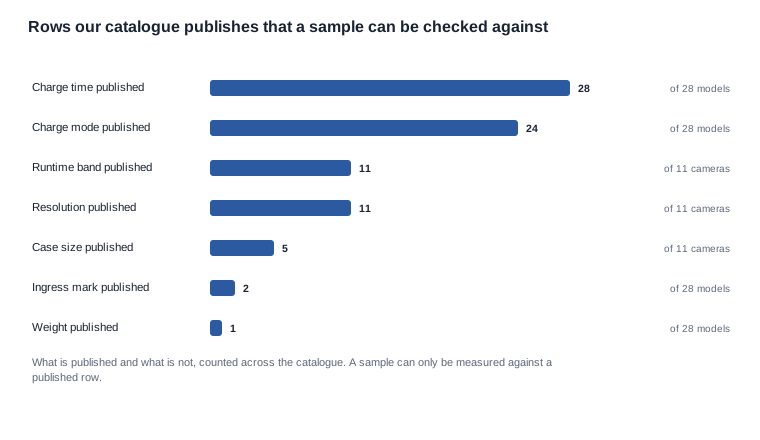
- The runtime band is the strongest benchmark in the range. All eleven camera models publish one: about seven hours on the MT6 and the L2 Utral, the L1 Pro and the CY03, and the CY05, six to eight hours on the KY06 and the MT5, and five to eight hours on the V03 Pro and the V03, and the S7 and the V06. A sample can be measured against it, provided the protocol names the starting state of charge, because the published figure carries neither a start state nor a termination criterion.
- The charge time is published for all twenty-eight models, at up to two hours on twenty-six of them and about one hour on the D17 and the ZH12. It is a bench condition rather than a product limit, which makes it a useful benchmark for the charger and a misleading one for a shift of use.
- The charging method is a benchmark on twenty-four of twenty-eight models. Magnetic charging is published on seventeen models and Type C on seven. The method is not published at all for four camera models, the L1 Pro and the CY05, and the MT6 and the CY03, so for those four the sample can only be checked against what the supplier states in writing.
- The resolution tier is a benchmark on all eleven camera models. Eight are published at 8 MP — the MT6 and the CY05, the CY03 and the KY06, the V03 and the V06, and the V03 Pro and the MT5 — and three at 13 MP: the L1 Pro, the L2 Utral and the S7. This is the cheapest benchmark to check and the one that catches a substituted tier fastest.
- The case option is published per model with real differences. 1400 mAh on the CY03, the CY05 and the L1 Pro, 900 mAh or 1400 mAh on the L2 Utral, a 1200 mAh folding case on the MT6, a case of unstated capacity on the KY06 and the MT5, and no case at all on the V03 Pro.
- The ingress marking exists on two models only. The IP54 marking appears on the V06 and the S7 as a catalogue annotation, with no third-party test report number published against it.
- The weight exists on one model only. The MT6 glasses body is published at 158 g, including its 265 mAh cell and its camera and excluding the 1200 mAh folding charging case, whose own weight is not published.
The rows where the benchmark simply is not there
Everything outside that set has no benchmark and no sample can create one. Sensor models, acoustic measurements and thresholds, ingress test report numbers, certificate numbers and validity dates, cycle life ratings, defect rates, and the weight of every model except the MT6 are not published in our catalogue.
Certification is the row buyers look for hardest and it is worth being exact about. The catalogue carries a company-level export certification page and no per-model certification row for any of the twenty-eight models, and its text contains no reference to CE, FCC or RoHS at all. That does not mean a supplier has no certificates; it means the certificate scope is a document to be requested, not a row to be compared.
The same applies to the charge state and the termination criterion behind the runtime and charge time rows. Those are published as numbers without their measurement conditions, which is why a buyer asking "does this unit meet the published band" gets an answer about the unit rather than about the protocol. The conditions are what the buyer has to supply.
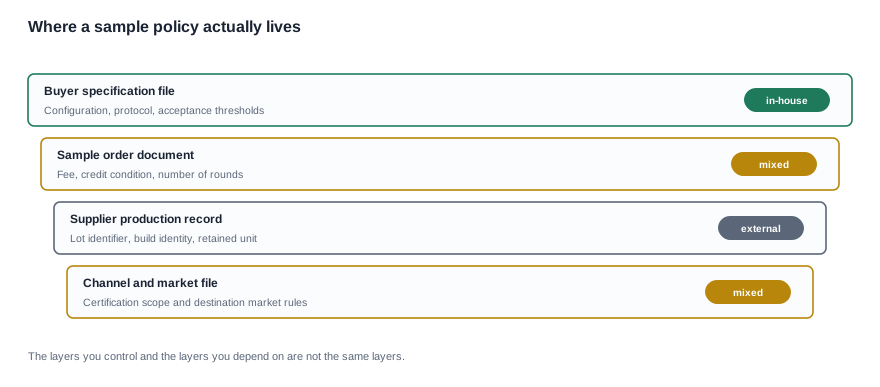
The seven elements, and who really owns each one
Common practice, and the gaps you have to close yourself
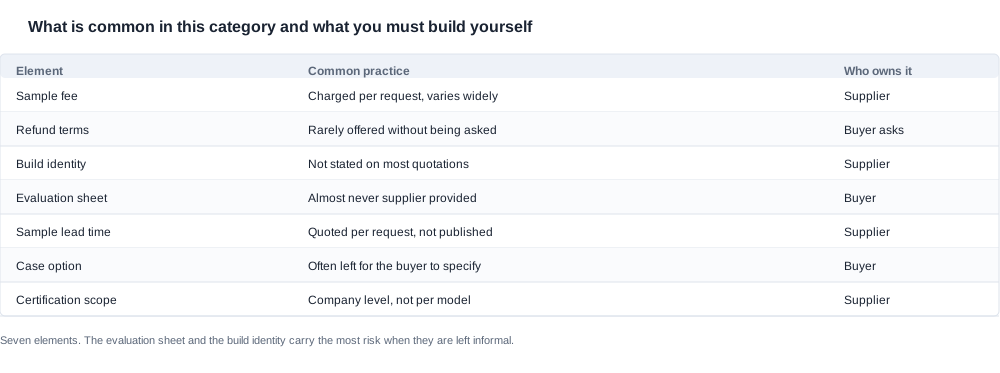
Every sample programme in this category contains the same seven elements. What differs between suppliers is not whether the element exists but whether it is addressed in writing. The table below is the working version, and the right-hand column is the part buyers consistently under-estimate.
| Element | What is common in practice | Who has to close the gap |
|---|---|---|
| Sample fee | Charged per request, varies widely by supplier | Buyer, by asking |
| Refund terms | Rarely offered unless the buyer asks | Buyer, by asking |
| Build identity | Not stated on most quotations | Supplier, by disclosing |
| Evaluation sheet | Almost never supplied by the supplier | Buyer, by writing |
| Sample lead time | Quoted per request, never published | Supplier, by committing |
| Case option | Often left for the buyer to specify | Buyer, by naming it |
| Certification scope | Company level rather than per model | Supplier, by disclosing |
Two of these seven carry disproportionate risk when they are left informal, and they are not the two buyers worry about. Buyers worry about the fee and the refund, because those are money they can see. The real risk sits in the build identity and the evaluation sheet, because they decide whether the money spent produces evidence, and neither of them appears on any invoice.
The convention benchmark: how a well-formed quotation reads
A supplier following the conventions of this category will produce a quotation that has certain features, and their absence is itself a benchmark failure rather than merely an omission.
A well-formed quotation names the configuration string rather than a model name, because a model name is a family and a configuration is a buildable thing. It states the sample fee, the refund condition and the number of evaluation rounds together, because these three are one commercial decision and separating them usually means the buyer negotiates each one alone. It states the sample lead time with its start condition, because a lead time without a start condition is not a commitment. And it distinguishes the build identity of the unit it will ship, because a stock unit and a pre-production build are different products at different prices with different evidentiary value.
When a buyer wants to know how to evaluate a quotation from an unfamiliar supplier, these four features are faster and more reliable than the price. A quotation that has all four can be compared with another quotation that has all four. A quotation missing the configuration string cannot be compared with anything at all, whatever it costs.

Asking for a benchmark without asking for a price
Nine questions that produce comparable answers
The benchmark a buyer actually needs is not a number from the market but a set of answers that are comparable across suppliers. Nine questions, sent in writing to every candidate at the same time, do that. The purpose is not to find a winner; it is to remove candidates who cannot answer questions, because a supplier who will not answer a written question about its own process is unlikely to produce the evidence a sample programme depends on either.
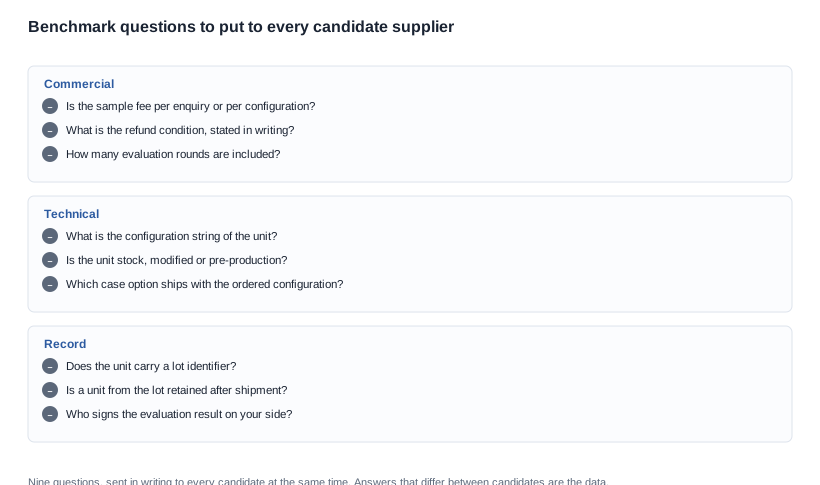
The completion test on every question is a specific answer, not a description of approach. "We have a rigorous sample policy" is not an answer. "The sample is a stock unit at the published specification, we credit the fee against the first order above a stated quantity, and the unit carries the production lot identifier" is an answer, and it is answerable by any supplier with a process.
The two questions that do most of the filtering are the configuration string and the basis of the minimum order quantity. A supplier that cannot produce a configuration string cannot quote a configuration, and a minimum that applies per model, per configuration and per order are three different commercial structures with three different consequences for a launch plan. A single number for the whole range is not an answer to either.
Asking each candidate the same thing
The reason to send the same nine questions to everyone rather than tailoring them is comparability. Tailored questions produce tailored answers, and tailored answers cannot be laid side by side. The differences between suppliers are only informative when the question was identical.
There is one adjustment worth making, and it is worth making in writing rather than in conversation: add the question about what happens if the unit does not match the order. Almost no supplier volunteers it, and the answers divide sharply. Some have a written process and describe it. Some have a good-faith intention and describe it at length. Some have neither, and the silence is the answer.
The shortlist, written down with reasons
The answers form the shortlist, and the shortlist should be written down with reasons rather than held in an email thread. Two or three candidates survive a screen of this kind, and that is the right number, because the sample budget is best spent on candidates who answer questions rather than on candidates being tested.
From the shortlist, the sample fee becomes comparable, because every candidate has now described the same thing. A fee quoted against a named configuration, with the credit condition and the round count stated, is a fee that can be compared with another fee quoted the same way. A fee quoted against a model name is not a fee, it is an opening position.

The two numbers that will never be benchmarked
The fee, and why there is no market rate for it
There is no published market rate for a smart glasses sample fee, and there is not going to be one, because the fee is not a function of the product alone. It is a function of what the supplier has to do to produce the unit you asked for: whether it is a stock unit taken off a shelf, a modified unit, or a pre-production build with your logo and your packaging and your firmware, and whether a case of a particular capacity has to be sourced. Two suppliers quoting the same model for two different configurations are quoting two different products.
This is why asking whether a fee is fair is a question without an answer, and why comparing two fees is a comparison of two different things. The right comparison is between two quotations for the same named configuration, and the way to get there is to specify first.
The defect rate, and the estimate you will have to write down
The second number with no benchmark is the defect rate, and it has no benchmark because it is a property of a supplier's process at a point in time, and no supplier publishes it. There is no way to benchmark it externally, and no way to measure it on a sample either.
What a buyer can do is write down the assumption. Put the defect rate you are using in the margin model into the specification file as a stated working assumption, with the date and the basis, and treat it as a figure that the first pilot lot will either confirm or correct. A buyer who leaves the assumption unwritten cannot challenge it later and cannot improve it; the number simply becomes part of the margin model by default, inherited from whoever first did the arithmetic.
The criteria for judging a supplier's sample policy are therefore mostly internal, and that is the honest position. The published rows tell you whether a unit matches the specification. Everything else — the round count, the credit condition, the disclosure, the record discipline — tells you whether the supplier runs a process you can depend on, and the only way to judge that is to test whether they will put it in writing.
What we publish, and how we handle a benchmark request
Our position on supplying benchmarks
Concretely, we will give you the benchmark that exists, which is the published specification, and we will not give you a benchmark that does not, which is the fee. We publish what our documentation states, we mark the rows that are open, and we will not fill an open row with a typical figure taken from a supplier's general data. A buyer who builds a claim on an estimated number finds the error in the field rather than in the quotation, and the correction is always more expensive than the question was.
Stated plainly, because buyers otherwise assume otherwise: we do not publish frame weight for any model, and where a weight is published, as it is for the MT6 glasses body at 158 g including the 265 mAh cell and the camera and excluding the 1200 mAh folding charging case, we say exactly what the figure includes. We do not publish per-model certification, because the catalogue has no per-model certification row for any of the twenty-eight models and its text contains no reference to CE, FCC or RoHS. And we do not publish sample fees, credit conditions or round counts, because those are commercial terms of one quotation.
What happens when you ask us for a comparison
Send the models, the quantities and the target market, and we will tell you which configurations exist, which of them are open on the published data, and what a sample would and would not settle for each one. If you are comparing quotations from several suppliers and need them on the same basis, we will tell you what has to be identical between them before the comparison means anything, and which single figure in each quotation decides whether that basis has been met.
If you need a benchmark that our catalogue does not contain, we will say so and tell you which document to request from the supplier instead. That is the whole of what a supplier can usefully contribute to a benchmark question before a single unit is built, and it costs nothing.
Related reading
- What a sample can and cannot prove — the framework the published rows support
- Sample policy hidden costs — where the money goes when the policy is thin
- What to ask before ordering — the questions in a different order
- MOQ guidance for smart glasses — the minimum order question that belongs in the same screen
- Bluetooth audio glasses — the eight-model audio range the same screen applies to
Send the configuration, the quantity and the market, and we will say which parts of the benchmark are published and which have to be asked for.


