

Five beliefs about smart glasses sample policy survive because each of them is true often enough to be believable and false often enough to cost money. A sample proves the product. Samples mean the factory has capacity. Certification is done at sample stage. A cheap sample means a cheap order. One sample covers every variant. Each of these sounds like an obvious proposition, and each of them is wrong in a specific, predictable and expensive way.
The reason these five survive is structural rather than intellectual. In a category where the published specification is short and the commercial terms are private, buyers substitute the belief they already hold for the fact they have not been given. Nobody has published a reference sample fee, so buyers believe samples are cheap. Nobody has published a per-model certification row, so buyers believe certification arrives with the sample. Nobody has published a defect rate, so buyers believe the approved unit predicts the production lot.
The remedy is not to be more sceptical in general. It is to replace each belief with a specific document, because a myth that has been given a document stops being a myth.
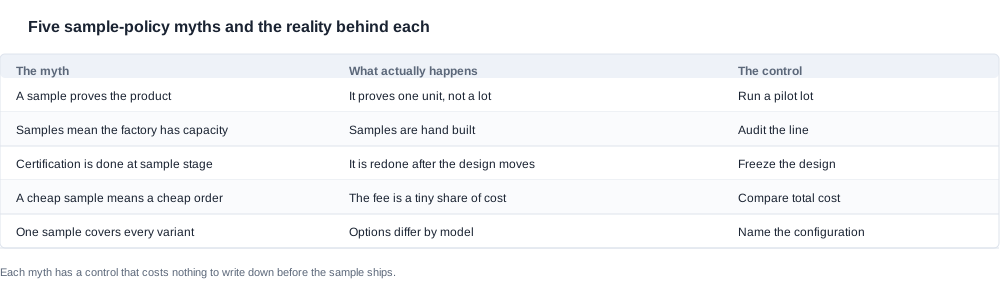
Smart glasses sample policy myths: the five that reliably cost money
Why these five and not some other five
A myth earns its place in this list on three conditions. It has to be widely held, it has to be wrong in a way that produces a measurable cost, and it has to be correctable with something a buyer can actually obtain.
Myth one, that a sample proves the product, passes all three. It is held by every buyer who has ever received a good unit. It is wrong because one unit is a design and not a process, and the cost arrives as a first lot that behaves differently from the unit that was approved. It is correctable with a split evaluation sheet and a pilot lot, both of which a buyer can schedule.
Myth two, that samples mean the factory has capacity, is wrong in a way that is easier to state than to fix. A sample is frequently a hand-built unit, and a factory that can build samples by hand is not thereby a factory that can build your volume. The cost arrives as a lead time that moves. It is correctable with a written question about what the line is currently running.
Myth three, that certification is done at sample stage, is the most expensive of the five because it makes a second payment inevitable. The cost arrives as a re-test after the design moves, at a fee nobody budgeted and on a schedule nobody quoted.
Myths four and five are the two that buyers are most confident about, and confidence is what makes them dangerous. A cheap sample does not mean a cheap order, and one sample does not cover every variant. Both are correctable with a written total-cost calculation and a configuration string.
The short answer on each of them
| The myth | What actually happens | The control |
|---|---|---|
| A sample proves the product | It proves one unit, not a lot | Run a pilot lot |
| Samples mean the factory has capacity | Samples are often hand built | Ask what the line is running |
| Certification is done at sample stage | It is redone after the design moves | Freeze the design first |
| A cheap sample means a cheap order | The fee is a tiny share of cost | Compare total cost |
| One sample covers every variant | Options differ by model | Name the configuration |

Myth one: a sample proves the product
What one unit actually settles
A unit settles questions about hardware. It does not settle questions about a process, and the distinction is easy to state and easy to lose.
A single unit can establish identity: whether the configuration that arrived is the configuration that was ordered, whether the case option matches the ordered option, whether the camera tier matches the published resolution tier. It can establish function against a published reference: whether the runtime falls inside the published band when the protocol names the starting state of charge and the duty cycle, whether the charging method on the shipped configuration matches the published method, whether the weight on the MT6 matches the published 158 g for the glasses body including the 265 mAh cell and the camera and excluding the 1200 mAh folding charging case.
What it cannot establish is anything about the production lot. It cannot tell you the defect rate. It cannot tell you whether the fourth run looks like the first. It cannot tell you whether the supplier's line will hold a tolerance. And it cannot tell you anything at all about a row the catalogue does not publish: sensor models, acoustic measurements and thresholds, ingress test report numbers, certificate numbers and validity dates, cycle life ratings, and the weight of every model except the MT6.
The control: split the evaluation sheet in two
The control is a single line on the evaluation sheet, and it is the line that does the most work in the whole document. Divide the attributes into two groups: those a hardware unit can settle, and those only a production lot can settle. Then run the first group on the sample and schedule a pilot lot for the second.
The published specification makes this easier than it sounds, because there are published rows for most of the first group. All eleven camera models publish a runtime band, about seven hours on the CY05 and the L2 Utral, and the MT6 and the L1 Pro, and the CY03, six to eight hours on the KY06 and the MT5, and five to eight hours on the V06 and the V03 Pro, and the S7 and the V03. The charge time is published for all twenty-eight models, at up to two hours on twenty-six and about one hour on the D17 and the ZH12. The charging method is published on seventeen models as magnetic and on seven as Type C, and is not published at all for four camera models, the L1 Pro and the CY03, and the CY05 and the MT6.
Those rows are enough to write a meaningful first-group sheet. The second group is short — consistency, defect behaviour, ageing — and it is the group that a pilot lot exists to answer. A buyer who has written the split knows before the unit arrives which questions the round will answer, and can decide when to ask whether the supplier's answer to the second group is a document or a promise.
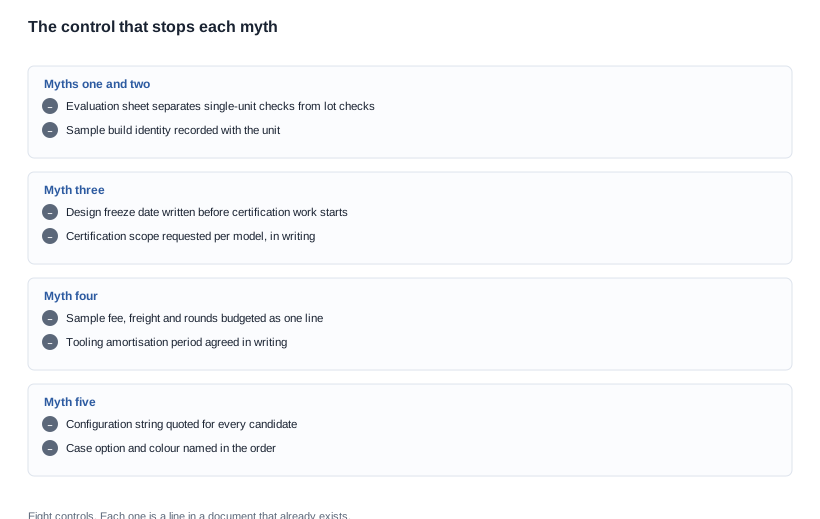
Myth two: samples mean the factory has capacity
What a hand-built unit tells you about a production line
A sample that arrives quickly, looks good and matches the published rows tells you that somebody in the supplier's organisation can build one good unit quickly. It does not tell you that the line can build a thousand of them, and the two facts are produced by entirely different capabilities. Sample units are frequently assembled by hand, by a person whose actual job is prototyping or customer support, and the capability that produces a convincing prototype is not the capability that produces a repeatable lot.
This myth is unusually expensive because the cost lands on the launch date rather than on the sample budget, and a launch date that moves is a cost that no line in the cost breakdown captures. It also has an awkward timing: the buyer usually discovers it at the exact moment the order is placed, when there is no longer a sample that would have helped.
The control: ask what the line is running, in writing
The question that exposes this myth is not about capacity in the abstract. It is about the current state of the line, and it has to be answered in writing to count. What is the line producing this month? What is the current output per shift? Which orders are on that line and when do they finish? What is the minimum order quantity and what does it apply to — a model, a configuration, or an order?
The reason to ask this before the sample rather than after it is that the answer changes the plan. A supplier whose current line is at a different configuration can often build your sample by hand and still be a good production partner; a supplier whose line is committed for two quarters is a schedule risk no sample will detect. This is a question about total cost and schedule risk rather than about product quality, which is exactly why it is skipped.
A capacity figure without its basis is not a capacity figure. If a supplier quotes a number, ask what it is derived from, and the derivation is usually the informative part: a number derived from headcount and cycle time is a real number, and a number derived from a wish is not. The questions to ask before you order are short, and this is one of them.
There is a second way to test the same belief, and it costs nothing but a week of attention. Ask what the supplier produced most recently that was not a sample and not a prototype. The answer tells you which line does your work, whether that line is running the configuration you are specifying, and how many other programmes are queued ahead of yours on it. A factory that has built three hundred units of somebody else's product in the last quarter can usually build yours, and a factory whose entire recent output was samples and demonstration units may be a development house rather than a production partner.
That distinction matters commercially as well as operationally, because the two relationships have different terms. A production partner can usually be held to a delivery schedule, a first-lot inspection and a defect remedy. A development house will negotiate all three as project work, and the programme carries the risk that the project is reprioritised. Which of the two you are dealing with is visible in the answer to this question before the sample is ordered, and it is invisible in the answer to any question about the product.
Myth three: certification is done at sample stage
Why the order of operations matters more than the amount
The belief goes like this: a supplier who offers certification at the sample stage is being helpful, the certification work is done once, and the buyer saves money by triggering it early. In practice the opposite is true, because certification work performed before the design is frozen is work that has to be performed again after the design moves.
A design moves for ordinary reasons. Firmware changes, a different cell, a revised antenna layout, a new packaging specification, a supplier substitution that nobody intended. Each of those is a small change and each of them can invalidate certification work, and the re-work is charged at the same rate as the first attempt while the programme is already committed to a launch date.
There is a second problem specific to this category, and it is the one buyers are most likely to get wrong. The catalogue carries a company-level export certification page and no per-model certification row for any of the twenty-eight models, and its text contains no reference to CE, FCC or RoHS at all. A supplier who says "we are certified" may be describing the company, the factory or the product line, and a buyer who treats that sentence as a per-model answer has accepted a scope that was never stated.
The control: freeze the design, then ask for the scope per model
Two controls, and both are cheap.
The first is a design freeze date written before any certification work starts. Everything before that date is prototyping; everything after it is certification. The date does not have to be realistic in the sense of being achievable — it has to be written down and defended, because its whole purpose is to stop work being triggered early.
The second is a per-model scope request. Ask what is certified for which model, under which directive, with which report number and which validity date. Where the answer is a company-level statement, record it as a company-level statement and ask again for the model. The Radio Equipment Directive is numbered (EU) 2014/53/EU, and the electromagnetic compatibility directive is numbered (EU) 2014/32/EU, and the two are routinely confused in conversation and in paperwork. A buyer who asks which one applies is doing useful work, because a supplier that has been quoting the wrong directive number is often quoting from a file that is older than the current product.

Myths four and five: the cheap sample, and the one sample for every variant
Myth four: the fee is the cost
The fee is the smallest number in the programme, and it is the one number that gets negotiated hardest. The costs that actually matter are the rounds the specification did not prevent, the engineering cost the programme inherits, and the reserve the quality assumptions generate on every unit it ships. A buyer who negotiates the fee hard and accepts an unstated configuration has saved a small number and bought a large one.
There is a specific trap here, and it is the one worth naming because it appears in quotations regularly. A sample charge that is credited against the first order looks like a discount and is not one — it is a deferred payment, and it is only a discount if the first order actually happens and the credit condition is honoured. Ask what happens to the credit if the programme is cancelled, if the volume drops, or if the order is split across two deliveries. A credit with a condition attached is a commercial term worth negotiating. A credit with no condition is a number that will disappear at the moment it is needed.
Myth five: one sample covers every variant
It does not, and the differences are published, which makes this myth easy to disprove. The L2 Utral is published in two case options, 900 mAh or 1400 mAh. The V03 Pro has no charging case at all. The L1 Pro and the CY05, and the CY03 are published with a 1400 mAh case, the MT6 with a 1200 mAh folding case, and the KY06 and the MT5 with cases whose capacity is not published. The charging method is not published at all for four camera models. And the resolution tiers split the camera range into eight models at 8 MP and three at 13 MP.
Each of those is a different unit, and each one is a different sample with a different configuration string, a different protocol reference and a different record. A programme that samples the CY03 and then orders the L2 Utral without a second round has not sampled the L2 Utral, whatever the paperwork says.
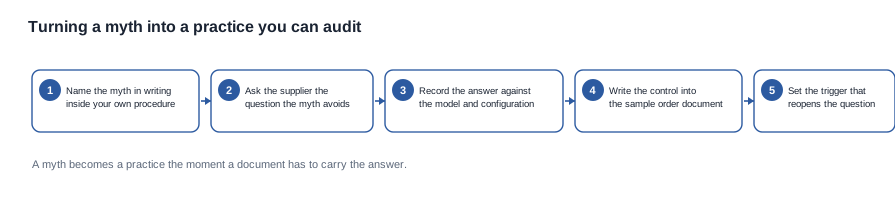
Turning a myth into a control, and what we publish
The five steps that make the conversion durable
A myth becomes a practice the moment a document has to carry the answer, and the conversion takes five steps.
- Name the myth in writing inside your own procedure. It has to be written down, because an unnamed assumption cannot be challenged by the next buyer who inherits the file.
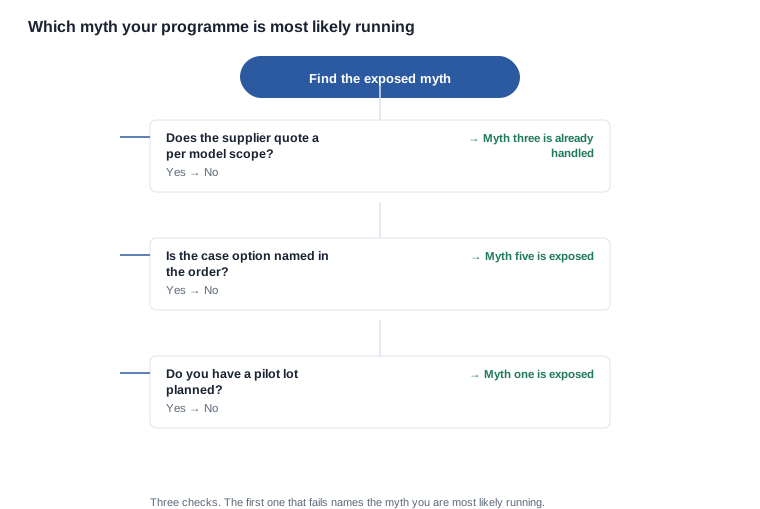
- Ask the supplier the question the myth avoids. For myth three that is the per-model scope; for myth two it is what the line is running; for myth one it is what the pilot lot will show.
- Record the answer against the model and the configuration. A general answer recorded against a specific model is a mistake waiting to be inherited.
- Write the control into the sample order document. Not into the procedure, which nobody opens, but into the document that the supplier has already signed.
- Set the trigger that reopens the question. A control with no review trigger becomes a habit, and habits expire quietly.
Step five is the one most programmes skip, and it is the reason a myth comes back. The trigger can be simple: a new model entering the range, a design change, a supplier change, a first shipment that disagrees with the approved unit. Any of those reopens the question, and each of them is a date somebody can put in a diary.
What we publish, and what we will not fill in for you
Where we draw our line is simple enough to state. The catalogue is the evidence we can put behind, and anything outside it is a question the supplier's own file has to answer. We mark the rows that are open rather than smoothing them over, and we will not substitute a typical figure taken from a supplier's general data for a number the supplier has not given us. The reason is arithmetic rather than principle: an estimate that turns out to be wrong is discovered in the field, where the correction costs more than the original question would have.
Three rows are worth naming because buyers assume they exist. We do not publish frame weight for any model, and where a weight is published, as it is for the MT6 glasses body at 158 g including the 265 mAh cell and the camera and excluding the 1200 mAh folding case, we say exactly what that figure includes. We do not publish per-model certification, because the catalogue has no per-model certification row for any of the twenty-eight models and its text contains no reference to CE, FCC or RoHS. And we do not publish sample fees, credit conditions or round counts, because those belong to a specific quotation rather than to a catalogue.
What we will do is tell you which of these five myths applies to the configuration you are actually specifying, before you pay for a sample, and what document to ask for in place of the evidence a sample cannot give you.
Related reading
- Practical advice for smart glasses buyers — the same ground as a working sequence
- Red flags to avoid — what a supplier looks like when a myth is running
- Sample policy SOP template — where the controls get written down
- What a sample can and cannot prove — the framework behind the split evaluation sheet
Send the configuration, the quantity and the market, and we will say which of the five myths your specification is exposed to.


