

Smart glasses shipping is a paperwork problem before it is a transport problem, and the paperwork is where first-time buyers lose their margin. The short version: a shipment of battery-equipped eyewear is decided by six documents, only two of which are about money, and a buyer who has those six in hand before the goods are packed will never be surprised by a customs hold, a refused load or an unbudgeted destination charge. This guide is the working version, in the order a buyer needs it: what the papers are, how to read the freight line, what the battery file has to say, what the carton decides, and where our own catalogue stops and your supplier's file begins.
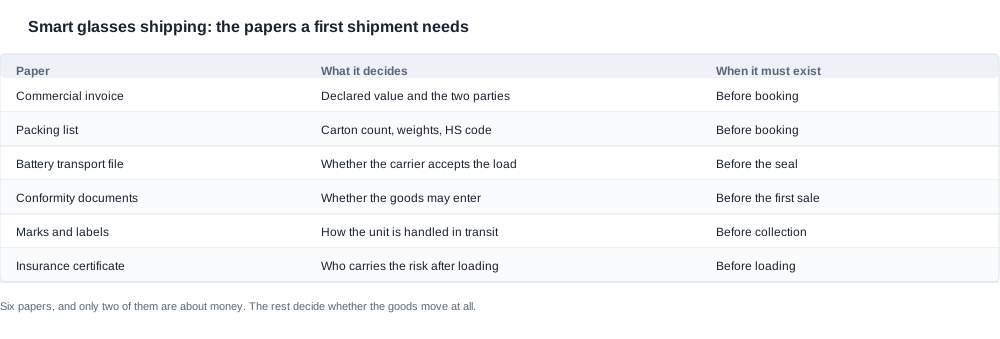
Smart glasses shipping for a first shipment: which document settles what
What a first-time shipper is actually managing
The reader here is a brand-side sourcing manager, a channel buyer or an importer who has never shipped this category of product and who is holding two or three quotations that do not look directly comparable. The fear underneath the enquiry is not a bad price. It is a shipment that is other than the sample the buyer approved, a document route that holds the goods up at a border, or an opening consignment that becomes a returns liability nobody carried. Those three are the same problem seen from three sides, and the paperwork is what prevents all three.
The reason a first shipment feels expensive is that the buyer is paying to learn something that a second shipment should be free. That learning is the cost of the first consignment, and it can be compressed from a whole cycle into an afternoon of document review if the buyer knows which papers to ask for and what each one has to settle.
The six papers and the order they have to be produced in
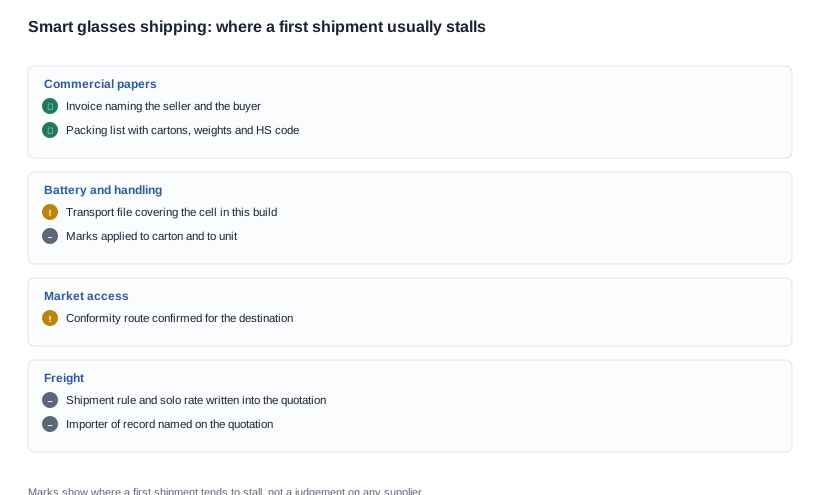
Six documents sit on a first shipment of battery-equipped eyewear, and they are not equally difficult to produce. The commercial invoice and the packing list are administrative and can be produced in a day once the goods exist. The marks and labels are applied to the carton and to the unit, and they have to be right before the carrier collects. The battery transport file has to be assembled against a specific cell configuration, and it has the longest lead time of the six. The conformity documents depend on the destination market and are largely outside the factory's control.
The order matters more than the list. The configuration is frozen first, because every other paper inherits from it. The battery file is requested against that frozen configuration, because a file written for a different build is the single most common cause of a refused load. The packing list is built from the physical cartons, not from the order quantity, because that is the only version of the count that will survive a customs check. The invoice is raised against the packing list, so that the declared value and the declared goods describe the same shipment. The marks are checked against both, and the freight is booked last, with the file in hand rather than in anticipation.


Reading a freight quotation line by line
The three questions a quotation has to answer on its face
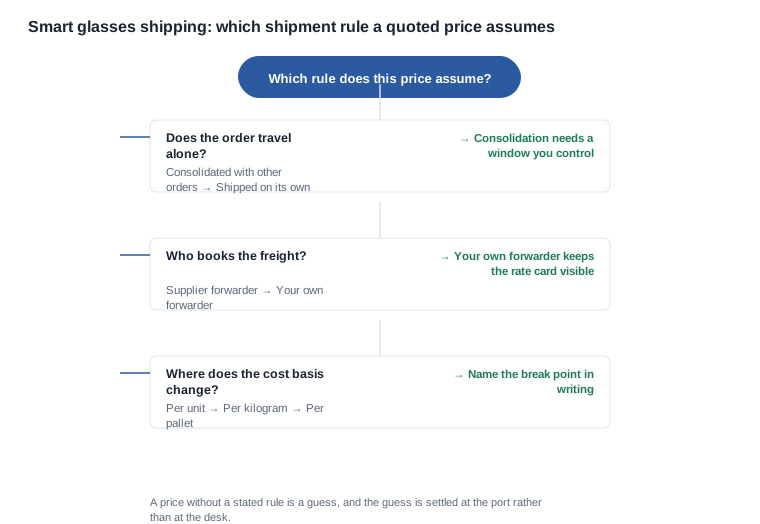
A freight quotation that has to be compared with another one has to answer three questions in writing, and if it does not, no amount of arithmetic will make the two comparable.
The first question is what shipment rule the price assumes. Consolidated with other orders, shipped alone, or split by configuration are three different prices for the same carton, and a quotation that does not say which one it is priced on is not a quotation. The second question is who books the freight. A supplier's forwarder and a buyer's own forwarder produce different visibility, and the second one keeps the rate card open to a buyer who is prepared to tender the lane.
The third question is where the cost basis changes. Per shipment, per kilogram, per unit and per pallet all behave differently as volume moves, and a quote with no stated break point gives the buyer no way to predict what the next consignment costs. That is the difference between a rate and a pricing model, and only one of them can be used to plan a year.
Why a blended freight number is the most expensive kind of quote
A single blended figure looks like the cheapest quote because it is the easiest to read, and it is the most expensive one to act on, for a reason that has nothing to do with the rate: it hides the rule. If the number is a blend, the buyer cannot tell whether it assumes consolidation, a carton dimension it has never seen, or a mode the buyer has not chosen. Any of those three can move the actual cost by a wide margin, and all three are cheaper to resolve in the quotation than in the invoice.
The test is simple and it works on any document. Take the freight line and ask what would have to be true for that number to be the number that arrives on the invoice. If the answer involves a phrase like "depending on the final packing" or "at the current rate", the quotation has told you that the rate is not yet a number. Push for the condition to be written down instead. A supplier who will state the rule, the solo-shipment rate and the break point is not necessarily cheaper than one who will not; they are simply quotable, and quotable is what allows a buyer to compare two suppliers at all.
The questions worth putting in the enquiry, in this order, are the ones that change the price or the schedule rather than the ones that confirm it:
- What shipment method does this price assume, and what is the rate if the goods travel alone?
- Is the packing specification written against this shipping route, and who approved it?
- Which transport documents accompany a battery-equipped consignment, and who assembles them?
- Who is the importer of record, and how are duty and clearance handled in this price?
- What are the shipping carton dimensions, the gross weight and the units per carton for this configuration?
- Where does the freight cost basis change, and at what volume break points?
A buyer who asks all six in the first round is not being difficult. They are establishing which of the quotations in front of them is a complete quotation, and a comparison is only possible between documents that answer the same questions in the same order.
The battery file that has to exist before the carton is sealed
What a transport file has to name to be usable
Every model in our range ships with a lithium cell, so a transport file is not optional for any configuration in the catalogue. The requirement has been in force for intercontinental air shipments since 1 January 2020, and it applies to the cell in the device and to the cell in the charging case when one is present.
What makes a file usable is that it names the configuration rather than the family. A test summary that names a model designation can be compared against the model designation on the unit and on the carton artwork in about two minutes, and that comparison is the check that most often finds a mismatch, because a summary is usually written for an earlier build of the same product. A file that names only the cell's nominal capacity cannot be compared with anything, because the same nominal capacity can be reached by cells with different chemistries, different protection circuits and different housings.
The buyer-side test is therefore short. Ask for the model designation on the test summary, ask for the watt-hour figure, and ask which cell part number the summary was written against. Then take the cell capacity from the cell specification and check the two against each other. Where they disagree, establish which figure the declaration will use before anything else is agreed.
Why air and sea are decided at the booking stage
The mode of transport is not a preference a buyer expresses at the end; it is a decision that changes the paperwork, and it has to be taken when the booking is made rather than at the port. Air and sea travel under different requirements for the transport file, and the requirement that applies is determined by the mode that was booked. A consignment that was prepared for sea and routed by air is a consignment that arrives with the wrong documentation, and the failure happens at the point where the goods are already moving.
There is a second reason the mode has to be decided early, which is the commercial one. Express and consolidated sea are different cost structures with different transit times, and the choice between them changes both the landed cost and the cash cycle. A buyer who has not decided the mode cannot compare a quotation that prices one route against a quotation that prices the other, and the comparison usually produces a false winner.
There is a third reason, which is the one that catches first-time buyers. The mode is also the trigger for a set of handling instructions, and those instructions end up on the carton. A consignment travelling by air carries labels and marks that a sea consignment does not, and a unit packed without those marks is a unit that has to be opened, checked and repacked at the acceptance point, which is a charge and a delay. The packing instruction therefore has to be written against the mode, and the mode has to be known before the carton is closed rather than after it is booked.
The battery rules that apply to each mode, and the file structure that makes them answerable, are set out on the battery transport page, and the shipping step by step article covers the full sequence around them.
Packaging, the carton, and the weight the carrier will charge
Chargeable weight and the carton that produces it
Chargeable weight is normally the greater of two numbers: the actual weight of the consignment and its volumetric weight, calculated from the packed dimensions. Which one binds depends on the density of the product, and this category is light for its volume. A boxed pair of glasses with a charging case is a small object in a box that occupies more space than its weight suggests, which is exactly the profile that makes volumetric weight the binding constraint.
That is why the shipping carton dimension is the number to ask for, and why it has to be asked for separately from the retail packaging dimension. The retail box tells you what the customer sees. The shipping carton tells you what the carrier charges. A buyer who requests the retail dimension and receives it will build a cost model on the wrong number, and the error does not show up until the first freight invoice.
Two further figures belong in the same request: the gross weight of the packed shipping carton, and the number of retail units per shipping carton. The first decides whether actual weight or volumetric weight binds. The second lets a per-unit freight figure be computed rather than estimated, and it is the figure that lets a buyer compare two quotations from two different suppliers on the same basis.
The packaging specification that has to match the route
Packaging chosen from a supplier's catalogue without reference to the shipping route is a packaging default, not a packaging decision, and it is one of the more common reasons a first consignment arrives damaged. The specification worth asking for names the conditions the packaging is designed to survive: the drop height, the vibration exposure, the moisture and temperature range, and the duration of the journey. It also names who approved it against the route, because a specification signed off against a warehouse shelf tells the buyer nothing about a container.
This matters more for this category than for a denser product, because the charging case is a second rigid object with its own shape and its own shock tolerance. A carton designed for a single retail box is not automatically designed for a box plus a 1400 mAh case, and the failure mode when it is not shows up as damage inside a sealed carton, which is exactly the kind of damage that is hard to claim.
The second consequence of the case is that it changes what has to be declared. A device that ships with a charging case carries a second cell, and that second cell changes the declaration, the packed weight and the classification question. Two configurations with an identical device inside are two different transport products, and a buyer who treats them as one line in a purchase order inherits a file that covers only one of them. This is the reason the case option belongs in the configuration string rather than in a later packing instruction: it is the difference between one file and two.
The four figures to request that no catalogue can give
The four figures below are never published, for any model, and they are the ones that decide what a consignment costs and whether it survives the journey. Requesting them in writing is the single highest-return action available to a first-time buyer in this category.
| Figure | What it decides | Why it is not in the catalogue |
|---|---|---|
| Shipping carton dimension | Whether the carrier charges on weight or on volume | It depends on the packing, which depends on the order |
| Gross weight per carton | Which side of the chargeable weight test binds | It changes with the accessories in the box |
| Units per shipping carton | Whether a per-unit freight figure can be computed | It depends on the retail box and the carton |
| Carton mark | Whether the destination can identify the cartons | It carries the buyer's own order number |
A quotation that states all four is a quotation that can be costed. A quotation that states none of them is a quotation that can only be compared, and comparing two of those tells a buyer which one is cheaper without telling them what they will actually pay per unit. The difference between the two is the difference between a procurement decision and a guess.

Where the catalogue stops and your own file begins
What the published catalogue settles about a first shipment
The published catalogue answers more of a first shipment than buyers expect, and it is worth using rather than estimating around.
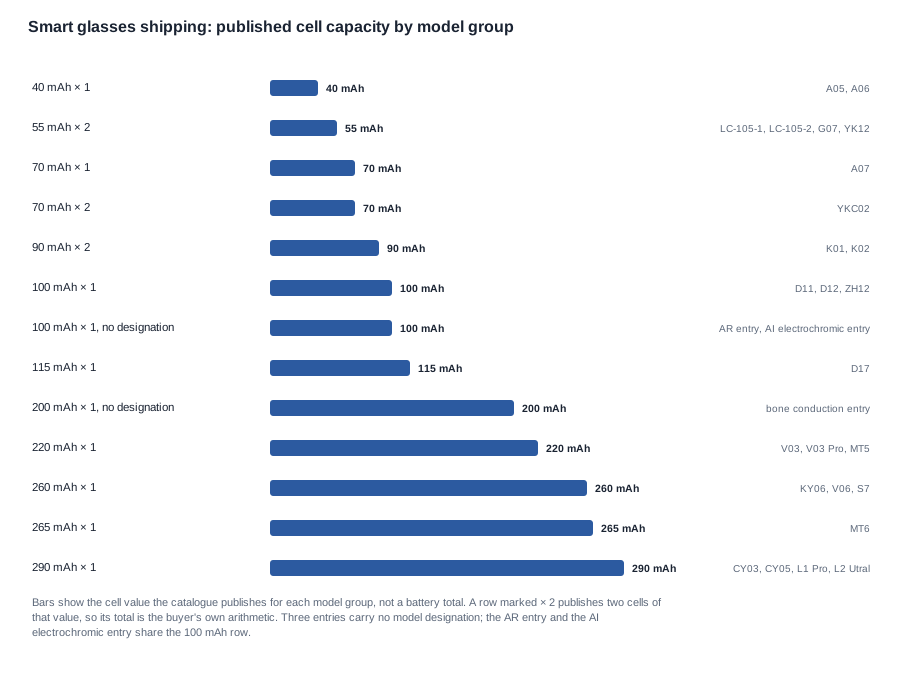
Cell capacity is published for every model, and the catalogue prints it as a cell value with a cell count rather than as a single total. The two-cell configurations are 55 mAh × 2 on the LC-105-1, the LC-105-2, the G07 and the YK12, 70 mAh × 2 on the YKC02 and 90 mAh × 2 on the K01 and the K02. The single-cell configurations are 40 mAh on the A05 and the A06, 70 mAh on the A07, 100 mAh on the D11, the D12 and the ZH12, 115 mAh on the D17, 220 mAh on the V03, the V03 Pro and the MT5, 260 mAh on the KY06, the V06 and the S7, 265 mAh on the MT6 and 290 mAh on the CY03, the CY05, the L1 Pro and the L2 Utral. Three catalogue entries carry no model designation — the AR glasses, the AI electrochromic unit and the bone conduction model — and their cell figures are 100 mAh, 100 mAh and 200 mAh respectively. Charge time is published for every model as well, at no more than two hours for twenty-six of them and around one hour for the D17 and the ZH12. Charge method is published for twenty-four of twenty-eight models, magnetic for seventeen and Type-C for seven; the CY03, the CY05, the L1 Pro and the MT6 have no charge method row in the catalogue, and all four of them publish a charging case capacity.
Charging case capacity is a separate list and it is shorter. The CY03 and the CY05, and the L1 Pro publish 1400 mAh, the L2 Utral publishes 900 mAh or 1400 mAh, and the MT6 publishes a 1200 mAh foldable case. The KY06 and the MT5 publish the fact of a case without publishing its capacity. The V03 Pro is one of the four camera models for which the catalogue prints no charging-case row at all, alongside the V03 and the V06, and the S7, which is a silence rather than a published absence, and it is a question worth asking rather than an answer to assume.
What we will not do to fill a gap
Three things are never published, and they are never published because they belong to a specific order rather than to a product line: the shipping carton dimension, the gross and net weight of the packed unit, and the certification evidence for a given destination market. We will not publish prices, lead times or capacity either, and we will not substitute a typical figure from a general supplier list for a missing one, because a plausible number that is wrong is more expensive than an acknowledged gap: it gets built into a cost model, a carton drawing and a quotation, and it is discovered at the container.
What we will do is take a model, a quantity and a destination market, and tell you which parts of the shipment are settled by published data, which are open, and what to request from the supplier for each open row. Certificate numbers, issuing bodies and validity dates are not published in our documentation, and the certification checklist sets out what a buyer should request in writing to close those rows.
Sending the model, the quantity and the market
If you have never shipped this category before, the fastest useful first step is not a price comparison. It is a document request, sent before the order, that asks for the six papers above plus the four figures the catalogue cannot supply: shipping carton dimension, gross weight, units per carton and the carton mark. A supplier who answers that request with papers and numbers is answering the question that matters.
Then check the answers against the published catalogue for the parts the catalogue covers, and treat any conflict as something to settle before the deposit rather than after the first consignment has cleared customs. The logistics and shipping section sets out the commercial framework that surrounds the documents, and the shipping checklist arranges the same ground by the stage at which each item has to be right.
Send the models, the quantities and the target market, and we will tell you which configurations exist, which of them are open on the published data, and what to request in writing for each one that is not.


