

A lithium-powered product carries more paper than most buyers expect, and the missing item is almost always the one that matters most on the day. The reason is structural rather than accidental: a smart glasses shipment is answered to by at least three different authorities on three different clocks, and the document that satisfies one of them is usually not the document that satisfies the next. This article sets out the set, grouped by the authority each document answers to, with the deadline attached to each one and the five checks that catch most of the mistakes before a container is sealed.
Smart glasses shipping documents and the authority each one answers to
The short answer on the document set
Every model in our catalogue ships with a lithium cell, so the battery transport file applies to every consignment in this category without exception. That single fact determines the shape of the whole document set, and it is the reason the paperwork here is heavier than the paperwork for a comparable non-powered consumer product.
Three authorities, three clocks:
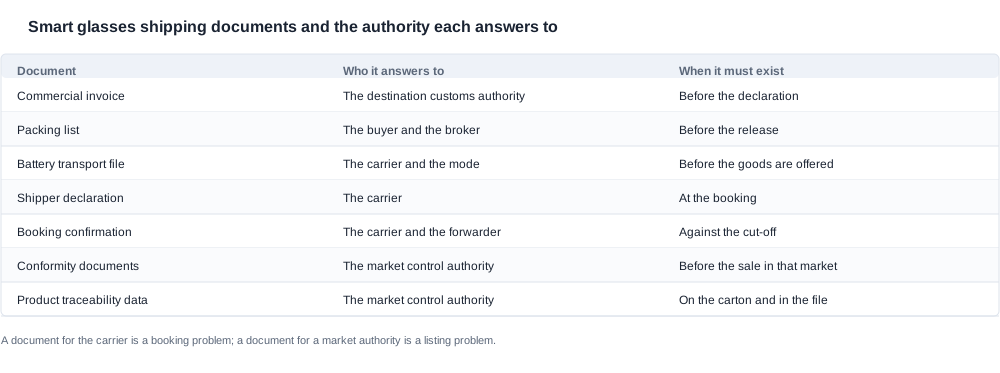
- The carrier wants the transport document set and a shipper's declaration, and wants them at the moment of booking or acceptance. A document for the carrier is a booking problem.
- The destination customs authority wants the commercial invoice, the packing list and the declared value, and wants them at the moment of declaration. A document for customs is a declaration problem.
- The market control authority wants the conformity and traceability data, and wants it before the goods are offered for sale in that market. A document for a market authority is a listing problem, and it is the one that cannot be fixed after the goods have arrived.
The practical instruction that follows from this: a document set should be built by authority, not by date. A buyer who builds the set chronologically ends up with a coherent sequence and a shipment that stops. A buyer who builds it by authority ends up with three short lists, each with an owner, each with a deadline that can be checked.
The buying task behind the document list
The reader is a procurement manager on the brand side, a channel buyer or an importer, and the question behind this article is almost always the same: which of these documents can I get, from whom, and by when? A buyer opening a new market needs to know what to request from the factory before the production slot is booked. A buyer with a programme already running needs to know which document is going to be the one that stops a consignment. A buyer comparing two suppliers needs to know which of them can produce a per-model technical file at all, because the answer changes the comparison.
What the reader is actually managing is a set of documents that have to be true at three different moments, for three different reasons, and that are normally assembled by the party with the least interest in assembling them. The cost of getting it wrong is rarely the missing document itself; it is the week of storage, the second listing check, or the retail-ready stock that comes back because the label and the file disagree.
The document set, by authority
| Document | Who it answers to | When it must exist |
|---|---|---|
| Commercial invoice | The destination customs authority | Before the declaration |
| Packing list | The buyer and the broker | Before the release |
| Battery transport file | The carrier and the mode | Before the goods are offered |
| Shipper declaration | The carrier | At the booking |
| Booking confirmation | The carrier and the forwarder | Against the cut-off |
| Conformity documents | The market control authority | Before the sale in that market |
| Product traceability data | The market control authority | On the carton and in the file |

The document set at each point in the shipment
The same seven documents appear in every shipment in this category. What changes between one shipment and the next is when they have to be in place, and who is holding them. A calendar is the most useful artefact a buyer can build for a programme, because it converts "the file needs to be right" into a set of dated obligations that somebody can be asked about.
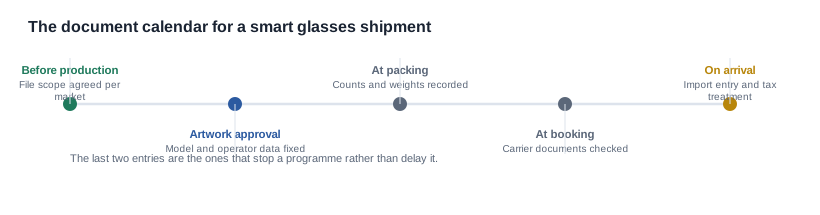
Before production: the market route and the file scope
Two things have to be settled before a single unit is made. The first is the destination market, because the market determines the route and the route determines the documents. The second is the configuration, because the technical file is written per configuration, and a file written for one cell configuration does not cover another.
This is the stage where the cost of delay is highest and where the buyer has the most control. The documentation route can be opened before the configuration is frozen, because the route depends on the market and the product category rather than on the colour. Starting it after production is booked is the most common self-inflicted delay in this category, and it is entirely avoidable.
What the file has to cover for the EU market is worth stating precisely, because the requirement is specific and the errors are general. Radio equipment falls under the Radio Equipment Directive, Directive (EU) 2014/53/EU. General Product Safety Regulation, Regulation (EU) 2023/988, applicable since 13 December 2024, adds the manufacturer identification, the responsible economic operator and the traceability labelling that a consumer-facing product needs. A buyer who knows these two references can ask a supplier whether the file covers them, and a supplier who cannot answer in writing is telling the buyer something important.
At packing: the counts, the weights and the marks
Three items have to be produced at the packing station rather than at the office, and all three are routinely done at the office and then corrected.
The carton count has to be counted, not estimated. The gross weight has to be recorded per packed unit, because it is one of the two inputs to the chargeable weight, and because a weight reconstructed later is a weight nobody trusts. The marks and labels have to be checked against the classification and the route, on the carton and on the unit inside it, because a mark applied to the carton and not to the unit is a mark that does not satisfy the requirement it was meant to satisfy.
The shipping cost breakdown article covers why the gross weight matters commercially, and the certification checklist covers the market-side document set in the field version of this list.
At booking: the carrier set and the cut-off
The shipper's declaration for dangerous goods, the marks and labels the classification requires, and the booking confirmation against the carrier's cut-off for the sailing. This is the stage where the schedule is decided, and it is the stage where a document that was "being prepared" becomes a cost measured in days per unit of the programme.
On arrival: the import entry and the tax treatment
Import documentation for the destination market, and — where the terms are delivered rather than ex-works — the customs entry and the tax treatment agreed at quotation stage. This is the stage where the declaration is tested against the physical goods, and it is where a mismatch between the invoice, the file and the artwork is discovered by somebody else.
After arrival: the file that has to be kept
A shipment can clear customs and still be stopped at the point of sale, and a technical file is the only thing that answers a market authority months later. Buyers should agree at the outset how long the file is kept, where the copies live and who can produce them after the goods have left — because a file held on one person's machine is not a record, and the question "who can produce this in two years" is a question about risk management rather than about administration.
Why the battery file is the one nobody chases
The battery transport documentation has a specific property that explains why it is the most commonly missing item in this category: it is the only document nobody needs until somebody demands it.
The commercial invoice is needed by the buyer and by the broker, so it is chased. The packing list is needed at receiving, so it is chased. The conformity documents are needed by the brand's own compliance team before the listing goes live, so they are chased. The battery file is needed by the carrier and by the mode operator, and until a consignment is actually tendered, nobody in the buyer's organisation has a reason to ask for it.

The structure of the file
The file has three parts, and the third is the one that most often turns out to be missing for the right configuration.
The first is the test summary for the cell in the box. It names the model designation, the cell and the watt-hour rating, and it has to match the unit that is actually shipped. A summary written for a sibling model with a similar name and a different cell is a document that reads correctly and covers nothing.
The second is the packing arrangement for that cell: how the cell is protected in the unit, and how the unit is protected in the carton. For a product that ships with a charging case, there are two cells in the carton, and the file has to cover both, because the classification follows the larger of them.
The third is the assembly position: whether the pack is assembled in-house from a qualified cell, or bought as a finished pack, and which party signs the declaration for the finished unit. This is the part that decides whose file the buyer is entitled to see, and a buyer who never asks it will discover the answer at the point where it is too late to change anything.
Why the timing is the real problem
The file is not a document that can be produced in an afternoon. It sits at the end of a chain: a test summary is written after a test, a certification is issued after an assessment, and a market file is compiled after both. So the lead time is not "the time it takes to print a certificate"; it is the time it takes to run a test and issue a document against a specific configuration.
The instruction that follows is the one a buyer can actually act on: confirm the file before the production slot is confirmed, not before the goods are collected. Asking for the file after the goods are made buys a schedule problem instead of a question, and the battery transport section is where the underlying document structure is set out.
The declared value, and the one thing not to negotiate
Under-declaring customs value to reduce duty is a decision that costs everything if the goods are lost, and it is the one term in this category where a supplier who offers it is telling you something about the rest of the file. The declared value should be the value, and it should be stated on the quotation along with the classification and the importer of record so that it can be compared with anything else.

Five checks that take ten minutes with the carton artwork
Most of the document failures in this category are visible in a single artefact that the buyer already has: the printed carton artwork. If the artwork is to hand, the checks below take about ten minutes and they catch the majority of what goes wrong.
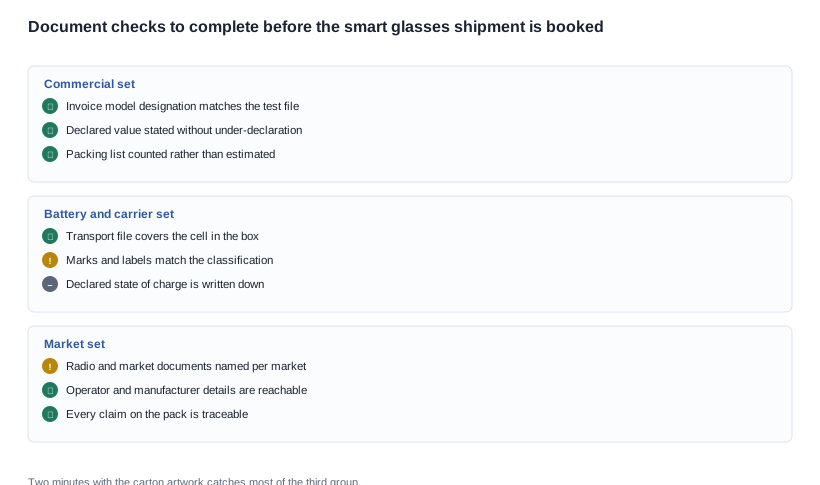
The checks, in the order to run them
- Model designation identical on the invoice, the test evidence and the artwork. Three documents, one string. This is the check that most often finds a mismatch, because the file is usually written for an earlier build of the same product. Completion test: a single string that appears on all three.
- Battery documentation present, current, and matching the cell in the shipment. Completion test: the cell designation on the summary is the cell in the box, and the summary names the configuration that has been ordered.
- Manufacturer and responsible operator details on the cartons consistent with the documents and reachable. A label that carries a name and an address nobody can answer for is a label that creates an obligation without meeting one. Completion test: the details on the artwork are the details on the file, and the contact route works.
- Every claim printed on the packaging traceable to something in the technical file. Completion test: each claim maps to a document. A claim that maps to nothing is a claim that cannot be defended if a market authority asks.
- The declared value and the classification stated on the quotation, with the importer of record named. Completion test: three items, in writing, before the order. This is the check that keeps two quotations comparable.
The criteria for judging a document set, and the red flags
Whatever the route, a document set can be judged against three criteria, and they are worth applying before a due diligence conversation rather than during a hold. Does it describe this configuration? Does it answer to the right authority? Is there a named owner and a date?
The red flags are the reverse of the criteria, and they are worth learning as shapes rather than as items. A document that names a product family rather than a configuration. A file that exists in one place with no owner. An artwork that carries a claim the file does not support. A file that "covers most models". Each of those shapes is cheap to detect and expensive to discover at a port, and each of them is a question worth asking before you order rather than a problem worth solving after.
What these five checks cannot do
They cannot establish that a file exists for a market the buyer has not asked about, and they cannot extend the validity of a document. What they can do is establish that the set the buyer holds is internally consistent, that it describes the goods actually in the box, and that the packaging does not say anything the file does not support. That is a large share of the failure surface, and it costs a printer's proof and an email.
There is one further check that is worth running once per programme rather than once per order: ask how long the file is retained, where the copies live, and who can produce it after the goods have left. A file on one laptop is not a record. A file in two places with a named owner is.

The contract lines that make the document set binding
A document set that is not referenced in the purchase order is a set that is reconstructed for every order, and the reconstruction is where the errors enter. Five clauses turn the set into something contractual, and they are worth having even when the relationship is a first trial order.
The document schedule clause attaches the list to the purchase order with a date and an owner against each item, and states that goods will not be tendered to a carrier until the carrier set is complete. This clause converts a shipping problem into a milestone, and a milestone is something a buyer can hold a supplier to.
The conformity scope clause names the destination markets the file covers and requires written notice of any change to that scope, including a change of cell part number, tooling or production site. It also states that a change reopens the file. Without this clause, a substitution made for supply reasons is invisible to the buyer until the goods are held.
The declared value clause states the basis on which value is declared and forbids under-declaration. It sounds trivial and it is the clause that protects the buyer if the goods are lost, because an under-declared consignment has no claim value.
The artwork and traceability clause binds the carton artwork to the file, and requires that any artwork change be approved against the file. It also covers the detail that is routinely missed: a carton printed for one market and shipped into another, which is the most common way a compliant product becomes a non-compliant one at the point of sale.
The retention clause states how long the technical file is kept after the last shipment and who can produce it. It costs nothing and it is the difference between a document and a record, and it is what a buyer is asked to produce years later in a market that has changed its requirements in the meantime.
The incoterm, and the classification dispute
Two further clauses belong in the same list. The first is the incoterm with a named place, in the purchase order rather than in a side letter, because a change of term moves the insurance obligation, the customs paperwork and the point at which risk passes at the same time. The second is the clause assigning a classification dispute to the party that wrote the technical file, which is almost always the party with the data to settle it.
What is not negotiable
The cost and the cycle of the testing and registration work behind a market file are fixed per product family and per market, and they do not fall with volume or with contract length. The useful question about that cost is not whether it can come down but whether the scope is right, because an unnecessary market in the quotation is a cost the buyer chose.
The documents we hold, the documents we do not
The short answer: we will supply the documents that exist for a given configuration and destination, and we will say plainly which ones we do not hold. The catalogue lists a company-level export certification page, and it does not carry a per-model certification row; the text of the catalogue contains no CE, FCC or RoHS marking, and we will not write "our catalogue states CE, FCC and RoHS" because it does not. Buyers will ask for CE, FCC and RoHS evidence, and the honest answer to that question is a written list of which document is held for which model and which is not held.
The rows we do not publish are these:
- Certificate numbers, issuing bodies and validity dates. Not published in our documentation, for any model, because we do not publish a figure that cannot be traced to a document.
- **Per-model certification scope.The catalogue lists a company-level export certification page and no per-model row, and we will not infer a per-model position from a company-level capability.
- The watt-hour rating and cell part number behind a test summary. These are properties of the file for a specific configuration, and they are supplied with the file rather than published in a catalogue.
- Packed carton dimensions, gross weights, units per master carton and transport classification. These follow the final retail packaging and the destination rather than the device.
- Freight rates, transit times, minimum order quantities and production lead times. Commercial positions that move with volume, season and market.
What we will not do is ship against documentation that does not cover the battery in the box, and we will not under-declare a customs value. Both are cheap to observe at the packing station and expensive to explain afterwards. We will itemise freight for a given configuration, quantity and destination, and we will tell you which documents exist for that configuration before the order is placed rather than after the goods are tendered.
Related reading
- Shipping cost breakdown — what the paperwork protects, in money terms
- Certification checklist — the market-side document list
- Battery transport — the document that stops goods
- Logistics and shipping — the sequence from carton planning to booking
Send the model, the destination market and the configuration, and we will say which documents exist for it and which are still open.


