

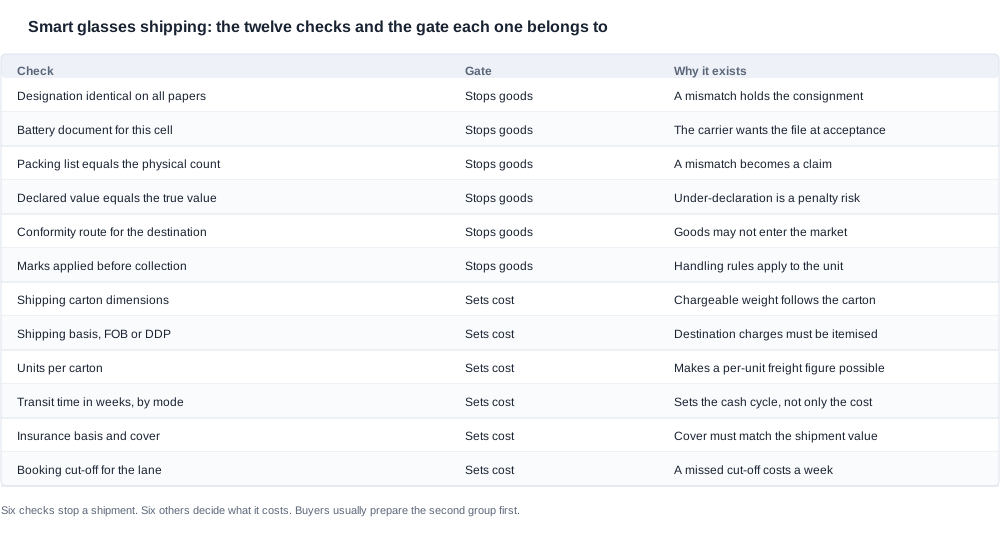
Smart glasses shipping divides into two gates, and the difference between them is the difference between a shipment that stops and a shipment that costs more than planned. The first gate is a set of documents that must exist and agree with each other before anyone packs a carton; a failure here stops the consignment. The second gate is a set of figures that decide what the consignment costs once it arrives; a failure here does not stop anything, it just moves the money. Twelve checks cover both, and this is the list, with the reason each one is there.
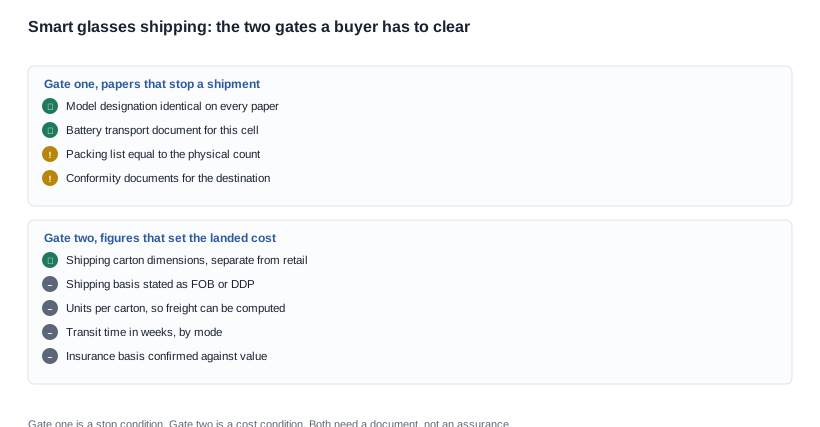
Smart glasses shipping: the two gates a buyer has to clear
Why one gate stops a shipment and the other one only changes the price
A buyer who treats a shipping checklist as one list of things to look at will clear the cheap gate first, because the cost figures are the ones they can chase in an email and the documents are the ones that need a supplier's own file. That is the wrong order, and the reason is simple: a missing figure can be corrected after the goods have shipped, while a missing document cannot.
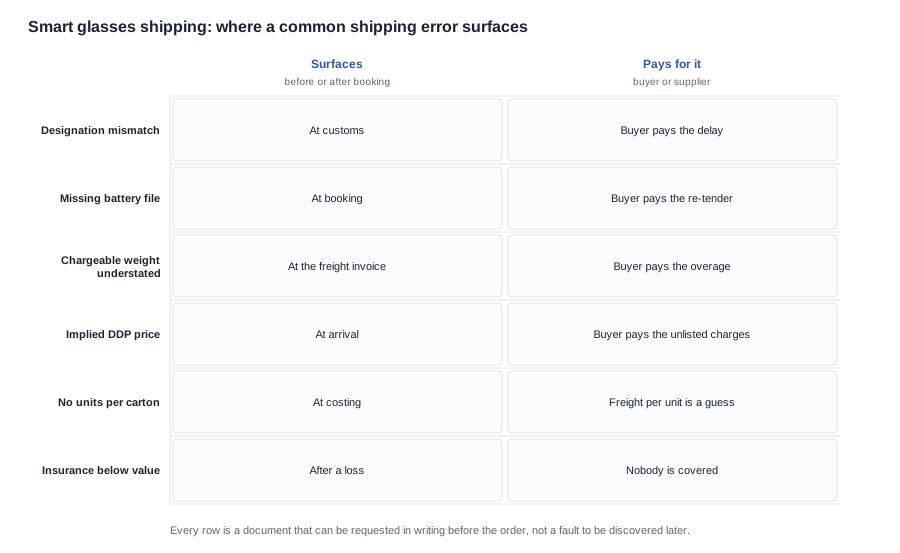
The distinction is about remedy, not importance. A designator that reads "V06" on the invoice and "S7" on the carton artwork is not a rounding difference; it is a consignment that a customs authority can stop and that a broker cannot defend without a correction from the factory, which takes days. A shipping basis that was assumed to be delivered duty paid when it was not is an overage that arrives with an invoice and can be paid, negotiated and budgeted. The first failure consumes schedule. The second consumes margin. A checklist that mixes them will let the buyer spend a week on margin and lose a month on schedule.
The practical consequence is that gate one has to be cleared before the goods are made, not before they are shipped, because a document that is missing at the packing stage has to be created and re-submitted, and a document that is missing at the booking stage has to be created twice.
Twelve checks, split by the consequence of getting them wrong
The first six checks are gate one. They are about documents, and each of them has a paper behind it that the buyer should hold, not a promise that the supplier has made. The second six are gate two. They are about figures, and each of them can be requested in writing at quotation stage in a single line.
The split matters for how the checklist gets used. Gate one is a pass or fail: either the documents agree with each other or they do not, and there is no averaging across the items. Gate two is arithmetic: each figure feeds a computation, and the computation is what tells the buyer whether the landed cost they planned on is the landed cost they will pay.

Gate one, the papers that can stop a shipment
The designation check that takes two minutes
The first check is that the model designation is identical, character by character, on the invoice, on the test evidence and on the packaging artwork, including any suffix. This is the cheapest check on the list and the one that finds the most, because model designations in this category carry suffixes that change the build: the V03 and the V03 Pro are different products with different configurations, the L1 Pro and the L2 Utral are different products with different charging case options, and the LC-105-1 and the LC-105-2 are different products with the same cell arrangement.
The check takes two minutes per shipment and it has to be done on the printed artwork rather than on the sample, because artwork is where a suffix gets lost. The specific failure it prevents is a consignment whose paperwork names one model and whose carton contains another, which is the kind of finding that stops a container and cannot be argued with.
The battery document, and what a file for the wrong build looks like
The second check is that the battery transport documentation covers the specific cell configuration in the shipment. Every model in our range ships with a lithium cell, and the arrangements differ across the range, so a document that covers one model does not cover its sibling.
What a file written for the wrong build looks like is not unusual. It carries a sibling designation with a similar name, or it quotes a capacity that belongs to the pack rather than to the cell, or it is a summary written for an earlier build of the same product after the cell supplier changed. None of those can be detected by reading the file. They are detected by comparing the designation on the summary with the designation on the unit and on the carton artwork, and by taking the capacity from the cell specification and checking it against the watt-hour figure on the summary.
The third check is the packing list, and the requirement on it is that it matches the physical count rather than an estimate. This is the check that stops a shipment because a packing list that disagrees with the cartons is a document that cannot be signed, and a document that cannot be signed does not get submitted.
The fourth check is the declared customs value, which has to equal the true value. The fifth is the conformity documentation for the destination market. For the European Union, radio equipment falls under the Radio Equipment Directive (Directive 2014/53/EU), and the General Product Safety Regulation (Regulation (EU) 2023/988), applicable since 13 December 2024, added manufacturer identification, responsible economic operator and traceability labelling requirements. The sixth is that the marks and labels required by the battery classification are applied before the goods reach the carrier, because a marking applied at the carton but not to the unit inside it does not satisfy anything.
Gate two, the figures that decide what it costs
Chargeable weight, and the carton that decides it
The seventh check is the shipping carton dimension, stated separately from the retail packaging dimension. Chargeable weight is normally the greater of actual and volumetric weight, and for a boxed pair of glasses with a charging case the volume is what binds. The carton is therefore frequently the binding constraint on the freight line, and it is the only figure on this list that the buyer can change without changing a single component of the product.
The eighth check is the shipping basis, stated as FOB or DDP with the destination charges itemised separately. The ninth is the number of units per carton, so that a per-unit freight figure can be computed rather than estimated. The tenth is the transit time to the destination, in weeks rather than days, and by which mode. The eleventh is the insurance basis, with confirmation that the cover sits on the declared value. The twelfth is the booking cut-off for the destination and mode.
Why an implied DDP price is the most expensive line on the quotation
A delivered-duty-paid price quoted without itemisation is the most expensive line on most buyer quotations, and the reason is not that the duty is high. It is that the buyer cannot see what is inside it, and therefore cannot tell whether it is being quoted at the right level for the buyer's own volume, whether the destination charges have been estimated from the wrong carton, or whether the margin has been taken in the freight rather than in the unit price.
Once the charges are itemised, three things become possible that were not possible before. The buyer can see the duty and clearance treatment as a separate line and test it against its own importer arrangement. The buyer can see the freight as a function of the carton rather than as a fixed sum. And the buyer can renegotiate the largest of the itemised lines instead of arguing about a blended total, which is the only negotiation that survives a change of volume.
The alternative framing is useful: a delivered-duty-paid quotation with itemised charges is not more expensive than an undelivered one. It is the same number, decomposed, so that it can be checked and argued about. What costs money is the buyer who receives a decomposition they did not ask for at the moment they needed it.

Running the twelve checks without a spreadsheet
The sequence that keeps gate one a pass or fail
The order of the twelve checks is what makes them usable. Running them in numerical order wastes effort, because checks seven to twelve can be requested in one message to the supplier while checks one to six have to be worked through against documents the buyer already holds.
The sequence that works has four moves, and they are listed in the order they should happen rather than in the order the checks are numbered:
- Collect the papers that already exist: the invoice, the packing list, the test evidence and the artwork proof, and read the designation on each one, comparing them character by character rather than by eye.
- Run gate one as a pass or fail, and treat anything that fails as a blocker for the production slot rather than as a task to be closed later.
- Ask for the six cost figures in writing, at quotation stage, in a single request, and then recompute the per-unit landed cost from the figures that came back.
- Write any difference between the recomputed cost and the quoted cost into the next order as a line rather than raising it as a complaint.
The fourth move is the one that turns the checklist into a procedure rather than a form. Once the per-unit landed cost has been recomputed from the supplier's own figures, any difference between that number and the number in the quotation is a line the buyer has not been shown. A complaint about a past consignment is not a control and a line in the next order is.

Recomputing the per-unit landed cost from the figures you received
The recomputation is arithmetic, and it is worth doing rather than accepting a total. Take the quoted unit price, add the freight per unit derived from the carton dimension, the gross weight and the units per carton, add the itemised destination charges if the basis is delivered duty paid, add the cost of the documentation route for the markets in scope, and add the returns reserve the buyer's own channel data implies. Compare that with the landed cost the business case was built on.
The returns reserve is the line buyers most often leave out, because it is not a shipping cost and it does not appear on any quotation. It is a real cost, it is knowable, and it belongs in the same computation. A category with a charging case in the box has a meaningful share of units that come back for a reason the buyer can forecast, such as a channel decision to change the bundle, a retailer consolidating stock, or a customer return that the channel cannot resell. The relevant number is not a percentage of units returned, it is the percentage of returned units that cannot be resold, because that is the part that becomes a write-off rather than a return. A buyer who has that number can put a reserve in the model; a buyer who does not has a landed cost that is optimistic by exactly that amount.
Two outcomes are possible and both are useful. If the numbers agree, the buyer has confirmed that the quotation is complete, which is the thing a quotation comparison cannot otherwise establish. If they do not agree, the difference is now a specific line rather than a general sense that the quote is high, and a specific line can be negotiated.

What this checklist cannot settle on your behalf
What the published catalogue settles, and what it does not
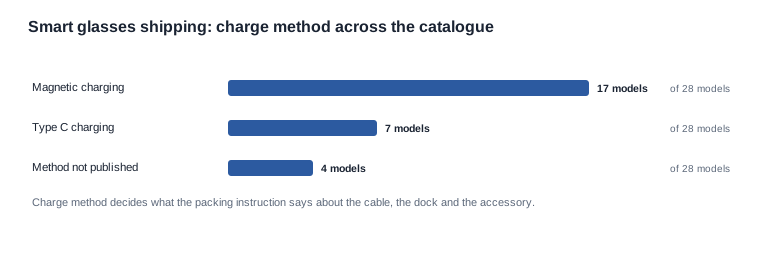
The catalogue settles the product half of the checklist and none of the shipment half. Cell capacity is published for every model, from 40 mAh on the A05 and the A06 to 290 mAh on the CY03 and the L1 Pro, and the L2 Utral and the CY05. Charge time is published for every model, at no more than two hours for twenty-six of them and around one hour for the D17 and the ZH12. Charge method is published for twenty-four of twenty-eight models. Charging case capacity is published for the CY05 and the CY03, and the L1 Pro — each at 1400 mAh, the L2 Utral at 900 mAh or 1400 mAh, and the MT6 at 1200 mAh in a foldable case.
The IP54 marking appears on exactly two models in the whole catalogue, the V06 and the S7, and it is a catalogue marking without a published third-party report number. A buyer whose retailer or customs authority asks for substantiation is asking for a document that has to come from the supplier's own file. We publish the marking and we will tell you plainly that the substantiating report number is not published.
None of the shipment figures are published for any model: not the shipping carton dimension, not the gross weight of the packed unit, not the units per carton, not the carton mark, and not the certificate numbers, issuing bodies and validity dates. Those are the rows the checklist turns into a written request, and the documentation requirements article sets out what to ask for in each case.
Where the checklist has to hand over to a person
Three items on the list cannot be closed by the buyer alone, and a checklist that pretends otherwise produces a false sense of control.
The importer of record is the first. It determines who signs the declaration, who pays the duty and who answers a customs question, and it is a legal role rather than a logistics one. The second is the classification and origin treatment, because the classification of a lithium-equipped product can depend on the configuration and the destination in ways that the factory's file and the importer's experience may answer differently. The third is the conformity route for a market where the buyer has no existing importer set up.
There is a fourth case that is easy to overlook because it looks like a logistics question rather than a legal one: who owns the goods at each point in the journey. A consignment sold on delivered terms and a consignment sold on a shipping-terms basis have different risk positions, different insurance obligations and different answers to the question of who compensates a buyer when a container is damaged in transit. The checklist cannot settle that, but it can make sure the question is asked before the Incoterm is written into the purchase order rather than discovered when a claim is filed.
For all three, the right move is to name a person on each side with a response time attached, because the alternative is that the question arrives at the port, where the only available answer is expensive. The battery transport rules that decide whether a consignment can be accepted at all are set out on the battery transport page, and the cost breakdown breaks the landed cost into the six lines the recomputation above uses.
The carton lever, and why it outlasts a rate negotiation
A pre-filled version
Of the twelve checks, the one that produces the largest permanent saving is the seventh, and it is the one buyers spend least time on. A shipping carton dimension, stated separately from the retail packaging dimension, decides whether the freight line is calculated on weight or on volume, and it is the only lever whose value is permanent across every future order in the programme. Halving the carton halves the freight line on this consignment and on every consignment after it, which is a different proposition from negotiating a rate that reverts at the next surcharge cycle.
There is a second-order effect, which is that a smaller carton improves the packing density, which changes the units per pallet, which changes the container utilisation, which changes the freight per unit again. A buyer who treats the carton as a packaging decision has missed the arithmetic entirely.
It is also the one check on the list where a supplier has a legitimate reason to push back, and that is worth handling well. The factory will argue that a tighter carton means a different tooling cost, and that may well be true. The answer is not to argue about the tooling but to ask for the two numbers side by side: the freight per unit at the current carton and the freight per unit at a smaller one, at the buyer's own volume. Most of the time the tooling is amortised over a programme that is long enough for the freight saving to dominate it, and the programme length is the buyer's decision rather than the factory's.
There is a limit to what the carton can do, and it should be stated so that the lever is not pushed past its value. A carton cannot fix a mode that is wrong for the volume, cannot fix a duty classification that is wrong, and cannot make an insurance cover adequate. It is one line on the checklist, and it happens to be the line with the longest useful life.
The remaining checks are cheaper to action than that one, and they are the ones that stop a shipment rather than the ones that save money. A designation that does not match, a battery document that covers a different build, a packing list that disagrees with the physical count and an unsupported packaging claim are all prevented by the same action: checking documents the buyer already holds against each other before anyone packs a carton. At that point the remedy is a corrected file. After the consignment has left, the only remedy is a delay.
Send us the destination, the model, the quantity and the case configuration, and we will return this checklist pre-filled with the papers that exist for that build, the marks that apply to your lane, and the rows that have to be requested in writing. The logistics and shipping section sets out the commercial framework around the same relationship.


