

Shipping vocabulary is not neutral. Every term in a smart glasses shipping quotation is a decision that somebody has made, and the words are used loosely enough in this category that the same sentence can mean two different commercial positions to the buyer who wrote it and the forwarder who reads it. This glossary is not a dictionary. It is a list of the terms that carry a commercial position, what each one actually settles, and the question a buyer should ask to remove the ambiguity before it costs anything.
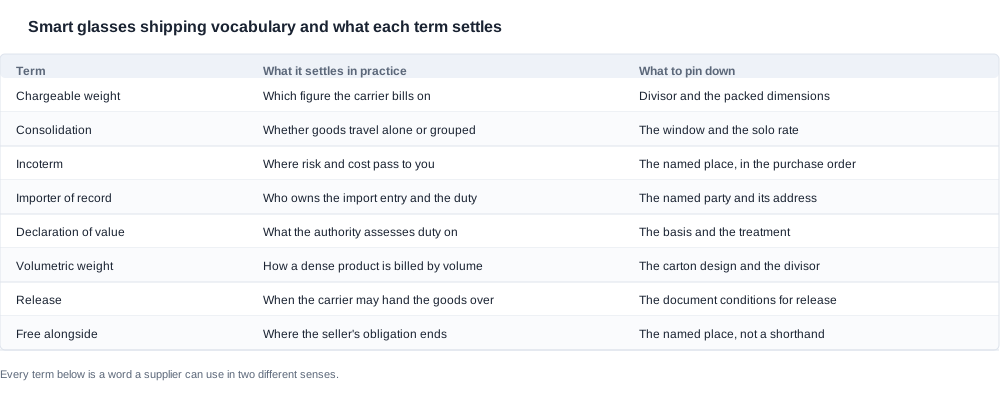
Smart glasses shipping vocabulary and what each term settles
The short answer on why a glossary matters here
A buyer in a mature supply chain can usually rely on the vocabulary. A buyer entering this category from another product category, or a buyer working with a forwarder they did not select, cannot. The forwarder is not being difficult; a term like "freight" or "release" or "delivered" has a working meaning inside the forwarder's system, and the buyer's meaning and the forwarder's meaning diverge quietly until a shipment stops.
The rule that follows is simple: an undefined term in an order is a term the forwarder defines for you. Not maliciously, and usually at the buyer's expense in the specific sense that the definition chosen is the one that requires the least work.
The practical version of that rule is on the checklist later in this article, and it is short: every term that appears in the commercial part of a quotation should have a line in the purchase order that says what it means for this programme. That is not a request for a legal document. It is eight or nine sentences, and they are the highest-leverage sentences in the whole file.
The buying task behind the vocabulary
The reader is a brand-side sourcing manager, a channel buyer or an importer, and the reason the vocabulary matters to them is that they are being asked to sign a document written in a vocabulary they have not audited. A buyer comparing two quotations, or a buyer opening a market where a new forwarder is involved, is exposed in the same way: both quotations use the same words and mean different things by them.
What the reader is actually managing is a document written in a vocabulary that has not been audited, against a forwarder working to a different one. That gap is invisible on the page and expensive in practice: it shows up as a storage charge the buyer did not know was possible, as a duty treatment the buyer did not agree, and as a release that came four days later than the plan allowed. A vocabulary that is not shared is a source of all three, and it stays entirely invisible until the first consignment.
The eight terms that carry a commercial position
| Term | What it settles in practice | What to pin down |
|---|---|---|
| Chargeable weight | Which figure the carrier bills on | Divisor and the packed dimensions |
| Consolidation | Whether goods travel alone or grouped | The window and the solo rate |
| Incoterm | Where risk and cost pass to you | The named place, in the purchase order |
| Importer of record | Who owns the import entry and the duty | The named party and its address |
| Declaration of value | What the authority assesses duty on | The basis and the treatment |
| Volumetric weight | How a dense product is billed by volume | The carton design and the divisor |
| Release | When the carrier may hand the goods over | The document conditions for release |
| Free alongside | Where the seller's obligation ends | The named place, not a shorthand |
There is a ninth term on that list which does not appear in it, and its absence is the point. There is no published word for the packed weight of a smart glasses unit, for the gross weight of a master carton, for the number of retail units in a master carton, or for the number of cartons in a consignment. Those four numbers are what a freight rate is calculated on, and they have to be asked for as numbers rather than expected as terms. Our catalogue publishes the MT6 glasses body weight at 158 g — including the 265 mAh battery and the camera, excluding the foldable charging case, whose weight is not published — and publishes no packed or carton weight for any model.

The terms that buyers routinely mix up
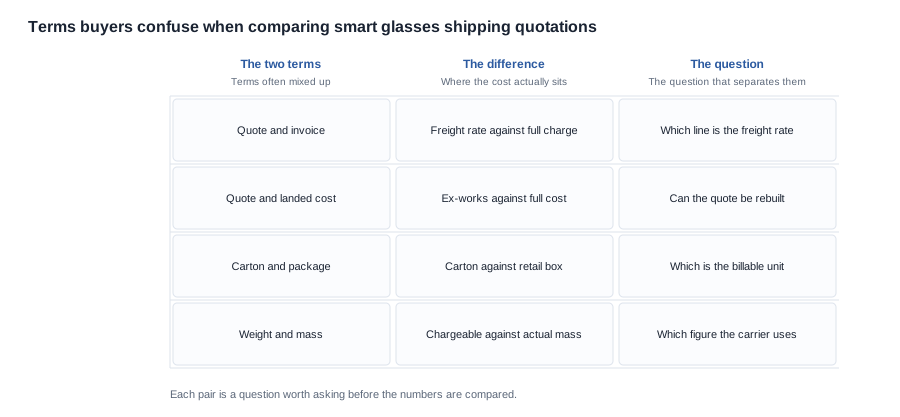
Four pairs cause most of the confusion in this category, and all four of them are pairs where the two words sound like a distinction and are actually a real one. The pattern is the same in each case: one term describes what was quoted, the other describes what was charged.
Quote and invoice
The quotation is what a supplier says the freight will cost. The invoice is what the carrier charges for moving the goods. In a well-run programme the two are close; in a badly specified one they are not, and the difference is not necessarily a margin grab on the part of anyone. The volumetric basis, the consolidation rule and the destination charges can each differ from what was assumed, and each of them is a term that the quotation may have left open.
The question that separates them is simple: which line in this document is the freight rate, and which lines are the carrier's own charges? A supplier who itemises the quote and separates the carrier's own charges has told you how to rebuild the number. A supplier who presents one figure has not.
Quote and landed cost
The quotation is normally for the goods and the freight to a named place. The landed cost is what the unit costs once the goods value, the freight, the duty, the clearance, the destination handling and the documentation are all in. A buyer comparing a delivered quotation against an ex-works quotation is comparing two different scopes, and the comparison produces a confident wrong answer.
The question that separates them is: can the landed cost be rebuilt from this quotation? If the packed dimensions, the gross weight, the volumetric divisor, the classification and the importer of record are all present, the buyer can rebuild it. If any of them is missing, the buyer is comparing a number to a number and hoping.
Carton and package
The retail package is what the customer receives. The shipping carton is what the carrier bills on, and it is the master carton rather than the retail box in almost every case. The distinction matters because the density of the master carton is the single number that most affects the volumetric line, and it is a number nobody sets unless somebody asks.
The question that separates them is: which is the billable unit, and how many retail units go into it? The published case capacities in this category — 900 mAh, 1200 mAh and 1400 mAh across the camera models, with the L2 Utral at both 900 and 1400 mAh — make this question concrete, because each capacity is a different carton.
Weight and mass
The actual weight of a consignment is what it weighs. The chargeable weight is what the carrier bills on, and for air freight it is generally the greater of the actual weight and the volumetric weight. The two are routinely used interchangeably in a conversation, which is fine in principle and disastrous in a quotation, because the two numbers can differ by a factor of several for a dense product in a retail box.
The question that separates them is: which figure does the carrier use, and on what basis? A buyer who has asked that question has already got most of what they need for the freight line, whether the mode is air or ocean.
The four questions each undefined term leaves open
Every undefined term in a shipping arrangement leaves the same four questions open, and they are worth writing down because they are the four questions a buyer will be asked — by a forwarder, a broker, an auditor or a market authority — at some point after the shipment has already been paid for.
Who decides? If a term is undefined, the answer is the party with the information: the carrier for chargeable weight, the forwarder for consolidation, the destination authority for classification, and the party that wrote the technical file for anything technical. Each of those defaults is defensible individually and collectively they hand the buyer an arrangement they did not choose.
What is it measured against? Almost every shipping term is a ratio or a threshold, and a ratio without a stated basis is a formula for a difference of opinion. Volumetric weight needs a divisor. Chargeable weight needs both inputs. Consolidation needs a volume. Release needs a date.
When does it take effect? The timing of a term is what turns it into a cost. A consolidation window that is met costs one rate and a consolidation window that is missed costs another, and the difference is charged per unit across the whole consignment. A release condition that is satisfied on the day of booking costs nothing; the same condition satisfied three days later costs three days of storage.
Who carries the consequence? This is the question that most often has no answer, and it is the one that decides whether a dispute is expensive. A quotation that does not say who bears a storage charge, a re-tender cost or a duty re-assessment is a quotation that has left the question to the day it matters.
The shipping step by step article puts these definitions into the sequence they belong in, and the beginner's guide covers the same ground for a buyer working through a first consignment without a logistics team.

Terms worth pinning down before the quotation arrives
The checklist below is the working version — the nine lines that belong in the purchase order, in the order they are usually settled.
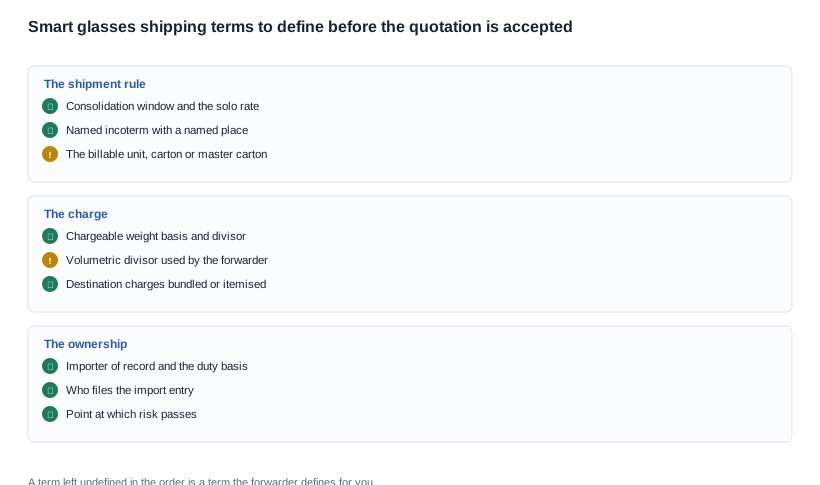
The nine lines, and what each one prevents
- The shipment rule and the solo rate. Prevents the case where a consolidation window closes and the goods travel alone at a rate that was never budgeted.
- The named incoterm with a named place. Prevents the case where the risk point, the insurance obligation and the customs filing point are all in different places.
- The billable unit. Prevents the case where the rate is quoted per carton and the buyer modelled it per unit.
- The chargeable weight basis and the divisor. Prevents the case where the freight line cannot be rebuilt.
- The volumetric divisor used by the forwarder. Prevents the case where the buyer's own divisor assumption is optimistic.
- Destination charges bundled or itemised. Prevents the case where two quotations are compared that are not in the same terms.
- The importer of record and the duty basis. Prevents the case where the party that owns the entry is not the party that made the commercial commitment.
- Who files the import entry. Prevents the case where the entry is filed twice, or by the wrong party, or with the wrong value.
- The point at which risk passes. Prevents the case where a buyer believes the risk was sold and it was not.
A glossary a forwarder will accept
There is a practical test for whether a glossary is doing any work: a forwarder should be able to read it and say "yes, that is what we meant". If a definition is so precise that it constrains the carrier, it will be resisted; if it is so loose that it constrains nothing, it will be ignored. The nine lines above sit in the useful middle because they describe the commercial position rather than the physical arrangement, which is a distinction a forwarder can work with.
Which term to fix first
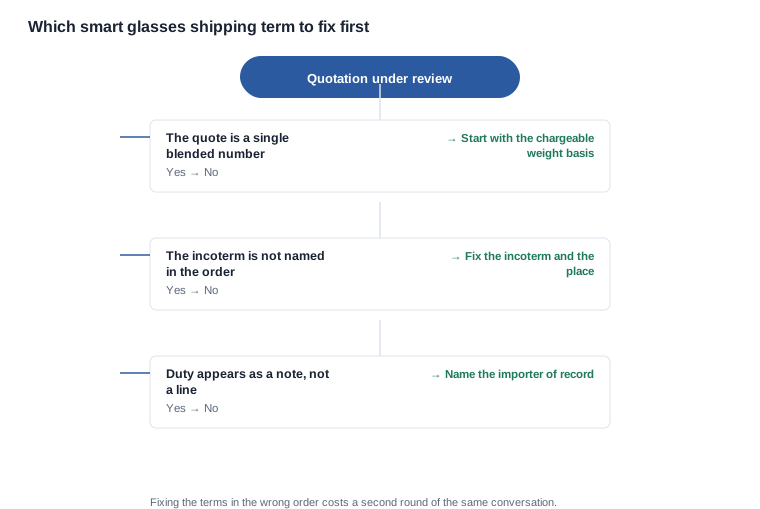
The order of the definitions is not arbitrary, and the decision path above is the short form of it. A quotation that is a single blended number cannot be compared with anything, so the chargeable weight basis is the first thing to fix, because without it the buyer cannot tell whether a cheaper quotation is cheaper or simply less complete. A quotation that names no incoterm leaves the risk point, the insurance obligation and the customs filing point in three different places, and fixing that second is what makes the first meaningful. And a quotation where duty appears as a note rather than a line has not told the buyer who owns the import entry, which is the person who has to defend the classification.
The terms that belong to the product file, not the shipping file
Three terms in this category are routinely argued about in the logistics conversation when they should have been settled in the product specification months earlier, and it is worth saying so explicitly.
The case is a product attribute with a freight consequence. Our catalogue publishes the case capacities for the camera models — 900 mAh, 1200 mAh and 1400 mAh, with the L2 Utral published at both 900 and 1400 mAh, the MT6 at 1200 mAh in a foldable case, the CY03, CY05 and L1 Pro at 1400 mAh, the KY06 and MT5 with a case of unstated capacity, and the V03 Pro with no case at all. Six published configurations of box, across eleven camera models, and every one of them is a freight input.
The configuration is a product attribute with a documentation consequence, and it is where the colour count and the case capacity meet: three colours on the V03 Pro, four on the V06, and a case capacity for each.
The interface is a product attribute with a packing consequence. The catalogue publishes the charging method for twenty-four of the twenty-eight models — magnetic for seventeen of them, Type C for seven, and unpublished for four camera models that are published with a case capacity instead — and the interface determines the accessory in the box, which determines what goes in the retail carton, which determines the carton.
Settling all three in the product file, rather than in the freight negotiation, is the difference between a carton that is designed for the route and a carton that is chosen from what is on the shelf.
Where a definition changes a price
Not every term in a shipping file is worth the effort of defining, and a buyer who spends a week on terminology rather than on the four lines that move money will get a worse outcome. These are the definitions that change a number rather than a description.
Defining chargeable weight changes the freight line
This is the most direct. The freight is billed on the chargeable weight, and the chargeable weight is the greater of the actual weight and the volumetric weight for a dense product in a retail box. A buyer who defines the divisor and the packed dimensions in the order is buying the right to rebuild the line; a buyer who does not is accepting a figure from a party that has every incentive to choose the larger basis.
Defining the incoterm changes duty, insurance and risk together
The three are not separable. A delivered term moves the duty, the clearance and the insurance into the price and the risk point back to the factory. An ex-works term does the opposite. The trade-off is not "more expensive versus cheaper" but "who is carrying the risk while the goods are in transit, and who is paying for the insurance on them", and the answer changes the price by more than the point of duty usually does.
Defining release changes the storage exposure
Release is the point at which the carrier may hand the goods over, and until that point the carrier is holding them, and holding costs money. A buyer who knows the release conditions in advance can plan the booking so that the documents are ready when the goods arrive. A buyer who does not is exposed to a storage charge that is set by someone else's timetable, and the storage rate is one of the least negotiable numbers in the whole arrangement.
Defining the case changes the carton
A case is a moulded object with a volume, and the volume is what the forwarder bills. Defining the case capacity — 900 mAh, 1200 mAh or 1400 mAh for the camera models — is what makes the carton, the print area, the artwork and the freight basis consistent with each other. It is the one definition in this category that reaches back into the product specification rather than staying inside the logistics file, and it is the one that a buyer is most likely to be too late to make.
What no definition will fix
Two things are worth naming, because a glossary creates a false impression of control. The dangerous goods handling charge is set by the cell class and the packaging arrangement, and no wording in a purchase order will move it; the battery transport section sets out the underlying documents. And the cost of the testing and registration work behind a market file is per product family and per market, and it does not fall with volume or with a longer contract. The useful question about that work is not whether it can come down but whether the scope is right.
The glossary boundary, and what to ask us
A glossary settles vocabulary, and it does not settle capability, price or compliance. It is worth being clear about the boundary, because the most common misuse of a document like this is to treat a well-defined term as evidence that the programme behind it is sound.
What a glossary can do is remove the ambiguity in a quotation, make two quotations comparable, and let a buyer rebuild a number instead of accepting it. What it cannot do is tell you whether a supplier can execute the arrangement, whether a file exists for a given configuration, or whether a quoted price is the price. Those questions need documents, a sample and answers — and the logistics and shipping section is where that sequence sits.
On the vocabulary, that we use the shipping terms the way a forwarder and a broker use them, and that we will not use a term loosely in a quotation. We publish the configurations, the colour availability, the case capacities, the interfaces and the endurance figures that the vocabulary describes, and we do not publish packed weights, carton dimensions, freight rates, minimum order quantities, production lead times or production capacity — because those are answers to a configuration, a destination and a quantity, not properties of a product.
What we will do is itemise freight against a given configuration, quantity and destination, with the shipment rule, the incoterm and the place named, and tell you which parts of the arrangement are settled, which are open and which have to come from a forwarder. We will also tell you when a term in your own paperwork is being used in a way that does not mean what the buyer intended.
Related reading
- Shipping step by step — the full sequence these definitions sit in
- Shipping beginner guide — the same ground for a first consignment
- Battery transport — the one term that cannot be negotiated
- Logistics and shipping — the wider framework
Pass the quantity, the configuration and the destination, and we will send freight terms we are both reading the same way.


