

Six beliefs about freight in this category sound reasonable, survive several rounds of internal discussion, and turn out to be wrong in ways that only show up on an invoice. None of them is exotic. A buyer can hold four of them at the same time without noticing that they contradict each other, because each one is independently plausible and each one fails somewhere different. The cost is rarely dramatic in a single shipment. It is the accumulation of six small misjudgements across a programme that makes a product look more expensive to land than it is, and a supplier who looks more expensive than they are.
The practical answer is short. Your unit cost is not a number, it is a set of conditions. Ask what conditions produced it before you accept it, and ask the same question of every competing figure.
The buying situation behind the six beliefs
The reader here is someone buying on the brand side, a channel buyer or an importer who has just received two quotations for the same product and cannot explain the gap. That gap is the real reason this article exists. A buyer comparing a landed cost against a carriage cost sees a difference that looks like a margin decision and is actually a comparison between two different objects.
Three situations bring people to this question. The first is a programme with a fixed launch date, where the freight line has grown and the buyer needs to know which part of it is reducible and which part is structural. The second is a quotation that looked competitive on unit price and landed badly, and the buyer wants to know what to change in the specification. The third is a renewal, where the incumbent supplier's rate has moved and the buyer is trying to work out whether the increase is market-driven or was never checked in the first place.
Underneath all three is a fear that is rarely named directly: that the buyer signed for a shipment arrangement that was never really described. A quotation is not a specification. A rate is not a cost. A carton is not a packaging detail. Six of the beliefs below are the most common ways a smart glasses shipping arrangement is agreed without anybody writing down what was actually agreed.
What the buyer is actually managing
A buyer in this category is managing three quantities at once, and they move independently of each other.
The first is the per-consignment cost: the lines that do not divide down with volume. Transport documentation for a lithium-equipped product, clearance, terminal handling, the booking and the release work. These are what make a small order expensive per unit, and they are the lines that a split order doubles rather than reduces.
The second is the per-unit cost: the goods, the packaging, the allocation of freight across the units, and the duty. This is the number most buyers think about, and it is the one that changes least when the arrangement changes.
The third is the schedule cost: the days that pass between the order and the goods being sellable, and the financial cost of those days. It is invisible in a quotation and it is often the largest single number in the programme. A belief that pushes a decision one week later has a real price, and the price is not a freight rate.
The six beliefs below each get one of these three wrong. That is why they are worth naming individually rather than as a general warning.

Smart glasses shipping myths and where each one actually lands
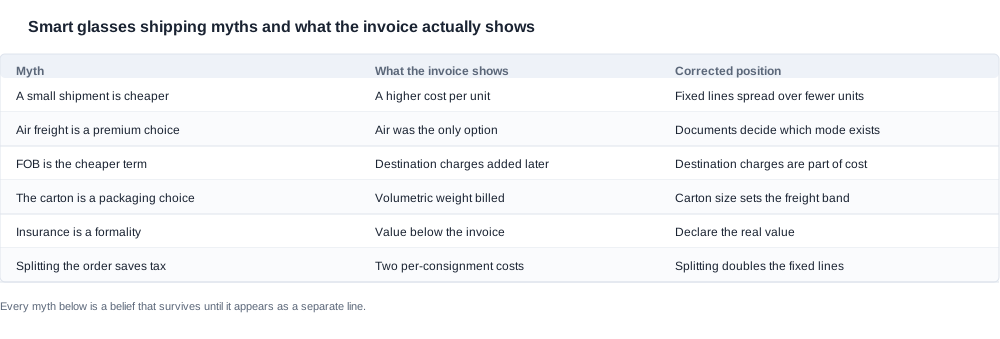
The table at the top of this article pairs each belief with what the invoice actually shows. The detail that matters is in the third column, because the corrected position is usually more specific than the belief it replaces.
One: a small shipment is cheaper
A small shipment costs more per unit, and the reason is not the carriage rate. It is the per-consignment lines. Dangerous goods handling is set by battery class and packaging rather than by weight or value, so it divides down as the order grows and dominates as the order shrinks. In this category that line is frequently larger than the ocean freight itself on a first order.
The same logic applies to clearance and documentation, which are also charged per consignment rather than per unit. A buyer who halves the order size in order to reduce the unit price has usually raised the landed cost of every unit in the order. The belief survives because the quotation shows a lower unit price, and the unit price is the only figure on the page.
How to test it: ask for the quotation at two quantities, on the same basis, and divide every per-consignment line by the unit count at each. If the per-unit total falls as the quantity rises, the belief was right about the goods and wrong about the shipment.
Two: air freight is a premium decision
For a launch window, air is often correct, because the schedule matters more than the margin. But the real question is whether the dangerous goods documentation exists in a form the carrier will accept, because without it there is no choice at all: sea for anything other than air, and the saving is not available to a buyer who never checked.
Air also changes the packing constraint. A short transit means less dwell time, so a buyer relying on a supplier's standard export carton may find the units arrive with pressure marks that a sea transit would have hidden, and the damage is discovered against the wrong cost line. The belief survives because urgency feels like a reason to pay more, and the documentation route is invisible from the outside.
How to test it: ask which transport documents travel with a battery-equipped consignment on that route, who prepares them and by when. If the answer is a description rather than a list, the mode has not actually been chosen.
Three: FOB is the cheaper term
FOB is cheaper on the quotation and more expensive in practice, because the destination charges — terminal handling, documentation, clearance, duty and tax — move onto the buyer’s invoice instead of disappearing. For a lithium-equipped product these are frequently larger than the difference negotiated on the goods.
The practical consequence is that two suppliers quoting the same FOB number are not comparable until the destination charge basis is stated. Ask for the same incoterm on both quotations, and ask whether the quoted destination charges are estimates or fixed amounts.
How to test it: take both quotations and rewrite the term line as a full landed cost, naming what is included. If the gap narrows or disappears, the difference was structural rather than commercial.
Four: the carton is a packaging decision
The carton is a freight decision. Chargeable weight for a boxed product is normally the greater of actual and volumetric weight, and a retail presentation sized for a shelf can double the volumetric weight on the same units. Shipping carton dimensions should be requested as a separate document from the retail packaging dimensions, and they are usually different numbers.
This is also the one saving that compounds, because a smaller carton reduces cost on every future order while a negotiated rate reverts at the next surcharge. It is worth an afternoon of work when the order is large enough for the saving to matter, and it is not worth it when the order is small and infrequent. The belief survives because the carton belongs to another department in the buyer's organisation and nobody owns the connection between it and the freight line.
How to test it: ask for the packed carton dimensions and the units per master carton. If the answer is a retail box size, the chargeable weight has never been calculated on this product.
Five: insurance is a formality
Under-declaring to reduce a premium is a decision that loses everything if the goods do not arrive. Declare the real value and insure on the declared value, and note that the two decisions are linked in a way that is easy to forget during a negotiation about unit price.
Insurance cost on a high-value-density product is a small percentage of goods value, which is precisely why it gets treated as an afterthought until a claim is filed. The belief survives because the premium is small enough to look trivial, and because a claim is an event most buyers have never had to handle.
How to test it: compare the declared value on the quotation with the value on the invoice. If they are not the same number, the saving is not insurance, it is a gap in cover.
Six: splitting the order reduces the cost
Splitting an order across two consignments does not reduce the per-consignment cost; it duplicates it, and it adds a second booking, a second clearance and a second delivery window. It is sometimes the right answer, and the reason is never arithmetic — it is a capacity constraint, a market-entry requirement, a certificate scope, or a deliberate decision to hold a second order in reserve against demand.
The belief survives because the second consignment looks smaller, and a smaller consignment feels cheaper. It is only cheaper if the per-consignment lines are genuinely small, which for a battery-equipped consignment they are not.
How to test it: count the per-consignment lines in each option before comparing them. If splitting adds a documentation set, a clearance and a delivery, add all three to the comparison rather than the freight rate alone.
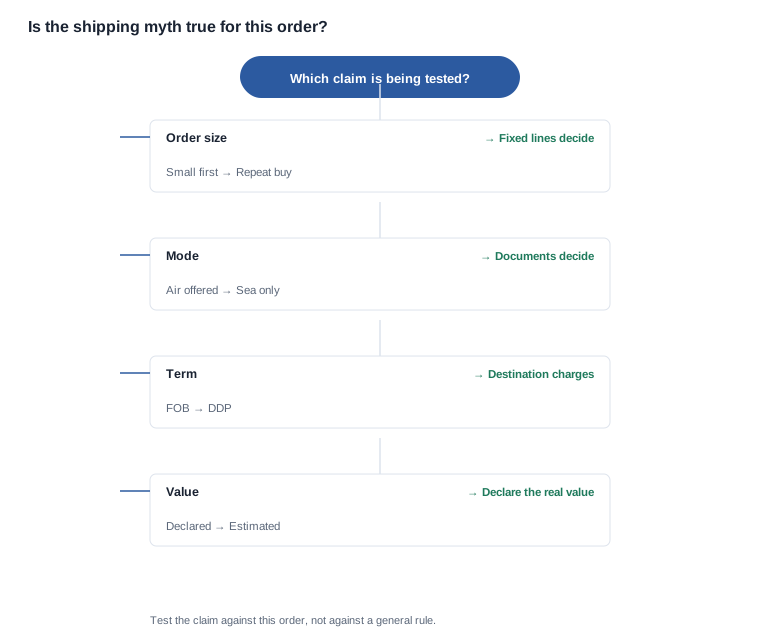

How to test a belief against a real quotation
Beliefs survive because nobody writes them down and then checks them. The process below is deliberately mechanical, and it is designed so that it can be run against two suppliers in the same afternoon.
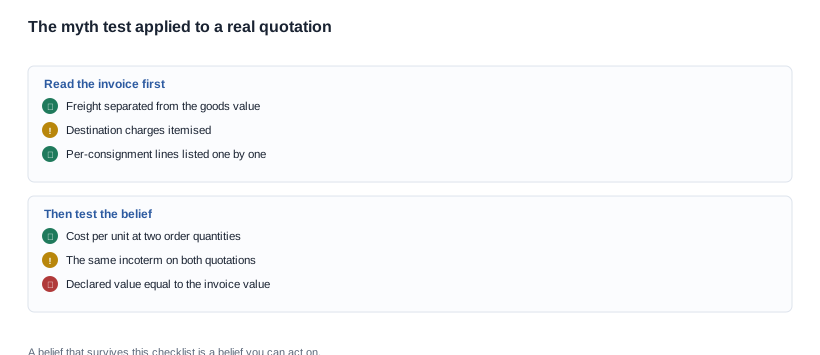
The first group is reading the invoice rather than the quotation. A quotation states an intention; an invoice states what happened. Separating the goods value from the freight and destination charges is the step that catches three of the six beliefs at once, because it forces the per-consignment lines into the open. Listing those lines one by one rather than as a single "shipping and handling" figure is what makes the small-order belief testable.
The second group is testing the belief itself, and it requires asking the supplier for something slightly inconvenient: the same basis at two order quantities, the same incoterm on both quotations, and a declared value that matches the invoice value. A supplier who can produce all three has nothing to hide behind. A supplier who cannot produce the third is telling you something about the insurance position.

The five steps in the flow are ordered deliberately. Read the invoice before you draw a conclusion, because a conclusion drawn from a quotation is usually a conclusion about the intention rather than the outcome.
The questions that make the test work
These are the questions to ask, in this order, and each one has a completion test rather than a judgement call:
- What shipment rule does this price assume, and what is the rate if the goods travel alone? Completion test: two numbers in writing. This is first because it establishes whether the quotation can be planned against at all.
- What is the packed carton, how many retail units go into a master carton, and what are the packed dimensions? Completion test: a number and a dimension. This is the input to the chargeable weight.
- Which transport documents will accompany a battery-equipped consignment, and who prepares them? Completion test: a document list with a named owner and a date.
- Who is the importer of record, and how are duty and clearance treated in this price? Completion test: a named party and a stated basis, either itemised or written as bundled.
- What is the declared value for insurance, and does it match the invoice value? Completion test: the same number in both places.
A buyer who asks all five in the first round is establishing which quotation is complete. The comparison between two quotations only works between quotations that answer the same questions.
When the test cannot be run
There are situations where the test produces no answer, and a buyer should recognise them rather than treat silence as a pass. A supplier who has never shipped this configuration cannot describe its actual transit behaviour. A forwarder who has never handled the destination cannot quote the destination charges. A factory that has never been asked for the packed carton dimensions may not have them, because nobody ever asked.
In each of those cases the correct response is to mark the line open and name who will close it and by when, not to discount the quotation and move on. A gap with a name and a date is a work item. A gap without one is a risk that has been accepted without being noticed.
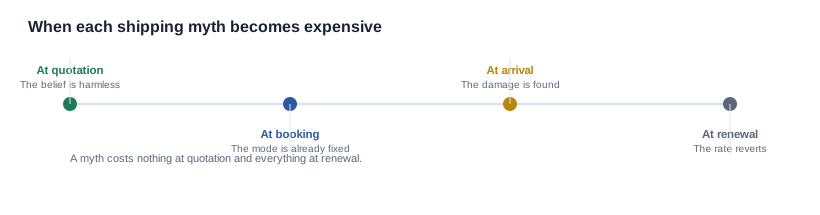
The timeline above is the argument for running the test early. Every belief on the list is harmless at quotation and expensive at renewal, because the rate reverts and the arrangement is then embedded in the programme rather than being a line you can still change.

The commercial lines that cannot be negotiated away
The negotiable part of a shipping cost is the shipment rule and the packaging, not the rate card. A supplier who will confirm the consolidation window, the solo-shipment rate and the split between their forwarder and yours gives you the ability to plan. One who offers only a blended figure does not, no matter how competitive it looks.
Incoterms belong in the purchase order rather than in a side letter, because a change of term moves three things at once: the point at which risk passes, the obligation to insure, and the point at which the customs entry is filed. If those three are separated, the buyer ends up carrying a risk they thought they had sold, and the forwarder is left defending a position the documents do not support.
The same applies to a shipment rule. A rate quoted for a consolidated movement, a release condition and an incoterm are three parts of one mechanism, and a buyer who negotiates one of them without the other two has moved the price and not the risk.
What is genuinely open
Three things in a smart glasses shipping arrangement can usually be improved by asking, and they are worth asking about in a specific order.
The consolidation window is the largest of the three. A rate that assumes consolidation is worth a great deal more than the percentage points usually argued about, and it is negotiable because it depends on the supplier's production and packing calendar rather than on anything structural. The question to ask is not for a better rate but for a date: the date by which goods have to be at the packing point to make a particular sailing.
The carton is negotiable in scope. A supplier may propose a different carton, and may be able to do better on units per master carton. What is not negotiable is the principle: a carton specified against the shelf rather than against the freight route is a defect, not a proposal, and no rate should be accepted against it.
The documentation scope is negotiable in a specific sense. Every model in this range ships with a lithium cell, so the transport document set applies to every consignment without exception. What is negotiable is how many markets the file is assembled for, and a buyer who has no plans for a market should not be paying for it.
What is structural
The cost and cycle of certification itself is structural, and the reason is that testing and registration are per product family and per market. They do not fall with volume, they do not fall with a longer contract, and they cannot be amortised across orders that use a different configuration. The useful question about that cost is not whether it can come down, but whether the scope is right, because an unnecessary market in the quotation is a cost the buyer chose.
The same is true of the per-consignment documentation work and the clearance process. These are not rates that improve with a bigger order; they are the reason a bigger order is cheaper per unit. That is the structural fact underneath the first belief, and it is the one worth remembering when a buyer is asked to accept a small-order premium.
The two clauses worth adding to the order
The first is a conformity clause that states what happens to a consignment that arrives short, over-shipped, damaged, or not matching the configuration string, and names the person who is contacted. Without it, a returns problem becomes a dispute, and a dispute is a negotiation the buyer will lose because they cannot produce the evidence.
The second is a consolidation clause that records the consolidation window, the solo-shipment rate, and the incoterm with a named place. Three lines, and they convert the first belief in this article from a rule you learn into a number you already have.
The cost breakdown article sets out the six lines these clauses have to cover, and the when to skip an optimisation article is about which of the six is worth a buyer’s time depending on the size of the order.
What we will and will not put in a freight quotation
The boundary we hold: a freight quotation without a carton, a destination and a mode is not a rate, and we will not issue one. What we will do is quote shipping itemised against a given configuration: the goods, the freight basis, the destination charges and the tax treatment, with each line marked as fixed or variable. That is a slower conversation than handing over a per-unit number, and it is the only version of the number that can be compared against a competitor’s itemised quotation.
We will not under-declare a customs value, and we will not split a consignment in order to move a shipment under a reporting threshold. The first is a claim decision made in the buyer's favour, and the second is a decision that transfers a compliance exposure onto the buyer while looking like a freight saving.
What we will not do is fill an open line with a typical figure. Some of the rows a buyer will ask for are not published: the packed carton dimensions, the gross packed weight, the units per master carton, the freight weight and the transport classification for a given configuration, because those depend on the final retail packaging and the destination rather than on the device. Per-model weight is published for one model only — the MT6 glasses body at 158 g, which includes its 265 mAh battery and the camera and excludes the foldable charging case, and the case weight is not published. For the other models no weight is published, and we would rather tell you that than quote a number you cannot verify.
Where the destination is a market with its own documentation route, the battery transport guidance governs the document set, and the logistics and shipping section covers the sequence those documents sit in.
Related reading
- Smart glasses shipping cost breakdown
- When you can skip an optimisation
- Battery transport compliance
- Logistics and shipping
Tell us the destination, the configuration and the quantity, and we will itemise the shipping against that configuration rather than quote you a per-unit rate that belongs to somebody else’s carton.


