
Most shipping disputes in this category are not disputes about freight rates. They are disputes about numbers that were never agreed in one place — a carton measured for one shipment, a weight taken from a different configuration, a battery detail copied from a datasheet rather than read from the build that actually shipped. The smart glasses shipping template below exists to put those six numbers in one document, with one date and one version, so that a disagreement has an obvious place to start.
The reason this matters is not tidiness. Each of the six fields has a different owner, and in a request sent as a set of emails each of them arrives from a different place, at a different version, with nobody holding the whole set. One document with a revision number removes that class of error before it can occur.
Smart glasses shipping requests: six fields and the number nobody owns
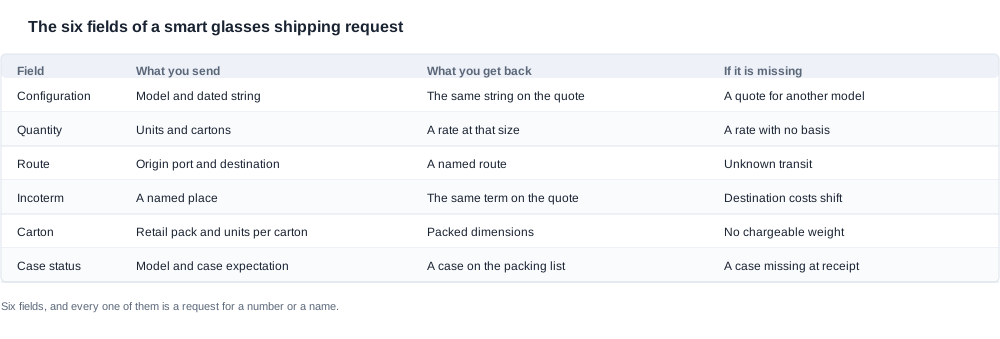
The six fields are: the configuration, the quantity, the route, the incoterm, the carton, and the case status. They are listed in the order they have to be settled rather than in the order they are easiest to answer, because the first two decide whether the other four can be answered at all.
Each field has an owner, and the owner is not the same party in every case. This is the part most request templates leave out, and its absence is why a request stalls for two weeks: nobody can tell whether the missing figure is the buyer's to produce or the supplier's to produce.
The configuration is owned jointly. The buyer supplies the model and the variant — the charging case option, the lens option, the colour — and the supplier supplies the dated string that identifies the product as it will actually be built. Both halves matter because the published designations are specific enough to be mis-transcribed: the V03 and the V03 Pro are different products with different charging arrangements and different lens options, the V03 Pro is published in three colours and the V06 in four, and the L2 Utral page carries a second designation string next to its published name. A request that says only "camera glasses" and waits for the supplier to fill in the rest will come back with a proposal, and the buyer will accept it because it is the first thing that arrived.
The quantity is owned by the buyer, and it has to be expressed twice: in units and in cartons. The catalogue publishes no unit count per master carton for any model, so the conversion is entirely supplier-derived and cannot be inferred from anything the buyer holds. A request that states units only will come back with a carton count derived from the supplier's standard, which is a reasonable default and frequently not the one the buyer's own warehouse planning assumes.
The route is owned by the buyer: origin port, destination, and the mode. The mode, however, is constrained rather than chosen, because the transport document set for a lithium-equipped consignment applies without exception — every model in this range ships with a cell — and what actually varies is which documents the route requires and how long they take to prepare.
The incoterm is owned by the contract, and it is the field most often left blank. A term without a named place is not a term, and the blank gets filled by whoever quotes first, which means the buyer inherits a risk position by default. Filling it in the request is a way of preventing that.
The carton is owned by packaging, and it is the field where the request most often fails, because the number requested is usually the retail carton rather than the shipping carton. Those are two different figures for the same product, and only the second belongs in a shipping request, since only the second is what gets weighed and measured on a freight route.
The case status is owned by the supplier, and it is the field with the most published variation behind it. Whether a charging case travels in the box is not one question with two answers in this catalogue; it is four different published states across the eleven camera models, and the request has to name the model and the expectation rather than a generic requirement.

The six fields, and what should come back
A request is only useful if it specifies what a complete answer looks like. The table above sets out each field, what the buyer sends, what a usable return contains, and what the omission actually costs.
Read the fourth column carefully, because this is where most requests fail quietly. A missing configuration does not produce an error — it produces a quotation for a product nobody ordered. A missing quantity does not produce an error either; it produces a rate with no basis, which cannot be compared against anything. A missing carton produces a rate with no chargeable weight behind it, and since chargeable weight is normally the greater of actual and volumetric weight, the omission removes the freight band from the comparison entirely. A missing case status produces a consignment that arrives without the case in the box for the models where one is expected, and the discovery is made by the buyer rather than by the supplier.
The response pattern is worth noting as well. A usable return is a number or a name in every row. A partial return is not a partial answer; it is a quotation that cannot be compared with a competing quotation, because the competing quotation was built on a different set of assumptions in the rows that came back blank. That is why the request should be returned as the same six-field document rather than as prose or as an attachment to a covering note. The structure is the check.
There are two fields that a buyer should add to the six rather than leave to the supplier, because they are the two that decide whether the returned figures are usable at all: the declared value and the importer of record. Declared value has to match the invoice value, because a declared value below the invoice value reduces the insurance premium as well as the duty and leaves a gap in cover on the goods. The importer of record has to be a named party, because "the buyer" is a decision rather than an answer and it transfers a compliance exposure instead of removing one.
The criteria a request has to meet before it is sent
Three criteria, and all three have to hold before the document leaves the buyer's desk. The first is that every field names a value or a source — not "the usual carton" but "the shipping carton, drawing revision, packed dimensions". The second is that every field names its owner, because a field with no owner is the field that comes back as an assumption. The third is that every field has a completion test, which is the thing that separates a request from a wish list.
These three criteria are also what make a request reusable, which is the point of having a template at all. A request that has to be reconstructed for each order is a request that will eventually be reconstructed from memory, and the field that gets reconstructed from memory is the one with no completion test — which is usually the carton, and the carton is the field that sets both the freight band and the level of protection available.
The question to ask about any field that comes back open is narrow and specific: who owns it, what will it be, and by when. Anything wider invites a paragraph rather than a number, and a paragraph cannot be compared against another supplier's number.

Pre-filling the request from the published catalogue
A large part of a good request can be assembled before it is sent, because the published catalogue settles more of it than most buyers realise. The pre-fill is not only an efficiency; it is what allows the request to carry a completion test for the fields the catalogue does not settle.
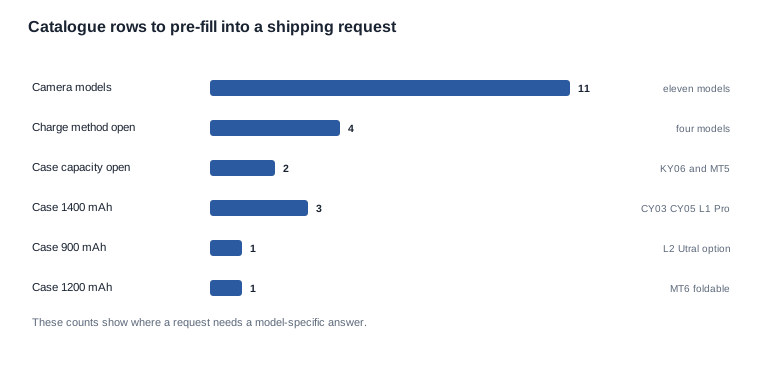
The catalogue publishes eleven camera models, and for each of them the pixel class, the cell capacity, the charge time, the endurance figure, the charging method for most, the charging interface and the case configuration where it exists. It publishes the charging method for twenty-four of the twenty-eight models in the range, and it does not publish it for the L1 Pro and the CY03, and the CY05 or the MT6. It publishes a case capacity for five camera models — the CY05 and the CY03, and the L1 Pro — each at 1400 mAh, the L2 Utral at either 900 mAh or 1400 mAh, and the MT6 at 1200 mAh in a foldable case — and it does not publish one for the KY06 or the MT5. It publishes no charging case row at all for the V06 and the V03, and the V03 Pro or the S7, and what the box contains for those four is an item to confirm with the supplier rather than a line to read.
So four of the six fields of the request can be pre-filled from published data for most of the range: the configuration, the case status, the charging method and the battery detail that the transport documents will need. What cannot be pre-filled is the carton, the packed weight and the unit count per master carton, because none of those depends on the device rather than on the final retail packaging and the destination.
That split is the useful part. The rows the catalogue settles should be quoted back to the supplier for confirmation, which is a cheap request that a supplier can answer immediately. The rows it does not settle should be requested with a named owner and a date, which is a more expensive request and a much more valuable one.
The two groups need different handling inside the request document, and mixing them is what makes a template unusable. The catalogue-settled rows belong in the body of the request as filled fields, because a buyer who leaves a published value blank has invited the supplier to guess it, and a supplier who guesses a published value will sometimes guess wrong in a direction that costs nothing to fix and everything to discover later. The unresolved rows belong in a separate annex, listed as open items with an owner, a date and the reason they are open — and the reason matters, because "not published in the catalogue" and "depends on the destination" are different reasons with different urgency.
The annex is also the honest record of what the buyer does not know at the point of ordering, which is the thing a procurement file is most often missing.
Handling the answers that come back
Answers to a six-field request arrive in one of four states, and each state needs a different response. Treating them the same is how a request turns into a delay.
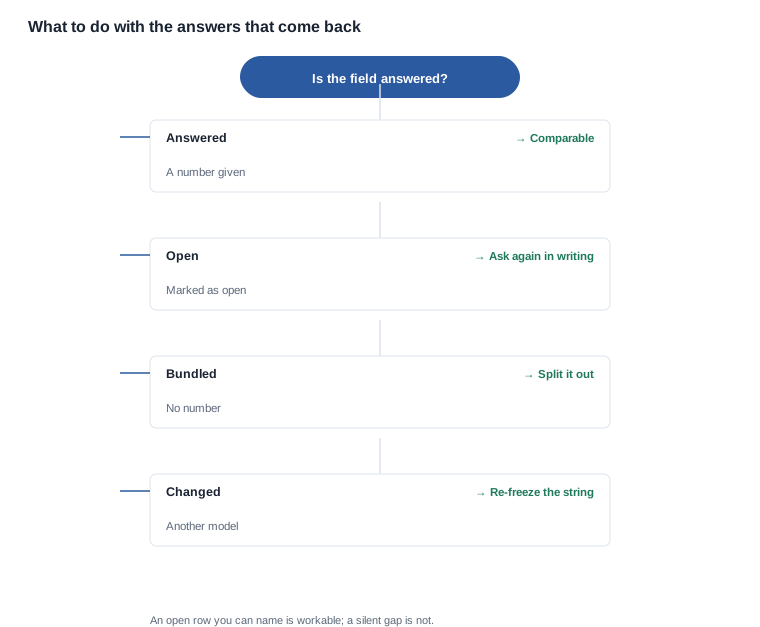
An answered field is one with a number or a name in it, and it is comparable. An open field is one the supplier has marked as not yet available, and the correct response is to ask again in writing with a date and an owner attached, because an open field that nobody owns becomes a silent gap by the time the order is placed. A bundled field is one where the figure exists but has been folded into another figure, and the response is to ask for it to be split out — this is common with destination charges and with the packing detail inside a carton. A changed field is one where the supplier has answered about a different model or a different variant from the one asked about, and the response is to re-freeze the configuration string, because a changed field usually means the question itself was ambiguous.
There is a further state that is not on the chart and is worth watching for: an answer that is wrong against the published row. When a supplier states a charging method for one of the four camera models whose method is not published, there is no contradiction to point at — the catalogue is silent. But when a supplier states something the catalogue does publish differently, that is a document-control finding, and it is more useful than any other finding in the set.
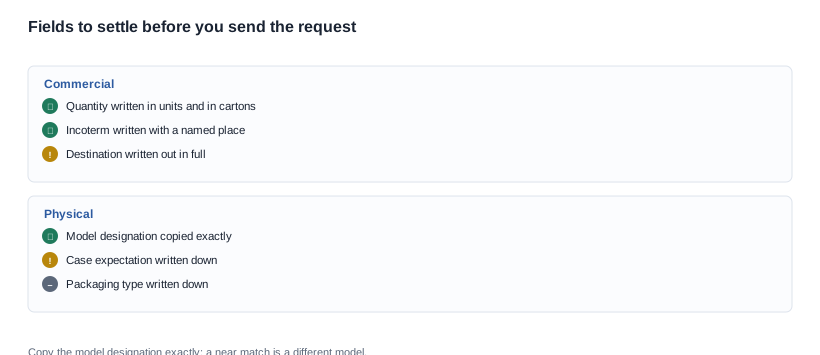
The pre-send checklist exists to stop the request going out in a state where the answers will be ambiguous. On the commercial side: the quantity written in units and in cartons, the incoterm written with a named place, the destination written out in full rather than as a region. On the physical side: the model designation copied exactly rather than retyped, the case expectation written down for that specific model, and the packaging type written down so that the answer cannot come back as a retail carton.
Which field to chase first
The four states have a priority order for follow-up, and it is worth writing it down rather than chasing whichever answer happens to arrive first.
A changed field comes first, because a changed configuration means every other field in the request is now answering a different question and the whole document has to be reissued. A bundled field comes second, because the figure exists and the only obstacle is that nobody separated it out — it is usually a short conversation, and it is usually the field with the largest effect on the landed cost. A silent field, where the answer was simply not addressed, comes third, and it needs the least effort because the supplier has usually not read that row. An open field comes last, because it has been labelled and will be answered on the schedule that was attached to it.
The general principle is that red flags are cheapest to fix before you order and most expensive after the goods are loaded, so the chase list is built in that order rather than in the order of annoyance. Before the order is placed, a changed configuration costs nothing to fix; after the shipment has been booked, the same change costs a replacement consignment.
Version control, and where our position sits
A request document that changes silently is worse than no request document, because it creates the appearance of an agreed specification while removing the ability to check against one. The version discipline is simple: a date and a revision number on the document, the same string carried onto the purchase order, and any change reissued rather than edited in place.
The reason this is worth the effort is that the six fields do not all age at the same rate. The configuration changes when the product or the packaging changes; the quantity changes every order; the route and the incoterm change when the programme does; the carton changes when the retail packaging changes; and the case status changes when the product line changes. A single revision for all six therefore creates churn, which is the mechanism by which request documents get abandoned in favour of email. Splitting the revision into two — one for the product and the packing, one for the commercial terms — keeps the stable half stable.
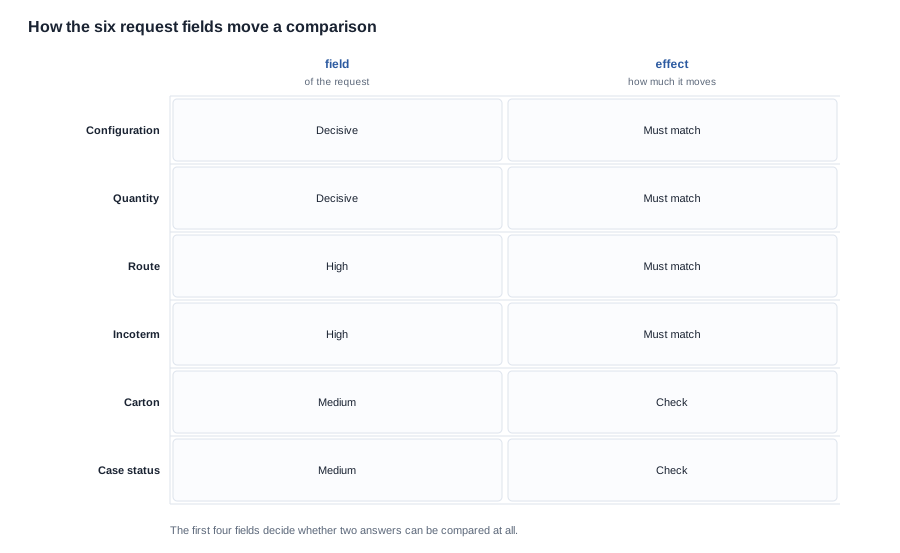
The matrix shows which fields actually decide whether two answers can be compared at all, and the answer is that the first four are decisive while the last two are checks. A comparison where the configuration and the quantity differ is not a comparison at all. A comparison where the carton and the case status differ is a comparison of two different physical shipments, and it may still be the right one to make — but it has to be made deliberately.
The value of the document is not tidiness; it is that it makes two things possible that are otherwise impossible. The first is comparison. To compare two quotations on the same basis, the basis has to have been written down, and the first four fields — configuration, quantity, route and incoterm — are what decide whether that comparison exists at all. A buyer comparing quotations that differ in model or in volume is not choosing between suppliers, they are reading two unrelated numbers.
The second is total cost. The total cost of a consignment is the goods value plus the freight plus the destination charges plus the cost of the delay, and only the first two are usually quoted. A request that carries the incoterm with a named place, the carton dimensions and the declared value can be turned into a landed cost, and a landed cost is the only figure that can be set against a margin. This matters most on a repeat order, where the gap between a rate and a landed cost is the gap between a procurement decision and an accounting one.
Here, we will produce this document for any order, with a date and a revision number on it, and we will tell you which field each number came from so you know who to ask when one changes. We will not fill an open field with an estimate: the charging method for the L1 Pro and the MT6, and the CY05 and the CY03 is not published, and writing "magnetic" because most of the range is magnetic would be a guess presented as a specification. The same applies to the case capacity for the KY06 and the MT5, and to the packed carton dimensions, the gross packed weight and the units per master carton, none of which we publish because they depend on the final retail packaging and the destination rather than on the device.
The one weight figure the catalogue does publish is for the MT6 glasses body at 158 g, which includes its 265 mAh cell and its camera and excludes the foldable charging case, with the case weight unstated — and it is a body weight, not a packed weight, so it does not answer the gross weight field of this request either.
For the reverse direction, the shipping supplier verification checklist covers how to score the answers once they arrive.
Related reading
- Smart glasses shipping supplier verification
- Smart glasses shipping cost breakdown
- Smart glasses shipping myths
- Smart glasses shipping SOP template
- Battery transport compliance
- Logistics and shipping
Send the six fields and we will return the same six fields filled, with the published rows quoted back for confirmation and the open rows marked with an owner and a date — so that every figure in the request has a place it came from.


