

Six questions come up in nearly every logistics conversation for a lithium-powered product, and they decide more of the landed cost than the unit price does. Can the goods travel by sea or only by air? Is the quotation FOB or DDP, and what sits between the two numbers? What does the shipping carton actually measure? How long is transit, and who carries the risk in it? Can the shipment be consolidated? And what happens when customs opens it? Underneath those sit two more that buyers rarely ask and that answer most of them: what does the landed cost look like per unit at my own sell-through rate, and what is the booking cut-off for my destination and mode? This guide takes the six in order, shows the answers that are complete, marks the catalogue data behind a freight quote, and separates what can be settled on paper from what only a forwarder or a broker can tell you.
Smart glasses shipping: the six questions that set the landed cost
The buying situation that raises these six questions
The reader is someone buying on the brand side, a channel buyer or an importer who has a quotation in hand and has to turn it into a landed cost before the order is worth approving. The conversation with the supplier has usually reached the point where the unit price and the sample are settled, and the remaining exposure sits in the part of the price that nobody has itemised yet: freight, terminal handling, documentation, customs clearance, duty and tax.
That is where a surprisingly large share of the total disappears, and it is why comparing two quotations is not a matter of comparing two unit prices. One quotation may be EXW at a lower goods value and the other DDP at a higher one, and the lower figure may still be the more expensive programme once the destination charges are added. A buyer who compares the two numbers is comparing two different products — one of which includes shipping and one of which does not.
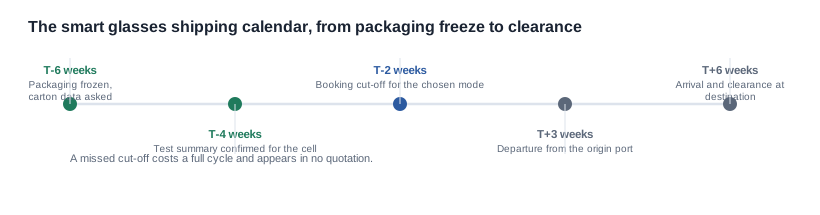
Two deadlines shape the urgency. The first is the artwork freeze, because packaging data cannot be requested before the retail box is settled and a carton dimension quoted against artwork that later changes is a carton dimension that will change again. The second is the sailing schedule, because a consignment that misses the booking cut-off for its mode waits a full cycle, and that cost appears nowhere in any quotation — it appears as a delay in the launch.
Why two quotations for the same goods can differ by a third
The gap between two quotations for the same model is rarely a disagreement about the product. It is a disagreement about what is included, and the inclusion list is where the money is.
Four inclusions move a quote more than any discount a buyer can negotiate. The first is the freight basis itself: whether the quotation is EXW, FOB, CIF or DDP, and which named place the term points at. The second is the dangerous goods arrangement, which for a lithium-powered product is a document and a packing rule rather than a line item, and which determines whether the goods are accepted by the carrier at all. The third is the packaging: retail box, printed carton, master carton and units per carton, because the master carton is normally the thing that determines chargeable weight and it is frequently the only lever whose value is permanent across every future order. The fourth is the destination charges, which are a line item on somebody else's invoice and which are frequently larger than the difference the buyer negotiated on the goods.
This is why a shipping quotation is only comparable with another shipping quotation when all four inclusions are named. The practical rule for a procurement team is to require the quotation to state the incoterm, the named place, the freight basis, the packing configuration and the treatment of the dangerous goods arrangement, and to treat a quotation missing any one of those as incomplete rather than as cheap.

What a complete answer to each freight question contains
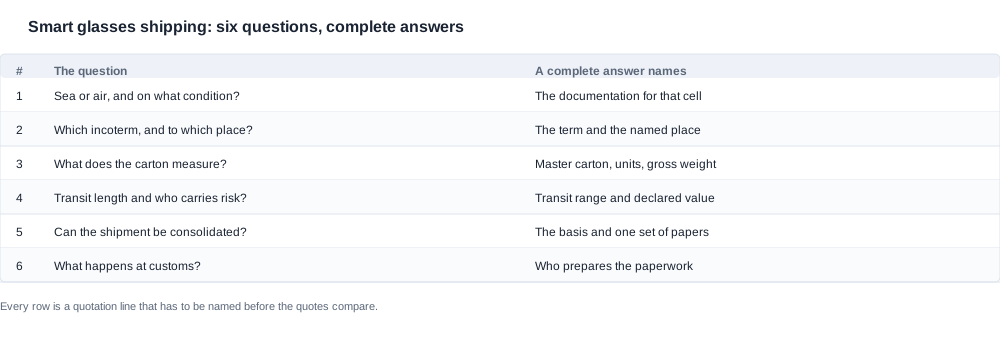
The six freight questions, side by side
| # | The question a buyer asks | A complete answer names | An incomplete answer sounds like |
|---|---|---|---|
| 1 | Can the goods travel by sea, or only by air? | The dangerous goods documentation that exists for the specific cell configuration | "We ship by air if you need it fast" |
| 2 | Is the quotation EXW, FOB, CIF or DDP? | The named place the term points at, and what is excluded from it | "The price is FOB" |
| 3 | What does the shipping carton measure? | Master carton dimensions, units per carton, and the gross weight | "Standard export packing" |
| 4 | How long is transit, and who carries the risk? | The transit range for the mode, and the declared value the policy is written on | "About one month by sea" |
| 5 | Can the shipment be consolidated? | The consolidation basis, and the single set of papers that covers it | "We can ship with other customers" |
| 6 | What happens at customs? | Who prepares the paperwork, and which query type is likely | "We will handle the clearance" |
What separates a shipping answer from a slogan
The test on each row is whether the answer names something that will still be true in ten weeks, when the booking is made and the paperwork is prepared. "We ship by air if you need it fast" is a statement of willingness; "sea is available for this configuration once the UN 38.3 test summary for the cell is issued" is a statement of fact with a condition attached, and the condition is something you can track.
Row three, the carton, is where the most value is usually lost and where buyers most often accept a slogan. "Standard export packing" is not a dimension, and a freight forwarder cannot price a forwarder quote from it. What is needed is the master carton's length, width and height, the number of units it holds, and its gross weight with the retail box inside. Two of those three numbers are unpublished in our catalogue, which is why a freight quote for a smart glasses programme is always partly a request rather than a lookup, and why the request has to be made early enough to be answered before packaging is frozen.
Row four is where insurance gets discussed, and the question deserves more precision than most buyers give it. The insurance policy should be written on the declared value, which means the declared value should be the true value. Under-declaring to reduce a premium is not a saving — it is a decision that loses everything if the goods do not arrive, and the premium saved is a rounding error next to the consignment.
Row six is the one most often answered with a single reassurance, and it deserves the most detail, because customs holds come in three kinds and each has a different remedy. A documentation query is resolved by producing the document. A classification query is resolved by agreeing the tariff code with a broker, which is a conversation and a piece of advice. A prohibited-goods query ends the attempt. The mitigation for all three is identical and it happens before packing rather than after, which is the argument for treating the checks in this guide as routine.
The two questions underneath the six
Underneath the six sit two that buyers rarely ask and that answer most of the other four. The first is what the landed cost looks like per unit at your own sell-through rate, which converts the destination charges from an abstraction into a margin percentage. The second is what the booking cut-off is for your destination and mode, because a missed cut-off costs a full sailing cycle and is the one freight failure that has nothing to do with price.
Both are cheap to ask and expensive to discover late. Both are also the two questions that most clearly separate a supplier who manages logistics from one who forwards your message to a forwarder.
The catalogue rows that shape a freight quote, and the rows that do not exist
What the catalogue publishes that a forwarder needs
Our catalogue publishes twenty-eight models, and the electrical rows it carries are the first set of facts a freight conversation depends on. Cell capacity is published for every model and runs from 40 mAh on the A05 and the A06 up to 290 mAh on the L1 Pro and the L2 Utral, and the CY05 and the CY03. That range matters because the dangerous goods arrangement is specific to a cell configuration: a test summary and packing arrangement issued for one configuration does not cover another, and the buyer who assumes a single document covers the whole range will find out at the carrier's acceptance check.
The charging method is the second published row with a logistics consequence, and it is worth asking about for a reason that is not obvious. Magnetic charging on seventeen models and Type C on seven means the retail box contents differ between configurations — a magnetic model may not need a cable in the box at all, while a Type C model does. That changes the packing list, the carton contents and occasionally the retail artwork. The method is not published at all for four camera models, the CY05 and the MT6, and the L1 Pro and the CY03, and for those four it has to be asked for rather than looked up.
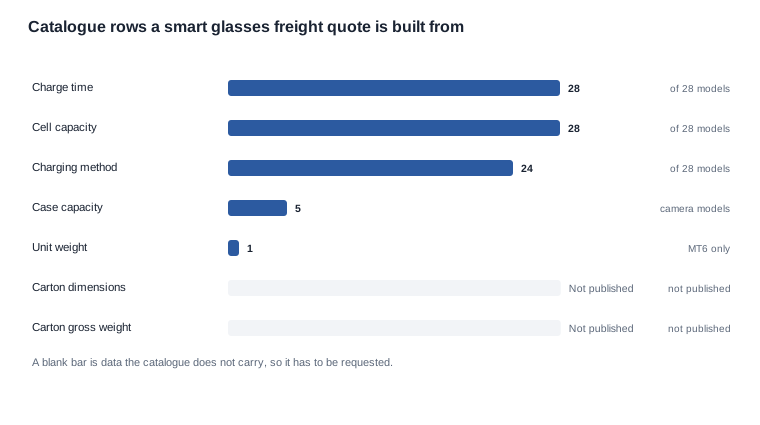
The third published row is charge time, which is on every model — up to two hours on twenty-six of them and about one hour on the D17 and the ZH12. It looks irrelevant to freight and is not, for one reason: the charging case. A 1400 mAh case on the CY03 and the CY05, and the L1 Pro, a 900 mAh or 1400 mAh case on the L2 Utral, and a 1200 mAh folding case on the MT6 all add volume to the package, and volume is what determines chargeable weight for a boxed product. The KY06 and the MT5 ship with a case whose capacity is not published, the V03 Pro is published without a case, and the catalogue contains no case row at all for the V03, the V06 or the S7.
The rows that do not exist, and how to ask for them instead
The data a forwarder actually needs — master carton dimensions, units per carton, gross weight, retail box dimensions, pallet configuration — is not published for any model in the range. There is one weight in our catalogue and it is a single figure on a single model: the MT6 glasses body is published at 158 g, including its 265 mAh cell and its camera and excluding the 1200 mAh folding charging case, whose own weight is not published. That is a component weight, not a shipping weight, and it cannot be turned into a chargeable weight by a buyer without the case and carton figures that the catalogue does not carry.
The way to handle an open row is to ask for it in a form that can be used, not in a form that sounds precise. "Please quote the freight on the following basis: one model, one colourway, one retail box configuration, one master carton of N units, gross weight G kg, carton dimensions L×W×H cm, and state whether the consignment is palletised." That request can be answered by a forwarder without any further conversation, and it is the request that exposes whether the supplier has ever priced this shipment before.
A second discipline is worth adding: ask for the same basis across all candidates. A freight comparison built on one supplier's carton data and another's is a comparison of two packaging strategies rather than of two quotes, and it will not survive the first invoice.

Verifying a shipping answer before the purchase order is placed
The five-step check
Verification of a shipping arrangement happens before the purchase order is placed, and it is a short sequence.
- Fix the packing basis in writing. Model, colourway, retail box configuration, units per carton and gross weight, so that every freight quotation in the comparison rests on the same physical thing.
- Confirm the dangerous goods route for that configuration. The test summary has to exist for the cell in the box, and the packing arrangement has to match what the forwarder will actually tender.
- Ask for both an EXW or FOB figure and a DDP figure to the same destination. Two numbers on the same packing basis are the only way to see the size of the destination charges.
- Establish the cut-off and the documentary deadlines separately from the transit range. Transit is an estimate; the cut-off is a calendar fact.
- Name who prepares each document and by when. Every document in the set has an owner and a deadline, and the ones without an owner are the ones that arrive late.

The documents that have to travel with the consignment
Five document sets travel with a lithium-powered consignment, and each has an owner. The commercial invoice and packing list are the buyer's and the supplier's respectively, and they must agree with each other on the value, the quantity and the carton count. The dangerous goods documentation is the supplier's responsibility and has to match the cell configuration inside the box. The transport document and the insurance policy sit with the forwarder, and the policy has to be written on the declared value that the invoice states. The import documentation is prepared for the destination market, which may be the importer's own broker rather than the supplier's forwarder, and the assumption that "we will handle the clearance" means the supplier's forwarder will do it is one of the more expensive ones in this category.
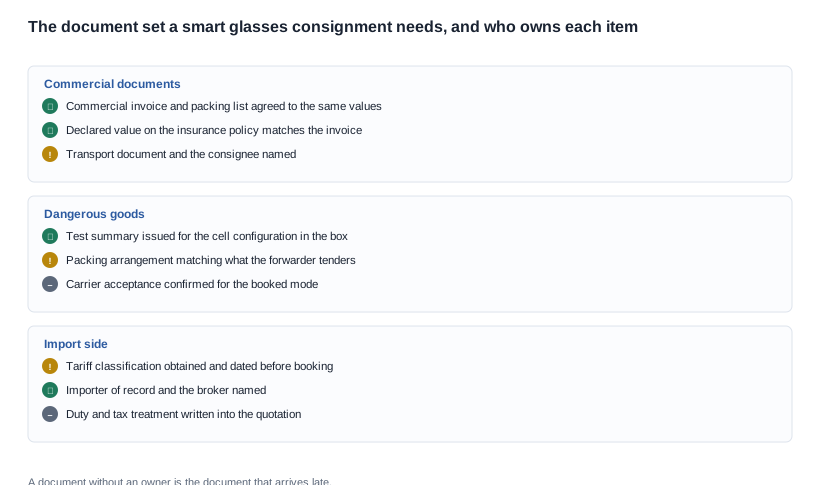
The questions to ask of any freight arrangement, then, are short and mechanical: which document do you prepare, which document do I prepare, what is the deadline for each, and what happens if it is late.
 A supplier who cannot answer those four for their own product has not shipped it before in the configuration you are asking about.

Where freight and customs disputes actually happen
Three disputes that are settled after the booking
The chargeable weight does not match the packing list. The forwarder weighs the master carton and computes the volumetric weight from the dimensions it was given, and the greater of the two governs. If the carton the supplier quoted and the carton that arrived differ — because the retail box was retooled, or the units per carton changed for a packing reason — the freight is re-rated and the difference is invoiced to whoever the contract says it is invoiced to. The prevention is one line in the purchase order fixing the packing basis, plus a photograph of the actual carton next to the quoted dimensions before the consignment is sealed.
The declared value and the invoice disagree. Insurance is written on the declared value, and the declared value has to be consistent with the invoice, which itself has to be consistent with the customs declaration. Where they are not consistent, the exposure is the consignment rather than the premium. The prevention is a single agreed invoice value used in all three places, which is the number the buyer should be able to state without looking it up.
A documentation query becomes a classification query. The consignment clears the carrier and the port and is then held because the tariff classification is not accepted. A classification query is not resolved by producing a document — it is resolved by agreeing the code with a broker, and it consumes days that are rarely budgeted. The prevention is to obtain the classification for the specific configuration before the booking, not after the hold, and to record it in the file with the date it was obtained.
The freight terms that move, and the ones the carrier fixes
The freight rate itself moves more than buyers expect, and it moves for reasons that are not about the supplier's margin. Mode, season, consolidation, and the size of the consignment all sit underneath it, and a large part of the available movement is in the packing basis rather than the rate — a carton that is dimensionally better designed changes the chargeable weight of every future order, and that is a permanent gain rather than a one-off discount.
What does not move is the dangerous goods work. The test summary, the packing arrangement and the carrier acceptance process have a fixed cost and a fixed lead time, and they are the reason why a first order in a new configuration is more expensive than the same order in a configuration already shipped.
The trade-off worth naming is between freight rate and consolidation. A consolidation saves money and requires nobody to change anything, but it moves the departure date to the consolidation schedule and it needs one set of papers covering what is in the consignment, which is simpler than two sets covering what is in each part. For a buyer with a fixed launch date that cannot move, the saving is not worth a week; for a buyer with a season to hit, it usually is.
A shipment worked through, and what we can and cannot quote
A first shipment reasoned through, step by step
The scenario below is built to carry an argument rather than reported from a client engagement. No customer, order or shipment is described; the model, the quantity, the destination and the launch date are assumed so that the reasoning can be followed from the first quotation to the landed cost.
A channel buyer is placing a first order for a camera model into a European market, with enough units for the first quarter of retail. The supplier has quoted a unit price and a freight figure. The buyer has a launch date that cannot move and a packaging design that is not yet frozen.
Step one is the incoterm. The quotation turns out to be FOB at a named Chinese port, with destination charges to follow as a separate invoice. The buyer asks for the same quotation on a DDP basis to the same destination and on the same packing. The difference between the two figures is not a rounding error — it is the terminal handling, documentation, clearance, duty and tax, and it is larger than the negotiated gap between two competing unit prices. That single comparison reorganises the supplier evaluation, because a supplier whose DDP price is high may still be the cheaper programme, and one whose DDP price is low may be quoting a narrower scope than it appears.
Step two is the packing basis. The supplier can quote a retail box and a master carton holding twelve units, with a gross weight and carton dimensions, and it can state which charger, if any, is in the box. The charging method on this model is published, so the box contents follow from the catalogue rather than from a guess. The carton data is not published for any model, so this is the first part of the answer that had to be requested rather than looked up — and it is the part that determines whether the forwarder's quote is a real number.
Step three is the dangerous goods route, where the cell configuration decides which documentation applies and the buyer's assumption that one document covers every model is corrected. Step four is the timeline: the booking cut-off for the mode and destination becomes a calendar entry with an owner, the transit range becomes a schedule rather than an estimate, and the insurance is written on the invoice value.
Step five is the landed cost, worked out per unit at the buyer's own sell-through rate. On that basis the buyer can see which of the remaining freight levers is worth pulling, and the answer is the packing rather than the rate — because the packing gain repeats on every order while a freight discount does not.
What we will quote and what we will not
To put it plainly — we will quote a shipment itemised: goods value, freight basis, the named place the term points at, the packing configuration the freight was calculated on, and the treatment of the destination charges — marking which of those lines are fixed and which move with the destination and the season.
We will not publish a standard freight rate, because a rate without a carton, a destination and a mode is not a rate, and a buyer who has one is comparing it against a quote that includes a carton. We will not quote freight for a model whose packing data we have not measured, and we will say so rather than fill the gap with a typical figure. We will not under-declare the customs value, and we will not split a consignment in order to move it under a reporting threshold — the second is a legal exposure that dwarfs the saving and it belongs in the conversation about how a shipment is structured, not in a quiet arrangement.
What we will do is take a model, a quantity, a destination and a mode, tell you which configuration exists, give you the catalogue rows that the forwarder needs, and mark the packing and dangerous goods data that has to be requested before the freight can be fixed.
What to send us to get a shipping quotation
Send the model, the quantity, the destination and the mode, and we will tell you what the published rows say, what the freight quotation would be based on, and which documents have to exist before a booking can be made. If you already hold a freight quote from another supplier, send it and we will mark the parts of it that are inclusion, rather than price.
Related reading
- logistics and shipping
- Shipping cost breakdown — the six lines
- Negotiating freight rates — when it pays
- Documentation requirements — what must exist
Send the configuration, the quantity, the destination and the mode, and we will show you which lines of a smart glasses shipping quotation are fixed and which move.


