

Smart glasses shipping is a document problem wearing a freight costume. The rate is a negotiation; the freight is a number; and neither of them is where a consignment actually stops. What stops a consignment is a cell count that does not match the file, a gross weight nobody agreed, a model designation on the paperwork that is not the model in the carton, and a charge state that was never decided. Twelve questions, asked before the cartons are packed, close all four. Here they are in the order a shipment actually fails.
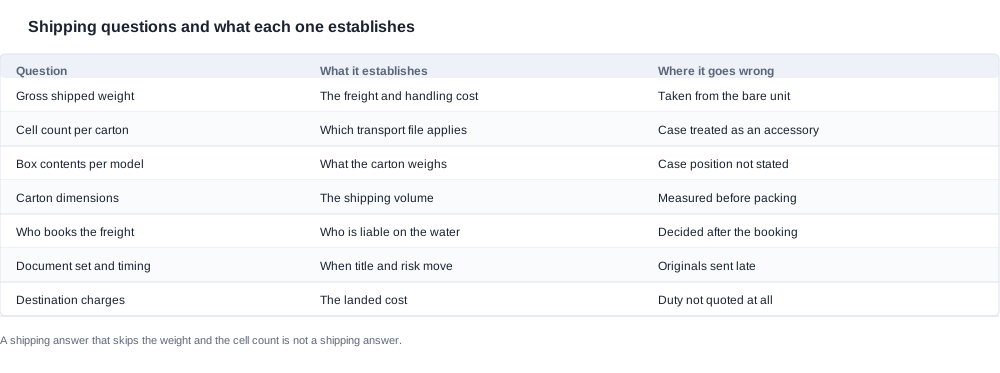
Smart glasses shipping questions are mostly about documents, not freight
The buyer reading this, and what a stopped consignment costs
The reader is a brand-side sourcing manager, a channel buyer or an importer whose goods are at the factory and whose next commitment — the balance payment, the promotion, the channel listing — depends on them arriving. They have usually already agreed the incoterm and have a freight quotation in hand, and the thing they are managing is everything that happens between the packed carton and the warehouse.
The cost structure of a failure is worth understanding, because it determines where the effort is worth spending. The direct cost of a held consignment is small: the freight is paid either way, and the goods eventually move. The real cost is the schedule — a launch window, a marketplace listing date, a retail season — and the second cost, which is the more expensive one, is the inventory that arrives after the promotion it was bought for and has to be carried at a lower price or sold into a different channel.
That is why the questions below are weighted towards documents and cartons rather than towards routes and carriers. A buyer who negotiates the freight rate down by a few per cent and loses a week at the port has made a losing trade.
Why the freight rate is the easy half
Freight is quoted per unit, per kilogram or per cubic metre, and the arithmetic is not contentious. What is contentious, and what the rate is silently assuming, is the gross weight and the volume of what is being shipped.
Both of those are unpublished in this category for almost every model. The catalogue publishes a weight for exactly one model: the MT6 glasses body at 158 grams, which covers the battery and the camera and excludes the folding charging case. The weight of that case is not published. For the other twenty-seven models, no weight is published at all.
The consequence is that any freight quotation for a smart glasses consignment is based on numbers the buyer cannot verify from the catalogue, and the two numbers most likely to be wrong are the gross weight per carton and the carton dimensions. Both of them are decided at packing time, which is after the quotation, which is after the order.
The four things that actually stop a consignment
Before going further it is worth naming them, because the questions in this article map onto them one for one.
- The cell count in the carton does not match the transport file. This is the one that stops a consignment outright.
- The gross weight and the volume were never agreed, so the freight was booked against an estimate and the difference is discovered at the dock.
- The model designation on the paperwork is not the model in the carton, which turns into a declaration problem at destination.
- The state of charge was never decided, which turns into an airline or carrier restriction at acceptance.
Not one of the entries here is exotic. All four are ordinary consequences of a shipment being planned from a catalogue row rather than from a packed carton.

What travels with the goods, and which cell it travels with
The carton is the unit of shipment, not the glasses
A consignment is a number of cartons. Each carton contains glasses, an accessory, a cable, a manual and a printed insert, and the weight and the volume of the carton are what the carrier weighs and what the freight is calculated on. The product weight published in a catalogue, where one exists, is a component of that number rather than the number itself.
Which means the carton is the thing that has to be specified. The questions are narrow and mechanical: how many units per carton, what is the carton gross weight including the outer carton and the packing material, what are the carton dimensions, and how many cartons per pallet and per container.
None of those are published for any model in our catalogue, and all four change the freight quote.
The charging case is a second cell, not an accessory
This is the point that catches buyers out, and it is the reason the catalogue's charging-case position matters for logistics and not only for retail.
A model that ships with a charging case puts two cells in the carton. That has consequences at every handover: the transport documentation has to describe the carton rather than the device, the declared weight changes, the packing instruction has to protect a cell that is not the one in the glasses, and the packaging has to prevent the two cells from being shipped in a state that a carrier will not accept.
The catalogue makes the case position ambiguous in a way that a buyer should resolve rather than assume:
- Five camera models publish a charging-case capacity — the L1 Pro and the CY05, and the CY03 — each at 1400 mAh, the L2 Utral at either 900 or 1400 mAh, and the MT6 as a 1200 mAh folding case.
- Two publish a case without publishing its capacity — the KY06 and the MT5.
- Four publish no charging-case row at all — the V06 and the V03 Pro, and the S7 and the V03. This is an unpublished item, not an absent accessory, and what the carton carries for them is a question to put to the supplier.
So for three camera models, a buyer who has not asked does not know whether the carton holds one cell or two. That is a transport question, and it is one of the twelve.
Where the catalogue is silent and the freight quotation is not
The catalogue is silent on three things a freight quotation depends on: gross weight, carton dimensions and units per carton. It is also silent on the charge method for four camera models — the L1 Pro, the MT6 and the CY03, and the CY05 publish a case capacity but no charge method row — which matters for packing because the cable and the charger in the box differ.
And there is one published figure that is routinely over-read: the charge time. Every model in the catalogue publishes a charge time, twenty-six of them at two hours or less and two at about one hour. What the catalogue does not publish is the state of charge the measurement started from, or the criterion that ends the charge. Without those, a published charge time cannot be converted into a shift-length interruption, and it cannot be read as a case turnaround time either. It is a charge figure, and it should not be asked to do work it was not measured for.
The IP54 marking and what it means for a shipment
Only two models in the catalogue carry an IP54 marking: the V06 and the S7. That marking describes resistance to dust and to spray water, and it is relevant to a shipment in a narrow, practical way — it tells you the specification level of the model you are buying, and it tells you which models you cannot claim anything about. It does not describe how the goods behave in transit, and it does not substitute for the packaging specification.
The handover points where a consignment stops moving
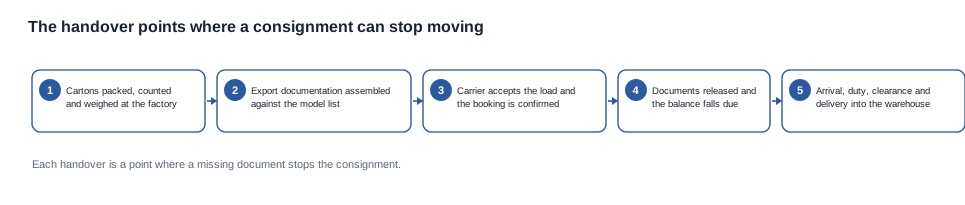
The flow above is the sequence a consignment actually moves through, and each handover is a place where a missing document stops it. The reason a shipment is worth planning before the cartons are packed is that most of these handovers cannot be repaired quickly once the goods are on the water.
At packing: the count, the weight and the contents
The packing list is generated here, and it is the document that every later handover depends on. It has to carry the model designation, the quantity, the carton count, the gross weight and the carton dimensions, and it has to state the number of cells per carton for each model included. A packing list that lists models without quantities, or that omits the cell count, is a document that will have to be corrected while the goods are moving, which is slow and sometimes impossible.
At documentation: the file, and the model designation on it
The transport file has to describe the configuration that is physically in the carton. Where a model ships with a case, the file covers the carton. The battery transport framework in the compliance section sets out the documents, and the practical discipline is short: check the model designation on the file against the designation on the purchase order and on the carton artwork before the shipment is released, and check it again when the file is issued.
That check matters because the catalogue publishes no per-model certification row for any of its twenty-eight models, and its text contains no CE, FCC or RoHS marking. The documentation therefore has to be requested against the specific model designation rather than assumed from the fact that the catalogue describes the product. A buyer who treats "it is in our supplier's catalogue" as evidence that the file exists is relying on a page that does not make that claim.
At booking: the carrier, the mode and the acceptance rules
The booking is where the transport rules bite. Lithium batteries travel under a set of rules that depend on the cell chemistry, the cell quantity in the package, the state of charge and the mode. A carrier will refuse a consignment at acceptance for a packaging or a charge-state reason, and a refusal at acceptance costs more than a documentation mistake caught the week before, because the goods have to be moved, unpacked and re-presented.
This is why the declared state of charge has to be decided in advance. It is a decision about the goods, not about the paperwork, and the decision belongs to the buyer because it changes what the supplier has to do at the packing stage.
At arrival: clearance, duty and the delivery into the warehouse
The final handover is the one the buyer is best placed to control and the one most often left to the supplier's forwarder. Who clears the consignment, who pays the duty, who handles the delivery and what happens to the pallet if it does not fit the receiving bay are all decisions that should be made before the booking.
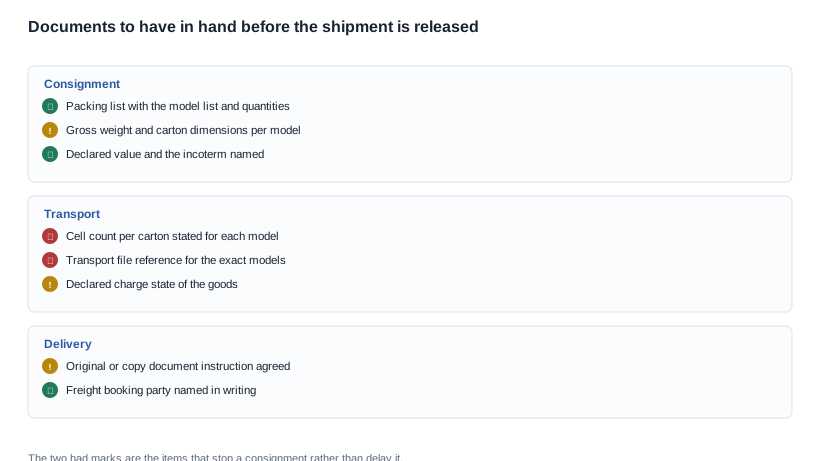

Asking for the shipment plan before the cartons are packed
The twelve questions, in the order they should be asked
- How many units per carton, and what is the gross weight of a full carton? Neither is published, and both determine the freight.
- What are the carton dimensions, and how many cartons per pallet and per container? Volume is billed separately from weight and is often the larger cost on a light product.
- How many cells are in each carton for each model ordered? This is the transport question, and it is ambiguous in the catalogue for three camera models and unquantified for two more.
- What is the declared state of charge at despatch, and who sets it? It is a packing-stage action with a scheduling consequence.
- Which model designations does the transport file cover? Check the designation against the order rather than accepting a generic file.
- Who books the freight, and on whose account? Determines who is liable on the water and who sees the carrier's charges.
- Which incoterm applies, and which party is importer of record? The importer of record carries the compliance obligation and the duty.
- Original or copy documents, and who holds them? Originals hold the goods; copies do not.
- When are the documents issued relative to the despatch? Documents that follow the goods cost days at the destination.
- What is the destination duty and handling estimate, and who pays it? Landed cost is not the freight.
- What happens if the consignment is held or refused? The remedy, not just the freight cost.
- Which party is liable for the goods between the two handovers? Insurance follows the contract, and the contract follows the incoterm.
The first four of those are packing-stage questions, and they are the ones a buyer can only ask before the cartons are sealed. The rest can be asked at any point up to the booking, which is why the sequencing matters.
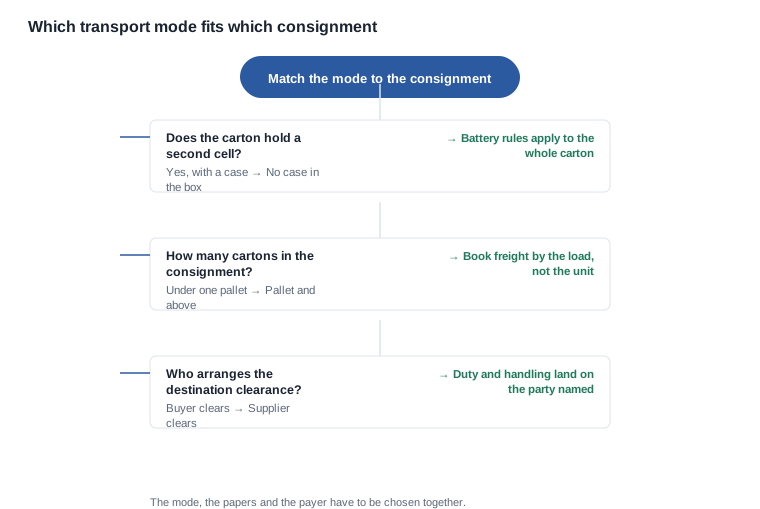
Incoterms, liability and the party who actually carries the risk
Most of the disagreements in this category are not about the rate. They are about the moment at which risk moves, and the incoterm sets that moment — so the incoterm is a decision, not a formality.
The practical consequence for a buyer is that the same physical shipment can carry very different risk depending on the term, and the difference is not visible in the freight quote. The buyer should establish which term is being quoted, what it means for the point at which insurance becomes the buyer's problem, and what the importer-of-record position is, because the compliance obligation sits with that party.
Two questions settle most of it. Does the buyer want to be importer of record, and does the buyer want the documents to arrive before the goods? The first is a tax and compliance decision, the second is a working-capital decision, and both are better made before the booking than after a hold.
The cost of a hold, and who absorbs it
A consignment that is held at the destination accumulates charges that are usually assigned to the party named on the booking, and the accumulation starts on the first day of the hold whether or not anyone has identified the cause yet. This is the strongest argument for getting the documents right before the goods move: the cost of a hold is rarely the direct loss and is often the schedule.

Where a shipment goes wrong after the factory releases it
The carton holds a second cell the file does not describe
What happens. The consignment is refused at acceptance, or stopped at destination, because the number of cells in the package is not what the documentation declares.
Why it happens. The case position was treated as an accessory detail. In our catalogue it is published for five camera models, present but unquantified for two, absent from the rows of three, and explicitly absent for one — so the ambiguity is in the specification, not in the packing.
How it is avoided. State the cell count per carton for each model in the order and check it against the file before the shipment is released. The shipping checklist for a first order is the version of this list that can be sent with a purchase order.
The freight was booked against an estimate
What happens. The consignment arrives and the carrier's charges are higher than the quotation, or the consignment is refused because it does not match the declared weight and volume.
Why it happens. Neither figure is published for any model in this catalogue, so the quotation was necessarily built on an estimate, and the estimate was made without the packaging that had actually been produced.
How it is avoided. Ask for the gross weight and the carton dimensions from a real packed carton, and for the units per carton, before the order is released for packing. If the packaging is custom, this is the point at which it has to be measured rather than designed.
The paperwork names a sibling model
What happens. The goods arrive and the declaration does not describe them, so the consignment is challenged at the border and the buyer discovers a documentation problem at the moment it can least be fixed.
Why it happens. The document was prepared from a catalogue listing rather than from the purchase order, and the designation was copied by hand.
How it is avoided. Compare the designation on every document with the designation on the purchase order and on the carton artwork. It takes minutes and it is the check that finds the majority of these, because the paperwork is usually prepared for an earlier configuration.
The goods arrive after the promotion they were bought for
What happens. The inventory is in the warehouse with no demand behind it, and the buyer is carrying stock at a cost per unit that was set by a launch date that has passed.
Why it happens. The shipping plan was agreed as a schedule and the schedule was treated as the supplier's problem, when in fact the dependencies — material allocation, the documentation scope, the charge state, the booking — are all things the buyer can influence or detect.
How it is avoided. Work backwards from the date the goods have to be in the warehouse, not forwards from the despatch date, and identify which of the twelve questions sits on the critical path for that date. The shipping mistakes article sets out the patterns in more detail, and the logistics pillar holds the structure reference.
What we publish about shipping, and what we answer per order
We do not publish freight rates, carton weights, carton dimensions or units per carton, and we are not going to invent them. A published weight would be a number for a carton configuration we would have to invent anyway, and a published freight rate would be meaningless without the origin, the destination, the mode and the consignment size.
What we do publish is the electrical specification that determines what travels and how. Every model publishes a battery capacity, a published runtime and a charge time. Twenty-four models publish the charge method — seventeen on magnetic charging and seven on a Type C interface — and four camera models, the MT6 and the L1 Pro, and the CY03 and the CY05, publish a charging-case capacity without publishing a charge method. The charging-case position is published across the camera range, with four camera models — the V03 Pro and the V03, and the V06 and the S7 — carrying no charging-case row at all. The IP54 marking appears on the V06 and the S7. And the MT6 is the only model whose glasses body weight is published, at 158 grams with the battery and camera and without the 1200 mAh folding case, whose own weight is not published.
Against that specification, we will answer the twelve questions in writing for a specific order: the packing plan, the carton count and weight and dimensions, the cell count per carton for each model, the declared state of charge, the transport file reference against the exact model designations, the booking party, the incoterm and importer of record, the document set, the duty estimate for your destination, and what happens if the consignment is held.
Send us the models, the quantities, the origin and the destination and we will tell you what the shipment plan looks like against your own order.
Related reading
- Logistics pillar
- Shipping checklist for a first order
- Shipping common mistakes
- Battery transport compliance
- AI camera glasses range
Tell us the models, the quantities and the destination and we will tell you what the shipment plan has to contain.


