

The advanced handling of smart glasses sourcing risk is not a longer list of things that could go wrong. It is a classification system for deciding which risk you are willing to carry, plus a mechanism for noticing when a supplier's documentation habits have changed. Both matter more here than in most categories, because a large part of what determines whether a purchase succeeds is unpublished, so risk has to be managed by agreement and by observation rather than by comparison.
The reason comparison does not work is structural. In this category the published catalogue is rich in the rows that are easy to publish and empty in the rows that decide whether a programme succeeds. The camera resolution tier is published for all eleven camera models — eight at 8 megapixels, the V03 and the V06, the KY06 and the MT6, and the CY03 and the V03 Pro, and the MT5 and the CY05, and three at 13 megapixels, the S7 and the L2 Utral, and the L1 Pro. The charge time is published for all twenty-eight models. The charging method is published for twenty-four. The case capacity is published for five camera models. The ingress marking is published for two, the V06 and the S7, and it is a catalogue marking with no third-party report number behind it. The unit weight is published for exactly one model, the MT6 glasses body at 158 grams including its 265 mAh cell and its camera and excluding the 1200 mAh foldable charging case, whose own weight is not published.
Everything that decides whether the product performs is absent. The sensor model, the field of view, the video format and the frame rate are published for no camera model at all. Microphone pickup distance and the noise reduction method are not published across the range. Ingress report numbers, certificate numbers, issuing bodies and validity dates are not published. No model carries a per-model certification row, and the text of the catalogue contains no reference to CE, FCC or RoHS. Production capacity, line count, production lead times, minimum order quantities, unit prices, defect rates, yield figures and warranty terms are not published by anyone in this category.
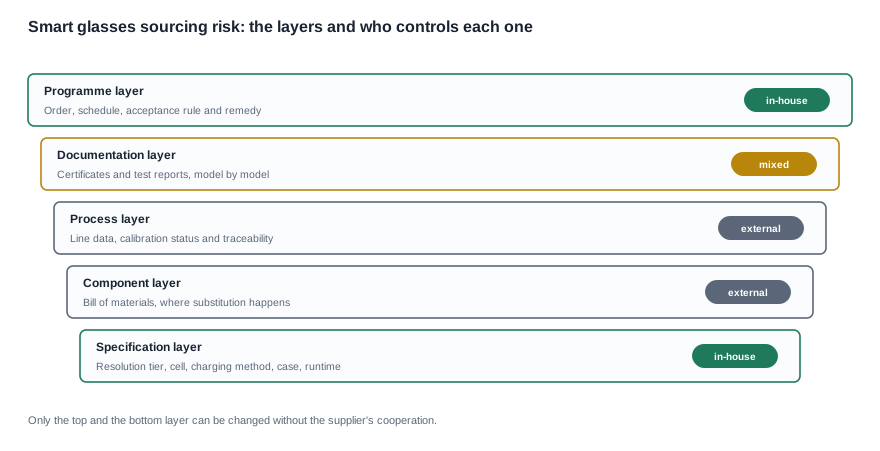
The five-layer picture above is the frame for everything that follows. Only the top layer and the bottom layer can be changed without the supplier's cooperation, and a buyer who understands this will spend their negotiating capital in the right two places instead of arguing with the three in the middle.
Smart glasses sourcing risk: where structural risk ends and a term starts
The first discipline of advanced risk management is deciding, before you raise anything, whether the item sits on the structural list or the negotiable list. Getting this wrong wastes the only resource a buyer really has, which is attention.
Structural risk exists regardless of which supplier is chosen. It cannot be negotiated away, and asking for it as though it could is the single most common way a buyer damages their own position in the first meeting.
- The sensor model, the field of view, the video format and the frame rate are published for no camera model. There is no row to point at and no value to request, because none has been recorded at the level a buyer would need.
- Unit weights are published for one model in the entire range. No bare frame weight has been published for any model at all.
- Ingress report numbers and certificate scope are absent, because the catalogue carries a company-level export certification page with ten patent certificates shown on it — eight appearance-design patents and two utility-model patents — and no per-model certification row behind it.
- The charging method for four camera models — the L1 Pro and the MT6, and the CY05 and the CY03 — is not published. Their catalogue rows carry the pixel tier, the cell capacity, the charge time, the rated use and the charging case capacity, and they stop there. The four models have a published charging case capacity and an unpublished charging method, which is a combination that is easy to misread in either direction.
- The Bluetooth version for any camera model is not published. The version numbers in the catalogue belong to the audio models, where the K01 and the K02 are published at V5.3 and the D11, the D12, the LC-105 pair, the G07 and the YK12 are published at V5.4.
Negotiable risk is not a fact about the product. It is a term, and a term is something two parties write down.
- Documentation issued against your configuration and your brand name.
- A first-article approval procedure with a defined signature.
- A defect definition with an agreed boundary and a measurement method.
- A configuration-change notice period and a re-approval route.
- A spare-parts availability commitment for the programme life.
- A contractual defect allowance measured on your own production runs rather than on the supplier's historic average.
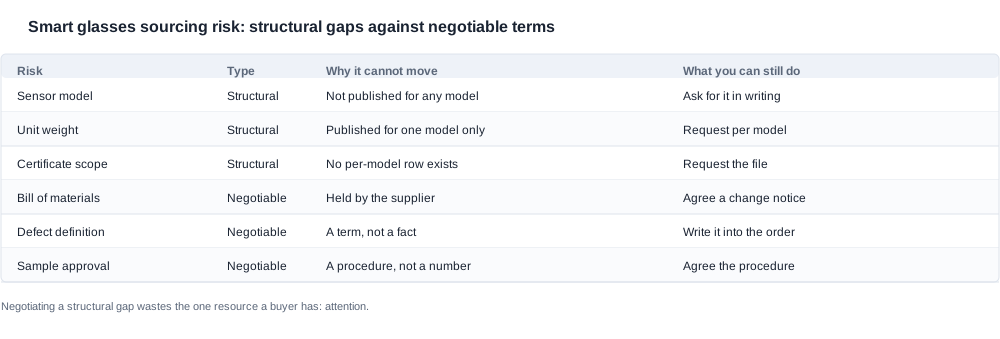
The table is the working version of the split. What makes it useful is the third column: for every structural item there is a reason the negotiation cannot move it, which tells the buyer what to do instead. Where a row is published the buyer's risk is that the factory will not build to it, and that is a supplier-evaluation question. Where a row is not published the buyer's risk is that the buyer will build a plan on a figure that does not exist, and that is a specification question, and it is the more dangerous of the two because it costs nothing to make and everything to discover.
The test that decides which list an item belongs to
Three questions, in order, settle it. The first is whether the answer is a published fact. If it is, it goes into the requirement and never into the negotiation, because a published fact is not a negotiating position, it is a specification. The second is whether the answer is a number the supplier chooses — a price, a lead time, a minimum order quantity, a defect allowance, a capacity figure. Those are commercial parameters and they belong in the quotation. The third is whether the item can be written as an obligation with a remedy attached. If it can, it goes into the contract.
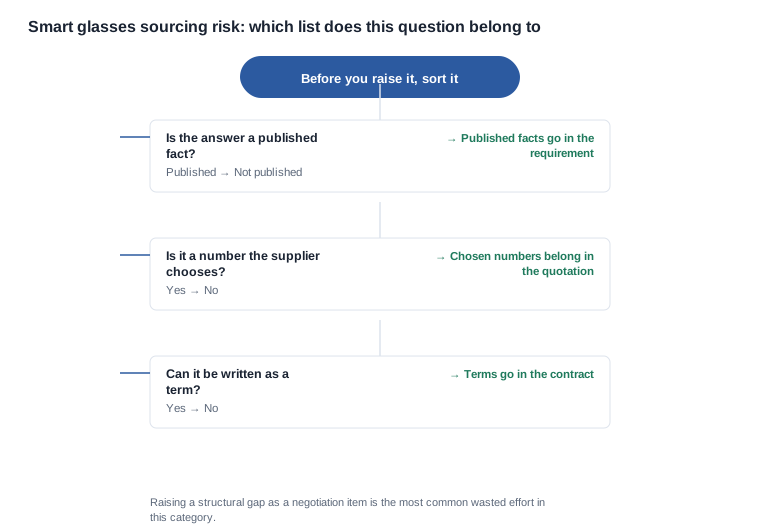
The practical value of this test is that it changes the tone of the conversation. A buyer who arrives with twenty questions sorted this way arrives with four specification rows, six commercial parameters and ten contract terms. The first two groups are comparisons, and the third group is drafting. It is a materially shorter meeting, and the supplier's answers are directly comparable between two candidates because the same twenty items were asked of both.
The structural half, and why negotiation fails on it
The productive move on the structural list is not to ask for the value. It is to change what happens in the absence of the value.
The most common failure in this category is a buyer demanding a number where none exists, treating the refusal as a supplier problem. It is not a supplier problem. It is the correct answer to a badly framed question, and the buyer who reads it as obstruction has spent a relationship on a question that could never have been answered.
There are four legitimate ways to handle a structural gap, and they are worth ranking because they are not equally strong.
First, substitute the measurement. If the sensor model is not published, the buyer can specify a measured performance requirement instead — a field of view measured in degrees, a frame rate measured on a captured clip, a minimum separation distance recorded on a test unit. A measured requirement is enforceable and it does not require the supplier to have published anything. It does require the buyer to write a test method, and that is a cost, but it is the cost that converts a gap into a specification.
Second, substitute the sample. If a value cannot be obtained on paper, it can be obtained on one unit. This is the correct use of the sample order, and it is a use that is frequently missed: most buyers test the sample for the features they can already see, and the sample's real value is in the rows that are not published. A buyer who tests the sample against the published rows has confirmed what was already known. A buyer who tests it against the gap list has converted the gaps into evidence.
Third, substitute the caveat. Where neither a measurement nor a sample can settle it, the gap can be written into the listing description as a limitation rather than as a claim. The practical version of this is a claim-to-document map: every statement in the product listing has to be traceable to something the supplier can evidence. The value of this control is that it moves the risk from the goods, which cannot be corrected at retail, to the description, which can.
Fourth, accept it in writing. Some gaps are genuinely acceptable, and recording that is better than leaving it open. A field of view that is not published is acceptable if the product is not sold on field of view. The four camera models whose charging method is not published are acceptable if the accessory set is defined by the configuration string rather than by the interface. An accepted gap with a named owner is a controlled risk; the same gap left on the register is an unmanaged one.
The ranking matters because the first three reduce risk and the fourth only relocates it. A buyer who reaches for the fourth option first has converted a specification problem into a legal one, and legal problems cost more to solve.
Turning an unpublished specification into a written commitment
The second discipline of advanced risk management is the conversion itself, and it has a form that works: every unknown either becomes a number, a test, a caveat or a contractual obligation, and an unknown that stays unknown has been accepted by accident rather than by decision.
The conversion has four steps, and each one has a completion test. The completion test is not optional, because a request without one produces a paragraph of context rather than an answer.
- Name the gap in one line, in the vocabulary of the product. "Sensor model for the CY03" is a gap that can be worked. "Camera quality" is not a gap, it is a complaint in advance. The rule for the naming test is that somebody else could read the line and know exactly what document would close it.
- State who would know the answer. This is usually the supplier's engineering or compliance function, and naming it in the request is what stops the request from circulating as a general enquiry and returning as a general answer.
- Choose the closing mechanism before asking. Value, test, caveat or obligation. Choosing it afterwards, once the answer has arrived, is how a buyer ends up accepting a number that does not fit the specification.
- Record it with an owner and a review date. An unknown on a register with no owner is a risk that nobody is managing, and a risk with no review date is one that will still be open when the programme ends.
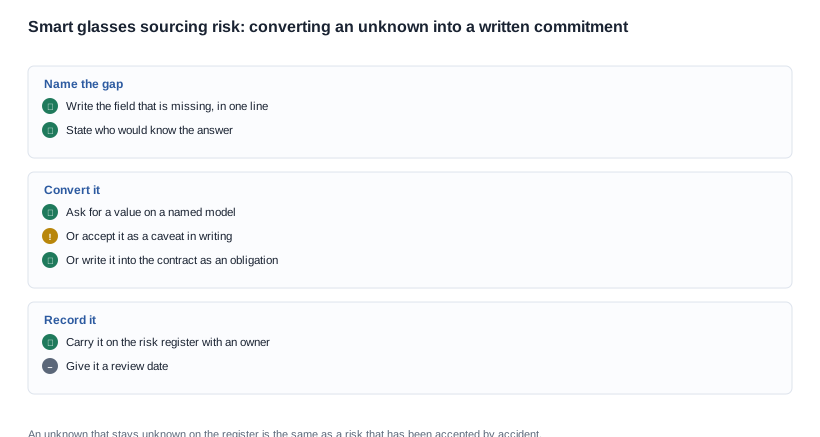
The third row of that checklist is where most programmes fail, and it fails quietly. A gap converted into a caveat disappears from the register, which looks like progress and is not. The conversion to a caveat is only complete when the caveat appears somewhere that a customer, a listing editor or an importer will actually see. A caveat that lives only in a procurement document has converted a technical risk into a commercial one, and it has done so invisibly.
What conversion looks like in practice
The published catalogue is a good source of worked examples because the gaps are visible in it. Take the charging method on the four camera models where it is not published. The conversion is not "is it magnetic or Type C" — that question asks for a fact that does not exist in the record, and it invites an answer the buyer cannot verify. The conversion is: the configuration string names the accessory set, the accessory set is listed on the order, and the order carries a clause that any change to the accessory set is a configuration change with a notice period and a re-approval right. The buyer's risk moves from "what interface is it" to "the interface cannot change without telling me", which is a risk a buyer can actually manage.
The same conversion applies to the unit weight. The catalogue publishes one weight in the range, for the MT6 glasses body, and it is carefully specified: 158 grams including the 265 mAh cell and the camera, excluding the 1200 mAh foldable charging case, whose own weight is not published. A buyer who wants a weight for a different model cannot have a catalogue value and should stop asking for one. The conversion is to specify the shipped configuration's gross weight as a requirement with a measurement method and a tolerance, and to have the first production lot weighed against it.

Watching for a change in the supplier's documentation habits
The third discipline is observation, and it is the one that separates an advanced buyer from a diligent one. Diligence is what happens before the order. Observation is what happens after it, and it is where the information that was not available at the start of the programme becomes available.
Documentation habits change, and they change for reasons that have nothing to do with the buyer's order. A quality manager leaves, a certification body changes, a customer programme ends and a supplier deprioritises a market, a laboratory accreditation lapses, a subcontractor changes. None of these is a signal about the buyer's goods specifically, and each of them is a signal that the documentary position a buyer relied on three months ago may no longer hold.
Four habits are worth watching, because each one degrades gradually and none of them announces itself:
- The date and the holder on the document set. A document that used to name a legal holder and a validity period and now names a department is a downgrade, even though the file is the same size.
- Whether the model designation on a document matches the model designation on the order. A supplier that used to name the exact model and now names a family has widened its scope, and a wider scope means a smaller guarantee.
- The interval between a request and a document. A supplier whose file sets used to arrive in the first round and now arrive after two rounds of chasing has changed how it assembles documents, and an assembled file set is not a record set.
- Whether the answer arrives in writing. An answer that used to be a document and now arrives as a statement in an email is still an answer, but it can no longer be attached to a shipment.
The detection method is deliberately cheap. The same short questionnaire goes out on a fixed interval, with the same completion tests, and the answers are compared against the previous round. The comparison is the product; the questionnaire is just the instrument. A supplier who notices that the same questions are being asked every quarter will keep the answers consistent, and a supplier who cannot keep them consistent has told the buyer something useful about the order that is coming.
There is also a version of this that applies to the buyer's own operation, and it is worth stating because buyers are often the last to notice. The risk register itself is a documentation habit. A register that was written once and never revisited is a register that has stopped describing the programme, and the signal that it has stopped describing the programme is that the entries no longer match what is actually happening in the schedule.
What Cynrin can and cannot close on our own side
Here, the distinction between structural and negotiable risk is worth making explicitly to a buyer, because it saves both sides an argument that cannot be won.
We publish the electrical rows and the resolution tier for every model in the range, the charging method for twenty-four models, the case capacity for the five camera models where it is published, the ingress marking for the two models that carry it, the charge time for all twenty-eight models, and the unit weight for the one model where it is published. We publish these because they are the rows a buyer can compare and because a published row is a row that does not need to be negotiated.
What we do not publish, and what is therefore a written request rather than a lookup in our material: sensor models, fields of view, video formats and frame rates for any camera model; microphone pickup distances and noise reduction methods; ingress test report numbers; certificate numbers, issuing bodies and validity dates; the Bluetooth version for any camera model; unit weights for every model except the MT6; cycle life ratings, defect rates and reliability reports; production capacity, line count and production lead times; unit prices, minimum order quantities, warranty terms, the storage path and the AI implementation. We would rather say that a number is not available than present one we cannot trace to a document, because a number that cannot be traced becomes a dispute at exactly the moment it matters.
The sourcing risk negotiation article covers how the negotiable half is put to a supplier, and the certification checklist pillar covers the documentary route per market. The procurement risk pillar sets out the wider framework. Send us the model, the configuration and the destination market, and we will tell you which items are structural on our side, which are negotiable, and which we will need to request before we can answer them at all.


