
Smart glasses sourcing risk that reaches the customer as a quality defect
The short answer on quality implications
A sourcing risk in this category becomes a quality problem at the moment the buyer discovers it cannot tell, from the paperwork, whether the goods in the carton are the goods that were approved. Until that point the risk is commercial: a price, a date, a clause. After it, the risk is a defect, a return, a review of the supplier's change history and a channel conversation you cannot win. The practical consequence is that every specification row you leave open at quotation stage has a quality consequence later, whether or not anyone wrote that down. Three moves prevent most of it. Freeze the configuration as a string that can be repeated back to you, attach the weight, the charge method and the camera resolution tier to the order rather than to a brochure, and put a written approval route in front of any component substitution. If a supplier cannot accommodate those three, the gap is not a paperwork problem — it is the operating method of the factory, and it will be visible in your first shipment rather than in your first sample.
The buying task behind a quality question
The reader is a procurement manager working for the brand, a channel buyer or an importer, and the situation is nearly always one of three: a quotation to compare, a new programme to open, or a market to enter with a date that has already been promised to somebody else. In each of them the underlying question is the same. It is not which product is better, because a better product that is not the unit the buyer approved is a worse programme. It is which of the two or three suppliers in front of you can build the configuration you have written down, repeat it on the next build, and show you the evidence for it — and what happens to your schedule and your channel if they cannot.
What the buyer is actually managing is downstream damage rather than a price gap. The fear under the enquiry is a lot that is not the sample that was signed off, a paper trail that halts the consignment at a frontier, a first batch that becomes a returns issue nobody budgeted. Sourcing risk matters commercially precisely because of its quality implications: the cheapest quotation in the comparison table is frequently the one that has not yet been charged for the specification work, the sample discipline or the inspection that would have made the goods match the order.
That is why the sourcing risk pillar is a decision document rather than a category, and why this article works in the order a buyer needs it: which rows decide quality, where the order goes quiet, what to ask, what a defect costs, and where our own published specification ends. The shortlist is built from the criteria set out below rather than from the headline price, because the criteria are the part that survives contact with a shipment.
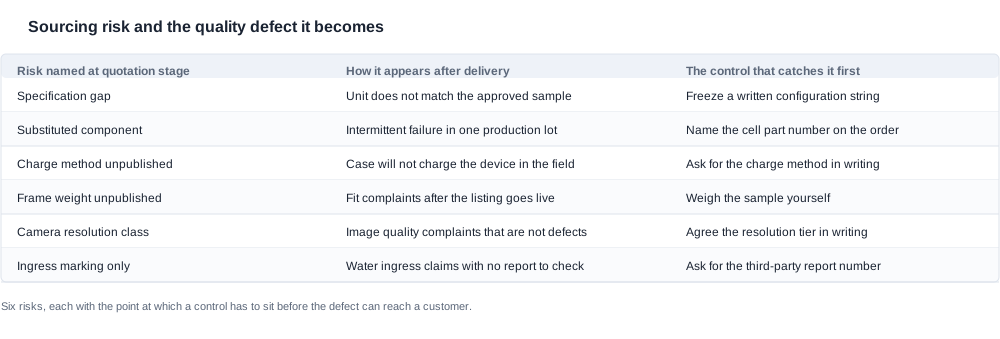
The table above is the working set. Each row names a risk in the language a buyer actually meets it, shows the form it takes when it reaches the customer, and names the control that has to sit in front of it. None of the controls is expensive. All of them are much cheaper before the order than after it.

The specification rows that decide whether a risk becomes a defect
How each attribute is tested and the line it has to meet
The rows below are written the way a supplier can answer them in writing, because a specification question answered verbally reappears at the goods-in counter with nothing attached. How to evaluate a row is to insist on the measurement condition before the number, and how to compare two quotations is to set them out in the same order before the figures are compared at all. The fourth column matters more than the second: an answer that is wrong in a predictable way is a negotiation, whereas an answer that is vague is an open row that will be closed by whoever receives the shipment.
| Attribute | How it is measured | The line it has to meet | How an inflated figure shows up |
|---|---|---|---|
| Configuration identity | Ask for the model, the colourway, the battery and the case as one repeatable string. | The same string comes back unchanged on the next build. | A family name with the variants described in prose. |
| Unit weight | Weigh the delivered sample on your own scale, with the case removed if a case ships in the box. | The figure on the order matches the sample within your stated tolerance. | A figure quoted for the whole retail package. |
| Charge method | Ask whether the interface is magnetic or Type C, or whether the method is simply not stated. | The method is named, or the gap is named as a gap. | A case capacity published without any charge method. |
| Camera resolution tier | Ask which published tier the ordered model sits in. | The tier is written into the order and the listing. | A phrase such as "HD camera" against a published pixel figure. |
| Ingress marking | Ask for the report behind the marking and the models it covers. | The report number is given and the model list is attached. | A catalogue marking with no third-party document. |
| Component substitution | Ask what may change without written buyer approval. | Nothing changes without written approval, and the clause names the parts. | A free substitution clause with no list attached. |
| Defect definition | Ask what counts as a defect and what happens on a confirmed one. | The definition and the remedy are in the order. | The remedy left entirely to the warranty text. |
| Sample-to-shipment identity | Compare the first production unit against the approved sample. | The unit matches the sample part for part. | A sample that was assembled from a different build. |
Two of these rows need care before they can be used at all. The weight row is the clearest example: our catalogue publishes a unit weight for one model in the whole range — the MT6, at 158 g for the eyewear body, which includes the 265 mAh battery and the camera and excludes the folding charging case, whose capacity is 1200 mAh and whose own weight is not published. Because the case and the device have separate weights, a buyer who receives a single number has to ask which of the two was measured. The same applies to the charge method row: in this category the charge method is magnetic on seventeen models, Type C on seven, and simply not published on four — and the four in that last group are camera models that do publish a case capacity, so the gap is in the method rather than in the box.
Two rows that cannot be compared between suppliers without care
The pixel tier is the second. The catalogue places eight camera models in the 8 MP tier and three in the 13 MP tier, and that split is a published fact that can be quoted directly in a comparison. What it cannot be used for is inferring anything else: the tier does not tell you the field of view, the video format, the frame rate, the storage path, the low-light behaviour or the unit weight, because none of those rows is published for any camera model in the range. A buyer who compares two quotations on the tier alone is comparing the one number both suppliers were able to publish, while every number that actually drives the customer complaint sits unpublished on both sides.
This is the general form the gap takes. Some rows are settled by the catalogue and can be treated as a specification; others are not published for any model and have to be requested from the supplier in writing; a third group — the lead-time rows, the price rows, the capacity rows and the certification rows — are outside what a catalogue publishes at all, and the correct treatment for them is not to assume a value but to turn them into a question with a named owner and a date. The documentation requirements article sets out the request format for that third group in detail.
Where the order goes quiet between a named risk and a returned unit
The four failure patterns that recur in this category

The failures in this category are rarely exotic and almost never technical in the sense the buyer fears. They are the same four shapes, in different programmes, and each one is a quality consequence of a commercial decision that was never written down. The red flags for all four are visible in the quotation, long before they are visible in the goods, and each of them is far cheaper to close before you order than afterwards.
The substitution that was approved by nobody. A component with a single qualified source was quietly replaced with a part from a second source, because the first source could not meet the date. The goods are within the published specification and the defect appears as intermittent behaviour in one lot. The control is the clause that requires written buyer approval for a named list of parts, plus a change-notification commitment with a response window measured in days rather than weeks.
The sample that was not the build. The unit that passed the buyer's evaluation came from a stock batch rather than from the production line, so it was made under different conditions from the units that arrived later. The control is a written instruction that the sample must be drawn from, and labelled as coming from, the first production run — and a golden sample retained at the factory for the life of the order.
The catalogue figure that was read as a test result. A marking published in the catalogue was treated as a certified performance figure. In this category the published material carries an ingress marking on the V06 and the S7, and it does not publish a per-model certification row or any CE, FCC or RoHS document reference; a buyer who treats the marking as a report number has no document to check. The control is to ask for the report behind the marking, with its model coverage, before the mark appears in your own listing copy.
The remedy that was never written. A confirmed defect was returned, credited at the supplier's discretion, and the unit went back into stock. The control is a definition of defect, a stated remedy, and a named process for a confirmed batch — none of which requires the supplier to accept a new obligation, only to state the one it already has.
None of the four is a reason to change supplier. Each is a reason to put a line in the order and a name against a document, which is a much cheaper outcome than a lesson learned after the units are in a customer's hands.

Gates that convert a commercial risk into a quality check
What to ask, and how to read what comes back
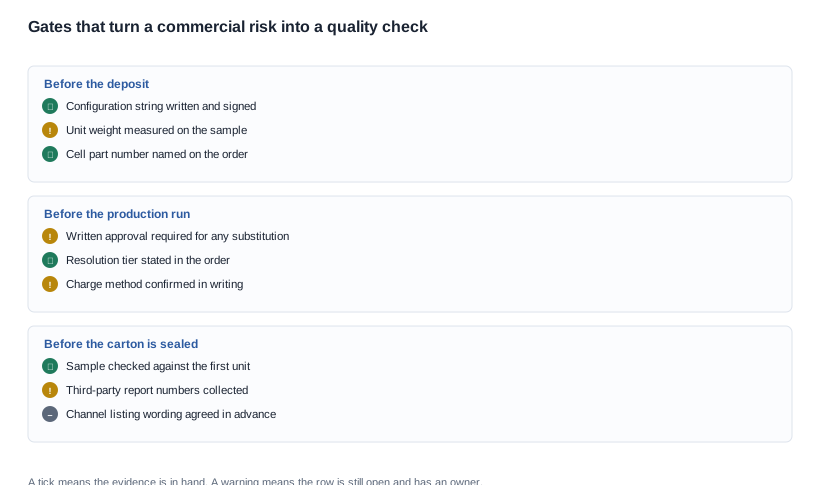
Verifying a supplier in this category is a document exercise with a physical check at the end, and it works when it happens before the configuration is frozen rather than after the first carton is sealed. The questions to ask are set out below in order, and the order matters more than the number of them, because each answer narrows the next one.
-
Ask for the configuration as a single string — model, colourway, battery, case, and the charge method in the same line. If the answer takes more than one paragraph, it is not a configuration. The test is whether you can paste it into the purchase order and the supplier can paste it into the production sheet without either side editing it.
-
Ask for the weight of the eyewear body and, separately, the weight of the charging case if one ships in the box. A single combined figure is an unusable figure, because it cannot be compared against anything and it hides which of the two is out of range. Where a figure is not published, the answer should say so rather than substitute a typical value.
-
Ask which published camera tier the ordered model sits in, and then ask separately for the field of view, the video format, the frame rate and the storage path. Expect that the second set is not published, and write the question into the order as an open row with a due date. The point is not to obtain the numbers before the order; it is to make their absence visible while it is still cheap to act on.
-
Ask what may be changed without written approval, and ask for the list of parts to which the answer applies. A general substitution clause with no list is worse than no clause, because it removes your ability to detect a change rather than granting you the ability to refuse one.
-
Ask for the report number behind any marking that is going to appear in your own product copy, with the models it covers, and check the model list against the models you are ordering. If the answer is a claim rather than a document, treat the mark as unverified in your listing and keep it out of the specification.
-
Ask what the supplier will do with a confirmed defect, in writing, and ask the same question about a suspected one. The two answers are usually different, and the difference tells you whether the quality system runs on inspection or on argument.
-
Take delivery of one unit from the first production run and compare it against the approved sample yourself — markings, connectors, the configuration string and the declared weight — before the balance of the shipment moves.
Run all seven against the same documents you intend to sign, and run them before the order rather than after the first shipment. The value of the sequence is that it turns a risk register from a list of concerns into a set of evidence you have seen. Where the answer is a document, ask for it in the form it will be kept in: a dated file with a named owner, not a photograph on a phone.

A worked programme in which the defect was named too late
One hypothetical case, step by step
This is a reasoning exercise written as a hypothetical case rather than a client project, because the value of the sequence is in the order of the reasoning and no client, order or figure is claimed here.
The scenario: a brand-side buyer is opening a camera glasses programme for sale into two markets, with a first order in the low thousands of units and a launch date already committed to a channel partner. Two suppliers have quoted. The catalogue under discussion is the one published on this site, and the buyer's problem is that the two quotations are not comparable as they stand.
Step one is configuration. Supplier A quotes a model family and a unit price. Supplier B quotes a model with a named case capacity and a named charge method. B's quotation is longer, and at first sight the cheaper number belongs to A. But A's price does not state whether the case ships in the box, so the two prices are not for the same set of goods and cannot be compared.
Step two is the rows that decide quality. The buyer asks both suppliers for the configuration string, the unit weight, the charge method and the camera tier. On the tier the comparison is straightforward, because our catalogue publishes it: eight camera models sit in the 8 MP tier and three sit in the 13 MP tier, and both suppliers' quoted models are named. On weight, only one of the two can answer, and the answer it gives covers the retail package rather than the device.
Step three is the open rows. The field of view, the video format, the frame rate, the storage path and the ingress report number are not published for any model in the range. The buyer therefore cannot close them by comparing suppliers; the correct move is to write them into the order as named gaps with a response date attached to each, so that the responsibility for closing them sits with the party that can close them.
Step four is the decision. The buyer concludes that the two quotations differ by more than price — they differ in how much of the specification is controlled — and takes the lower quotation only after the configuration string, the weight basis, the substitution clause and the defect remedy have been written into the order. The commercial result is that the lower headline price is replaced by a comparable one, and the quality result is that the first shipment no longer contains a defect nobody had named.
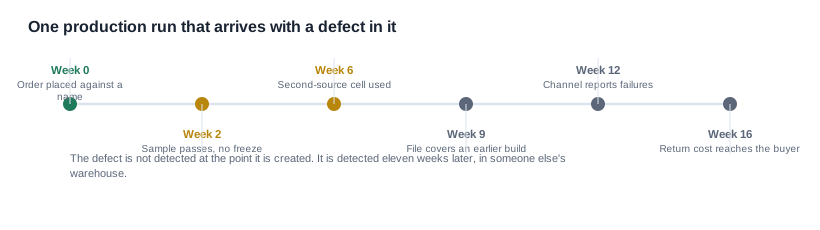
The timeline above is the same programme drawn against weeks rather than steps, and it shows the structural point of this article. The defect is not detected at the moment it is created. It is detected in a warehouse that does not belong to either party, eleven weeks later, by a customer who has no relationship with the factory at all.
The clauses that decide who carries the cost
The total cost of a quality failure in this category is rarely the price of the returned unit. It is the channel conversation, the relisting, the working capital tied up while the replacement is built, and the schedule that no longer fits the launch. The commercial side of this question is who pays when the risk fires, and the clauses worth negotiating are specific. The refund condition on the deposit matters because it sets the point at which the buyer's exposure stops growing. The cost split when a compliance requirement changes mid-programme matters because a change in a regulatory requirement does not silently become the buyer's cost. The re-approval route for substitutions matters because it is the difference between a detectable change and an undetectable one. The definition of a defect and its remedy matter because they decide whether a returned unit becomes a credit or an argument. The notice period for releasing a delivery slot matters because capacity that has been reserved for you and then released is not recovered by asking later.
The thing worth noticing is that a supplier carrying a defect allowance, an inspection window and a slot release notice is carrying a quantified risk, and that shows up in the unit price. A supplier carrying none of it is cheaper, and the difference between the two prices is frequently smaller than the cost of one bad shipment. Comparing quotations on the headline unit price alone, without checking which clauses are present on each side, systematically undervalues the quotation that protects you. The quality consistency article covers what that consistency costs in practice.
Two of these clauses are routinely refused and are worth pushing on, because a refusal is usually a statement about the factory's process rather than about the risk: the written re-approval route for substitutions, and the rule that a regulatory change does not automatically transfer to the buyer. Where a supplier declines both, the risk has not gone — it has been moved onto your balance sheet, and the correct response is to price it.
Where our published specification ends and yours begins
What we publish, and what we will not fill in
Stated plainly: the published rows are the specification, and the unpublished rows are questions we would rather you asked than an estimate we made on your behalf. We publish the per-model electrical data, the resolution tier for each camera model, the published charge times, the catalogue ingress markings and the model designations. We do not publish unit prices, minimum order quantities, production lead times, sensor part numbers, field of view, video format, frame rate, storage path, the acoustic figures, the photochromic response figures, certification numbers with their model coverage, or any third-party report number behind a marking. Those rows are written as Not published, and we will not fill an open row with a typical figure from general industry data, because a typical value is how a product ends up failing its own specification sheet three months after launch. The common pitfalls in this category are not in the product; they are in the contract language that leaves an open row open. Those are written as Not published, and we will not fill an open row with a typical figure from general industry data, because a typical value is how a product ends up failing its own specification sheet three months after launch.
There is one weight in the whole published range, and it needs its context. The catalogue publishes the MT6 eyewear body at 158 g, including the 265 mAh battery and the camera and excluding the folding charging case; the case capacity is 1200 mAh and the case weight is not published. No bare frame weight is published for any model in the range, and we would rather say that than quote a figure you cannot verify. The same honesty applies to certification: the catalogue carries a company-level export certification page and does not publish a per-model certification row, and it does not contain CE, FCC or RoHS documentation references for any model. Those are documents to request in writing from a supplier, and the request itself is the leverage.
Running the same configuration string past two suppliers
Take the configuration you are actually contemplating and write it as one string — model, colourway, battery, case, charge method. Send that string to two suppliers and ask each of them to return it unchanged, together with the unit weight, the weight basis, and the written list of parts that may change without your approval. Where a supplier cannot answer in writing, that answer is the most useful information in the comparison. Send us the models, the quantities and the target market and we will tell you which configurations exist, which of them are settled by the published data, and which rows are ours to close and which are yours.
Related reading
- Camera and audio smart glasses range
- Documentation requirements for sourcing risk
- What quality consistency actually costs
Send the configuration, the quantity and the market, and we will say which parts of the risk are settled and which are yours.


