

Smart glasses sourcing risk: the order each red flag is tested in
The short answer on red flags
A red flag is not a lie. It is a gap that has not been closed, and in a sourcing conversation it almost always shows up before the goods do. The discipline that works is narrow: name the signal, ask the one question whose good answer would close it, and read what comes back for what it covers rather than for what it asserts. Three signals account for most of the trouble in this category. A price with no configuration attached, so the two quotations in front of you are not for the same goods. A compliance claim with no document behind it, so there is nothing to check and no scope to compare. A date given as a range, so the launch date is a belief rather than a reservation. None of the three requires the supplier to be dishonest, and each of them can be closed in a single exchange of messages if you ask about it while the order is still cheap to change. The reverse is also true: a supplier who answers all three in writing, with the basis of the figure attached, has told you more about its operation than a factory profile ever will.
The buyer who meets these signals, and what each one costs
The reader is a brand-side procurement manager, a channel buyer or an e-commerce seller who is holding two or three quotations and has to choose between them, or who is opening a programme and has to decide what to insist on before anything is quoted. The situation is always the same shape, whatever the product: the specification is not yet fixed, the schedule is fixed, and somebody downstream is waiting for the goods.
What makes sourcing risk hard to handle is that the signals are cheap to ignore and expensive to close later. A quotation without a configuration can be reissued in half a day at quotation stage and can cost a full production cycle once the tooling is committed. A compliance claim with no document behind it can be resolved with one email before the deposit and can stop a consignment at the border afterwards. A date given as a range can be converted into a slot against a written order in a week, and cannot be converted into anything at all once the channel has committed its own marketing. So the questions in this article are not about detecting bad suppliers. They are about detecting incomplete information early, while the cost of closing it is still a message rather than a shipment.
The sourcing risk pillar sets out the wider framework. This article is the field version of one part of it: the signals themselves, where they appear, and what to do with each.
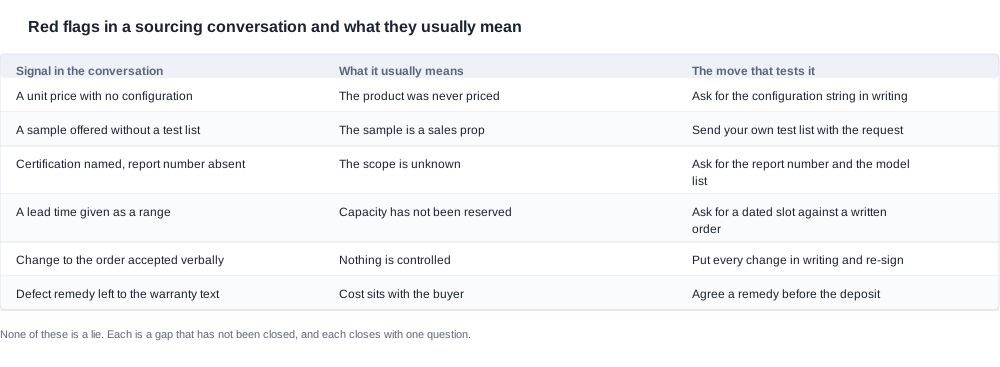
The table above is organised the way a buyer actually meets these things: the signal, what it usually means, and the move that tests it. Every "move" is a question, and every question can be answered in writing inside a working day.

Reading a documentation answer instead of the claim attached to it
The four questions that separate a real answer from a fluent one
Most sourcing risk in this category hides in the gap between a confident sentence and the document behind it. Suppliers are not being evasive; a fluent answer is simply what a commercial conversation rewards. The way to tell is to move the conversation from assertion to scope, and there are four questions that do that reliably.
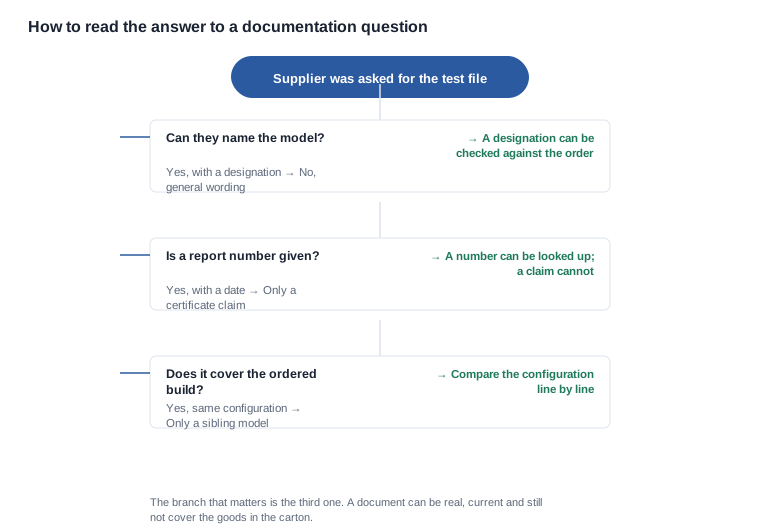
Does the answer name a designation? A document covers a specific product, a specific configuration and sometimes a specific cell. "We have the paperwork" is not a designation. "The summary covers the 13 MP variant of the model you quoted" is. The test is whether you can write the answer onto the purchase order and check it against the goods when they arrive. A supplier who cannot name the designation has not done the work, and their price will move later.
Is there a number, a date and a model list? A claim cannot be checked; a document can. Ask for the report number, the issue date, and the list of models the report covers — and then compare that list against what you are ordering. Documents get reused across configurations more often than anyone intends, and the reuse is usually invisible from the outside.
Does it cover the ordered build rather than a sibling? This is the branch that matters most, because a document can be entirely genuine, entirely current and still not cover the goods in the carton. The camera models in this catalogue illustrate why: eleven camera models are published, and they are not interchangeable — eight sit in the 8 MP tier and three in the 13 MP tier, with the L1 Pro and the L2 Utral, and the V03 Pro and the V03, differing in ways that change the document position. When you ask for a file, ask which of the published models it was written for.
What is not covered, stated as an open row? This is the question most often skipped, and it is the one that protects the buyer. Ask what the supplier cannot provide, rather than only what it can. The answer should be a list: the ingress report number behind a catalogue marking, the field of view, the video format, the frame rate, the storage path, the unit weight, the certification report references. A supplier who names the open rows is telling you the truth about the file. A supplier who names none of them is telling you the file is a description rather than a document.
Work the four questions in that order, because each one depends on the answer to the one before it. And when the answer is a document, ask for it in the form it will be kept in: a dated file with a named owner, not a photograph on a phone that will be unreadable in six months.
Where in a programme each red flag becomes visible
The three stages of a programme and what is still cheap at each one
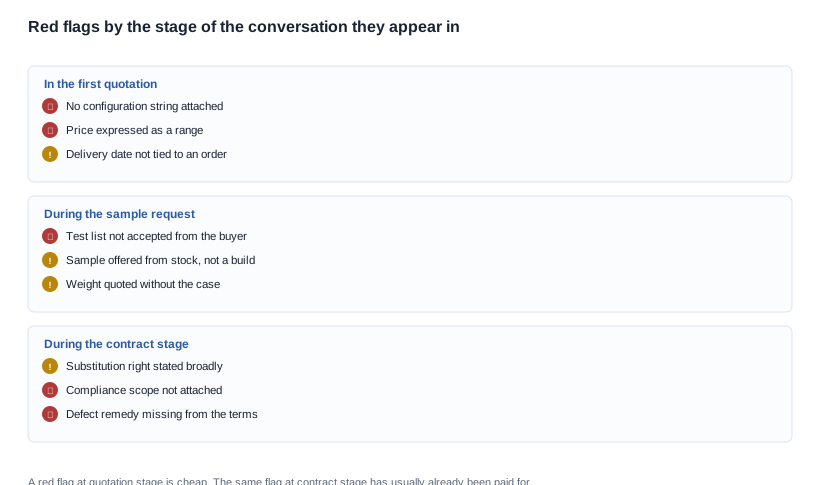
The same programme produces signals at three stages, and the cost of ignoring them rises steeply between the stages. The useful habit is to read the signals at the stage where they are still cheap, which means reading the first quotation carefully rather than the first shipment.
At quotation stage, a signal is almost free to close. A price with no configuration is fixed with a message. A missing case specification is fixed with a question. A certification claim with no reference is fixed by asking for the document. Almost nothing has been committed at this point, so almost every question can be treated as routine rather than adversarial. The trap is that buyers often read the quotation stage as preliminary and defer the detail work to the contract stage, which is exactly backwards: detail questions are cheap in the quotation and expensive in the contract.
At sample stage, the cost of an open row has risen from a message to a week, because the sample itself takes time and because a specification discovered at this point may require a second sample. The signals that matter here are about identity rather than data. A sample offered from stock rather than from a production build tells you nothing about the build you will receive. A sample without a written test list tells you nothing about whether it was tested against anything. A sample whose stated weight includes the charging case tells you the figure will not be comparable with a figure quoted the other way round.
At contract stage, the signals are no longer gaps but terms, and they are usually read quickly because the commercial pressure is on the other side of the document. A substitution clause with no list attached. A defect remedy that defers entirely to a warranty text. A certification scope described in a sentence rather than attached as a document. Each of these is fixable, but each now costs a clause rather than a message.
The ordering rule that follows is simple: settle what has to be true before production begins, then work backwards to the commercial terms. A buyer who reverses that order negotiates the price first and discovers the specification afterwards, which is the worst of both.

The signals that recur most often, and what they cost to leave open
Four recurring signals and the clause that closes each one
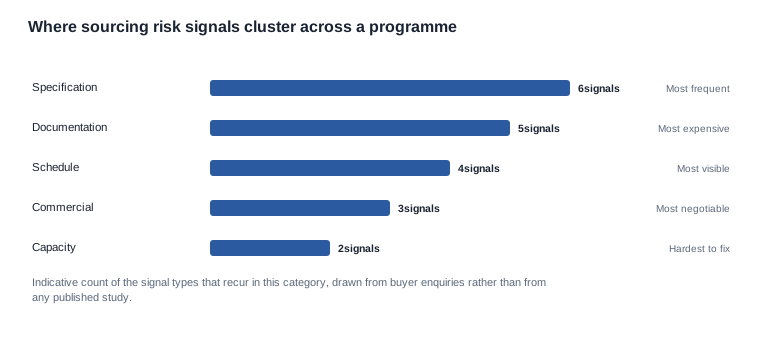
Four signals account for most of the exposure in this category, and each has a specific closing clause rather than a general reassurance.
A price that changes when the configuration is named. The supplier's first number assumed a default build, and naming the configuration moves it. That is normal commercial behaviour rather than a red flag in itself, and it is manageable — but it is a red flag for a different reason. If the number only exists under a default assumption, then the buyer's own requirement is the thing that moves the price, which means the cost of the specification is real and should be in the order rather than discovered at invoicing. The clause to ask for is one that fixes the price against a written configuration string, so that the string and the price move together from then on.
A charging case named without its capacity and without its charge method. In this catalogue, "a case" is at least four different things. Five camera models publish a case capacity — the L1 Pro and the CY05, and the CY03 — each at 1400 mAh, the L2 Utral at 900 or 1400 mAh, and the MT6 as a folding case at 1200 mAh. Two more, the KY06 and the MT5, publish a case without publishing its capacity. Three camera models have no case row in the catalogue at all, which is not the same statement as having no case. One, the V03 Pro, is published explicitly without one. A quotation that says "with charging case" therefore tells you nothing about what arrives in the box, and the clause to ask for names the case as a line in the configuration, with its capacity and its charge method where both are known.
A weight quoted without its basis. There is one published weight in the entire range, and it needs its context to be usable: the MT6 eyewear body at 158 g, which includes the 265 mAh battery and the camera and excludes the folding charging case, whose capacity is 1200 mAh and whose own weight is not published. Any figure quoted without a basis — device, body only, or full retail package — cannot be compared with any other figure. The clause is a requirement that the weight be stated with its basis and measured on the sample.
A compliance statement with no document. The catalogue carries a company-level export certification page and does not publish a per-model certification row, and it contains no CE, FCC or RoHS documentation references for any model. So a supplier who writes that the product is "CE and RoHS compliant" has not given you anything you can check, and a buyer who carries that sentence into their own product copy has published a claim they cannot defend. The clause is a requirement that the document be provided, with its number and its model coverage, before the mark appears anywhere in the buyer's listing.
None of the four is exotic, and none of them is a reason to change supplier. Each is a reason to put a line in the order and a name against a document, which is a far better outcome than a lesson learned after the units are in someone else's warehouse.

Turning a signal into a priced decision
A hypothetical quotation read flag by flag
This is a reasoning exercise written as a hypothetical case rather than a client project. No client, order, supplier or figure is claimed; the model, the quantity and the market are assumed so that the reasoning can be followed.
The scenario: a channel buyer is opening a camera glasses programme for a European marketplace listing, with a first order in the low thousands of units, a channel launch date already fixed, and two quotations in hand. The decision to work through is which quotation to shortlist and what to require before a deposit.
The first quotation names a model family and gives a unit price with no battery, no case and no charge method. The second quotation names a specific model, gives a case capacity and a charge method, and gives a date as a range rather than a slot. On the headline number, the first is cheaper. Read flag by flag, the first quotation has three: a price with no configuration, a case that may or may not exist in the box, and no basis for the weight. The second has one: a range where a slot is needed.
The decision the buyer makes is not to accept or reject either. It is to send both suppliers the same configuration string — model, battery, case, charge method — and ask for the price against it, and to ask the second supplier for a dated slot against a written order rather than against a quotation. Both requests are cheap. The result is a comparison that is actually a comparison, because both quotations now describe the same goods.
The second stage is the documentation. The buyer asks for the files and, with them, the list of what cannot be provided. One supplier returns the open rows honestly; the other returns a single compliance sentence. The honest answer is the more useful one, because the buyer now knows exactly which questions to put into the contract and which will have to be closed with evidence the supplier has to obtain. The clause that follows from the open rows is the one that carries the quality risk: substitution, the defect definition and its remedy, and the notice period for releasing a reserved slot.
The third stage is the commercial one. The two quotations differ by less than the cost of one replaced production run, which is the calculation that decides the question. The buyer takes the quotation whose clauses match the risks the open rows describe, and treats the price difference as the premium for a controlled programme.

What the price difference between two quotations actually contains
The comparison above only works once the quotations describe the same goods, and once you can see which clauses are present on each side. That second point is where most comparisons go wrong, because the headline unit price is the one number on the page that is always legible.
A quotation that carries a defect allowance, an inspection window, a written change-notification commitment and a slot release notice is carrying a quantified risk, and that risk is priced into the unit price. A quotation that carries none of them is cheaper, and the difference between the two is often smaller than the cost of a single bad shipment. Comparing on unit price alone systematically undervalues the quotation that protects you, and the trade-off is invisible in the document that quotes it. The way to make it visible is to list the clauses side by side before the prices, so the comparison shows what each price is buying.
The clauses worth arguing for, in this order, are these. The refund condition on the deposit, because it sets the point at which your exposure stops growing. The re-approval route for substitutions, because a change nobody has to report is a change nobody can detect. The definition of a defect and the remedy, because it decides whether a returned unit becomes a credit or an argument. The rule that a change in a regulatory requirement does not silently become the buyer's cost. The notice period for releasing a delivery slot. And the price consequence of a substitution, which is either an explicit mechanism or an argument you will have at the worst possible moment.
Two of these are routinely refused, and a refusal is usually a statement about the factory's operating method rather than about the risk itself: the written re-approval route for substitutions, and the regulatory change clause. Where a supplier declines both, the risk has not disappeared, it has been transferred onto your own balance sheet, and the correct response is to price it rather than to argue further.
What our published material can and cannot be used to judge
The rows that are settled, and the rows that are only questions
The published catalogue is the part of a supplier's answer that can be checked, and everything outside it has to be requested in writing rather than inferred. We publish the per-model electrical data, the resolution tier for each camera model, the published charge times, the charge method where the catalogue states one, the case capacities where the catalogue publishes them, the catalogue ingress markings on the V06 and the S7, and the model designations themselves.
What we do not publish, and will not estimate, is the other half. Unit prices, minimum order quantities, production lead times, sensor part numbers, field of view, video format, frame rate, storage path, acoustic figures, photochromic response figures, certification numbers with their model coverage, and any third-party report number behind a marking. Those rows are written as Not published in our material, and a red flag in a supplier's quotation that touches one of them is answered by requesting it in writing.
There is also a boundary worth naming, because it is the one that gets misread most often. The catalogue carries a company-level export certification page, which is a company capability rather than a per-model statement, and it does not publish a per-model certification row for any model in the range. A supplier who quotes certification in a general sentence, and a buyer who copies that sentence into a product listing, have both created a claim that cannot be defended with a document. We would rather tell you that the row is open than let it be closed by assumption. If a document exists, ask for it and we will say whether it covers the configuration you are ordering.
The red flags, this week
Take the configuration you are contemplating and write it as a single string — model, battery, case, charge method. Send that string to two suppliers and ask each to return it unchanged, together with the unit weight and the basis of that weight, and the list of parts that may change without written approval. Where a supplier cannot answer in writing, that answer is the most useful information in the comparison. Send us the models, the quantities and the target market, and we will tell you which configurations exist, which are settled by the published data, and which rows are ours to close and which are yours.
Related reading
- The practical advice — sourcing risk practical advice
- The register template — sourcing risk template
- The framework in use — procurement risk management
Send the configuration, the quantity and the market, and we will say which parts of the risk are settled and which are yours.


