

A smart glasses sourcing risk register is not a list of worries. It is a document with a fixed set of columns, each column designed to break a specific ambiguity, and each row designed to be closed rather than filed. The template below has seven columns, and the reason it has seven and not three is that most registers fail in the same place: they capture what the author was worried about and nothing that a second person could check.
The test of a register is therefore not "does it contain the risk" but "can somebody who did not write it pick it up and tell you whether the risk is controlled". That is a much harder standard, and it is the standard the columns are built for. A row that names a model, a trigger, a consequence, a control with an owner, the evidence for that control, one status value and a review date can be audited by a colleague, a finance reviewer or the person who inherits the programme after a reorganisation.
The register also has to earn its place commercially. The purpose of running one before an order is to move the decisions that are still open into a place where somebody owns them, and to write down the two or three that would stop the programme if they fired. Nothing in this depends on the supplier guessing what you meant.
Smart glasses sourcing risk: a register another person can audit
The seven columns and the test that proves each one
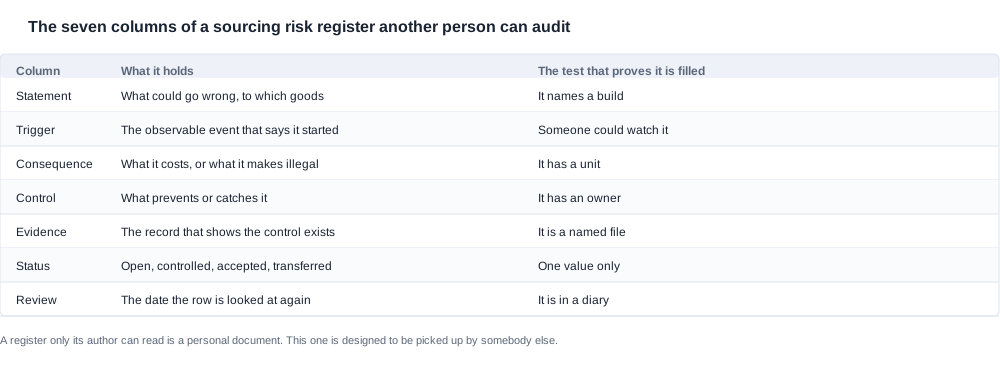
The columns are deliberately few, and each one exists because of a specific way that registers fail. The Statement column breaks vagueness, the Trigger column breaks the difference between a real hazard and a general worry, the Consequence column breaks the difference between a concern and a cost, the Control column breaks the difference between intending to do something and doing it, the Evidence column breaks the difference between asserting a control and demonstrating it, the Status column breaks the difference between an open row and an abandoned one, and the Review column breaks the difference between a register and an archive.
Read in that order, the first three columns describe the exposure and the last four describe the response. That split matters, because most templates collapse them: a column called "risk" or "mitigation" mixes the two, and a row written in that form can be read as describing something that is already handled when nothing has been done at all.
What the template deliberately does not have
There is no severity column, and no likelihood column. Both are familiar and both are excluded on purpose. A severity rating invites the register to be argued rather than used, because every row becomes a negotiation about the scale of a number that nobody can observe, and the negotiation outcome is driven by whoever is most senior in the room. A likelihood column has a worse property: it converts an estimate into a decimal, and the decimal then gets multiplied by a cost somewhere else and presented as an expected value that nobody actually computed.
What replaces them is the Consequence column with a unit — days of schedule, money already committed, a market that cannot be entered — and the Review column, which replaces the probability that something will happen with the date on which somebody will find out. A register built this way produces statements that can be checked, which is the only reason to keep it.
How a row moves through the template

The flow is not a workflow with approvals; it is the order in which the columns have to be filled. A row cannot be given a status before it has a control, and it cannot have a control before someone has decided what the consequence would be, because the control is chosen in proportion to the consequence. Starting at the end of the row — writing the statement and stopping — is the common failure, and it produces a register that reads as complete because every row has text in it.
The first three columns: what could happen, how it announces itself, what it costs
Statement: one sentence, one build, one market
The Statement column takes a single sentence that names the goods and the market it applies to. Not "the goods may not comply", which cannot be checked and cannot be closed, but "the camera configuration ordered for the European market has no model-scoped radio evidence attached to the file".
That sentence is doing more work than it appears to. Once the goods and the market are inside the statement, two things follow automatically. The row now has a scope, so it can be handed to a named person rather than to a department. And it can be tested: if the statement does not name the goods, then it is either a general concern that belongs somewhere else, or a gap in the specification that the buyer has not yet closed — and both of those are useful answers.
Trigger: the event that says it has started
A trigger is an observable event, and it has to be watchable by somebody who was not in the room when the risk was identified. A customs hold at the border is a trigger. A late delivery against a confirmed build slot is a trigger. A sample that does not match the configuration string is a trigger. "The supplier does not perform" is not a trigger, because it describes the conclusion rather than the event.
Writing the trigger is where a lot of registers quietly fail, because the trigger is the first column that forces the writer to imagine the future in detail, and imagining the future in detail is uncomfortable when the details might be wrong. It is also the column that decides whether the row is worth anything operationally: a row with a trigger can be attached to a monitoring point, a report line or an inspection step, and a row without one can only be read.
Consequence: give it a unit or admit you do not know
The Consequence column takes a number of days, an amount of money, or a named blockage. Days and money are the easy ones and they are the ones that make the register usable in a commercial conversation, because a schedule slip of two weeks on a launch date and a commitment of a deposit at thirty per cent are both comparable with the plan.
Some consequences have no number, and the honest entry is a named blockage rather than a guess: the programme cannot enter the European market, the listing cannot be published, the configuration has to be reworked. Writing that down is better than writing a probable value, because a named blockage can be priced through the decision that avoids it, while an invented number can only be argued with.
The discipline worth keeping is that the consequence is stated once, in one unit, and that the unit is chosen before the number is estimated. Switching units mid-row — one day of delay expressed as money in one meeting and as schedule in the next — is the fastest way to lose a register's credibility with a finance reviewer.
The last four columns: the control, the evidence, the status, the review date
Control and Evidence: intending to do something, then showing it
A control is an action that either prevents the exposure or catches it early enough to do something about it. It has an owner, and the owner is a person. "Procurement will ensure compliance" is not a control; "the compliance request for the camera configuration is sent to the supplier on the date the requirement sheet is issued" is, because it can be checked for whether it happened.
The Evidence column then names the record that demonstrates the control exists and works. This is the column that separates a register from a wish list, and it is the one that most often gets dropped because it is uncomfortable to write. A control that cannot be evidenced is an intention, and writing it as an intention is not dishonest — it is simply not a control, and the register should say so in the Status column rather than hiding it.
Status: four values, and no fifth
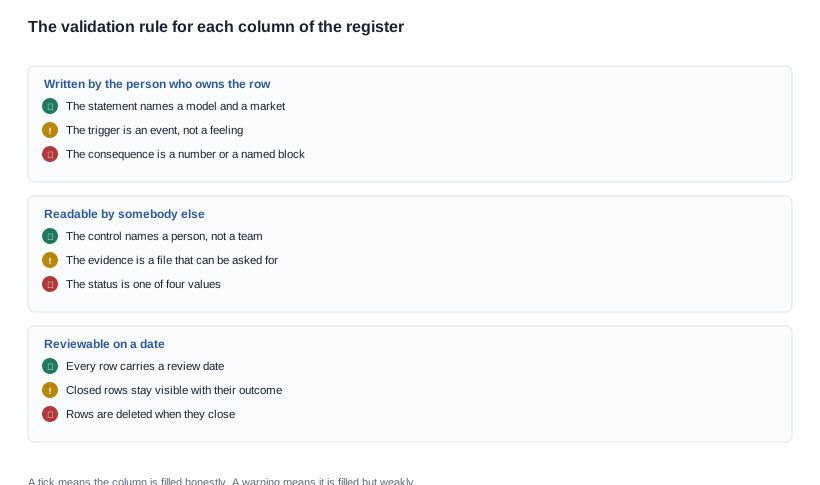
The Status column takes exactly one of four values: open, controlled, accepted, or transferred. Open means the exposure is real and the response is not in place. Controlled means a control is in place and the evidence for it is named. Accepted means somebody has decided to carry the exposure, and the decision is written down with the name of the person who made it. Transferred means the exposure has been pushed to somebody else — a customer, a carrier, a distributor — and the transfer is documented.
The reason for four values and no more is that each one implies a different next action. An open row needs a control. A controlled row needs its evidence re-checked on the review date. An accepted row needs the acceptance re-examined, because an accepted exposure that was never re-examined becomes a forgotten one. A transferred row needs the receiving party confirmed to have taken it.
Review: the date that turns a register into a control
Every row carries a review date. The date does not have to align with a milestone — a fortnightly cycle is enough — and the point is not the frequency but the guarantee that every open row is looked at by somebody with the authority to close it.
Closed rows stay visible, with the outcome recorded. Deleting a closed row is the single most damaging habit in register use, because it removes the evidence that a decision was made and makes the same question reappear in the next programme with no history behind it. A register that shows forty closed rows and four open ones is a working document. A register that shows four rows is either new or badly maintained, and there is no way to tell which from the outside.

Running the register in a review, and the decision it has to produce
The review is not a status meeting
The purpose of running a register is to reach a decision, and the decision is not usually the one the meeting was called for. The meeting is called to review progress and it should end with one of a small number of outcomes, each of which has to be written down:
- Proceed, with the remaining gaps written into the order. The commonest outcome, and it only counts as an outcome if the gaps appear as clauses or as named open items with owners.
- Split the order. Reduce the exposure by ordering a smaller first run, a single colourway, or a single market, on the basis of a named row.
- Hold the commitment. Move the deposit or the production slot until a specific row closes, with a date.
- Stop. The only outcome that should be available, and the one that disappears from most programmes because nobody has costed it in advance.
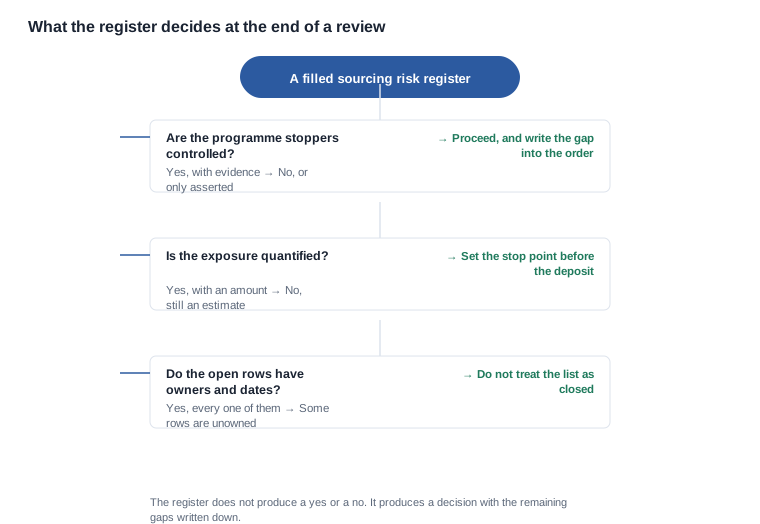
The fourth outcome is the one worth preparing, because it is the one that gets taken under time pressure. A register that has already quantified the committed exposure at each point in the schedule lets a buyer decide the stop point before the pressure arrives. A register that has not makes the decision in the last forty-eight hours before a deposit, which is the worst possible time to make it.
Running it against several suppliers at once
The register works well as a comparison instrument, and this is where its structure pays off. Two quotations that answer the same questions can be compared row by row, because each row asks for the same thing in the same form. A row whose Status is open for one supplier and controlled for another is not a judgement — it is a difference in what the two suppliers have shown you.
The comparison that matters is not the unit price. It is the set of rows that are controlled by one supplier and not by the other, priced against what it would cost you to close those rows yourself. A cheaper quotation with three uncontrolled rows is not cheaper if closing those rows costs more than the price difference, and the register is what makes that calculation possible rather than speculative.
The four ways a register template gets misused
The register that is actually a category list. Rows reading "supplier risk", "quality risk" and "delivery risk" have not been written; they have been labelled. Nothing about them can be closed, which is why they survive every review. The fix is the Statement column test — if the sentence does not name a build, it is not a row.
The register where the Evidence column is always empty. It happens because writing an evidence reference commits the writer to producing the document. A register in which every row says "certificate on file" without naming the file is a register of intentions, and it is usually written by a team that has not yet asked for anything.
The register that stops at the top of the funnel. Early-stage rows are worth writing, but a register full of market-level risks is being used as a strategy document. The test is whether a row has an owner who could act on it this month. If not, it belongs in a planning note rather than in the register.
The register that is never re-ranked. Rows are added, controls are attached, and the list grows. Because the Consequence column carries a unit, the register can be sorted, and a sorted register is what turns a list into a decision list — because the top three rows are the ones that need a decision this week, and everything below them can wait for the next review.
One row taken from open to controlled, written out in full
The following is a hypothetical case rather than a client project: no buyer, supplier, order or figure is claimed, and the row is constructed to show how the columns interlock.
A channel buyer is opening a camera glasses programme for one European market, first order in the low thousands of units, launch date fixed by a marketplace listing. The Statement column reads: "the camera configuration ordered for the European market has no model-scoped radio evidence attached to the file". The Trigger reads: "the evidence request is returned without a model designation". The Consequence reads: "four weeks, because the documentation route runs alongside production rather than before it".
The Control reads: "the requirement sheet is issued with the model list attached, and the evidence request is sent on the day it is issued, naming the model and the destination market". The Evidence reads: "the supplier's dated answer, with the model designation written on it". Status is open. The review date sits two weeks out, before the deposit.
At the first review the answer has arrived and it names a sibling model rather than the ordered configuration. The Status therefore does not move to controlled — which is the interesting part of the example. The Control was performed exactly as written, so a register that only tracked whether the control happened would have closed the row. The Evidence column is what prevents that, because the evidence is judged against the statement, and the statement named the ordered configuration.
What the row does next depends on the review, not on the template. The buyer can hold the deposit until a model-scoped answer arrives, or split the order to a market where the requirement is already covered, or accept the risk in writing and move the row to accepted with a named owner. All three are outcomes. What is not an outcome is a row that quietly returns to open because the review passed without anyone comparing the evidence to the statement.
What our published rows do and do not contribute to your register
The rows you can close before you have spoken to a supplier
A register is most useful when it is started before the supplier conversation, because a specification sheet written first turns most of the questioning into retrieval rather than interrogation. Our published catalogue settles a large share of the rows a buyer would otherwise list as open, and those rows can be closed in the template before any supplier is approached.
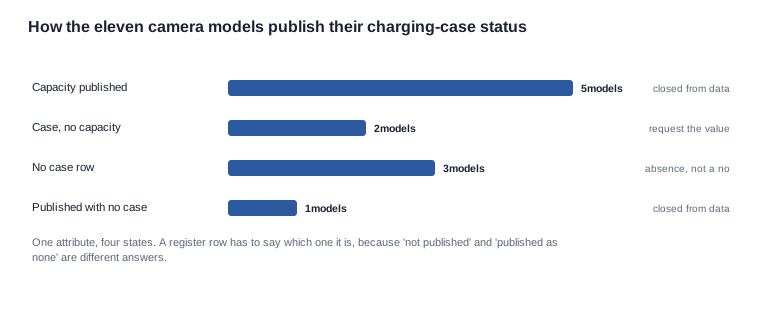
The camera range is a good example of why the Status column needs four values rather than two. Across the eleven camera models, the charging-case status splits four ways: five models publish a case capacity, two have a case whose capacity is not published, three have no charging-case row in the catalogue at all, and one has no charging-case row. Those are three different kinds of "not known" and one kind of "known", and a register row that collapses them into a single "case: unknown" has lost the distinction that determines whether the question is worth asking.
The same pattern runs through the rest of the catalogue: charging method is magnetic on seventeen models, Type C on seven, and unpublished on four; charge time is published for every entry; the camera resolution tier splits into eight models at 8 MP and three at 13 MP; and an ingress marking appears on two models only. Each of those is a register row that can be closed from published data, with the source named in the Evidence column.
The rows we will not fill in for you
We do not publish unit prices, minimum order quantities, production capacity figures, production lead times, defect rates, certificate identifiers or the frame weights on all but one model, and we will not insert a typical figure into your register to close a row that is genuinely open. A buyer who builds a downstream commitment on an estimated number finds the error in the field rather than in the quotation, and the correction costs more than the question would have.
What we will do is take a configuration, a quantity and a market, and tell you which rows of your register are settled by published data, which are open because nobody has asked yet, and which are open because the answer does not exist in our documentation. Those three categories need three different responses, and the supplier verification method is how the second category gets closed.
The practical advice article covers the surrounding habits, and the red flags article covers the signals that usually arrive before a register exists. The procurement risk management section sets out the wider framework.
Related reading
- The practical advice — sourcing risk practical advice
- The red flags — sourcing risk red flags
- The working framework — procurement risk management


