

Smart glasses sourcing risk is not a broad subject. It resolves into a short list of factors, and the useful thing about the list is that nearly every entry on it has a control a buyer can pull before the goods are made rather than after they are sitting in a warehouse. Six factors account for most of the exposure in this category: the structure of the supplier, the gaps in the published specification, the evidence the destination market will ask for, the behaviour of the sales channel, the configuration of each order line, and the timing of the whole programme. What makes this category unusually easy to reason about is that the published position is specific about electrical rows and silent about commercial ones, so the risk sits in a small number of well-defined places rather than spread across everything.
Smart glasses sourcing risk: the six factors, and who pulls each one
The short answer on smart glasses sourcing risk
Three conclusions carry most of the weight. First, the risk in this category is concentrated in the document chain and in the configuration, not in the hardware: a catalogue that publishes 28 models with their cell capacities, charge times and runtimes has already removed the large part of the technical uncertainty. Second, the factor that multiplies the other five is timing, because a specification gap found before the order is a sample test and the same gap found after production is a claim. Third, if a supplier cannot name the builder, the document holder and the evidence for a given model in writing, that is the finding, and it is worth more than any other single answer on the list. What follows sets out the six factors, the control attached to each, the published rows that carry the most exposure, and the order in which a buyer should work the evidence.
Who is reading this, and what they are actually managing
The reader here is a procurement manager working for the brand, a channel buyer or an importer. The common situation is that two or three quotations are sitting in the same inbox, the model is roughly decided, and the remaining work is to work out which supplier can be defended to a colleague in a launch review six weeks later. The thing being managed is rarely the unit price. It is a programme where a missing document, a mismatched configuration or an unpinned date stops a launch window, and where the cost of being wrong falls on the party who put the product in the channel rather than on the party who made it.
That is why the vocabulary of this subject is documentary. A brand owner does not lose money because a cell is slightly smaller than advertised. They lose it because a listing has to be withdrawn, a retail partner asks for substantiation, a shipment is held, or a customer service team starts answering the same question every week. The controls that prevent those outcomes are all procedural: a configuration sheet, an evidence request, a milestone schedule, a document schedule with named owners.
Why two quotations for the same model can differ by a factor of two
The gap between quotations in this category is not usually a margin argument. It is a scope argument. One supplier has already run the assessment for a configuration and a destination market, and the quotation carries the file; the other has not, and the quotation carries only the hardware. The second quotation looks lower because the documentation work is not in it yet, and it becomes the more expensive one the moment a channel, a customs broker or a certification body asks for the file.
The second reason is configuration. The catalogue covers 28 models, and the configurations are not uniform. Twenty-four of the 28 publish a charging interface row — 17 on magnetic charging and 7 on Type C — and the L1 Pro and the MT6, and the CY03 and the CY05 publish no interface row at all, although all four do publish a charging case capacity. On charge time, all 28 publish a figure: 26 are written as a ceiling of two hours or less, and the D17 and the ZH12 are written as about one hour. Read that ceiling correctly. A figure written as "two hours or less" is an upper bound, so a buyer cannot treat it as "under two hours" and then wonder why the other two models behave differently.
A third reason is what the quotation is assumed to include. A quote for a bare device, a quote for a device with a charging case, and a quote for a device with a case, packaging artwork and a documentation handover are three different products. Comparing them on unit price alone is the single most common way a buyer ends up with the wrong shortlist.
The six factors and the control behind each one
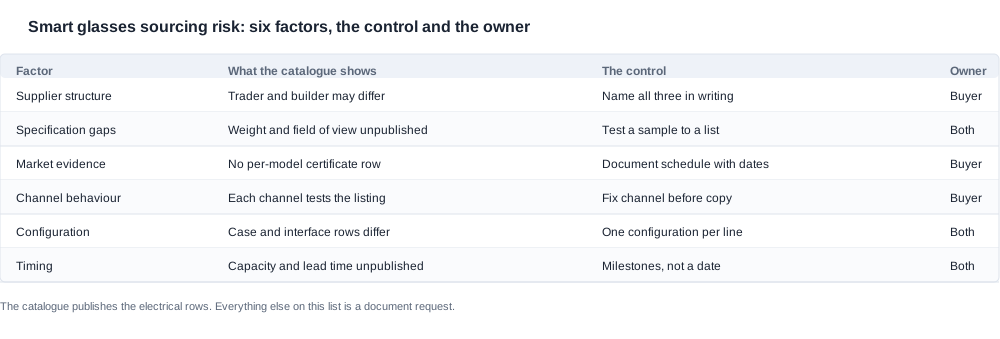
| Factor | What the catalogue shows | The control that reduces it | Who pulls it |
|---|---|---|---|
| Supplier structure | Trader, builder and document holder may differ | Name all three in writing before the order | Buyer |
| Specification gaps | Weight, field of view and frame rate are unpublished | Test one sample against a written list | Both |
| Market evidence | No per-model certificate row anywhere in the catalogue | A document schedule with an owner and a date | Buyer |
| Channel behaviour | A marketplace, a retailer and a direct channel test different things | Fix the channel before the copy is written | Buyer |
| Configuration | Case and interface rows differ from model to model | One configuration per order line, signed and dated | Both |
| Timing | Capacity, line count and lead time are unpublished | A milestone schedule with evidence, not a date | Both |
The table is a control set rather than a specification. It tells a buyer what to ask, and the last column tells them which side of the transaction has to move first. The rows that a buyer controls entirely — supplier structure, market evidence, channel behaviour — are the ones that are cheapest to fix and easiest to leave undone, because none of them requires a factory to change anything.
The factor that multiplies the other five
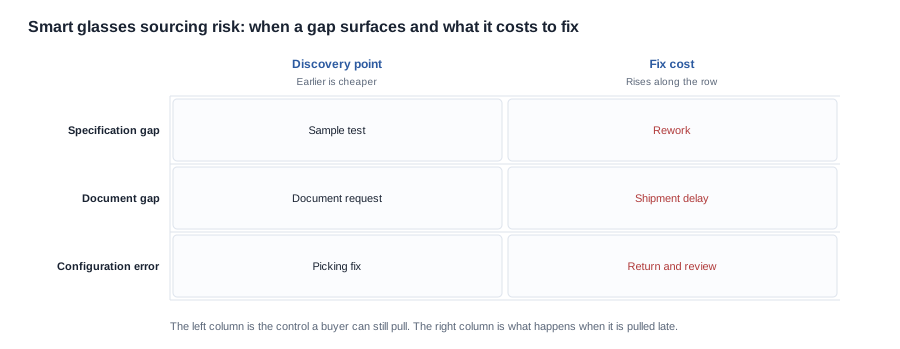
Timing is the multiplier, and the mechanism is simple. A specification gap discovered before the order becomes a sample test costing days. The same gap discovered after production has started becomes a rework, a schedule slip and a conversation with a customer. A document gap discovered before the order is a request; discovered after the goods are made, it is a delay at the dock. A configuration error is a picking error, a return and a public review.
In a category with this many published gaps, the schedule is not a commercial consideration sitting beside the risk assessment. It is the thing that multiplies the rest of the assessment. A buyer who freezes the configuration early has already converted most of the specification risk into a cheap sample test, and that single act is worth more than any negotiation over unit price.

Where the published specification gaps concentrate the exposure
The configuration rows a buyer has to freeze
Not every unpublished row carries the same weight. The ones that change what physically ships are the ones to freeze, and there are four groups of them.
The first group is the charging case. Among the 11 camera models the position is not two states but three. Five publish a case capacity — the CY03 and the CY05, and the L1 Pro — each at 1400 mAh, the L2 Utral at 900 or 1400 mAh, and the MT6 as a 1200 mAh folding case. Two publish a case without a capacity, the KY06 and the MT5, which is a case that exists in the published specification but has not been sized. Four publish no case row at all — the V06 and the S7, and the V03 and the V03 Pro — which is an absence rather than a statement that there is no case. A buyer who reads only the published capacities will believe the range is smaller than it is, and a buyer who reads the missing rows as "no case" will build a packing list that is wrong for four models.
The second group is the charging interface. Twenty-four models publish one, split 17 magnetic and 7 Type C, and the four camera models that publish a case capacity without an interface row are the exception that matters. The question to put to a supplier is not "is it magnetic or Type C" but "which connector is on the unit in the carton", because the answer is not inferable from the catalogue for those four.
The third group is the camera specification. Eight of the 11 camera models publish 8 MP and three publish 13 MP — the S7 and the L1 Pro, and the L2 Utral. The camera models publish no Bluetooth version, so a buyer who needs a specific radio version for a given market has to ask for it rather than read it. One marketing source of error is worth naming: the IP54 marking is published on two models, the V06 and the S7, and on no other row, so a landing page that generalises it across the range is making a claim the catalogue does not support.
The fourth group is the physical envelope. Only one model in the whole catalogue publishes a weight, and it is the MT6, at 158 g for the glasses body including the 265 mAh cell and the camera, with the folding charging case excluded and the weight of that case unpublished. Every other model in the range has no published weight, and a buyer who needs one has to request it in writing for the specific model rather than assume it from a sibling.
What the catalogue publishes and what it leaves open
The table below maps the three failure types a buyer will meet in practice onto the point at which the gap surfaces. The left column is the control that is still available. The right column is what happens when the control is pulled late, and it is the part that gets quoted back at you in a channel review.
| Failure type | Gap found before the order | Gap found after production |
|---|---|---|
| Specification gap | A sample tested against a written list | Rework, schedule slip, a claim |
| Document gap | A written request with a date | A held consignment and a delayed launch |
| Configuration error | A corrected order line before picking | A return, a review and a channel dispute |
Two of these rows cannot be compared between suppliers without care. A published capacity quoted by one supplier may describe a single cell while the same figure from another describes a pair of cells, and the difference is real because the catalogue publishes values such as 55 mAh twice and 90 mAh twice rather than a combined figure. Where a comparison depends on a combined number, state plainly that it is a derived figure and not a published one.
The other caution is about the certification question, because it is the one most often answered wrongly. The catalogue has a single company-level export-certification page and no per-model certification row at all, and the text of the catalogue contains no reference to CE, FCC or RoHS for any model. That does not mean the products are uncertified. It means the evidence is not published, so it is a request with a date attached rather than a line in a specification, and a buyer who treats it as the latter will be exposed when a channel asks for substantiation.
Working the sourcing risk evidence in the order that protects the schedule
What to request, and from whom
A sourcing risk request is only useful if it names the model, the configuration, the destination market and the date. "Please send your certificates" is a request that can be answered with a company brochure, and a company brochure cannot be reconciled against a specific unit. "Please confirm, for the V06 in the 8 MP configuration intended for the European market, the ingress test report reference, the issuing body and the validity date" is a request that produces an answer worth putting in a file.
Three parties usually hold the answers, and a buyer should be clear about which is which. The manufacturer holds the test evidence and the product specification. The trading company holds the contract, the payment terms and the commercial relationship. The brand or the importer holds the destination-market declaration, which is the importer's own document and is not transferred by a supplier. A buyer who asks the wrong party for the wrong document gets a polite answer and no progress, and the delay is then usually attributed to the wrong cause.
The seven-step sequence
The sequence below is ordered so that each step is cheap relative to the one after it. The first three steps cost nothing but attention, and they are the ones most often skipped because they do not look like procurement activity.

- Freeze the model and the configuration on one written line, including whether a charging case ships in the box and at what capacity.
- Collect every published row for that model from the catalogue, so the internal specification is a fact rather than a memory.
- Mark each unpublished row as a written request with an owner, rather than as a defect in the supplier.
- Ask the supplier for the evidence in writing, model by model, and put a date on the request.
- Test one sample against the written list, with a pass or fail recorded against each line.
- Record the result, the sample serial and the date on the configuration sheet, and keep the sheet with the purchase order.
- Freeze the sheet and only then start the schedule, because a schedule that starts before the configuration is fixed is a guess.
The pre-order evidence checklist
The checklist is the same sequence in a form that can be sent to a supplier, with a state against each line so that both sides can see what is outstanding. The marks below show the state of a typical programme rather than a judgement on any supplier. A programme that has reached the deposit stage with the lower half of the list still open is not unusual; a programme that reaches the deposit stage without noticing it is.
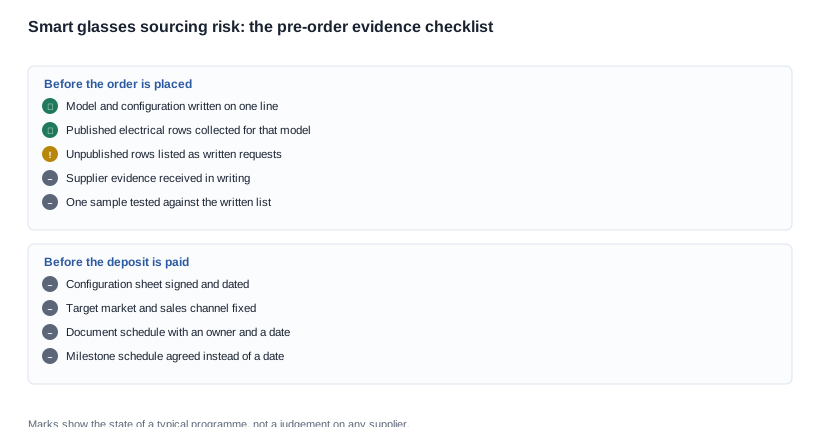
The order of the two groups matters more than the items in them. The first group is evidence, and evidence can be gathered in parallel. The second group is commitment, and commitment should be the last thing that happens, because a deposit paid against an unfixed configuration buys the right to be uncertain.

How a sourcing risk becomes a channel claim
Most sourcing risk in this category does not fail loudly. It fails in a channel, on a listing, weeks after the goods have landed, and by then the cost is no longer the cost of the fix. Four patterns account for most of it.
The first is a listing that says more than the specification supports. This is easy to do and easy to prevent: the copy has to be built from the published rows plus the evidence received, and every claim has a line in the configuration sheet behind it. A claim about ingress resistance, a claim about a battery figure, a claim about a certification mark, each of these has to trace to a document before it goes live.
The second is a channel mismatch. A marketplace magnifies the return rate and the language of the reviews, a retailer asks for substantiation before it asks for anything else, and a direct channel leaves the burden entirely with the brand's own service desk. The control is to fix the channel before the description is written, because the description and the claims are what the channel tests.
The third is a documentation drift. A cell or a component is changed after the file was written, and the file is never reissued. The control is to treat the model designation and the bill of materials as controlled items on the purchase order, and to reopen the file on any substitution.
The fourth is the configuration error, which is the cheapest to prevent and the most expensive to absorb. Every case configuration is a separate material set, and a buyer who allows two case capacities on one model — which the L2 Utral genuinely has — needs two order lines, two picking rules and two descriptions.
None of the four is exotic, and none of them is a reason to change supplier. They are reasons to put a line in the order and a name against a document.

A hypothetical sourcing decision, step by step
The scenario
The following is a reasoning exercise rather than a customer story. No client is described and no figures are claimed; the model, the quantity and the market are assumed so that the reasoning can be followed. A brand-side buyer is opening a wearable programme for a single sales market and a single retail channel, and the decision is which of two quotations to develop. Both quotations are for a camera model in the 8 MP class. One supplier quotes a bare device; the other quotes a device with a case in the box. The channel is a retailer that asks for substantiation before it lists anything, and the launch window is fixed.
The first step is the configuration, because it decides the order lines. The chosen model is a camera model in the 8 MP class that the catalogue publishes with a magnetic charging interface and a case row that carries no capacity. The case capacity is therefore an open item, and it is placed on the request list before anything else, because it determines the packing list, the packing weight and the case line on the purchase order.
The second step is the specification sheet, built only from published rows: cell capacity, charge time as a ceiling, run time, camera class, charging interface, and the presence or absence of a case row. The published weight is left off the sheet for every model except the MT6, and even there it is stated as the glasses body only, with the case weight recorded as unpublished. Writing it any other way would put a claim in the listing that the evidence does not carry.
The third step is the evidence request, split by holder. The manufacturer is asked for the ingress and radio evidence for the named model and configuration, with a reference, an issuing body and a date. The importer is asked, separately, what the destination declaration will be and who signs it, because that document is the importer's own and does not transfer with the goods.
The fourth step is the sample test, with a written list, a recorded pass or fail per line, and the sample serial written on the sheet. The test is deliberately narrow: it verifies the published rows and the requested rows, and it does not try to characterise performance the catalogue does not claim.
The fifth step is the comparison of the two quotations on the same scope. The bare-device quotation and the case-in-box quotation are not compared at all until the second is re-quoted with the same configuration as the first, because a unit price comparison between them measures the case rather than the product. On the corrected basis, the visible price gap narrows and the remaining differences are the ones that matter: the evidence already in hand, the milestone schedule, and the after-sales route.
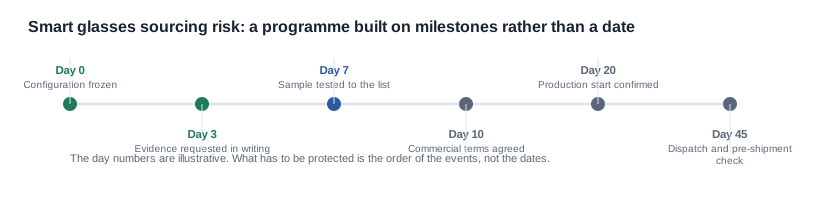
The sixth step is the schedule, built on milestones. A milestone with an owner and a document attached, and a date that moves when the evidence moves, is a better negotiating position than a fixed date that has to be defended.
What we publish about sourcing risk, and what we ask you to confirm
Here, sourcing risk in this category is concentrated and controllable, and the six factors above are most of it. We publish the electrical rows for 28 models — cell capacity, charge time, run time, charging interface or the absence of an interface row, camera class where it applies, and the charging case capacity where it is published. We do not publish per-model certification, because the catalogue does not contain per-model certification rows, and we would rather say that than imply a mark that is not in the file. We do not publish a frame weight for any model except the MT6, and even that figure is the glasses body alone, without the case.
What we cannot do is answer questions about our capacity, our lead time or our yield, because none of those is published. What we can do is tell you which rows exist for a given model, which are absent, and what to request to close each gap. The factory audit guide covers when a visit adds something and when the paperwork is enough; the sample order checklist is the item list for the test step; the certification documentation requirements article is the field-level version of the evidence request; the shipping red flags article is the operational version of the configuration control; and the lead time calculation article is how to turn a milestone into a date.
If you tell us the market, the channel and the volume, we will say which factor is likely to bind and which published rows to put in front of the supplier first. The sourcing risk guide is the shorter version of the same argument, and the procurement risk pillar sets out the wider framework. Written in one sentence: smart glasses sourcing risk is mostly a timing problem wearing six different hats, and the control that addresses all six is a configuration sheet that is frozen before the schedule starts.


