
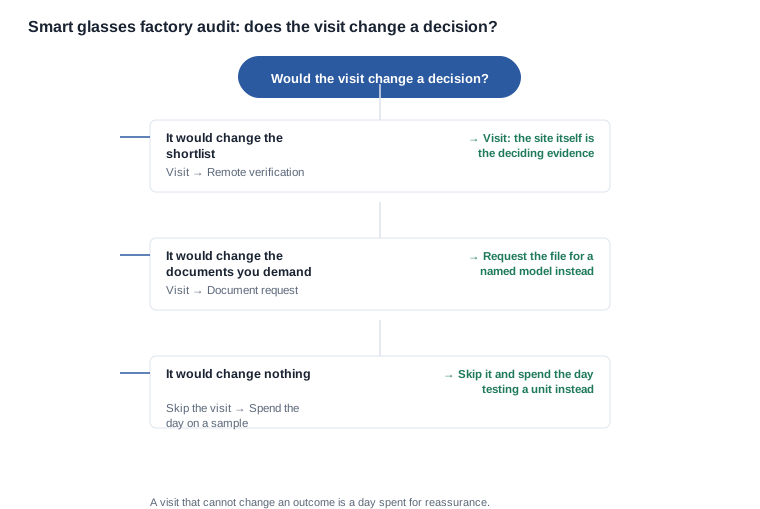
There are smart glasses factory audit situations where skipping the visit is the right decision, and the test for which one you are in is short: would the outcome of the visit change anything you would do? A smart glasses factory audit is worth the travel and the day when its result changes one of four decisions — the configuration you order, the supplier you shortlist, the documentation you demand, or the terms you write into the contract. When none of those four would move, you are spending a day to feel more confident about a decision you had already made, and the sample on your bench is a better use of the same day.
We publish the model data and the capability gaps, and we do not publish unit prices, minimum order quantities, capacity figures or lead times. What follows is a rule for deciding when the visit is redundant, what to ask for instead, and the cases where skipping it is the expensive decision.
Smart glasses factory audit: the observation only a site visit can produce
A smart glasses factory audit is usually discussed as a sign of seriousness, and that framing wastes the opportunity. The visit is an instrument for producing one specific kind of information: direct observation of a production site by a buyer who is not the buyer of record. That instrument is expensive, slow and hard to schedule, and it is genuinely superior to any substitute for a small number of questions that only a site can answer.
The questions it is superior on are narrow. A visit shows you whether the line that makes your configuration actually exists and runs. It shows you whether the people assembling the units are the people your order will be assigned to. It shows you the state of the process around the build — incoming inspection, soldering, firmware loading, packing, traceability of the batch. And it shows you the gap between what a supplier says about its own capability and what a half-day of observation reveals.
Everything else a visit is credited with is better obtained by a cheaper instrument. The published specification for a catalogue model is a document, and a document beats an observation when the question is what the product is. A sample beats a visit when the question is what the unit does. A file request beats a visit when the question is what evidence exists. And a named counterparty beats a visit when the question is who is responsible.
The mistake is paying for the expensive instrument when the cheap one would have answered the question, and the cost of that mistake is not only the travel. It is the delay to the order, the credibility spent on the request, and the false confidence that comes from believing a general impression is evidence.
Smart glasses factory audit: four decisions the visit can and cannot change
The cleanest way to run the test is to write the four decisions down and ask, for each, what the visit would have to show in order to change your answer.
The configuration you order
A visit can change this when the question is whether a published figure corresponds to what is built. If the catalogue states a cell capacity, a charge time, a rated endurance and a charging interface for a model, the visit adds nothing to those numbers — a sample and a document both confirm them more cheaply. What a visit can change here is the unpublished behaviour of the configuration: whether the firmware on the line matches what the sample did, whether the assembly route for your colourway is the same as the one photographed. That is a narrow, specific reason to visit, and it is much more common for a camera product than for an audio product.
The supplier you shortlist
A visit can change this when the question is whether the contracting party is the party that produces your goods. If the contracting entity, the production site and the documentation holder are named and consistent, the visit confirms what the paperwork already says. If they are not consistent, the visit is not the right remedy either — the remedy is a question, and the question has to be answered before a ticket is bought.
The documentation you demand
A visit can change this when the question is whether a document exists in a usable form rather than whether it is claimed. A request for the file for a named model, with the holder identified and the model designation matching the model in the order, answers the existence question at a distance and in a day. A visit answers a different question — how the file is generated, how long it takes, whether the process is real — and that question matters when you have been told the file will be ready for a date.
The terms you write into the contract
A visit can change this only in one case, which is when the visit reveals a production step that you did not know about and that changes who should carry responsibility for a defect. That is rare, and it is discoverable in the ordinary due diligence of a first order.
The test therefore has a shape: the visit earns its cost when the answer it produces changes one of the four decisions. It is not a proxy for diligence, and diligence is not the same activity.
Smart glasses factory audit: what a substitute has to reach
The reason so many buyers treat the visit and the diligence as one thing is that nobody specifies what a substitute is supposed to accomplish. A substitute has to reach the layer of the supply chain that holds the evidence for the question being asked. There are five layers, and each answer lives in a different one of them.
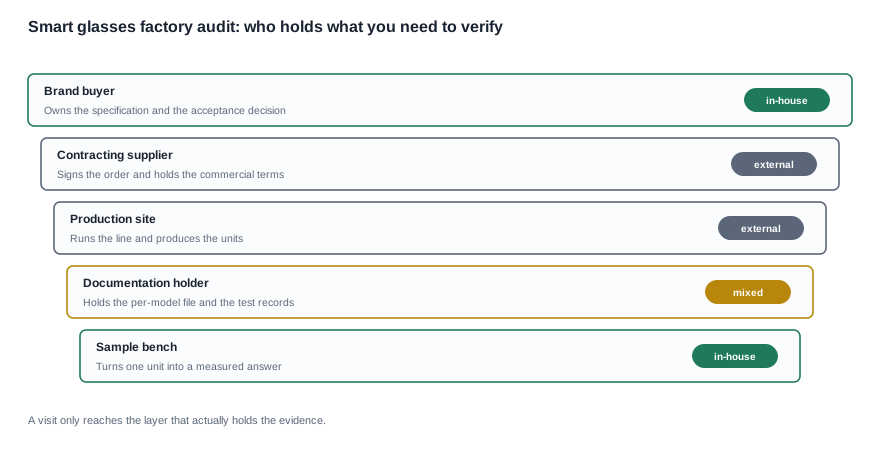
The brand buyer holds the specification and the acceptance decision, and a buyer who has not written a specification cannot use any substitute, because there is no standard for the answer to be measured against. The contracting supplier holds the commercial terms and the order book, and if the question is about responsiveness or commercial behaviour, that is the layer to test — not the production line. The production site holds the build, and the questions it can answer are the ones about process and capability: how a unit is assembled, how firmware is loaded, how a batch is traced. The documentation holder holds the per-model file and the test records, and this is the layer most often mistaken for the production site. The sample bench holds the only instrument that turns one physical unit into a measured answer.
The two conclusions sit on opposite sides of the relationship. First, a buyer who has not written the specification has no use for a visit at all, because a visit cannot supply a standard. Second, a supplier who refuses a visit but produces, within a day, the file for a named model and answers the sample questions in detail has demonstrated competence in the layer that actually holds the evidence — which is more than a supplier who hosts a visit and says nothing specific has demonstrated.
For a trading company arrangement, the point becomes explicit. A trading company is not a red flag in itself. It is a red flag when the production site is hidden, because then the document holder and the party with the test records are unknown. If the factory is named, if the model in the order can be traced to it, and if the file for that model is produced on request, then a physical visit to the trading company's office tells you very little that the file and the sample do not. The factory and trading company guide covers the distinctions in more detail, and the supply chain due diligence article sets out the wider evidence model.
Smart glasses factory audit: the four cases the document cannot close
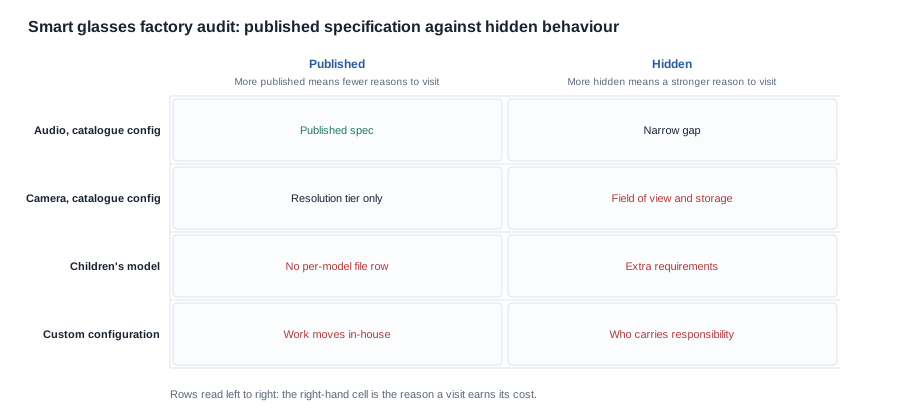
The mirror image is worth stating precisely, because these four cases are where a skipped visit turns into a larger loss later.
The product is a camera product and the image is the proposition
The camera specifications are not published for any model in the range — no sensor, no field of view, no video format, no frame rate, no low-light behaviour, and no per-model certification line anywhere in the catalogue. The catalogue does publish the resolution tiers: eight camera models at 8 MP and three at 13 MP, the 13 MP group being the L1 Pro, the L2 Utral and the S7. A resolution tier tells you how many pixels the image has; it tells you nothing about whether the image is usable. That gap is exactly the gap a visit and a sample can close and a document cannot, because the camera pipeline — optics, sensor, processor, firmware, storage — is where the difference lives. Two further gaps compound it. The charging arrangement across the camera range is not uniform, and the catalogue is silent on it in three distinct places: five camera models publish a charging-case capacity, two publish that they have a case without giving its capacity, and three carry no charging-case row at all, which is an absence of information rather than a statement that there is no case. And the catalogue publishes a charge time against no stated start state and no stated end condition, so those figures cannot be turned into a shift-change interruption without an assumption the catalogue does not support.
The product is for children
The A05, the A06 and the A07 are the children's models in the range, at 40 mAh for the A05 and the A06 and 70 mAh for the A07. The applicable requirements for children's products sit on top of the radio and chemistry requirements, and the catalogue publishes no per-model certification row for any model — the certification page in the catalogue is a company-level export page, and the text of the catalogue contains no reference to CE, FCC or RoHS at all. A supplier who cannot produce the evidence for a children's configuration is a supplier whose site you should see. Note carefully what this does and does not mean. It is not an assertion about any market access claim on anyone's part; it is an observation about where the written evidence for a specific model has to come from, and about the fact that the general requirements and the children's requirements are assessed separately rather than together.
The order carries customisation
A printed box, a logo, a custom colour or a firmware branch moves work in-house and changes who is producing your goods. The OEM requirements checklist is the field-level list for what a branded programme involves, and customisation is where the production site stops being a detail and becomes a party to the order.
The relationship is new and there is no production history together
In this case the visit is not about the supplier, it is about establishing a baseline you can compare the second order against. The factory audit beginner guide covers what a first visit should look like, and the factory audit checklist is the item list to take with you.

Smart glasses factory audit: the substitutes that cost nothing
When you skip the visit, you have not skipped the diligence. Four substitutes answer most of what a first visit would, and all four can be asked for in the same email.
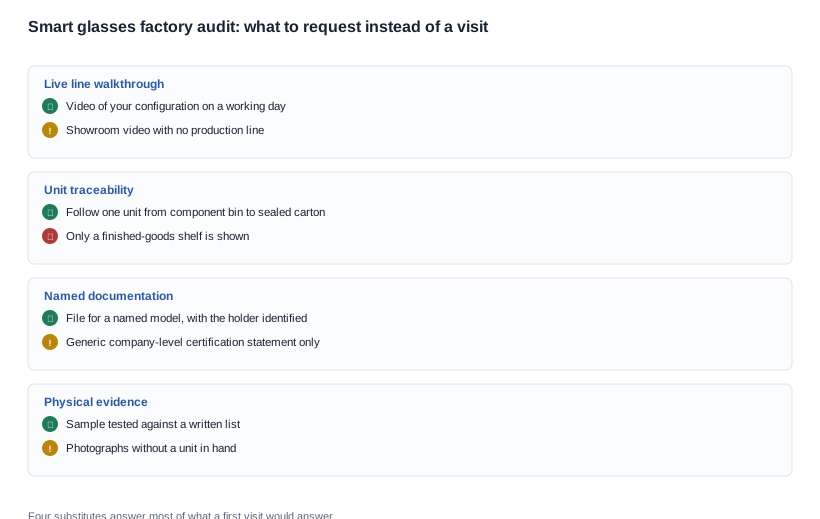
- A live walkthrough video, filmed on a working day, of your configuration. Not a showroom, not a staged pack table. The request is that the camera follows one unit from the component bin to the sealed carton. That single request tests more than a day of questioning, because the sequence of operations is what a buyer is actually trying to establish.
- A file for a named model, with the holder identified. The model designation on the document must be the model in the order. Ask also about the IP54 catalogue marking carried by the V06 and the S7, since a marking without a test report number is a claim and a report number is evidence.
- A sample, tested against a written list. The sample is the only instrument that will tell you the field of view, the capture path, the endurance under your own load, and the charging behaviour — none of which is published for any model. The sample policy answer sets out when sampling is and is not worth the cost.
- A written answer on who builds, who contracts and who holds the file. Three names, consistent with each other. If they are consistent, the visit has told you less than the names did.
A fifth substitute is worth adding when the order is large: a third-party pre-shipment inspection on the production run. It does not replace a visit, but it is closer to the goods than the visit is, and for a camera configuration it is the point at which a drift from the approved sample becomes visible.
The response to a refused substitute is itself a finding, and it is worth having a rule for it in advance rather than improvising. Three signals matter. A supplier who refuses the live walkthrough video but offers a staged one is telling you the line is not the part worth showing. A supplier who cannot produce the file for a named model within a stated period is telling you the file is produced per shipment rather than held, which changes how long your own documentation work will take at the end of the run. And a supplier who will not ship a sample against a written test list has made a commercial decision that the buyer will have to accept or overrule — usually by changing supplier, and usually at a point where the order is already placed. The factory audit supplier verification method is the fuller version of that test, and the sample request sequence covers what to ask for when a sample is the instrument you have chosen.
Smart glasses factory audit: a trading-company scenario, walked through
The scenario below is a reasoning exercise rather than a customer story. No client is described and no figures are claimed; the model, the quantity and the market are assumed so that the reasoning can be followed, and every product fact referenced is taken from the published catalogue.
The situation: an audio model bought from a named trading company
A channel buyer is sourcing an audio-glasses line for resale into a single market. The supplier is a trading company that has named the factory that produces the units, has a documented quality process, and has quoted three hundred units of a catalogue model in one colour. The buyer's internal policy requires a factory audit before any first order above a value threshold, and the order sits just under it. The buyer is deciding whether to spend the travel and the day anyway.
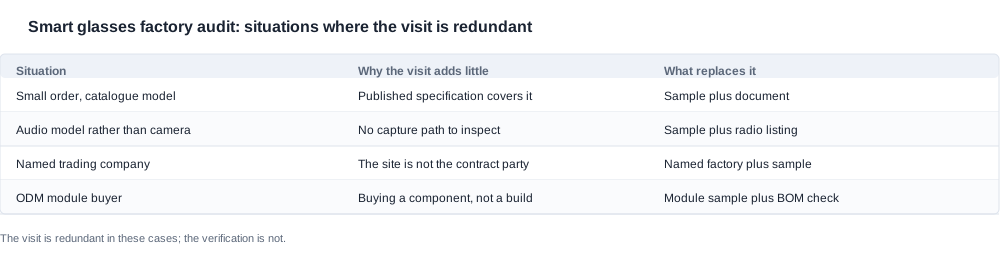
Step one: run the decision test rather than the policy. Four decisions are on the table — configuration, shortlist, documentation, terms — and the buyer writes what the visit would have to show to change each one. On configuration, the catalogue publishes the cell capacity, the charge time, the rated endurance, the charging interface and the radio version for the audio models, and a sample confirms them; the visit would not change the answer. On the shortlist, the three names are consistent, so the visit confirms rather than changes. On documentation, the file for the named model can be requested directly. On terms, no production step has surfaced that would change responsibility. The visit changes nothing.
Step two: identify the layer that holds the answer. The audio models in the range are eight — the K01 and the K02 at radio version 5.3, and the D11, the D12, the LC-105 pair, the G07 and the YK12 at 5.4 — with published per-temple cell configurations from 55 mAh by two up to 100 mAh. There is no camera module, no capture path and no storage path in a product like this, so the questions that would justify a visit are correspondingly few. The layer that holds the answers is the documentation holder and the sample bench, not the production floor.
Step three: buy the substitutes instead. The buyer requests the live walkthrough video, the file for the named model, and a sample against a written test list, and records the decision to skip the visit with its reason in the supplier file. The order proceeds on a written specification annex, an approved sample as the inspection reference, and an acceptance clock tied to the payment trigger, which is the same drafting logic described in the contract clause answer.
Step four: decide in advance when the visit would happen. The file records that a visit becomes mandatory if the second order introduces a camera configuration, if a children's model enters the range, if customisation is added, or if the file for the named model is not produced within a stated period. That converts a one-off decision into a standing rule and stops the question being re-argued on every reorder.
The working rule we apply: skipping an audit is a decision and should be recorded as one, with the reason, because the next person to look at the supplier file will need to know whether the site has been seen. We publish the cell capacities, the case capacities, the charge times, the charging interfaces, the rated endurance, the resolution tiers, the model data and the catalogue markings. We do not publish unit prices, minimum order quantities, production capacity figures or lead times, and we will answer the four substitute questions directly ourselves.
If you want to work through a specific supplier, send the model, the configuration, the quantity and the target market, and we will tell you which of the four decisions a visit could actually change for you, and what to request instead when it could not.


