
Smart glasses sourcing risk is not proportional to the size of the order. A large catalogue-configuration order carries very little sourcing risk, because almost everything about it is published. A smaller custom order carries a great deal, because most of what matters about it is not written down anywhere — including, in this category, in the supplier's own catalogue. That gives a buyer an unusual advantage: the risk can be read off the published specification before anybody visits a factory. This is how to read it, and the eight questions below are the ones that close what reading it leaves open.
Smart glasses sourcing risk concentrates where the buyer has least visibility
The buyer reading this, and what they are actually insuring against
The reader is a procurement manager at the brand, a channel buyer or an importer who has a supplier in front of them and a decision to make. The thing they are managing is not the supplier's honesty. It is the set of things nobody has written down.
In most categories this requires a factory audit to establish. In this one it does not, because the catalogue is unusually specific about its own limits. The catalogue publishes twenty-eight models across three families — eleven camera models, eight audio models and three sport models — and for each one it states the battery capacity, the published runtime and the charge time. It publishes the charge method for twenty-four of the twenty-eight. It publishes the camera resolution tier, the charging-case position for the camera models, and an IP54 marking on two models only.
And it is equally specific about what it does not publish. There is no per-model certification row for any of the twenty-eight models, and the catalogue text contains no CE, FCC or RoHS marking anywhere. The charge method is unlisted for four camera models. The charging-case capacity is unpublished for two camera models and the charging-case row is absent for three more. A model weight is published for exactly one product. The MT6 glasses body is published at 158 grams, covering the battery and the camera and excluding the 1200 mAh folding case, whose own weight is not published.
Every one of those gaps is a place where a buyer can be surprised. Read as a map rather than as a list of omissions, they are the risk map.
The two-axis test: what is unknown, and how much money is riding on it
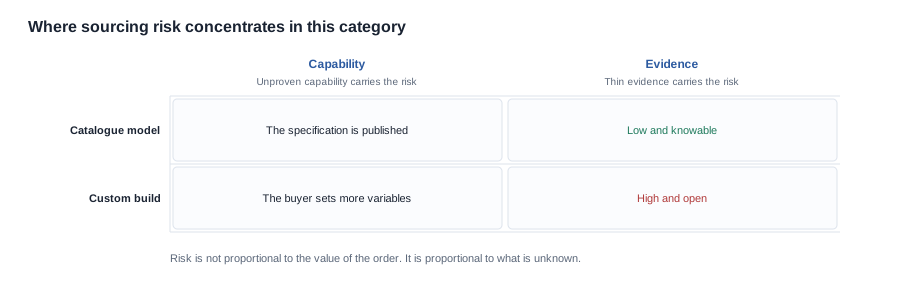
Sourcing risk is best separated along two axes, and the useful cell is the one where capability is unproven and evidence is thin.
The capability axis asks whether the supplier has done this before, and whether anyone can show it. The evidence axis asks how much of the buyer's decision rests on something nobody has written down.
On a catalogue-configuration order, the capability is partly provable from published evidence — the specification is published, the configuration is documented, and the same model can be ordered again. On a custom build, the buyer has set variables that nobody else has set, the evidence has to be manufactured during the programme, and the risk concentrates.
The interesting result of this test is that it is not the value of the order that drives the risk. A high-value catalogue order is a low-risk order. A modest-value custom order with three unspecified variables is a high-risk order, and it is the one where the deposit should be smallest and the specification should be tightest.
The risk sources in this category, and what closes each one
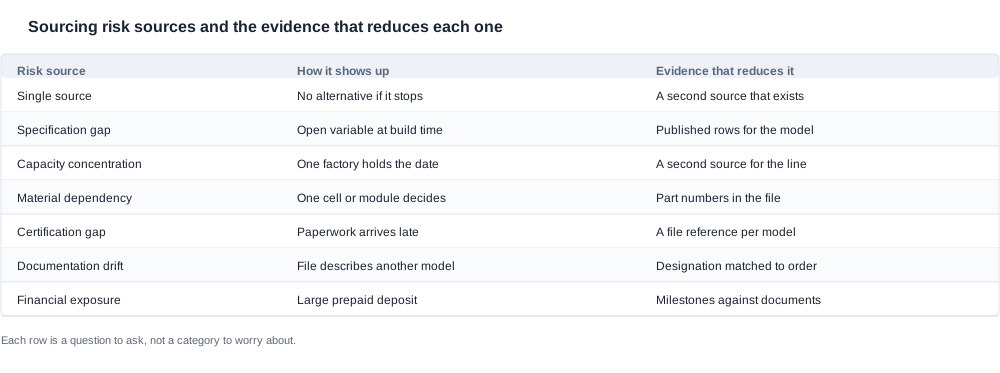
The table below is written as a due-diligence list rather than as a worry list. Every row names the risk, the way it appears, and the evidence that reduces it — which is a document, a reference or a written answer, in every case.
Single source, and no alternative if it stops
How it shows up. The programme depends on one factory for the model, one supplier for the cell, one line for the build. There is no fallback, so a problem at that point is a problem for the programme.
How it is reduced. Not by finding a second supplier in advance, which is expensive and slow, but by asking a narrower and more useful question: does a second source exist for this configuration, and if so who qualifies it and what would have to change for it to be used. A qualified alternative that has to re-qualify is not an alternative; a qualified alternative that is already qualified for the same part number is a real one.
The specification gap, which the catalogue already shows
How it shows up. The buyer finds out at build time that a variable nobody specified was decided by somebody else — and the decision was reasonable, which makes it harder to challenge.
How it is reduced. The published gaps are a checklist. Ask for the charge method on the four camera models where it is unlisted. Ask for the case capacity on the two where the case exists but the capacity is not published. Ask for the case position on the three where no row is published, and note that the V03 Pro has no charging-case row, which is a different thing entirely and must not be treated as the same kind of unknown.
The discipline is worth stating plainly: an unpublished row is not an absent feature. The catalogue's silence is a request for information, not an answer.
Capacity concentration, where one factory holds the date
How it shows up. Every unit of the programme comes from one production line in one period. A queue, a material delay or a tooling problem becomes a launch date problem with no workaround.
How it is reduced. Ask which line and which stage the build sits on, and what the fallback is if that stage slips. A supplier who has a second line for the same configuration has reduced this risk materially; a supplier who has a second line that cannot run that configuration has not.
The component dependency behind one part number
How it shows up. A single component decides whether the programme can be built on time, and it is usually not visible in the product description at all.
How it is reduced. Ask for part numbers rather than brand names, for the cells and the camera modules in your configuration specifically. A brand name cannot be checked against a bill of materials; a part number can, and it is the part number that tells you whether a second source exists.
The certification gap, which is a documentation problem before it is a compliance problem
How it shows up. The programme is aimed at a market that requires documentation, the documentation was assumed to exist because the product is a real product, and it turns out that nobody has a file for the exact model designation.
How it is reduced. Ask for the file reference and the model designations it covers, in writing, before the order. The framework for radio equipment is the Radio Equipment Directive (EU) 2014/53/EU, and the certification buyer checklist is the request list.
Documentation drift, where the paperwork describes a different product
How it shows up. A file, a packing list or a declaration names a sibling model. The difference is a suffix and the consequence is a hold.
How it is reduced. Make the model designation on every document an acceptance criterion, checked against the purchase order and the carton artwork, at the point the document is issued. The factory audit documentation requirements set out what the file should contain.
Financial exposure, where the money leaves before the evidence arrives
How it shows up. The deposit is committed against a specification the buyer has not seen a working sample of, and the balance is due before conformity is checked.
How it is reduced. Tie payment events to documents rather than to dates, and keep the point at which money becomes unrecoverable behind the point at which the buyer has evidence. The MOQ verification article covers the volume commitment, and the lead time verification article covers the schedule commitment.
Ordering the risk instead of listing it
Most sourcing questions are answered in a list, and a list of ten risks produces no decision. The useful move is to order them, and the ordering rule in this category is short: risk is a function of what is unknown, not of what is large.
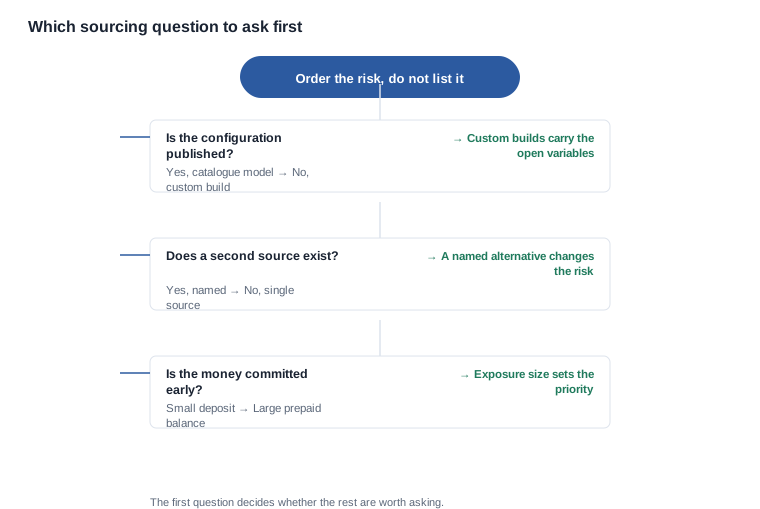
The first question: is the configuration published?
If the configuration is a catalogue model with no custom elements, then most of the specification risk is already closed — not by anything the supplier has done, but by the fact that the specification is fixed and public. The remaining risk is concentrated in three places: the documentation, the capacity and the payment schedule. Those three are worth the diligence.
If the configuration is custom, then the buyer has introduced variables and the risk has moved from the supplier's side to the buyer's. The diligence priority changes completely. The questions become: which variables did I set, which did I leave open, and which of the open ones does the supplier have to decide on my behalf?
This is the point at which most sourcing reviews go wrong. A custom programme is assessed with the checklist for a catalogue programme, which produces reassurance about the wrong things.
The second question: is there a named alternative?
"Where could we go if this supplier could not deliver?" is a better question than "is this supplier reliable", because it is answerable. A named alternative with a qualified part number is a real answer. "We could find someone else" is not, because finding someone else is a project, not a switch.
The third question: how much of the decision is still open?
Count the variables the buyer has not decided and the supplier has not published. Each open variable is a place where a decision is going to be made without the buyer's participation, and each one is a line in the acceptance criteria that will have to be written afterwards rather than before.
If the count is high, the answer is not to proceed more carefully. The answer is to reduce the count before the order, because the cost of closing a variable before the deposit is a phone call and the cost of closing it afterwards is a claim.
Scoring the open variables so the list is usable
An open-items list of ten items is not more useful than no list, because nothing on it gets prioritised. A simple scoring pass makes it usable, and it needs only three columns.
Can the variable be decided by the buyer, or must it come from the supplier? Variables the buyer controls — the artwork, the packaging position, the accessory in the box, the firmware build identifier — can be closed internally in a day. Variables only the supplier can close — the charge method on a model where it is unlisted, the part number behind a cell, the capacity of a case the catalogue does not quantify — need to be requested, and they need to be requested now.
Does the variable change what the buyer is buying, or only what the supplier is doing? A variable that changes the product — the accessory, the packaging, the firmware — is a specification item and belongs in the configuration document before the deposit. A variable that changes only the supplier's internal process — which line, which shift, which cell lot — belongs in the risk register and in the commercial structure. Mixing the two is why open-item lists tend to get ignored: the buyer's own decisions are buried among requests that will take three weeks.
What happens if it is never closed? This is the column that turns a list into a structure. A variable that can be closed late, at a cost, is a commercial term — it justifies a holdback or a smaller deposit. A variable that cannot be closed at all is a reason to change the configuration rather than to accept the risk, because some variables genuinely have no acceptable answer and the only way to remove them is to specify differently.
Scored that way, the list produces one of three actions: close it internally, request it with a date, or change the specification so that it stops existing. Those three actions are the whole output of the review, and each of them is executable before a deposit is paid.
Running a sourcing review before the deposit is released
The sequence below is ordered so that the expensive questions come before the irreversible ones. Each step has a completion test: a document, a reference or a written answer with a date on it.
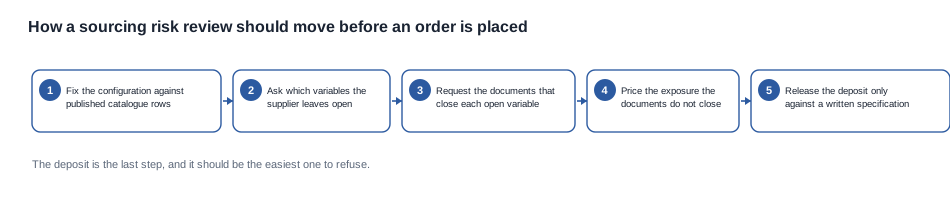
- Fix the configuration against the published rows. Write down the model, the accessory position, the charge method and the destination market in one document, and send that document to every supplier. A supplier's answer to a written specification is comparable; an answer to a conversation is not.
- Ask which variables they leave open. This is the question that reveals a custom programme's real risk, and it is better asked as a list than as an assurance.
- Request the documents that close each open variable. Part numbers for the key components, the file reference for the model designation, the charge method, the case position.
- Price the exposure the documents do not close. Anything still unknown after step 3 is a risk the buyer is carrying, and it belongs in the commercial structure — a smaller deposit, a holdback, a right to inspection before the balance.
- Release the deposit only against a written specification, with the payment events tied to documents and with an acceptance criteria set attached.
The sample order checklist covers the evidence step, and the lead time template is a usable structure for the schedule commitment. The beginner guide to sourcing risk is worth reading first if this is a first programme.
What the review should produce at the end
Three outputs, and they are all short.
A configuration document. One page, written by the buyer, describing the model, the accessory position, the charge method, the artwork and packaging position, the destination market and the firmware build. Every later document should be checked against it.
An open-items list. The variables that are still not decided, with an owner and a date against each one. A list with no owner is a worry list; a list with owners is a plan.
A risk-priced commercial structure. Deposit size, milestone structure, inspection point and remedy, each set in proportion to what is still unknown. This is where the diligence pays for itself, and it is the step most reviews stop short of.
Three sourcing risks that are invisible until they are expensive
The second cell, added after the file was written
What happens. A charging case is added to the configuration as an accessory decision, after the transport documentation has been written for the device alone. The carton now holds two cells and the file describes one.
Why it happens. The case is treated as a packaging item rather than as a change to what is being shipped. In this catalogue the case position is published for five camera models, present but unquantified for two, absent from the rows of three, and explicitly absent for one — so there is always a defensible reading of the catalogue, and the accessory decision does not feel like a specification change.
How it is avoided. Freeze the box contents with the cell configuration, and make any change to the carton a re-issue of the documentation rather than a note to the packing team.
The module substitution nobody was told about
What happens. A second source is qualified for a component partway through the programme, the units built after that point are not the units the sample was built from, and the difference is subtle enough that it shows up in the channel rather than at the dock.
Why it happens. Substituting a part is a sound supply decision made for a sound reason, and the people who make it are not the people who hold the acceptance criteria.
How it is avoided. Make the component part number a controlled item on the purchase order, with any substitution treated as a change that reopens the acceptance criteria and the first-article check.
The file that covers the family rather than the model
What happens. Documentation is produced for a product family, the model designation on the file is not the designation in the order, and the issue is found at the destination rather than at the factory.
Why it happens. Family-level documentation is the sensible thing to produce once, and the buyer who has never seen a file for the exact designation has no reason to doubt that one exists.
How it is avoided. Ask for the designation on the file, not for a file, and compare it with the purchase order. That single comparison catches the majority of these and takes about a minute per document.
What we publish about sourcing risk, and what we will confirm per order
We do not publish our production capacity, our yield, our lead time as a standing number, our defect rates, or any certification claim. None of those is a fact you can verify from outside the factory, and publishing an unverified version of them would be a liability rather than a convenience. Our catalogue contains no per-model certification row and no CE, FCC or RoHS marking, so we will never present the catalogue as evidence that a model is certified for a market.
What we do publish is the specification, and it is complete enough to be used as the fixed point of a sourcing review: the battery capacity, the published runtime and the charge time for every model; the charge method for twenty-four of the twenty-eight and its absence for four camera models; the camera resolution tier across the eleven camera models; the charging-case position including the five camera models with a published capacity and the V03 Pro published explicitly without one; the IP54 marking on the V06 and the S7; and the single published model weight, the MT6 glasses body at 158 grams excluding its folding case.
Against that specification we will confirm, in writing and against a named order: which variables the configuration leaves open, which part numbers sit behind the cells and camera modules for your build, which document covers which model designation, what the open items are, and what the commercial structure should look like if some of them stay open.
That is the honest division of labour. The published rows let you do the review yourself; the open items are the part we have to answer for, and the order in which you ask them is the order in which they should be closed.
Related reading
- Procurement risk pillar
- Certification buyer checklist
- How to verify the MOQ commitment
- Lead time supplier verification
- Factory audit documentation requirements
- Sample order checklist
- Lead time schedule template
- Sourcing risk beginner guide
Send us the configuration, the quantity and the destination market and we will tell you which variables are open before you commit.


