

A d17 smart glasses best for answer does not exist in our documentation, and this article is not going to invent one. What does exist is enough published data to build an evaluation that produces the answer for your channel, and the evaluation is the subject here. The D17 is one candidate inside a three-model sport group; the rows that decide between them are the same rows for all three, and the two rows that would settle most questions fastest, price and weight, are not published for any of them. So the honest method is a framework, and the framework is what follows.
The published position of the D17. It is a sport model with a 115 mAh cell, a charge time of about one hour, a use time of about seven hours, Type-C charging, Bluetooth V5.4, a remote control photo row and a surround sound row. The other two models in the sport group are the YKC02, which publishes two 70 mAh cells at about eight hours with magnetic charging and a surround-sound row, and the ZH12, which publishes a 100 mAh cell at about eight hours with Type-C charging, a remote-photo row and a stereo surround row printed in Chinese. That is the entire published comparison surface, and it is narrower than most buyers expect.
D17 best for: framing the question before any model is named
Most model-selection conversations start with the model, and that is the structural mistake. A model under discussion becomes the answer, the scenario is reverse-engineered to fit it, and the published rows get read selectively to justify a choice that was made in the first ten minutes. Start with the scenario instead and the model is an output.
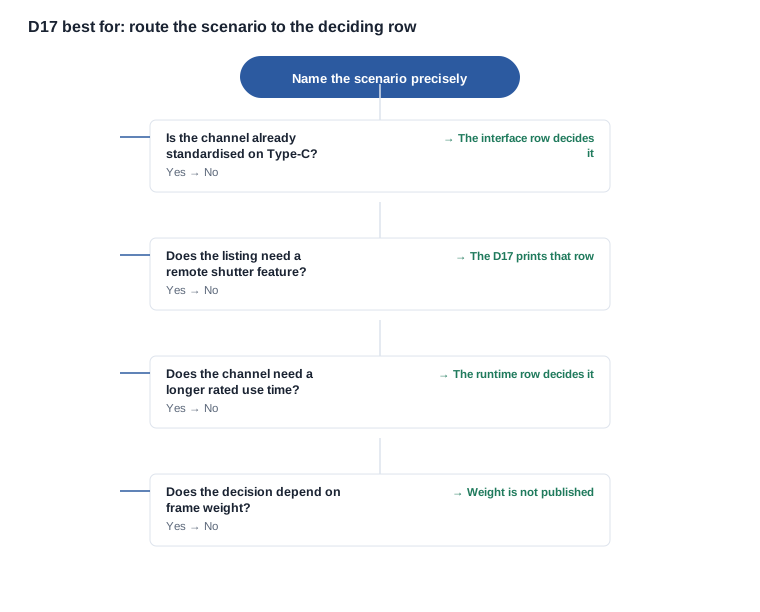
The decision chart above is the routing step. Each branch ends in a published row, not in a model, because the whole purpose of the exercise is to find out which row the channel's scenario actually depends on. Once that row is known, the sport group can be read against it in minutes, and the outcome is a shortlist with a documented reason, which is a different artefact from a preference.
The four scenario variables that decide this category
A scenario is only useful if it is specific. In this group, four variables between them account for nearly every decision a buyer makes, and a scenario that does not state all four is not ready to be scored.
- The interface the channel can carry. Type-C or magnetic. A channel with no dock ecosystem and no appetite to build one is working in a different category from a channel that already ships magnetic docks.
- The length of continuous use in the field. This is the shift length, the training session, the run, the shift on site, and it is a number the buyer already has.
- Whether the listing needs a named feature. The three sport models print different feature rows, so a channel that needs a differentiator has a real filter to apply here, and a channel that does not should stop looking for one.
- What the channel has to prove. A channel entering a regulated market needs documentation; a channel selling a consumable accessory for a phone needs almost none. The evidence requirement changes what a model is worth to the channel.
What the framework deliberately will not produce
It will not produce a ranking, a value judgement, a price tier or a recommendation, and the reason is not editorial caution. The catalogue publishes no price, so a value ranking would be invented. It publishes a frame weight for one model in the entire range, so a comfort or balance ranking would be invented for the other twenty-seven. It publishes no per-model certification row, so a compliance ranking would be invented as well. A framework that produces a conclusion from data that does not exist is a framework for producing false confidence, and this one stops at the shortlist.
We will also say plainly, because buyers ask it directly: the group divides into structural groups, not into price tiers, and the catalogue contains no price information whatsoever. The D17 versus YKC02 piece is worth reading on exactly that point, because the grouping in that article is about structure and the grouping in this one is about the rows that decide a scenario.
The structural groups in the sport range, not price tiers
Three models make up the sport group, and the published rows divide them in a way that is easy to see once the same three columns are set side by side.
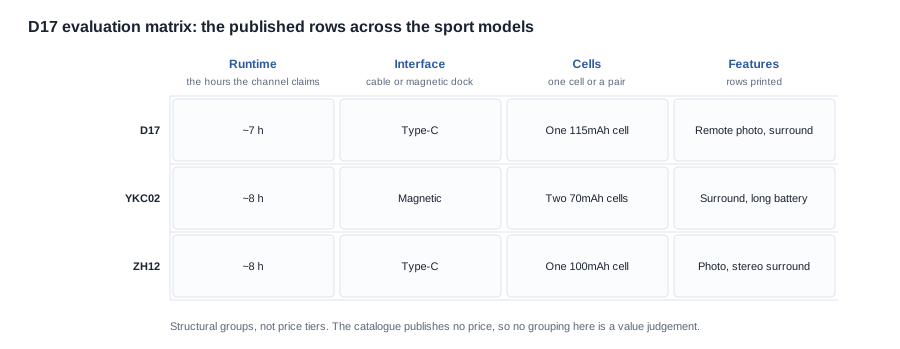
Read that matrix as three questions. On the use time, the D17 publishes the shortest figure of the three, about seven hours against about eight for the other two. On the interface, the D17 and the ZH12 are on the Type-C side and the YKC02 is on the magnetic side. On the cell layout, the D17 and the ZH12 each carry one cell and the YKC02 carries a pair. On the feature rows, the D17 and the ZH12 both carry a remote-photo row, the YKC02 does not, and all three carry a surround-sound row of some kind.
Those are structural facts, and they are the only facts available. What they are not is a hierarchy, because hierarchy requires a criterion the buyer supplies, and the criterion is not in the catalogue.
The one row that separates the D17 from the ZH12
Between the D17 and the ZH12, three of the four published rows are close: a single cell either way, Type-C either way, and a remote-photo row on both. The use time differs by an hour, and the cell figure differs by 15 mAh in a derived sense. The feature rows differ in wording: the D17's surround-sound row is printed in English and the ZH12's is printed in Chinese and describes a stereo surround.
That last point is worth pausing on, because it is a translation artefact rather than a specification difference, and a buyer who reads the two rows as different features is reading a language difference as a product difference. What the two rows do and do not mean acoustically is not published for either model, and the open-ear audio page covers why that specification is a substantial question in this category rather than a detail. The D17 against ZH12 comparison works through this pair in more depth.
Where the D17 sits against the camera models
A scenario that involves recording, or a customer who expects the product to record, is not a D17 scenario at all. The D17 publishes no camera row, because the sport group is an audio and control group; the camera group in the catalogue is a separate set of eleven models, and the ones whose product names carry a sport positioning are the V06 and the S7, both of which also carry the only two IP54 markings in the whole range. That distinction between a sport camera model and a sport audio model is a frequent source of confusion in channel conversations, and the D17 against S7 piece sets it out.

Scoring a scenario against the published rows
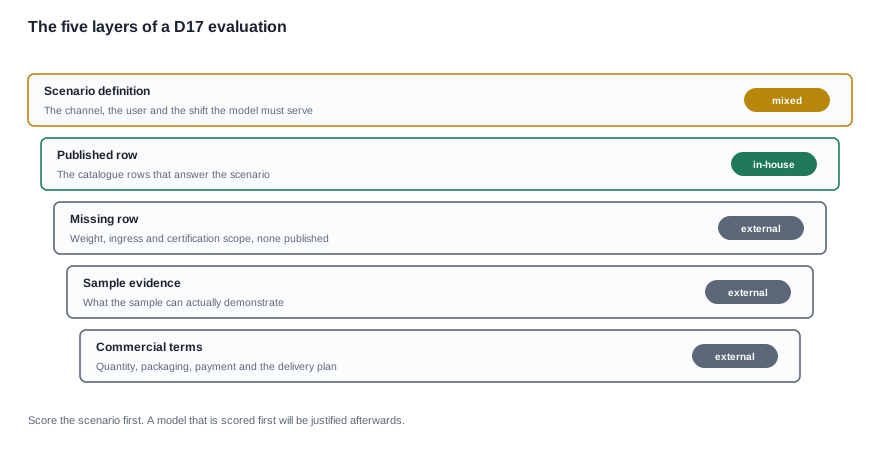
Once the four variables are stated, the scoring is mechanical. The point of a scorecard is not to produce a winner at the end. It is to produce a record of which rows carried the decision, because that record is what makes the shortlist defensible later.
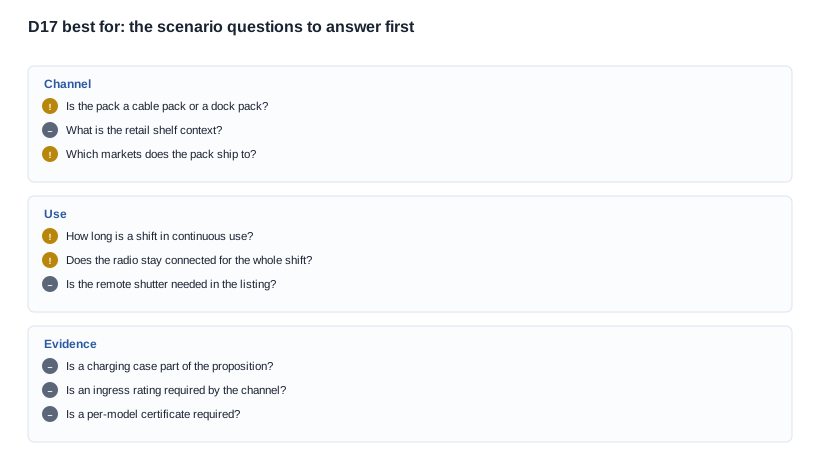
The checklist above is the pre-scoring work. Every line on it is either a channel fact the buyer already owns, or a published row that has to be read, or a blank that has to be filled by asking. It is a short list on purpose: a long questionnaire gets answered thinly, and a thinly answered questionnaire is worse than no questionnaire, because it looks like diligence.
A worked scoring example
Take a hypothetical channel and walk it through, because the mechanics are easier to see than to describe.
The channel. A sports apparel brand, selling direct to consumers through its own site and through two marketplace listings. The use case is a run, a gym session and a long cycle ride. The customer is not a corporate buyer and never will be.
Variable one, the interface. The brand has no dock ecosystem, has no shipping process for a magnetic accessory, and the product goes out on its own in a mailer. The interface requirement is therefore Type-C, and it is a requirement rather than a preference, because a magnetic model in a mailer means either a dock in every parcel, which is a cost and a packing decision, or a customer who receives a product they cannot charge. Two of the three sport models satisfy this.
Variable two, the length of continuous use. A long cycle ride is the case the customer cares about, and a two-hour ride is two hours. A published figure of about seven or about eight hours is more than enough for the use case, and it stops being a differentiator. The use-time row therefore does not decide this scenario, and saying so is as useful as a score.
Variable three, the feature requirement. The listing needs a differentiator, and this is where the remote-photo row becomes interesting. The D17 and the ZH12 both print one, and the YKC02 does not. What the row means is not published, because the D17 and the ZH12 publish no camera row, so a shutter control is listed on a model that does not record. The realistic possibilities are that it triggers a paired phone, that it belongs to a separately sold unit, or that it is a shared platform artefact. All three are speculation, and none of them can go on a product page. So the feature row narrows the shortlist to two models and then immediately produces the question that has to be answered in writing before either can be listed with that feature.
Variable four, the evidence requirement. A consumer brand selling in its own market needs a declaration of conformity for the destination market, a battery transport file for the cell, and a Bluetooth qualification trail. The catalogue has none of these for any model, so the evidence requirement becomes a gating item on both shortlisted models rather than a tiebreaker between them.
The result. A shortlist of two models, a documented reason for excluding the third, an unresolved feature question on both, and a documentation request outstanding on both. That is a legitimate, complete answer to the scenario. What it is not is a recommendation, and the difference between the two is the whole point of the framework.
The scoring sheet, in practice
A one-page sheet is enough: scenario, four variables, the row each variable points at, the published value for each shortlisted model, and the open items. Keep the open items visible, because a shortlist with three open items behaves very differently from a shortlist with none, and a buyer who collapses the two will be surprised later. The D17 buyer review checklist is the instrument for closing those items, and the D17 certification status piece is the document trail for the last two.

Where the D17 scores badly against its own segment
An evaluation framework that only produces advantages is not an evaluation framework, and the D17 has three weak positions that a buyer should confront early rather than late.
It publishes the shortest use time in its own group. About seven hours against about eight for both the YKC02 and the ZH12. For a channel whose scenarios run long, that is a real disadvantage against two close alternatives, and no amount of framing changes the published row. The mitigating factor is that the figure is unconditioned on all three models, so the gap may be smaller or larger in practice, and the acceptance test in the D17 battery life piece is how a buyer finds out which.
It publishes the largest single cell in its own group, and still the shortest use time. The D17's 115 mAh against the ZH12's 100 mAh and the YKC02's two 70 mAh cells, which add to a derived 140 mAh. This is the clearest illustration in the catalogue that capacity and runtime are separate rows, and a buyer who expects the largest cell to produce the longest run will be disappointed by the published data. The D17's real argument is the about-one-hour charge time, which is a downtime argument, and it is an argument about the recharge interval rather than about endurance.
It publishes no ingress rating, and neither does anything else in the group. The only two models in the catalogue with an IP54 marking are the V06 and the S7, and both are camera models. For a brand selling running and cycling products, water resistance is a question the customer will ask, and there is no published answer for any of the three sport models. That makes a test report a procurement task rather than a catalogue lookup, and it is the single item most likely to delay a launch. The IP ratings page explains what a marking would establish if one existed, and the D17 limitations page lists the other blanks on this model.
The remote-photo row is a liability as well as a filter. It narrows a shortlist, as described, and it also produces a question about the function that has to be answered before the product page is written. A model with a shutter button and no camera is a support ticket generator if the explanation is not settled, because reviewers will ask. The D17 common questions article covers that question in the format a buyer would use with a supplier.
Building a shortlist you can defend in a review
The output of this framework is not a model. It is a shortlist with a documented reason, an open-item list, and a set of documents requested from the supplier. Three things make that output defensible in a review meeting, and each of them is a habit rather than a document.
Keep the criterion visible. Write the scenario and the four variables at the top of the sheet, above the model comparison. A review that cannot see the criterion will question the outcome, and the defence is a single line pointing at the top of the page.
Record the exclusions, not only the inclusions. A reviewer always asks what else was considered. The answer, in this group, is the other two sport models and, for a recording use case, the camera group. Recording the exclusion and the reason prevents the same shortlist being rebuilt from scratch in the next meeting, and it stops a model that was excluded on a stale assumption from quietly reappearing.
Separate the published facts from the open items. Two columns, never mixed. The published column is what the catalogue prints and it is citable. The open column is what has been requested and not yet received, with the date of the request against each line. A shortlist that mixes the two cannot be summarised accurately, and the summary is usually the document that gets circulated to a customer.
The commercial layer sits on top of all of this. Minimum order quantity, sample cost, production capacity, delivery plan, warranty term, payment milestones and incoterm are negotiated rather than read, and the pricing page, the contract terms page and the payment terms page cover how those usually get written down. Two of them in particular, the minimum order quantity and the delivery plan, interact with the interface decision, because a dock and a device rarely share an order quantity.
And the last layer is the customer. A channel that knows who is buying and what they will do with the product can answer the scenario question without help. The who needs the D17 piece works through that layer from the demand side, and the customisation page covers the packaging and branding layer that sits between the channel and the customer.
A closing note on running the framework in a review. If the shortlist comes back with more than two models on it, the scenario has not been narrowed enough, and the right response is to tighten the scenario rather than to add criteria afterwards. If it comes back with one model, check that the exclusions were recorded, because a single-model shortlist produced by a scoring exercise is usually a sign that the scoring was done after the answer was known. Both checks take a minute, and they are the difference between an evaluation a supplier can read and defend and one they will quietly disregard in the next quotation.
On the D17, our position is that it is a well-specified model inside a narrow segment, with two published rows that are genuinely strong, one published row that is the weakest in its group, and several important rows that are blank. We will not tell you it is the right model for your channel, because the rows that would decide that are not published. We will give you the framework, show you what the D17 prints against every row, and name the items that are still open. Send us the scenario, the four variables, the markets and the quantity, and we will score the sport group against your scenario and hand back the shortlist with its reasons and its open items.
Related reading
- Where this model sits — the D17 product page
- The published set in one place — D17 specifications and features
- The nearest alternative — D17 against ZH12
- How to close the open items — D17 buyer review checklist
Send us the scenario, the four variables, the markets and the quantity, and we will score the sport group against it and hand back a shortlist with its reasons.


